Posts tagged ‘hong kong films’
Too Much Heaven, Part Three: Hong Kong Cinema at the San Francisco Film Society

Buzz Chung, astronaut, Echoes of the Rainbow, 2010
This weekend the San Francisco Film Society presents Hong Kong Cinema, the first of two Chinese-language film festivals, which runs for three days with seven films from the former Crown Colony. Although it doesn’t include any blockbusters, the brief festival runs the gamut from romantic comedies to crime films to melodramas and is a good look at the range of films coming out of Hong Kong these days. Herewith are a few of the films included in the series.
Punished
A sleek, economical crime film that’s actually a family drama in disguise, Punished is produced by Johnnie To and directed by Law Wing Cheong, To’s editor and frequent second unit director. The story moves along at a brisk and efficient pace, emphasizing the dysfunctional family relationships behind the kidnapping drama.

Moral choices, Anthony Wong and Richie Jen, Punished, 2010
Anthony Wong is outstanding as Wong Ho-chiu, a ruthless and powerful businessman seeking vengeance for his errant daughter’s kidnapping and death–his performance is subtle and explosive and as usual he can do no wrong. Richie Jen is also excellent as Anthony Wong’s bodyguard and hatchet man with his own family issues to deal with. Supporting performances are uniformly strong and the mood is mostly realistic throughout–the bad guys aren’t too bad and the good guys aren’t too good, so the film possesses a great deal of moral complexity. Each person has a motivation for his or her actions, justified or not, and no one is completely evil or completely good.
In the end, it’s a mother-daughter relationship that’s the catalyst for the resolution of Wong’s moral crisis. As with the best Hong Kong films the movie is also unafraid to tap into the characters’ deep emotional responses–men cry, women swoon, and children weep unashamedly. Director Law keeps things pretty straightforward, with none of the annoying quirks of fellow Milkywayer Wai Ka-Fei. The film makes intelligent connections between the corruption of big business, damaged family dynamics, and immoral criminal activity.
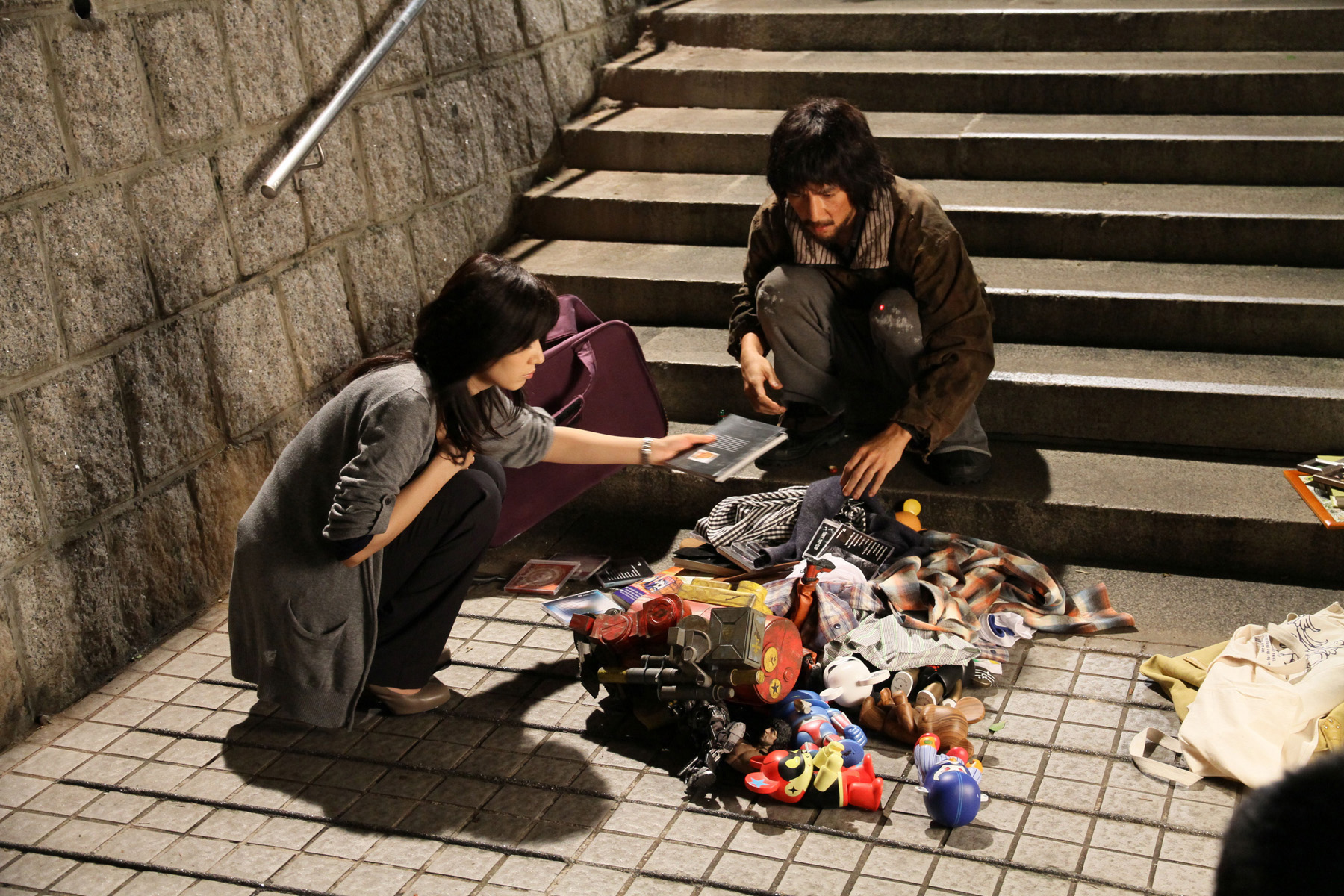
Meeting cute, Gao Yuan Yuan and Daniel Wu, Don't Go Breaking My Heart, 2011
Don’t Go Breakin’ My Heart
An adequate rom-com that attempts to capture the uber-success of early 2000s Johnnie To flicks Needing You and Love on A Diet, Don’t Go Breakin’ My Heart stars Louis Koo, Gao Yuan Yuan, and Daniel Wu in a love story set in Hong Kong and China. The three play young urban professionals, with Gao unable to decide between playboy Koo and nice guy Wu.
Gao’s dilemma becomes tedious pretty quickly since Louis Koo’s character is so clearly a womanizing asshole. It’s hard to understand what she sees in him, especially with the charming and sensitive Daniel Wu also courting her. But the plot demands a love triangle so the audience must suffer through her indecision for nearly two hours (whatever happened to the excellent concept of the 90-minute Hong Kong movie?) while she dithers between her two beaus. Director To even cribs from his own most successful romantic comedy, Needing You, by using the device of would-be lovers communicating the movie’s catchphrase by signage. There’s some clever usage of messages pasted on office building windows but even that seems awfully contrived by the end of the movie. Though both are cute and dimply, Gao and Koo never seem to really spark–Gao and Wu’s chemistry is better, with Wu nicely conveying a sense of romantic longing. Gao lacks the manic goofiness and exquisite comic timing of To’s usual rom-com muse Sammi Cheng and Louis Koo just isn’t charming enough to warrant Gao’s long-term fascination. Daniel Wu is very sweet as the long-suffering third party but he doesn’t have much character development except his ongoing dedication to a neon green frog. But as rom-coms go, this one is serviceable, with three good-looking and well-dressed lead actors amidst the glamorous backdrop of Hong Kong’s skyscrapers.
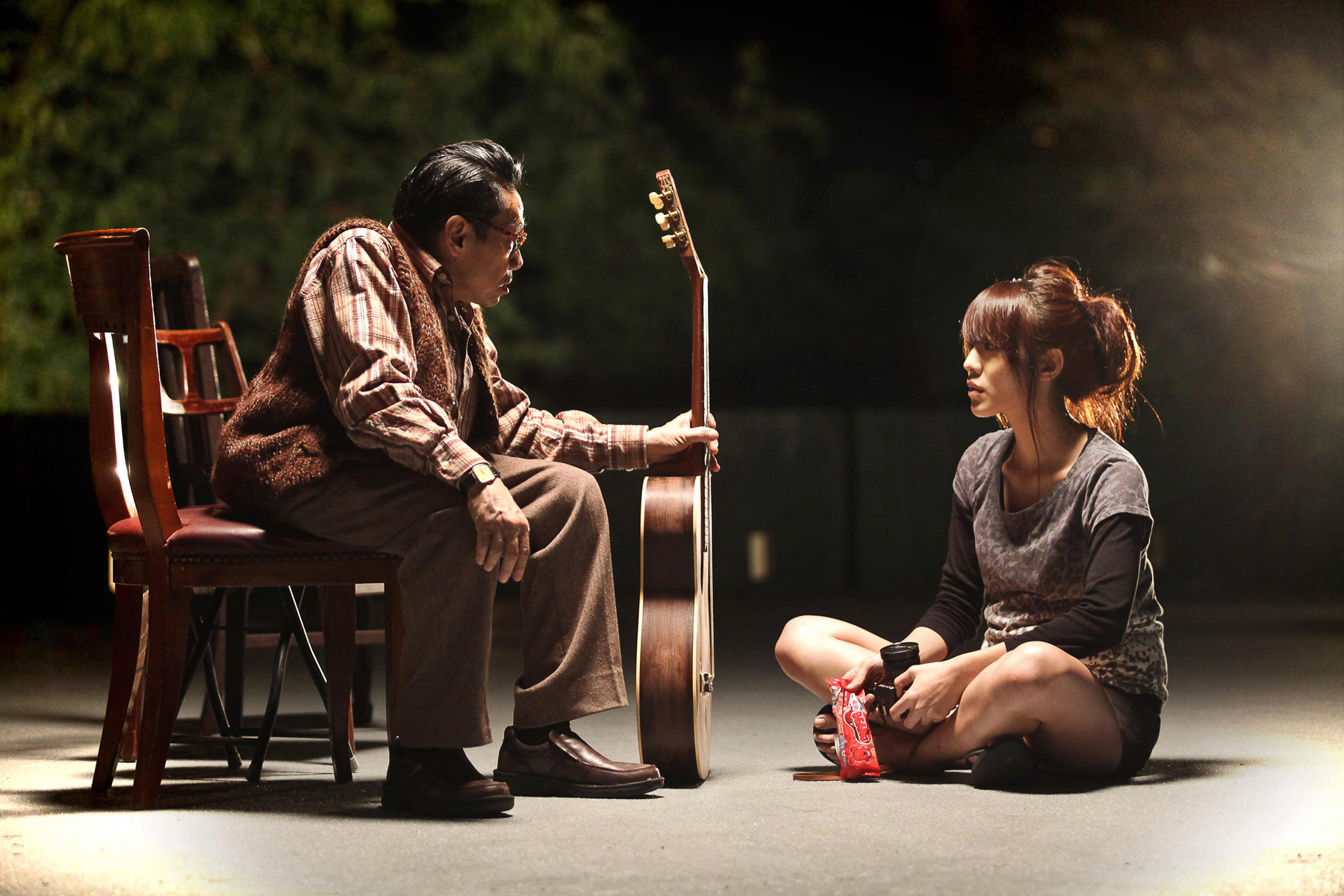
Choices, Teddy Robin and Ella Koon, Merry-Go-Round, 2010
Merry-Go-Round
Though it looks great, with beautiful, rich cinematography and art direction, Merry-Go-Round, (dirs. Yan Yan Mak and Clement Cheng) is just a bit too long and a bit too dependent on coincidence to be completely effective. Ella Koon and Nora Miao play two Hong Kong ex-pats living in San Francisco who return to the former Crown Colony after long absences. Koon’s character is a young bohemian with a hidden past, and Miao’s is a master herbalist who left Hong Kong to follow her bliss in the United States. Their lives converge in somewhat forced circumstances– the film’s narrative links its many characters with overly convenient plot twists.
Merry-Go-Round takes a light but serious look at death, loss, and separation. The film uses the idea of returning home as a metaphor for going back, not forward, in life, with several characters attempting to make amends for past misjudgments or dealing with the results of long-gone choices. It also makes some nice points about the advantages of moving on with life instead of dwelling on past traumas, with one character wistfully telling another, “I would have forgotten long ago but you keep reminding me.”
Teddy Robin, who won Best Actor for Gallants (also directed by Clement Chang) at last year’s Hong Kong Film Awards, is very effective as the lovelorn manager of the coffin home/mortuary where Koon ends up working. Also excellent is Nora Miao as the imperious herbalist who so long ago followed her fate to the U.S. But the time structure of the film seems a little skewed–if some of the characters were young adults in 1938, that means that they would be in their nineties now, and the actors playing them in the modern-day sequences seem much too young to be nonegenarians.
Despite its handsomely mounted production design, Merry-Go-Round’s storyline is a bit too unfocused to be completely convincing. But it’s nice to see a Hong Kong film that’s a serious drama instead of the martial arts/triad/comedy flicks that the city’s film industry usually puts out.
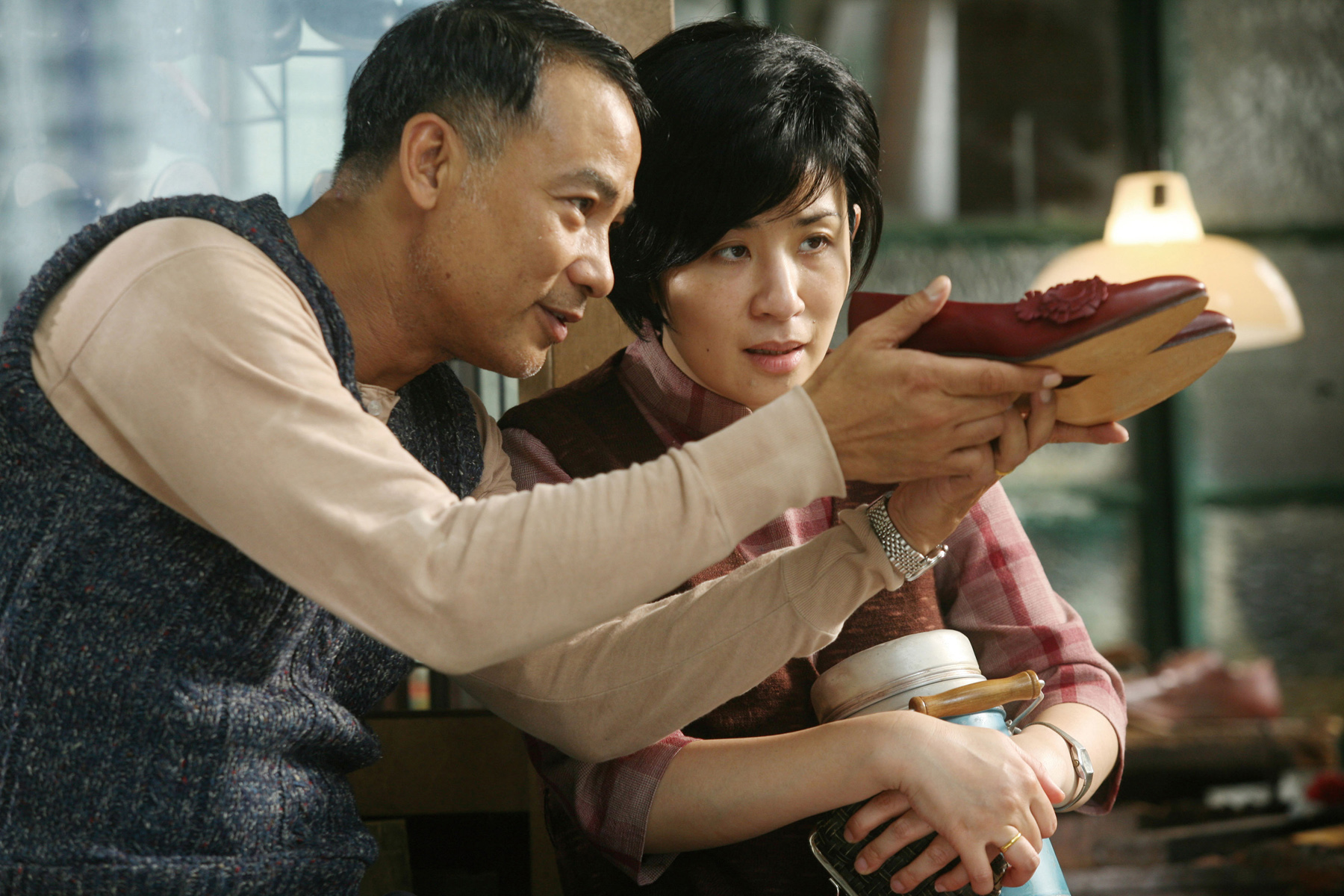
Shoemaking, Simon Yam and Sandra Ng, Echoes of the Rainbow, 2010
Echoes of the Rainbow
A charming family drama set in 1960s Hong Kong, this melodrama by Hong Kong New Wave director Alex Law stars Buzz Chung Shiu-Tiu as Big Ears, a young boy whose shoemaker father, his mother and his older brother strive to make an honest living making and selling shoes in their working-class neighborhood. Though a bit soft around the edges, the film is best when it illustrates the community neighborliness found amongst the residents of the street. One pleasant moment occurs when Big Ear’s family takes its nightly meal out to the street behind their house to eat on a homemade dinner table built on top of a tree stump. They’re joined by the rest of their neighbors who are also dining al fresco, presumably to escape the heat of their small, non-airconditioned houses. This small but engaging scene underscores the sense of belonging, safety, and comfort found in an earlier, less hectic time and place.
The film also makes cogent point in its examination of class differences between Desmond (Aarif Lee) and his girlfriend Flora (Evelyn Choi). In one scene Desmond walks for a very long time from his humble street to visit Flora, eventually arriving at the toniest neighborhood in town. The length of his journey and his awkwardness and discomfort in such rarefied surroundings contrasts nicely with the sense of ease and belonging he feels in his own neighborhood and underscores the great gulf in social status between himself and his wealthier sweetheart.
Simon Yam and Sandra Ng are excellent as the cobbler and his wife, and Buzz Chung is endearing without being saccharine. Aarif Lee is suitably modest despite his blazing hotness and Evelyn Choi is sweet and charming as his love interest. Eventually the film succumbs to extreme melodrama but it still remains a lovely rendering of a more innocent time in Hong Kong history.
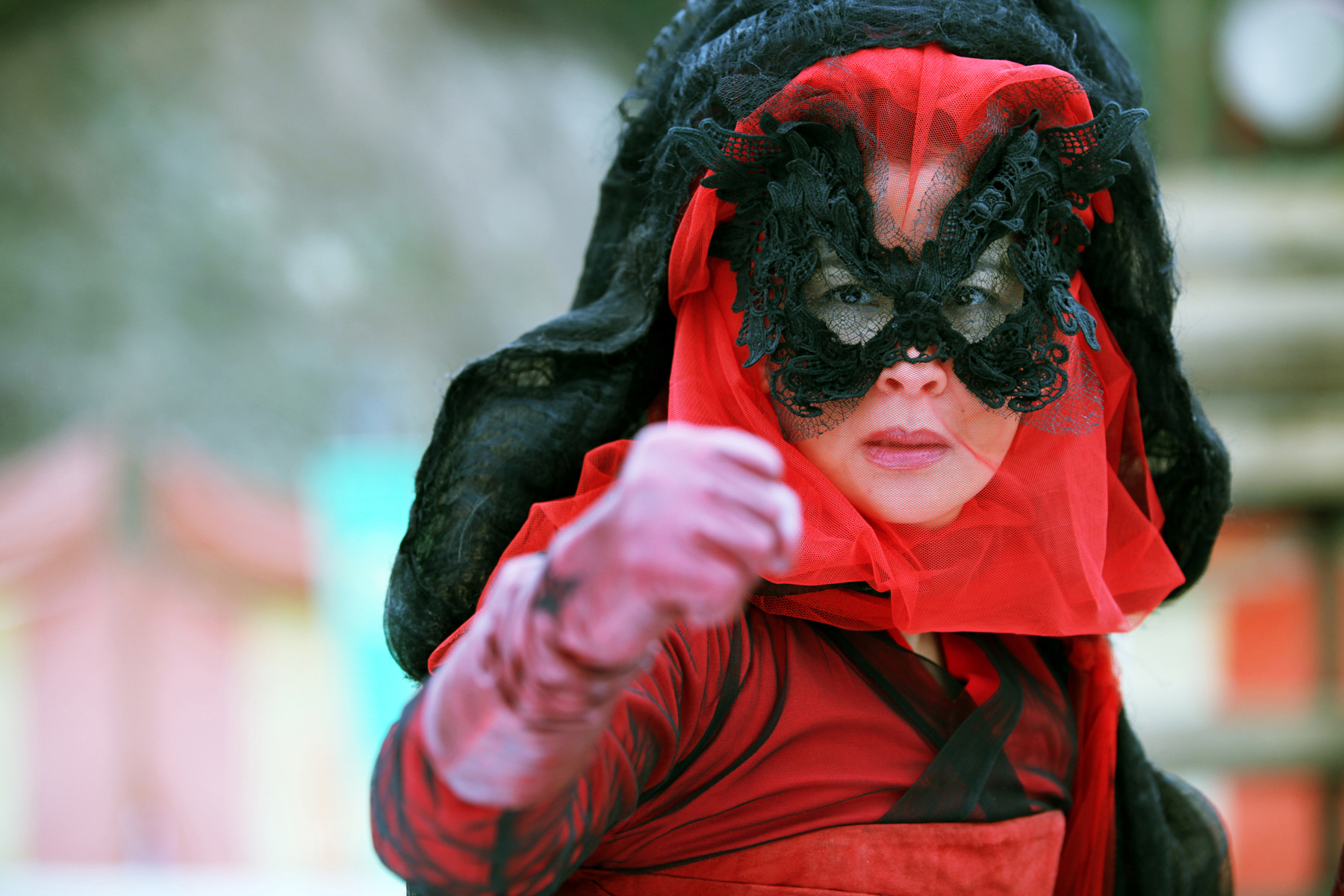
Ass-kicking, Sandra Ng, Mr. and Mrs. Incredible, 2011
Mr. and Mrs. Incredible
A period piece directed by Vincent Kok, the sometime collaborator of king of comedy Stephen Chiao, this superhero comedy feels a lot like a Lunar New Year film, with its wacky concept, broad humor, slapdash production design, and lead performances by popular stars Louis Koo and Sandra Ng. Koo and Ng play a married couple who are also the retired superheroes formerly known as Gazer Warrior and Aroma Woman (both excellent superhero names). The two erstwhile heroes have renounced adventuring and have settled down incognito in a quiet village where they run a pork bun shop. Their attempt to start a family and to live anonymously in peace is interrupted by a martial arts contest, a life-force sucking villain, and other outlandish circumstances.
Goofy and mild, with humorous banter between its amiable co-stars, the film is a bit talkier than you’d expect from a movie about costumed heroes. It’s carried by the charming performances of Koo and Ng, who are unafraid of looking ridiculous and whose good-natured interplay makes the film an innocuous and pleasant timepass.
Also screening: Redoubtable auteur Ann Hui’s All About Love, a lesbian love story starring Sandra Ng and Vivian Chow, and Benny Chan’s City Under Siege, an action film that involves toxic waste, mutants, circus performers, and other everyday Hong Kong denizens, starring Aaron Kwok and Shu Qi, with production design by the legendary William Chang Suk-Ping (In the Mood for Love, Rouge, 2046).
Hong Kong Cinema
Sept. 23-25, 2011
San Francisco Film Society New People Cinema
1746 Post Street, San Francisco
San Francisco
Too Much Heaven, Part Two: City of Life and Death and Detective Dee reviews

Andy Lau, sleuthing, Detective Dee and the Mystery of the Phantom Flame, 2010
Two more Chinese-language films have their theatrical releases in San Francisco, and, although they are completely different in subject, tone, and treatment, both are testaments to the vitality of the new Chinese cinema.
City of Life & Death, dir. Lu Chuan, 2010
My head was spinning when I walked out of the screening for City of Life and Death, Lu Chuan’s devastating and uncompromising look at the Rape of Nanking (or Nanjing). City of Life and Death is an unflinching look at the infamous Japanese occupation and destruction of the Chinese capital in 1938–the film is a stellar example of the ways in which cinema can both explicate and elevate events from real life. Lu masterfully utilizes wide-screen, black and white, mostly hand-held cinematography, subtle and emotional performances, and a story structure that precludes simplistic nationalism.

Civilians, City of Life and Death, 2010
At the very start in the first hour of the film Lu kills off one of the main characters, forcefully undermining any pretense of a conventionally told story and serving notice that the film will be merciless in the treatment of its characters. As in the real-life occupation of Nanjing, no one is safe and no one will be spared from the casual brutality of wartime and the mentality it fosters. The film also refuses to focus on acts of heroism, although though there are brave and unselfish acts throughout the film’s 2.5 hour running time. No single character is a savior, nor are there any simple answers to the inhuman violence that was perpetrated upon the citizens of Nanjing.
As a Chinese filmmaker Lu makes the unusual choice of presenting the well-known story, which has been used in China to demonize Japan, in part through the eyes of Kadokawa, a Japanese soldier. The opening shot of the film is a close-up of the wide-eyed and impressionable Kadokawa’s terrified face as he and his fellow Japanese soldiers prepare to storm the walls of Nanjing. Kadokawa’s horrified responses to the violence surrounding him as well as the pivotal choices he makes at the end of the film belie any condemnation of the Japanese as inherently bestial or subhuman, The film refuses to lay the blame for the events in Nanjing on inborn flaws in the Japanese national character, instead placing responsibility on the insanity of militarism itself.

Atrocities, City of Life and Death, 2010
Viewers shouldn’t be deterred by the grim subject matter as this is filmmaking of the finest order. The wide screen black and white cinematography underscores the huge scope of the atrocities, and director Lu Chuan understands the value of a long, long take in creating an almost unbearable tension. The performances are also uniformly outstanding. Liu Ye is excellent in his brief but significant role as a pragmatic Chinese officer, utilizing his sensitive, evocative face to great effect. Wei Fan is also very effective as a bureaucrat working for the Germans who realizes too late that his position does not grant him immunity from the horrors around him.
A scene near the end of the film where the Japanese soldiers perform a celebratory dance underscores the violent group psychosis of war. While taiko drummers beat out a mournful cadence, the crouched-over soldiers move through the rubble-filled streets with blankly fierce expressions on their youthful faces. After the screen carnage of the past two hours their procession seems like an exercise in group insanity as the men move in hypnotic lockstep, driven by a rhythm dictated to them and with little will of their own. The scene becomes a grim and surreal commentary on the collective madness of war and the indoctrination that makes young men such as Kadokawa into unfeeling, obedient machines of destruction. This image and many others in City of Life and Death make the film absolutely essential viewing, The film’s current theatrical release makes it possible to experience it on the big screen, where its vast and detailed rendering can completely engulf the viewer and magnify its cataclysmic impact.
Detective Dee and the Mystery of the Phantom Flame, dir. Tsui Hark, 2010

Andy Lau investigates, Detective Dee and the Mystery of the Phantom Flame, 2010
A film epic of a completely different sort than City of Life and Death, Tsui Hark’s extravagantly fun and fantastic movie is another example of the outstanding product coming out of China and Hong Kong. Like Benny Chan’s Shaolin, Detective Dee is a brilliant blending of traditional Hong Kong moviemaking with the super-high production values of recent mainland films.
Detective Dee is very loosely based on the exploits of real-life historical figure Di Ren-jie, also known as Judge Dee, who has been the subject of several Hong Kong and Chinese films, books, and television series. Here Dee is played by the ageless Andy Lau, as an implacable sleuth assigned to determine the cause of a spate of spontaneous human combustion.
Carina Lau plays another historical figure, Wu Zetian, who was the only woman to ascend to the Chinese imperial throne. Both Andy and Carina, who started their careers at TVB long ago in the 1980s, are excellent as the titular sleuth and the Empress who may or may not be his adversary. Carina Lau holds the distinction of being one of the only actresses of her generation (along with Maggie Cheung and Michelle Yeoh) who is still working, and she brings a presence and authority to her role. Andy Lau has turned into an excellent screen actor and his ability to convey thoughtfulness and depth (despite his incredible good looks) is a result of his experience in more than a hundred films. He’s not afraid to take roles that emphasize his maturity, as seen here and in Shaolin, which is a nice testament to his graceful aging.

Phatasmagoria, Detective Dee and the Mystery of the Phantom Flame, 2010
As expected from a Hong Kong fantasy film, Detective Dee includes a surfeit of cleverly staged action set pieces, underscored by director Tsui’s fantasmagoric set designs and kinetic camerawork. But Detective Dee moves beyond earlier Hong Kong films’ visual realizations with its excellent use of extensive digital effects. The world of digital effects has finally caught up to Tsui’s gloriously saturated cinematic vision and in Detective Dee he makes the most of them. Whereas Tsui’s 1990s fantasy classics such as Green Snake featured charmingly unconvincing rubber prosthetics and matte paintings, Detective Dee has the advantage of a full slate of DFX, here outsourced to a well-known Korean effects house. Tsui utilizes this to full effect in realizing his lavishly imaginative vision, which includes transmogrifying faces, a herd of talking (and fighting) deer, characters convincingly immolating from the inside out, and a skyscraper-sized statue of a female bodhisattva.
At the same time Tsui doesn’t let the digital madness take precedence over plot or characterization. The film’s story is a clever and well-developed mystery, and Andy Lau, Carina Lau and Li Bing Bing portray intriguing and complex characters. Tony Leung Kar-Fei is excellent as a revolutionary with a long grudge against the empress. In fine Hong Kong movie tradition, Li and Andy Lau court and spark as conflicted would-be lovers separated by duty and circumstance. As is his wont, Tsui also throws a bit of political commentary into the mix in his critique of the corruption of power.
Detective Dee won Best Director and Best Actress statues at the most recent Hong Kong Film Awards and represents a comeback of sorts for longtime auteur Tsui. Although it was financed by mainland Chinese money and performed in Mandarin, Detective Dee is still a Hong Kong movie through and through, and is an outstanding example of what might come from the integration of mainland and Hong Kong commercial cinema.
City of Life & Death
opens Fri. Sept. 23, 2011
Landmark Opera Plaza Cinema
601 Van Ness Ave.
San Francisco, CA 94102
(415) 267-4893
Detective Dee and the Mystery of the Phantom Flame
now showing
Landmark Embarcadero Cinema
One Embarcadero Center, Promenade Level
San Francisco, CA 94111
(415) 267-4893
Landmark Shattuck Cinema
2230 Shattuck Avenue
Berkeley, CA 94704
(510) 464-5980
Too Much Heaven: Shaolin, My Kingdom, and Love In Space movie reviews

Aaron Kwok and Rene Liu in zero-gee, with chocolate, Love In Space
For those of us lucky enough to be in the Bay Area, San Francisco is going to be an epicenter of theatrical Chinese-language film screenings as in the next couple months we are about to get slammed by a profusion of movies from Hong Kong, China, and Taiwan. Two film festivals plus several open-run screenings will be taking place in the last part of 2011, giving us sinophile film otaku many chances to partake of our favorite addiction on the big screen. In fact, there are so many Chinese-language movies playing in the next couple months that this is the first of at least three posts on the subject, with upcoming entries on two more movies from Hong Kong and China next week, as well as two film festivals sponsored by the San Francisco Film Society (SFFS) respectively focusing on Hong Kong and Taiwan.
With China’s increasing financial clout and the subsequent meteoric rise in the Chinese film industry (64 percent growth last year, to US$1.6 billion; 526 films produced in 2010, up 15%; and 6,000 new cinemas planned for next year) we are witnessing a new era of Chinese-language films. For better or worse the Chinese film industry has grown exponentially in the past decade and with the inexorable integration of the finest talents from the Hong Kong film industry, Chinese cinema has evolved from the arthouse-oriented political allegories of the 20th century to highly accessible commercial fare like the three films releasing this week. Shaolin, My Kingdom and Love In Space, opening in the U.S. on Sept. 9, represent the new paradigm of Chinese filmmaking and their appearance in U.S. theaters, along with and other upcoming Hong Kong and Chinese releases, heralds a trend toward increased Chinese theatrical releases in this country. These three recent Chinese-language films, one from Hong Kong and two from mainland China, also reflect the trend toward Hong Kong-China co-productions, as all three are cross-pollinated projects with talent both from Hong Kong and “the North.”
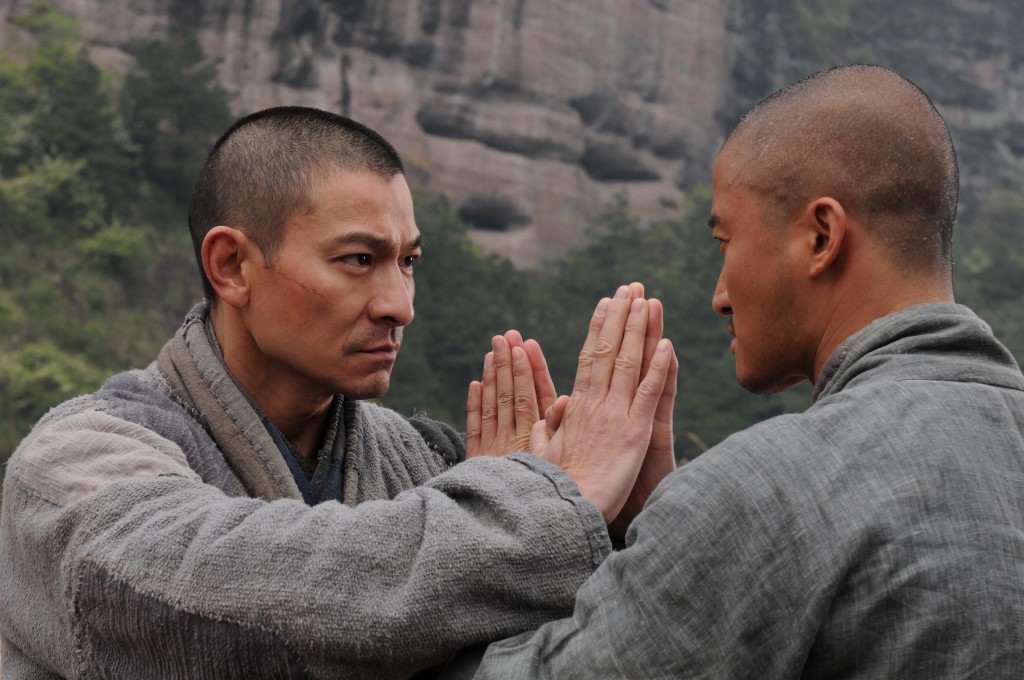
Andy Lau and Wu Jing, monks, Shaolin
Now playing at the Four-Star Theater (and also playing at the San Francisco Film Society’s New People theater on Sept. 28-29) is Shaolin, director Benny Chan’s historical martial arts film involving warlords, monks, and lots of kung fu. Shaolin is an exhilarating big-budget spectacle that captures a lot of the fun of classic 1990s HK moviemaking—although the producers claim the movie is a tribute to Jet Li’s debut film from 1986, the storyline doesn’t have a lot to do with that old-school kung fu classic, aside from having a cadre of righteous, kick-ass monks defending the honor of the legendary martial arts stomping ground. This Shaolin is set in the Republican era of the early 20th century when ruthless warlords duked it out for domination of their various fiefdoms. Superstar (and my favorite Heavenly King) Andy Lau ably anchors the film as an ambitious warlord who tragically learns the error of his ways. He’s aging beautifully, and that aquiline nose and perfect jawline look as photogenic now as they did twenty-five years ago. Nicholas Tse as Andy’s adversary is a bit less effective, overacting his way through his villainous role decked out in shiny black boots and an evil sneer. Wu Jing leads a group of crack martial artists as awesome Shaolin monks defending their sacred turf. Jackie Chan’s supporting role as the temple cook provides him a fun little fight scene, as Chan uses woks, cleavers, and other kitchen implements to showcase his trademark comic kung fu style.
Also outstanding is Cory Yuen’s fantastic action choreography, which includes a furious fight on wheels during a nighttime horse and carriage chase through the city as well as excellent hand-to-hand martial arts with bad-ass monks showing off their mad skilz, armed only with wooden staffs or their bare hands against rifle-carrying bad guys. As with many Chinese co-productions these days there are also the obligatory sadistic European actors maniacally giggling their way through senseless destruction. Fan Bing Bing (not to be confused with Li Bing Bing) is effective as Andy Lau’s wife, though she mostly just bats her eyes and weeps.
The film’s scenery, art direction, and cinematography are all top-notch–if this is the future of Hong Kong films then I’m all for it. Veteran HK director Benny Chan does a great job scaling up and the movie blends the big-budget production values of recent mainland films with the heart and emotion of Hong Kong movies.

Han Geng, popstar, with porkpie, My Kingdom
Two other films from China also open up Stateside today from distributor China Lion, which has been putting out series of monthly day-and-date releases of Chinese commercial films. The lineup has been a somewhat random and diverse slate of pics including 3D Sex and Zen: Extreme Ecstasy (officially banned in China but a massive hit in Hong Kong), the weepy Shu Qi/Liu Ye melodrama A Beautiful Life, and the Chinese Communist Party epic Beginning of the Great Revival.
Its release postponed a month due to the success of 3D Sex & Zen, My Kingdom is an action melodrama played out against the backdrop of classical Chinese opera. The film has the typically high production values of current commercial Chinese films and nicely recreates 1920s Shanghai, with great art direction and cinematography. But the 90-minute movie is very slight in comparison with the big kahuna of Chinese opera movies, Chen Kaige’s Farewell My Concubine. While Chen’s film was a vast, emotionally wrenching epic writ large across twentieth-century Chinese history, My Kingdom focuses on a much smaller story of love, revenge, and opera.
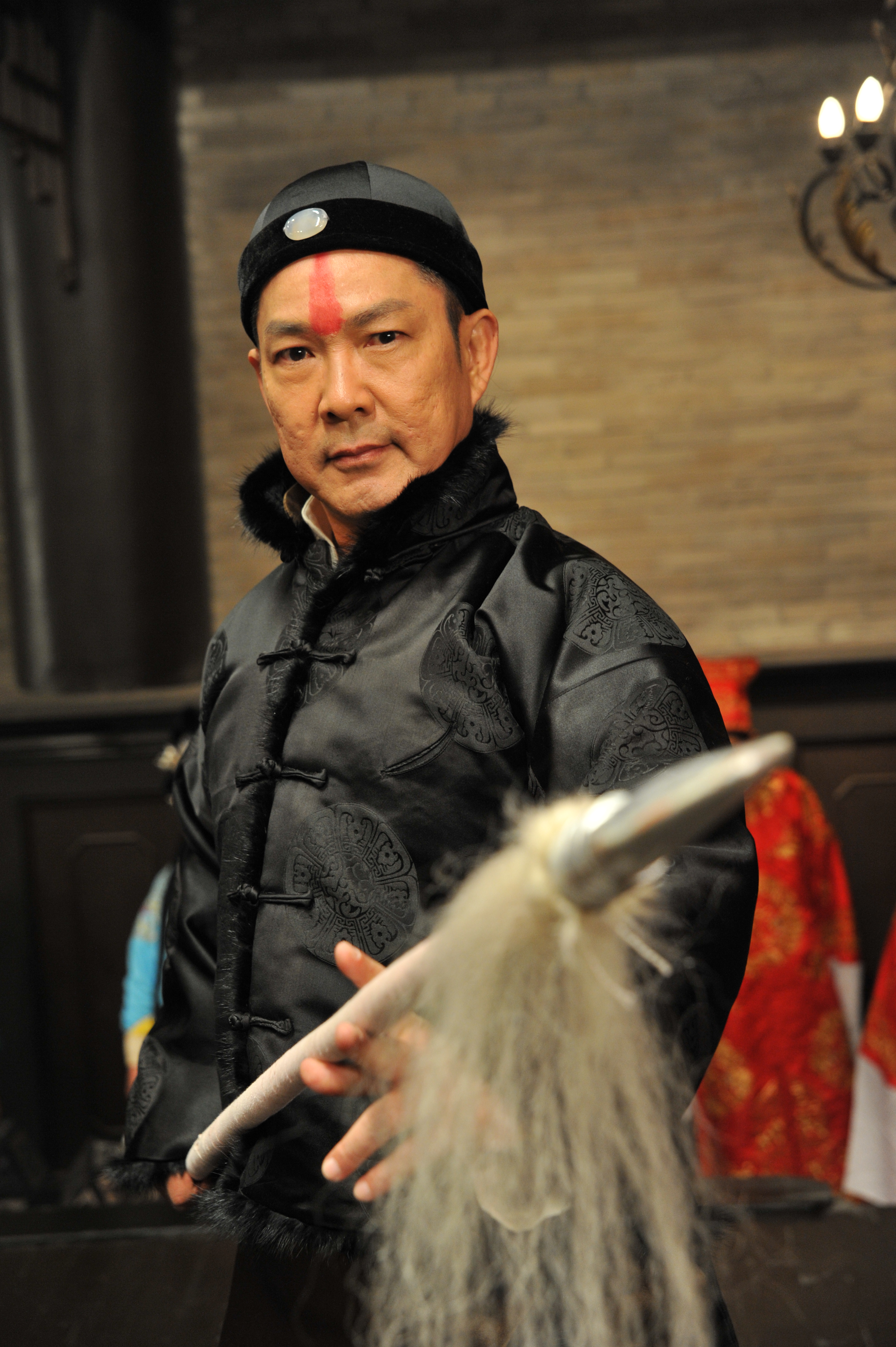
Yuen Biao and staff, My Kingdom
The movie also suffers from the callowness of its lead performers, with Sinopop idols Wu Chun and Han Geng cast as Yi-Long and Er-Kui, sworn brothers trained as “opera warriors.” Although Wu occasionally works up to a good smolder, the wide-eyed Han seems a bit overwhelmed by his role and never really seems like a man consumed by a desire for vengeance. Barbie Hsu is adequate as the opera troupe’s lead actress but she’s not convincing as a diva, much less one desired by most of the male cast. The three leads also are less than stellar in their opera performances, and the choreography in some of these scenes is also pretty uninspired. The exception is when the fabulous Yuen Biao, one of Jackie Chan’s “brothers,” shows up at the beginning of the movie in a brief role as the Yi-Long and Er-Kui’s sifu. Both his acting and his footwork demonstrate Yuen’s genuine Chinese opera training, and showcase “big brother” Sammo Hung and Chin Kar-lok’s fluid and efficient action choreography.
The film’s producers were clearly aiming for the youth market, but the singers cast here are not quite up to the task of driving the emotional, convoluted plotline. Especially miscast is the floppy-haired actor who plays a scheming policeman–the actor looks about 22 years old and his haircut seems to be channeling Justin Bieber. However, the movie is an interesting example of the ongoing integration of Hong Kong and mainland Chinese commercial film productions, with Hong Kong stalwarts such as Yuen and Hung teaming up with their younger mainland co-stars.
Also from China Lion is Love In Space, the only modern-day film of the three on the docket this week. Love In Space follows the romantic adventures of three sisters, an actress, an artist, and, yes, an astronaut, in Bejing, Sydney, and orbiting around the planet. This fun and fanciful little film reflects co-director Wing Shya’s whimsical fashion photography–it also stars a slew of pop stars (including three generations of male idols–Aaron Kwok, Eason Chan, and Jing Boran) who are put to better effect than their compatriots in My Kingdom.

Guey Lun-Mei and Eason Chan get wacky, Love In Space
Most effective are Cantopop king Eason Chan and Guey Lun-Mei (who kicked ass in Dante Lam’s crime thriller The Stool Pigeon) who play a garbageman and his germ-phobic love interest. Both Chan and Guey have mobile, expressive faces and excellent comic timing, and their story is the most fun and engaging to follow. Also good, though a bit more twee, are Angelbaby and Jing Boran as a movie-star-in-hiding and her spunky, watermelon-selling suitor. Oddly enough, the least compelling story features Rene Liu and Heavenly King Aaron Kwok as estranged lovers working together on a space station. The space-station set and the constantly revolving camerawork suggest a rom-com Solaris, and the soundtrack even features The Blue Danube waltz from Stanley Kubrick’s 2001: A Space Odyssey, but the storyline is predictable and Liu and Kwok’s performances are unconvincing. However, the movie as a whole is a delightful confection and a far cry from the dour political allegories of Chinese filmmakers from the 20th century.
Next week will find Indomina Pictures continued U.S. rollout of Tsui Hark’s blockbuster Detective Dee and the Mystery of the Phantom Flame, as well as the World War II drama The City of Life and Death. Relativity Media also recently announced a deal with SAIF Partners and IDG China Media to produce and distribute Chinese films for the international market. With more product comes the need for more consumers and, although the billion-person Chinese market is a good start, the Chinese film industry sees more income ripe for the picking in the international market. As an Asian film aficionado I see no reason to complain–seeing movies on the big screen beats torrenting any day. It will also be interesting to see how the demands of the international market further affect the look and feel of Chinese cinema in the 21st century.
Shaolin
4 Star Theater
2200 Clement Street
San Francisco
(415) 519-8716
NOTE: live perfomance by Shaolin monks, Friday, Sept. 9, 8p, free
Love in Space and My Kingdom
AMC Loews Metreon
16101 Fourth Street
San Francisco, CA 94103
(888) 262-4386
AMC Cupertino Square 16
10123 North Wolfe Road
Cupertino, CA 95014
(888) 262-4386
My Ever-Changing Moods: Francis Ng 2010 In Review
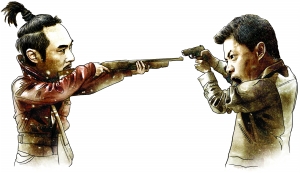
Wind Blast goes graphic
2010 was a busy year for Francis Ng. Just out of the gate on New Year’s Day, Francis made headlines across Asia when he and his Singaporean wife got into a tiff with another customer at a Hong Kong bakery. Apparently Francis’ wife complained when a worker sweeping the floor started getting dust on the baked goods. She and the worker got into it, then another patron jumped into the fray, mouthing off to the missus and possibly pushing her to the floor. Francis, who had been waiting in the car with his 1-year-old kid, heard the commotion, charged into the bakery, and allegedly grabbed the offending customer by the neck and slapped him upside the head. Photos from the scene showed the guy with a bloodied ear and Francis’ wife clutching her damaged hipbone. Francis went to the police station, everyone else went to the hospital, and the Asian press had a field day.
Francis was charged with assault, although he claimed he was only trying to protect his wife. No doubt the best thing about the incident was that it was re-enacted in one of Next Media’s renowned computer animation sequences for Apple Daily News in Taiwan, with Francis joining Tiger Woods, Lindsey Lohan, and other disgraced luminaries in CGI-rendered infamy.
Netizens were fairly divided on the topic, with some giving props to Francis for chivalrously supporting his wife and others chiding him for his straight-up thuggin’. His Hong Kong movie pals also leapt to his defense, with Michael “Laughing Gor” Tse claiming, “It is a man’s duty to protect his girl. I would have stepped up as well.”

Naughty professor
The case dragged on until April when Francis pled guilty to “wounding” and was fined HK $10,000. At his final court appearance Francis looked particularly unhappy, dressed in a brown suit and wearing unflattering black glasses that made him look like a vaguely sinister high school chemistry teacher.
For better or worse, Francis laid low for a while, avoiding appearing in public in Hong Kong. Professionally he kept busy, shooting three films (Wind Blast, Midnight Beating, and The Warring States) in quick succession in mainland China.
But by fall the beatdown incident was mostly forgotten and Francis enjoyed a resurgence of popularity.

Fashion plate
Wind Blast was released at the end of October and was the number one film in China for three weeks running, knocking Tsui Hark’s Detective Dee and the Phantom Flame out of the top spot and earning in excess of RMB 68 million.
The hybridized gangster flick/Western set in the Gobi Desert featured elaborate action sequences including a dusty chase scene involving a Jeep Cherokee, a couple horses, and a gigantic yellow dump truck. Francis in particular was lauded for his portrayal of a world-weary, conflicted bounty hunter and he stole the show from a cast of mainland movie stars including Wu Jing, Duan Yihong, and Ni Dahong. His character’s distinctive red leather jacket briefly became a icon and Francis modeled variations on the theme in a couple high-fashion photo shoots.

Anthony does Francis
Francis also landed on the cover of the Chinese fashion magazine Mr. Mode, sporting a black double-breasted trench coat and a little moue that his good buddy Anthony Wong then ruthlessly parodied for a Chinese newspaper.
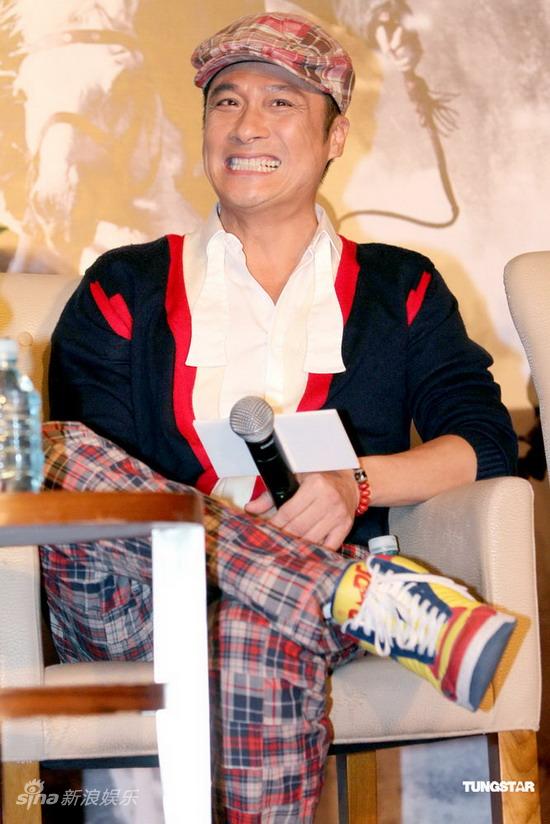
Happy in plaid
Francis later was photographed in Beijing shopping for presents for his kid’s second birthday, which further ingratiated him to the public in China and Hong Kong. He made guest appearances on Chinese television showing off his improving putonghua skills and modeled his natty b-boy wardrobe and continually changing hairstyles in the Chinese press. He also appeared at an event for Jet Li’s One Foundation charity that benefitted autistic children,which further rehabilitated his public rep.
But Francis made the news one more time at the very end of the year. In early December several pictures showed up on the interwebs of what appeared to be Francis getting busy with an unnamed young woman, harkening back to the infamous “sexy photogate” scandal that sank Edison Chen’s career.
News agencies across China gleefully flashed the pix around the ‘net and it seemed like Francis had again been caught with his pants down (see Ellen Chen karaoke oopsie). However, upon closer examination it was apparent that the photos were stills from Midnight Beating, Francis’ upcoming low-budget horror flick (also starring Simon Yam and a quartet of Chinese starlets) and that the woman in question was in fact Francis’ co-star. Cheap publicity stunt or honest mistake?
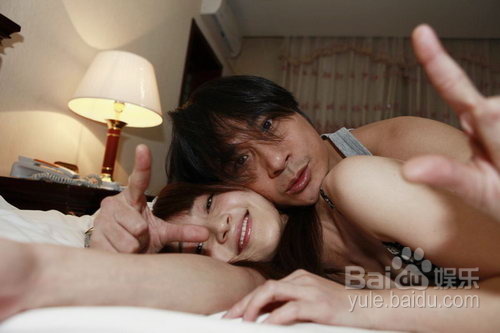
Faux photogate
At any rate, Midnight Beating was released on Christmas Eve and even up against heavy-hitters like Jiang Wen’s Let The Bullets Fly and Feng Xiaomeng’s If You Are The One 2, the cheapie screamfest made a respectable showing at the box office (before it showed up a couple weeks later on the torrent streams, of course).
Francis has subsequently finished shooting Love Island (also starring Simon Yam, Chang Cheh, and Joan Chen, among many others) and Traffic (with this year’s Golden Horse Best Actress Lu Li-ping, and Wind Blast’s Ni Dahong), and he’s on board for A Land Without Boundaries in 2011. Due out in April is The Warring States, Francis’ first period costume film, and its publicity machine is already revving up. The film promises to be a flashy extravaganza, with Francis and co-star Sun Honglei duking it out for the title of most badass.

Back in the saddle
All in all it’s been an eventful year for our boy Francis, who’s shown an uncanny ability to bounce back from public brawling, internet scorn, bad hair, and myriad other obstacles. Like a cat, Francis just keeps landing on his feet.



Constant Sorrow: Tracing Shadow film review
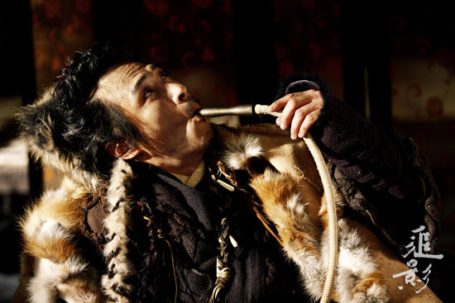
Francis Ng contemplates filmmaking, Tracing Shadow, 2009
Dear Francis,
Just wanted to let you know that I saw your new movie, Tracing Shadow, and I’m sorry to say that I didn’t really like it very much. Although it had some killer martial arts sequences, the art direction was divine, and you yourself looked quite lovely in your braided hair extensions and little mustache, the movie as a whole really stank. Unfortunately, since you’re the director as well as the star of the film, there’s no one else to blame for the slipshod pacing, unimaginative blocking and framing, egregious mugging and overacting (Xie Na being the absolute worst offender on that account), and aggravating, abrupt shifts in tone and mood throughout the movie. You yourself put in a less-than-thrilling performance, which I didn’t think you were capable of doing. And both you and your love interest, Pace Wu, have really nice cheekbones, but there isn’t a whole lot of chemistry between the two of you otherwise.
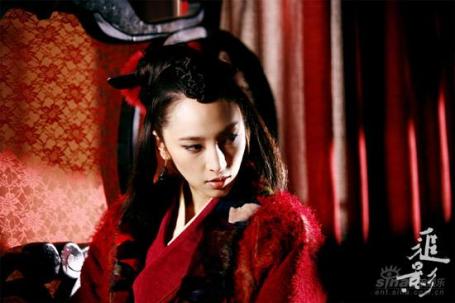
Pace Wu and bone structure, Tracing Shadow, 2009
Ever since it was announced several months ago I’ve been looking forward to this film, since you’re my favorite actor and your last wuxia movie, The White Dragon, is a great little flick. But somewhere along the way something went terribly wrong. It’s a shame, since the movie has the bones of a much better film. The storyline is classically drawn, with martial-arts masters converging on a village in search of a lost treasure map. But the film’s execution is so off-kilter and confused that it feels bad regional theater. At times it seemed like two or three different pictures competing for screen time—the slapstick comedy, the martial-arts action film, the dramatic mystery—with none given enough time or attention to cohere successfully. I felt myself wishing that you’d stuck to a straight-ahead dramatic treatment of the material, ala the film’s supposed inspiration, King Hu’s classic Dragon Inn, instead of using the story for laughs.
Your past directorial efforts, although flawed, showed flashes of brilliance and promise. But all three of your other movies were small-scale affairs rather than big-budget extravaganzas like Tracing Shadow. 9413 was an intense crime drama that showed a feel for mood and intensity as well as some cinematic chops. What Is A Good Teacher brought out some good, quirky moments from its youthful cast. Dancing Lion had some great improvisational set pieces. But all of those also had top-drawer actors, yourself included, to move things along, whereas the cast of Tracing Shadow–a TV show hostess, a model, and the son of a famous man–is, to put it delicately, pretty weak.

Xie Na and Jaycee Chan mug for the camera, Tracing Shadow, 2009
I’m truly sorry that the film turned out so badly. I really wanted you to achieve your dream of directing a successful movie. I don’t know exactly why things went so wrong–I’m not sure if it was the strain of holding together a big-budget costume picture, the complexity of mixing so many genres, or the pressure of living up to the hype of a high-profile project. I wonder if there was pressure from your financial backers (Huayi Brothers) to make the film as accessible, i.e., lowbrow, as possible, too, or if that decision was yours. At any rate, I hope that you get another chance to direct a film and that you’re more successful next time. This time I’m afraid you lost your way.
Sincerely,
your biggest fan
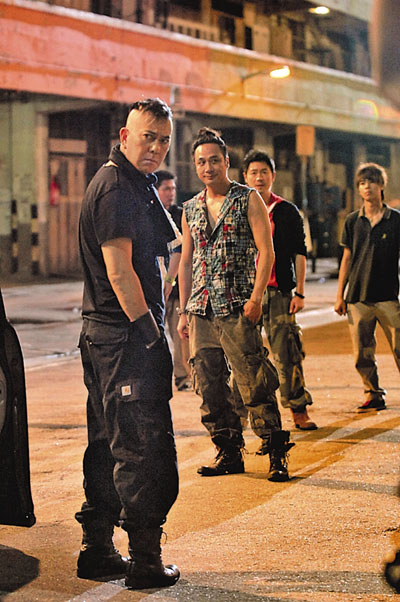
Anthony Wong with Francis Ng in happier times, Laughing Gor: Turning Point, 2009
PS: Congratulations on Laughing Gor: Turning Point—I’ve heard that it’s really good and that it’s doing great box office, too, which hopefully takes some of the sting out of Tracing Shadow’s disappointing ticket sales.
UPDATE: Go here for a much nicer, more positive review of the movie.
Kinda Like A Big Deal: The Beast Stalker, Full Alert and Greatness in Hong Kong Movies

Nick Cheung and wonky eye, The Beast Stalker, 2008
Just saw The Beast Stalker (Dante Lam, 2008) at the San Francisco International Film Festival and, although it held up pretty well and wasn’t an embarrassment, it wasn’t quite all that. Introduced by the Film Festival as “perhaps the best Hong Kong action film since Johnnie To’s Election,” this gritty thriller demonstrates that the former Crown Colony can still crank out hard-ass crime dramas. But the field has been mighty thin in Hong Kong of late and in other, more fruitful years, The Beast Stalker might’ve been just one of the crowd.
Former teen heartthrob Nicolas Tse plays a tough cop (!) haunted by the death of a child hostage he accidentally kills in a chaotic shootout/car crash involving malevolent gangsters, innocent bystanders and much shattered glass. Nick Cheung plays a kidnapper-for-hire in charge of snatching the dead girl’s twin sister whose lawyer mother is involved in prosecuting the crime. Their meshing stories play out in a dizzying spiral of guilt, honor, fate and obligation.
The Beast Stalker has several full-on child-in-extreme-danger moments and the cast realistically sports facial scars and other mementos of mortal peril, but somehow the film falls short of greatness. Nic Tse, further distancing himself from his youthful idol years, shrieks angrily at his subordinates, but he still can’t nail the crying scenes. Likewise, Nick Cheung, who won Best Actor statues from both the Hong Kong Film Critics’ Association and the Hong Kong Film Awards for this role, glowers menacingly but doesn’t quite bring the extra layer of pathos and complexity that might have deepened his portrayal. As my pal Laura, aka redbean, aka longtime Hong Kong movie fanatic, noted, “Anthony Wong would’ve eaten this role alive.” Unfortunately Anthony wasn’t cast and in this case Nick Cheung only makes a so-so substitute.
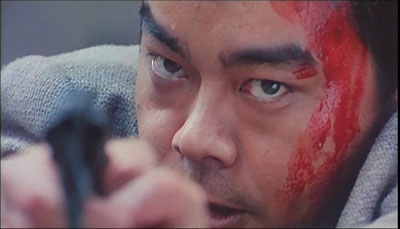
Lau Ching-Wan shoots straight, Full Alert, 1997
I recently purchased a copy of Ringo Lam’s brilliant crime thriller Full Alert (1997), which bears some similarities to The Beast Stalker in its depiction of the complex relationship between a cop and a criminal. But Full Alert has the inestimable actors Lau Ching-Wan and Francis Ng in the lead roles and their sublime skills breathe life into their stock characters and make the film’s cat-and-mouse story vibrant and believable. Francis brilliantly creates a strangely sympathetic yet reprehensible character and Lau Ching-Wan’s finely tuned fits of anger and frustration show a cop dangerously on the edge of sanity. The final confrontation between these two driven characters beautifully brings their fraught relationship to a stunning conclusion. On the other hand, The Beast Stalker’s antagonistic pair never fully reach the heights suggested by their intertwined destinies and their anticipated showdown is merely a tease.

Nick & Nic mix it up, The Beast Stalker, 2008
Full Alert and The Beast Stalker both have magnificent car chases as their centerpieces, the work of car-choreography specialist Bruce Law. The action direction in The Beast Stalker, however, unfortunately succumbs to the closeups and nausea-inducing jerky camerawork now in fashion, whereas Ringo Lam understood the need for distance and framing in an action sequence. Attesting to its greatness, Full Alert more than stands the test of repeated viewings, even more than a decade after its release. The Beast Stalker is a exciting, smartly-made movie but if, as several critics have suggested, this is one of the best of recent Hong Kong films, then the bar has been seriously lowered.
Dante Lam will soon have another chance to make a great Hong Kong movie. His next project, Most Wanted Terrorist, has just announced its cast, which includes the dream team of Lau Ching-Wan, Anthony Wong and Francis Ng, along with Nick Cheung. Hopefully Nick Cheung can keep pace with his illustrious co-stars, as they’re widely held to be among the best actors of their generation. He did just fine opposite Anthony and Francis in Exiled, and even in The Beast Stalker he showed glimmers of potential. but if he’s not careful the rest of the cast is going to blow him out of the water.
Interestingly, Dante Lam has indicated that he will forgo any Mainland Chinese financing for Most Wanted Terrorist in order to preserve a Hong Kong sensibility in the film. Several recent HK/China co-productions, including Sammi Cheng’s recent Lady Cop and Papa Crook, have suffered from the restrictions of Mainland film censors, so Lam’s decision to avoid PRC money is an interesting one. With Hong Kong film financing languishing due to the economic recession it’s a bold and risky move, but Lam is determined to retain his artistic freedom without having to answer to the Mainland government.
Let’s hope Most Wanted Terrorist gives everyone involved the chance to strut their stuff to their fullest capabilities. With its killer cast and seasoned director, if all goes well, we could once again see greatness in Hong Kong films next year.
The Beast Stalker opens Friday, May 15 at one of the last places in the Bay Area to see Hong Kong movies on the big screen, the 4-Star Theater, 23rd Avenue and Clement Street, San Francisco.
All For The Winner: 28th Hong Kong Film Awards

Crocodile tears? Xu Jiao wins Best New Performer for CJ7
Just a quick note about this year’s Hong Kong Film Awards, which took place this Saturday. Wilson Yip’s biopic Ip Man, about the martial arts legend, took Best Picture, with Ann Hui winning Best Director for The Way We Are, her docudrama about the New Territories town of Tin Shui Wai. The Way We Are, with its mostly non-professional cast, also won three other awards including Best Actress, Best Supporting Actress, and Best Screenplay. Nick Cheung (The Beast Stalker) nabbed his first Best Actor statue, adding it to his award from the Hong Kong Film Critics’ Society. Cute little girl Xu Jiao won Best New Performer for her crossdressing turn as Stephen Chow Sing-Chi’s son in Chow’s sci-fi blockbuster CJ7. Unfortunately, according to the Golden Rock’s liveblog she gave a horribly fake acceptance speech that included fake crying. I guess child stars are the same all over the world.
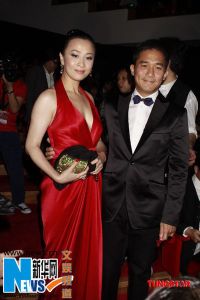
Carina Lau & Tony Leung burn up the red carpet, HKFA 2009
Interestingly, in a repeat of the Golden Horse Awards last year, John Woo’s lavish epic Red Cliff was shut out of the major acting and directing awards (including Tony Leung Chi-Wai’s failure to win his sixth Best Actor award). Red Cliff did clean up in several creative categories such as Best Art Direction and Best Visual Effects, winning five awards. Apparently this year’s nominations were only for Red Cliff 1—Red Cliff 2 will be eligible again next year so maybe then it will make out a little better in the major awards. Ironically, Red Cliff is probably the only film among the award winners that will receive international distribution.

Simon Yam in brown satin, Hong Kong Film Awards, 2009
Poor Simon Yam, nominated for Best Actor for Johnnie To’s Sparrow, went home empty-handed again. But he got to wear a natty two-toned sharkskin suit, white spats, and a spider-motif tie, and looked way too dashing for a man in his fifties. Sadly, Sparrow also lost (to Red Cliff) for Best Film Score, which just goes to show that not everyone appreciated its awesome Martin Denny/Michel Legrand/Henry Mancini homage.
For a full listing of the awards go here.
For lots more pix of celebrity finery go here.
For a great liveblog of the event go here.
And here’s the trailer for Sparrow, for a sample of its excellent soundtrack:
10,000 maniacs + gratuitous Francis Ng pix

Walking softly and carrying a big sword, Francis Ng, Chasing Shadows, 2009
Hey! This blog just got it’s ten-thousandth hit (thanks, Edison) so in honor of reaching that milestone I’m posting some gratuitous pictures of the reason I started blogging in the first place. So here’s a recent publicity still from Chasing Shadows, Francis Ng’s upcoming wuxia movie which is now in postproduction. Note the excellent updo that Francis is sporting, which suggests a touch of goth in the art-direction mix.
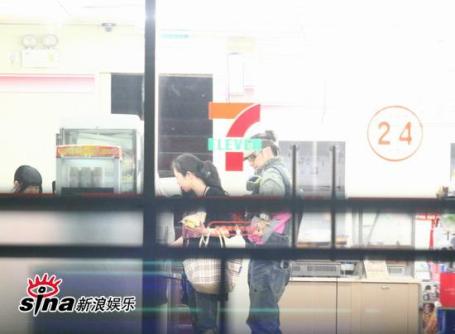
Going out for snacks, Francis Ng & friend
Francis has been getting into some extracurricular trouble lately with “production assistants” and “music consultants” while editing Chasing Shadows in Beijing. He’s been spied wandering around late at night with women who are not his wife (who just gave birth back in October), supposedly walking with his arm around one of them and suspiciously playing loud music in his apartment at all hours of the night. It’s all conjecture and speculation, of course, but it makes for good tawdry unsubstantiated gossip so the Chinese press is all over it. Look out for those telephoto lenses, Francis, the next time you visit the 7/11 at midnight!
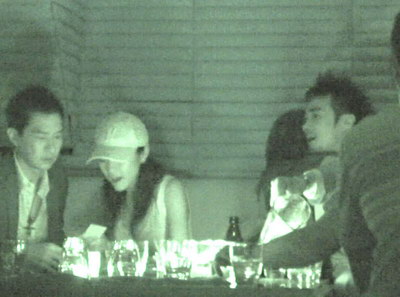
Francis gets caught with his hand in the cookie jar, 2007
Francis is apparently getting a rep for being a playa in Hong Kong entertainment circles. A couple years ago he was caught on video canoodling in a karaoke bar (video below) with Ellen Chen, who played a sexy prostitute alongside Francis in Exiled. At first he denied it but when confronted with the videotaped evidence he ‘fessed up. Luckily he managed to get his wife to publicly forgive him.
Last year he attempted some damage control by releasing a series of pictures of said wife, then pregnant, and himself in marital bliss, with Francis dutifully following her around Hong Kong while she window-shopped. It was also noted that he cooked special soup for her during her pregnancy.
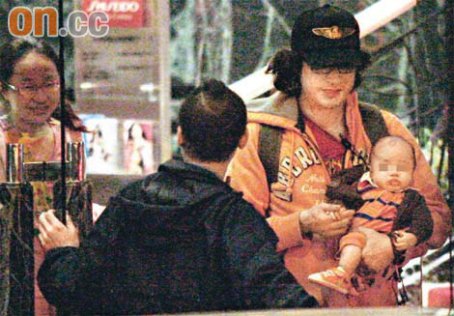
Two of a kind, Francis & Feynman Ng, 2009
Some other conveniently shot pictures from this February showed Francis, wife, and infant son Feynman (named for the physicist) tooling around Hong Kong, with father and son in matching orange outfits.

Method acting, Francis & co-star
But Francis’ attempts to salvage his rep have taken a hit these past couple weeks with the gossip about his purported shenanigans in Beijing. Reports also mention his close personal relationship with starlet Jiang Yi-Yan, who played his mistress in Deadly Delicious. Apparently the two prepped for their make-out scenes by drinking together, which lead to some pretty convincing love scenes.
It’s none of my business what celebrities do in their personal lives but I’m always surprised when they get caught on film or video messing where they shouldn’t be messing. It should be patently obvious that when you’re a movie star, you’re living in a fishbowl and you should be on guard at all times against sneaky papparrazi with hidden cameras. There have been rumors for a long time that a couple of the Heavenly Kings are gay (you get to guess which ones) but there has never been a scrap of supporting evidence to prove it, even with Hong Kong’s notorious media machine constantly on the prowl. So there are three probable scenarios at work here:
1. Francis Ng has really poor judgment.
2. Francis Ng has really lax handlers.
3. Francis Ng has nothing to be guilty about and he just likes having business meetings with his production staff in the middle of the night in his private apartment.
You make the call.
Note: Thanks to dleedlee for the translation help and advice. You rock.
UPDATE: Thanks to the hkmdb for more Francis Ng damage control. How many times can he trot out his wife & kid to show he’s a happily married man? Sorry for the cynicism but it seems awfully calculated to me. That said, I do hope it works because one of the greatest pleasures in my life is watching Francis Ng act on the screen and I’d hate to see his career flounder, for whatever reason. Luckily Edison Chen is providing a much better distraction for the HK press & public so hopefully Francis will get a pass.
Bonus video: Francis Ng & Ellen Chen get busy. Canoodling starts around :46. Warning: bad karaoke singing.
UPDATE 2: Francis has been cast in a couple new Hong Kong flicks, Laughing Gor, which is based on the popular Michael Tse television character, and Most Wanted Terrorist, Dante Lam’s follow-up to Beast Stalker. There’s also the upcoming summer release of Tracing Shadow, which Francis stars in and co-directed, so I guess his peccadillos haven’t hurt his career too badly. Edison Chen should probably get a special award for running interference for everyone these days in Hong Kong.
A God And A King: Chow Yun-Fat and Shah Rukh Khan
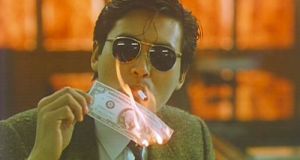
Chow Yun-Fat sparks it up, A Better Tomorrow, 1986
After viewing Rab Ne Bana Di Jodi, my first Shah Rukh Khan film, at this year’s San Francisco International Asian American Film Festival, I’ve been happily watching as many of his films as I can get my hands on. Since I’ve been living under a rock since my first daughter was born in 2000 I’d never had the pleasure of viewing one of Khan’s movies, though I’d heard of him before. His dominance in the Hindi-language film market reminds me of the heyday of Chow Yun-Fat, another flamboyant and charismatic actor who in his prime ruled supreme over his film industry and who in the 1980s and 90s was the undisputed lord of Chinese-language cinema. However, Shah Rukh Khan’s fate may be very different than Chow’s, as he’s so far chosen a different career trajectory than his suave Chinese counterpart.

King Khan looking suave, 2009
Khan, also know as SRK or King Khan to his fans, is the reigning monarch of Bollywood, India’s Hindi-language commercial film business that turns out movie musical extravaganzas by the hundreds every year and that’s one of the biggest film industries in the world. Khan is by nature an exuberant, flashy actor who’s also able to turn in more subtle performances as befits the role he’s playing. Like most Bollywood stars he’s also an excellent dancer and he’s got great comic timing as well. Not to mention dramatically arched eyebrows, dimples to die for and a recently buffed-out bod featuring a killer six-pack. Shah Rukh Khan’s first name literally translates as “face of the king” so it’s fitting that he’s the top actor in Bollywood. The 43-year-old performer has appeared in over sixty films since breaking into the scene in 1992, including Dilwale Dulhania Le Jayenge, which has been running continuously in Mumbai theaters for a record-breaking 700 weeks since its release in 1995. Khan’s won seven Filmfare Best Actor statues as well as many other Indian film awards and his name is a virtual guarantee of box-office success throughout the subcontinent and beyond.

CYF in his prime, The Killer, 1989
Similarly, from 1976-1995 Chow Yun-Fat appeared in more than 70 films in his native territory of Hong Kong and he was the standard-bearer for the heyday of Hong Kong cinema in the 1980s and 90s. His easy charm and screen presence, graceful athleticism and overall hotness garnered him huge critical and popular acclaim in classics like A Better Tomorrow, Hard-Boiled, and The Killer (all directed by John Woo), as well as City On Fire, Prison On Fire, and Full Contact (Ringo Lam), God of Gamblers and God of Gamblers Returns (Wong Jing), and An Autumn’s Tale (Mabel Cheung) and All About Ah-Long (Johnnie To). He was nominated ten times for Best Actor at the Hong Kong Film Awards, with three wins, for A Better Tomorrow (1986), City On Fire (1987), and All About Ah-Long (1989). Like Shah Rukh Khan, his name on the bill meant surefire ticket sales, not only in Hong Kong but throughout most of Asia. At that time the native film industries of Korea, Thailand, Vietnam and other Asian territories had not yet fully developed and audiences depended on Hong Kong imports for much of their cinematic fare. Chow was Asia’s biggest movie star and was commonly known as the “God of Actors.”

Thai Chow, Anna and the King, 1999
In 1997, Chow decided to try his luck in Hollywood, hoping to parlay his huge popularity in Asia into a successful career in the West. Things initially looked promising, with the Los Angeles Times declaring him “the coolest actor in the world,” before he had even appeared in a Hollywood movie. But his first U.S. films, including The Replacement Killers, The Corruptor, and Anna and the King, were less than successful and since then the roles he’s gotten have been a mixed bag. Hollywood has never really figured out what to do with Chow, as evidenced by his relatively paltry output of only nine movies in the twelve years since his trek across the Pacific (compared to his starring in ten films in Hong Kong in both 1986 and 1987 each). He’s been in a few successful films, including Ang Lee’s Crouching Tiger, Hidden Dragon, but his highest-grossing Hollywood film to date has been Pirates Of The Caribbean: At World’s End, where he played a sinister Fu Manchu-type character that was such a stereotypical caricature that the Chinese government trimmed ten minutes of his performance “for vilifying and defacing the Chinese” before allowing the film to screen in China.
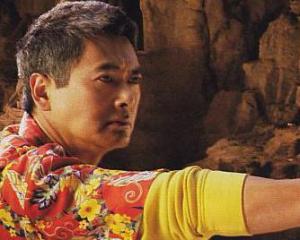
Chow Hawai'ian, Dragonball: Evolution, 2009
CYF’s most recent film, Dragonball: Evolution, is a supporting, Mr. Miyagi-type role that’s a far cry from the towering heroes of his prime. Chow is obviously cognizant of his disappointing travails in Hollywood. In a recent tour of Asia in support of Dragonball: Evolution, he noted, “American audiences know only Chinese kung-fu movies and nothing else about us, and I am not a kung-fu actor. We (Asian actors) don’t get any non-kung-fu or non-gangster/fighting offers. We only get Asian-specific roles. They don’t offer anything non-ethnic to us, not like they would do for Denzel Washington or Will Smith.” Chow has recently returned to Hong Kong cinema, appearing in Ann Hui’s The Postmodern Life of My Aunt (2006). His next role is the lead in the Chinese biopic of Confucius, the seminal Chinese philosopher and scholar, which began shooting this week.
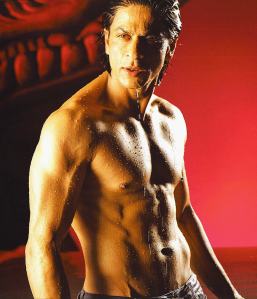
Buff, toned and cut Shah Rukh Khan, Om Shanti Om, 2008
At 43 years old Shah Rukh Khan is now about the same age as was Chow Yun-Fat when he left Hong Kong in 1997 to try to conquer Hollywood. Khan is at the top of his game both as an actor and as a producer, with his Red Chillies Entertainment putting out hit movies like 2008’s Om Shanti Om, which is the second-highest grossing Bollywood film of all time. In 2008 Newsweek named him one of the 50 most influential people in the world (Barack Obama topped the list).
With his fluent English and charisma to burn it might seem like SRK could be a crossover performer, yet when asked if he’s likely to try his hand breaking into Hollywood, Khan is philosophical, noting, “It’s not like Steven Spielberg is waiting with a script for me. I don’t think I’ll ever be offered a great international film in my lifetime, so I’d rather be a king here.” However, SRK fans spotted him paired as a presenter with Slumdog Millionaire star Freida Pinto at the last Golden Globe Awards and in front of an international television audience he came off like a champ.
Khan may also be approaching Hollywood from a different angle, as a mogul rather than as a performer. At one point there were reports that Walt Disney Productions planned to invest $30 million in Khan’s Red Chillies production house. This might ultimately give him more creative control over any roles he might take in Hollywood, since money talks in Tinseltown.
I can’t help but think that SRK has learned something by observing Chow Yun-Fat’s frustrating attempts to break into the top ranks of Hollywood. Other Hong Kong actors also seem to have been watching Chow’s painful efforts and are either approaching Hollywood with caution or are sidestepping it altogether. Comedy superstar Stephen Chow Sing-Chi so far has simply re-packaged his HK product for the U.S. market (Shaolin Soccer; Kung Fu Hustle), though at one point he was slated to star in and direct the big-screen version of The Green Hornet. Instead of braving Hollywood, Francis Ng has polished up his Mandarin and is mostly taking roles in Mainland China productions. And the numbers of Asian American actors who have had to flee from the U.S. to Asia to find success are legion, including Daniel Wu, Daniel Henney, and of course Bruce Lee. Although times are changing and Slumdog Millionaire won Oscar’s Best Picture this year, roles for Asian lead actors are still non-existent in Hollywood (sorry, John Cho). If Chow Yun-Fat, God of Actors, with his mind-blowing charisma, talent, and good looks, has had to struggle to make it in the U.S. and is relegated to crappy films like Bulletproof Monk, why should lesser mortals expect any better?
NOTE: Thanks to my colleague Marlon Hom for the Chow Yun-Fat interview translation.
UPDATE: Rumor alert! I just heard that Chow Yun-Fat is possibly slated to portray Sun Yat-Sen in the new Peter Chan-produced HK blockbuster, Bodyguards & Assassins. No link yet–will update when confirmed.
UPDATE 2: Alas, rumors about CYF playing Sun Yat-Sen were inaccurate. He decided to take the part in Confucius instead. Though I’m sure he would’ve been great as both Chinese icons. Now Leon Lai Ming is rumored to be Sun Yat-Sen, which would probably suck, since Lai Ming is boring, can’t act and has no charisma. But he’s tall, so maybe that’s all that matters.
UPDATE 3: Maybe SRK is heeding Hollywood’s siren song after all. Reports state that he’s angling to meet “serious” film director Deepa Mehta in hopes of landing a role in one of her arthouse flicks, the better to possibly attract the attention of Oscar voters in the near future. If this is indeed true, let’s hope that King Khan fares better than CYF in his dalliance with Hollywood.
UPDATE 4: Go here to read about my night with Shah Rukh Khan, as an extra on his latest film, My Name Is Khan.
Here are a couple Shah Rukh Khan musical numbers for your viewing pleasure.
Dard E Disco (Pain of Disco), from Om Shanti Om:
Suraj Hua Maddham, from Kabhi Kushi Kabhie Gham, with Kajol:

 beyondasiaphilia
Recent Comments