Sour Times: How To Survive A Plague film review

Peter Staley exercises his civil rights, How To Survive A Plague, 2012
As I watched our President sworn in for his second term this week I was pleased to note that in his inauguration speech he gave a shout-out to the Stonewall riots and made encouraging noises about marriage equality. Though subtle and fleeting, it was a definite indicator of the mainstreaming of the LGBT movement.
This is especially evident after seeing David France’s stunning new documentary, How To Survive A Plague, which focuses on the early days of the AIDS crisis in the U.S. The contrast is stark between President Obama’s careful but inclusive mention of LGBT rights and the Reagan/Bush administration’s rampant homophobia and indifference to the AIDS crisis in the 1980s and 90s. France’s film specifically looks at the efforts of ACTUP (AIDS Coalition To Unleash Power) in New York City as that grassroots organization sought to increase awareness of the epidemic and to pressure the government to develop treatments for the disease.
As one who lived through those times the film was very hard to watch in several spots, bringing back memories of the countless early deaths that devastated the gay community, here in San Francisco as well as in New York City and around the world. Though it’s very New York white middle-class male-centric (hello, Haiti?) it’s nonetheless a well-made and impressive piece of filmmaking. The documentary traces the stories of several young, mostly HIV-positive men who take up the struggle after the U.S. government fails to address the epidemic (then-President Ronald Reagan didn’t publicly utter the word “AIDS” until 1987, more than six years after the first case was diagnosed). The film follows several of these newly minted activists as they pressured the government, the medical establishment, and the pharmaceutical companies to search for effective treatments for AIDS.

Silence = Death, How To Survive A Plague, 2012
The genesis of ACTUP coincided with the widespread use of the camcorder and the film is comprised primarily of historical camcorder footage interspersed with modern-day interviews. Although it took my digitally acclimated eye a little while to adjust to the unsharp VHS and Hi8 footage, the softer, fuzzier images are very evocative of the time and ultimately become a visual signifier for the era. Though not as crisp and clear as modern-day digital recordings, the footage is nonetheless powerful and moving as it documents seminal moments such as ACTUP’s infamous 1989 St. Patrick’s Cathedral “die-in,” the confrontation between ACTUP member Bob Rafsky and then-presidential candidate Bill Clinton (who gives as good as he gets, by the way), and the capping of extreme homophobe and all-around dickwad Senator Jesse Helms’ house in a massive canvas jimmy hat. The handheld, lo-fi quality emphasizes the immediacy of the footage and one archival sequence in particular, where dozens of protestors fling the ashes of loved ones who have died of AIDS onto the White House lawn, becomes astoundingly powerful in its intimacy.
Director France skillfully weaves together historical footage of the often-contentious ACTUP meetings (one featuring fire-breathing playwright Larry Kramer lambasting the bickering factions), various demonstrations, interventions, and acts of civil disobedience, and more personal footage of several significant participants, following them to their eventual fates. Sadly, for many including performance artist Ray Navarro, this means death from AIDS-related illnesses. After witnessing Navarro gleefully skewer the religious right as he performs as Jesus in early ACTUP demonstrations, it’s painful and poignant to watch his last days captured on video as he succumbs to blindness and delirium. The film follows other individuals who meet similar fates and, after watching video footage of them playing with their children at birthday parties or speaking out eloquently against ignorance and homophobia, their deaths are deeply felt losses. The film effectively captures the horror of the era as seemingly healthy young men are articulate and strong one day and are frail and dying of opportunistic infections and Kaposi’s sarcoma the next.

Ray Navarro does Jesus, How To Survive A Plague, 2012
Some may argue that the movie is just another rehash of the ACTUP/Larry Kramer/New York City mythology that’s way too focused on a small group of gay white men to the exclusion of the rest of those affected by AIDS. To be fair, there are a couple women activists included (but their stories aren’t followed to the extent of the men in the movie), Latino artist and DIVA-TV member Ray Navarro has a featured role, and some of the b-roll includes images of African American men. Would the film have been a more inclusive and representative picture of the AIDS epidemic if there had more Haitians or females or people of color included? Sure. Would that make it a better, more powerful film? Not necessarily, it would just make it a different film. As it stands, the emotional and visceral impact is there, the craft is there, and the storytelling chops are there. Despite its somewhat narrow worldview, the movie makes a strong case for grassroots organizing and for standing up to institutional indifference, hostility, and outright discrimination, and for that it’s a significant and important piece of work.
Everyday People: An interview with In The Family director Patrick Wang
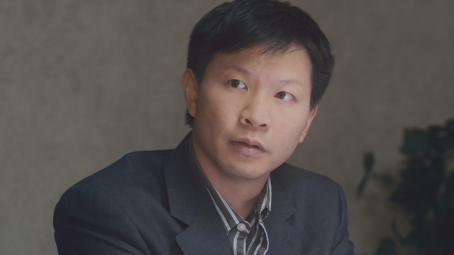
Director Patrick Wang, In The Family
I recently had the chance to sit down with Patrick Wang, the director, writer, and star of the amazing indie narrative film In The Family, which just opened its second theatrical run in San Francisco. In The Family is possibly the most surprising film of the year (longer review here), a family drama that steers clear of melodrama even when dealing with tragedy, a movie about a gay interracial family living in the South that’s not about identity, and a film by a first-time director that displays a singular vision and directorial style that recalls work by filmmakers like Ozu, Bergman and Hou Hsiao-hsien. Patrick proved to be as thoughtful in person as his filmmaking suggests, discussing the movie’s unusual distribution trajectory, his love for seeing the film in a theater with a live audience, and how being an outsider to the film world can be an artistic advantage.
beyond asiaphilia: How are you liking it back in SF?
Patrick Wang: I’m really excited because I was here for the (San Francisco International Asian American Film Festival) and I wasn’t able to be here for the opening. This week I get to spend a whole week here—-these days I don’t get to spend a whole week anywhere (laughs).
BA: I was kind of wondering about that—-what’s up with this distribution pattern, it’s kind of random—or is this intentional?
PW: Y’know, it keeps changing. I am the distributor and part of it is that I’m learning as I go along. I think you have to do some of that with every film, so I’ve just been figuring it out. Every few weeks a new opportunity comes up or something doesn’t work out quite the way we hoped so we have to readjust. There are other Bay Area theaters watching what happens this week so if we do well they’ll pick us up pretty quickly. And I’m kind of learning that pattern as well.
BA: But you were here in San Francisco already—-right after the Festival? It’s okay if you come back?
PW: It’s one of those things that—-it’s what’s normal and then, um (laughs). And all I see is there’s this huge gulf between the number of people who have seen it and those who would like it and would get something out of the experience, and I’m going to keep trying to bridge that gulf.
We do a lot of things we’re not supposed to. First of all, we’re not supposed to keep playing this long. People told me at the beginning, “You gotta get your DVD going,” and I said, “No, I’m not ready for that, I still haven’t finished—”
BA: The touring around?
PW: Well, its life in theaters, that’s not done, and I’m barely starting to understand it, there’s still work to be done there. So, yeah, we’ll leave a city, we’ll come back to some cities many times.
BA: Which ones have you come back to?
PW: Miami, Chicago, we just reopened in New York
BA: And people come in?
PW: And people come in, and actually more people. It’s funny, word of mouth is just—-y’know, there’s manufactured word of mouth, which behaves a certain way, and there’s real word of mouth—-for it to organically happen takes time. And it’s a question mark, y’know—if the time we’re giving it and the opportunities we’re creating for people to see it in the theaters will ever align.
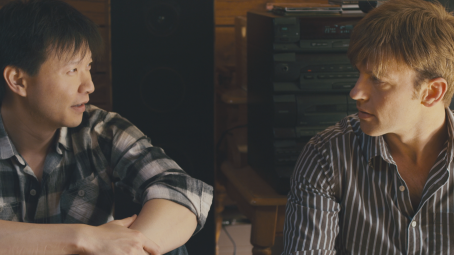
Word of mouth, In The Family, 2011
BA: That’s interesting because it kind of reflects the aesthetic of the movie itself, right? I mean you have these long takes—-I wonder where that comes from. You’re from theater, I know, but you’re also an economist, and you do other stuff. You weren’t even in film at all—
PW: I didn’t do much, y’know, I acted in a couple (films) and that’s pretty much it. But you know, it’s funny that you sometimes hit these points in life where different strands of your life that seem completely unrelated and completely in different camps kind of come together. And I think everything from the work I did as an economist managing a team—people think, oh, it’s in the business side, but no, it’s the managing the team and realizing how to balance the use of hard and soft powers, and how to help people do what they’re good at, and help them realize that, that’s directing.
And there was a time when I taught kindergarten, and that came back to be useful, too, because I know how five- and six-year-olds talk and I know how to work with that.
BA: As well as the grown-up five- and six-year-olds, I guess.
PW: Uh huh.
BA: That’s pretty cool that you were able draw on different parts of your life together to work on this project. I think a lot of people don’t realize that a lot of the filmmaking is the marketing and getting it out there, people watching it.
PW: Yeah, and I hope this doesn’t happen to too many other films, but y’know, a good film—-you’re sometimes left with no one else willing to do something for it and so you have to decide if you’re going to do it for yourself. And some filmmakers, very understandably, don’t know or aren’t interested or can’t do that.
BA: So you’re outside life experience has helped with that—
PW: It’s helped but I think the really big thing is just I saw what happened in the first few audiences when we screened it in New York and I just—-it made me angry that people were not getting the opportunity to see this. It’s this opportunity and I did not want it to be lost. It’s this film that can do a lot of good and now it needed a way to do that and I was willing to learn what that took.
BA: And you’re sort of learning on the job, I guess.
PW: I am learning on the job, but you know, it’s not unlike the filmmaking—-you have certain experiences you bring in. A lot is new and you figure it out, and actually it is very similar to filmmaking—-you put together this team to make the movie, and I kind of put together this team to help get the movie out. And the way we broke rules in the making of the movie, we’re breaking rules in the distribution, too!
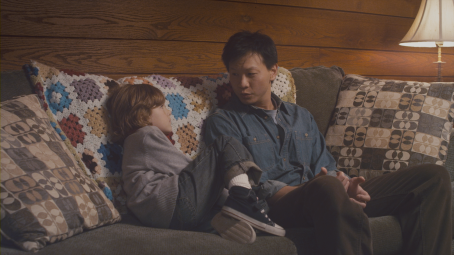
Learning on the job, In The Family, 2011
BA: So, you’re fairly self-taught so you don’t have expectations about what you need to do—-I don’t want to use the word “outsider” because that seems sort of hierarchical, but you’re not trained from film school, which is a really particular way of thinking of how you have to make a movie or how you have to deal with the movie business.
PW: Yeah, and I really like that word “outsider” because I think it’s very useful. Like every field of endeavor, whether it’s in the arts or something else, I feel like the outsider is very valuable, someone not engrained in the conventions or the general thinking about a kind of long-term path. I think what weighs down a lot of young filmmakers is their head is already in their career and their next two movies. So I feel like there’s quite a bit of freedom being from the outside, of having no expectations for how the thing is received or what’s the next step in your career.
BA: But you must be thinking a little bit about that?
PW: I think a little bit about that but not so much that it changes what I do. I guess that’s the key thing, you want to think enough that you create some opportunities but not so much it changes the important decisions you’re making about your project now, the one that’s right in front of you.
BA: Is that something that’s inherent in your personality, is that something you’ve learned? I mean, it does kind of reflect the filmmaking itself—-
PW: I don’t know, but there is this funny parallel, and I hope I have that very satisfying third act (laughs) that the film has.
BA: Well, I think there’s a certain tenacity the way you’ve approached the film itself. I’ve read about the directing experience—-it’s not that people openly fought you but I know that the way you made the movie is not like a conventional way to shoot a movie and the way you’re distributing it is kind of interesting too—-someone I know said, “It’s coming back to San Francisco?”
PW: (laughs) I think it’s definitely unpredictable, and that’s what keeps me interested in filmmaking and that’s what keeps me interested in the distribution.
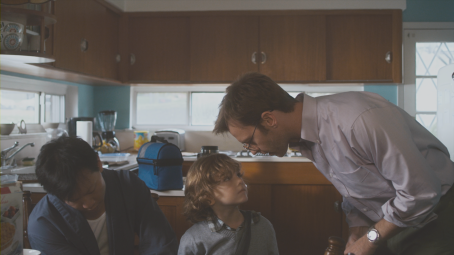
Unpredictable, In The Family, 2011
BA: So do you prefer people seeing it the theater?
PW: I absolutely do.
BA: Why is that?
PW: I think that there’s this focus that the theater allows. You can’t push “pause” in the theater. And other people, you feel them. Even if it’s a small crowd you to feel them and you feel some sort of responsibility that’s different—-the manners type of responsibility, as in we’re sharing a space and this is how we behave, but there’s also some sort of social responsibility that kind of jumps to life as people interact with this movie amongst other people. And there’s also the sharing of the emotion—-you hear and you feel it in the audience and it forms this type of comfort that you can’t get at home.
BA: That’s an interesting way to describe it. It’s like you’re very bonded to people you don’t know.
PW: There’s this one part in the film that I never expected would be a high point. There’s sort of a series of events and actions that Chip does when they come back from the funeral and when he clinks glasses—-people remember that detail when they’ve seen it at home, they remember that scene, but there’s this release in the theater, people laugh—-there’s like this communal exhale. And it’s across all cultures, it happens here in the U.S., Canada, Brazil, it happened in Taiwan. It’s so unpredictable to me—-I never expected that to be such a vocal moment. But somebody made the point that that will only happen in the theater.
BA: Someone said that you’ve seen the movie a lot of times—-
PW: I’ve seen the movie a lot of times—-I think we’re getting close to 200.
BA: That’s a lot of times.
PW: Yeah—-
BA: But you enjoy it every time, it sound like—-you get something out of it.
PW: I still get a lot out of it, and I think it’s mostly because it’s people—-it’s kinda like, y’know, it’s 200 people, (laughs). Y’know, you don’t say, I’ve had enough of people, I don’t need to meet anyone else (laughs).
BA: That could come from being in the theater and performing arts, too, right?
PW: Exactly, and someone had a very interesting way of putting it. A part of the performance is on screen, and then part of it is that the audience performs, and that performance is gonna change.
BA: And so that’s still really interesting to you—-
PA: Yeah, and especially some cities, I mean, obviously San Francisco’s huge, there’s lots of voices, local voices opining and talking about the film, but you get to a smaller town and there’s nobody in town that’s reviewing the movie or that’s talking about the movie and so you kind of have to go in there to see what it’s doing.
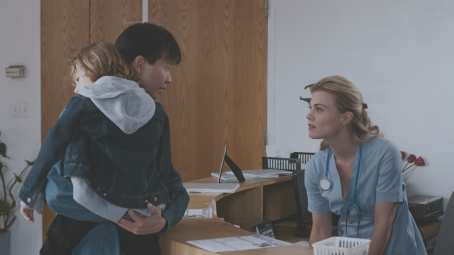
Comfort, In The Family, 2011
BA: So what about these small towns, what’s the response been? What’s the smallest city you’ve played?
PW: Y’know, there’s a town, fairly small—-I mean it’s not tiny, I mean it used to be the largest or the second-largest in Maryland—-Cumberland, Maryland. And it was such a feeling of community—-it was at a community college. And it’s people who have had some challenges in life. It’s definitely not an arthouse crowd! The arthouse crowds are wonderful but these are people who have probably never seen an art film. That’s the thing, you get a range, like anywhere.
BA: And how did they like the movie?
PW: They loved it, and some of the smartest commentary and questions—
BA: They could relate to it.
PW: Yeah. And I think that there’s some sort of pride, actually, in smaller towns that we screen in—-the same way there’s a pride in Tennessee, in that “we’re proud this movie takes place there and it reflects the range of what we’re capable of there.”
BA: It’s a very nuanced view of that part of the world that you don’t usually get. I know you deliberately chose to set the movie in the South, and that was interesting-—you’re from Texas.
PW: I’m from Texas!
BA: Do you consider that the South?
PW: Y’know, it’s up for debate (laughs). Different people consider it different things-—I do. But I didn’t set it in Texas because I didn’t want it to be too familiar. I wanted someplace for me to go, because if there’s a place for me to go, I feel like the discovery is a little more honest for the audience, too. Same thing for the story, too—-I didn’t know quite where it was going, and I think that translates to the audience’s experience. It’s not quite predictable.
But everyone I’ve met from Tennessee the few times I’ve been there—-there’s something I see in a middle-class life in Tennessee that is, in my view, dramatic, but I think in most films is not particularly interesting, is not particularly dramatic, these type of characters are not necessarily the stuff of drama, but I see a lot in their lives.
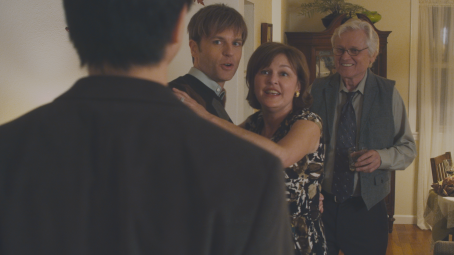
Dramatic, In The Family, 2011
BA: I think you’ve probably heard people tossing around names like Ozu and Bergman, which is pretty flattering for a first-time filmmaker.
PW: It’s wonderful, yeah.
BA: Those filmmakers really do look at middle-class people, everyday people, they’re not looking at extraordinary people at all, and there’s a similarity in that as well as the stylistic similarities.
PW: You know, I’d never seen an Ozu film before, and when the reviews started coming out, I decided to start with a comedy—-I saw “Good Morning,” and I loved it, and I loved how funny it was, how great the actors are. Making a movie is wonderful because you get this great viewing list-—and not even a viewing list, someone compared it to Alice Munro’s short story and I started reading those and they are tremendous. I think she’s pretty much rocketed to the top of my favorite author list.
BA: I wanted to ask you a little bit about the characters and yourself. It’s obviously really important that the characters are a gay couple, but what about being an Asian man, a Chinese American man who is adopted, or fostered, and has a really interesting background. There’s never any overt discussion of his ethnicity.
PW: There isn’t, and one of the very interesting things is when you leave out certain terms, it’s interesting to see how people fill in whatever they want. It’s nice to have that flexibility to fill in. For example, when I wrote it, he’s not Chinese, and yet a lot of people assume he’s Chinese, and so that’s interesting.
BA: His name is not Chinese, obviously, but I guess that’s part of the backstory.
PW: Yeah, but it’s a really interesting combination. I think one of the nice things that happens is that all these things combined kind of jam a lot of signals. For example, though some people may be used to two-dad families, they’ll look up there and they cannot process that face with that voice. So I think when you have that combination of things it helps you start from scratch because it’s so unfamiliar.
I think a lot of times people view places and people as averages, whereas I feel what’s much more realistic are these anomalies from time to time. You know, you’ll be in that town where there’s that one person, and somehow they got there, and they have a story and everybody knows them and they’re okay. I feel like it also helps to provide these situations where you’re not quite sure which aspect of Joey people are responding to, because there’s also a class issue at play, and I think that’s also very realistic, because in life you’re like, “What exactly is this person responding to? Is it how I’m dressed, is it my gender, is it my race?” You just don’t know.
BA: And sexuality.
PW: Yeah.
BA: I think that’s another thing that’s interesting is the way you elide a lot of the obvious things that could have made the film much more dramatic in a conventional way but by avoiding them you don’t ever touch on them—
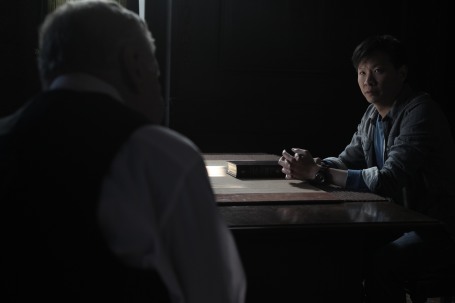
Eliding, In The Family, 2011
PW: Well, even things like coming out—-somebody wrote something very interesting about the film. It’s almost like there’s this continual process of coming out that Joey does but it’s not the way we’re used to seeing it or thinking about it—-it’s so small and unspoken. There’s this film called Nighthawks, a British film, that was one of the first to depict a gay life and it’s tremendous. There’s this moment where the character comes out to his friend but it’s in this way where he just uses the correct pronoun to describe a relationship, and they don’t speak about anything and you see her shocked, adjusting, and then deciding to continue the conversation, and it’s so beautiful. I think a lot of scenes in life are like that.
BA: Yeah, and I think that’s why your film is so real because it’s not melodramatic in a conventional sense. The things that happen are melodramatic but the reactions are very real. The audience appreciates that you’re not forcing them to think the way that you want them to think. You talked a little bit about how the audience is the participant in the making of the story.
PW: It really is, and they’re a participant in the emotional flavor. I do the work to set up the situation and, especially early in the film, I’ll pull back at the height of the emotion, and it’s to let the audience complete it, and I think when they do that it becomes a much more personal emotion.
BA: And this was a conscious decision?
PW: Yeah, it makes sense as the shape of things, and I think most movies do the opposite, right, they give you no context, and this emotional burst comes out of nowhere and you can’t understand it.
BA: Right, it’s like you’re observing more than participating. So when you’re making the movie you’re thinking about how this is going to play as people were watching it?
PW: Thinking about it, but mostly just thinking about how it plays with me, how I feel as I’m going through this, and it’s a basic approach that I know a lot of people talk about but if you don’t assume the audience is any better or worse than you—-both are dangerous—-you get really far. Somebody said, “It’s shocking for a movie to assume that I’m a human being, that I’ve actually had some human experiences,” (laughs) “that I’m not a bear, that you don’t have to explain the basics of being human.”
BA: Which I think is nice-—you leave a lot of space for people to fill in the blanks.
PW: And they can, and they like doing it. We do it in life, too.
BA: It’s like a respect for people’s intelligence.
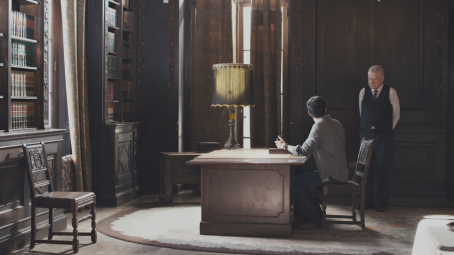
Fill in the blanks, In The Family, 2011
BA: So I guess the standard question is, what’s next? Are you going to keep touring it around for as long as it will play?
PW: This week will tell us a lot and then we’ll have to readjust, if we get to play longer, if more people want to play us, because a lot of other cities, not just theaters in the Bay Area, but theaters in other cities are watching.
BA: How many prints do you have?
PW: Of the 35mm we have twelve prints, and we have DCP now.
BA: That’s a fair amount.
PW: It’s not a constraint, and that’s the thing I wanted. I never wanted the number of prints to be a constraint and it hasn’t been so far. We had a philosophy at the beginning—every time we screen it, we do it a favor, even if two people come, even if it’s in a place you’re not expecting.
BA: So have you had that experience where only two people come?
PW: We’ve had experiences where two people come.
BA: And have they liked it?
PW: Yeah, I think one of the best screenings I was at there were nine people, including myself, and the two owners of the theater. But it felt like I made the movie for those nine people, it was such an active screening, so much laughter, so much warmth in the room. Because you get disappointed, you see empty seats in the room and a part of you is disappointed, but I’m like, “What kind of person have you become when two people don’t matter, or these nine people don’t matter?”
BA: So they all count?
PW: Exactly. If it has an impact on them, and I think it does, you see people coming out of the theater and you see them just cracked open a little bit, you see something in their eyes, you see them just cracked open to something. They’re feeling something a little more fully, they’re processing a lot of things in their own lives and rethinking, revisiting maybe some of the conflicts and family issues in their own life—so it matters. It matters.
UPDATE: In The Family will open Fri. Dec. 14 at the Roxie Theater in San Francisco. Go see it!
In The Family, dir. Patrick Wang
opens Fri. Dec. 7, 2012
Opera Plaza Cinema
601 Van Ness Avenue, San Francisco, CA, 94102
(415) 267-4893
San Francisco CA 94102
The Pleasure Principle: San Diego Asian Film Festival

Kim Young Geon and aloha shirt, Young Gun In The Time, 2012
I’m suffering from severe film festival withdrawal right now after a whirlwind weekend at the San Diego Asian Film Festival, where I screened my latest short experimental documentary, The Chinese Gardens. SDAFF is a great festival, with a massive schwag bag, karaoke and lots of free food and drink in the guest lounge, and a jam-packed schedule full of outstanding film product. I flew in Saturday morning and returned Monday and in about 36 hours I saw more films than I usually see in a week, all on the big screen. Not only is SDAFF one of the biggest Asian American film fests, showcasing the newest and best Asian American movies, it also features a slew of outstanding Asian films as well. In my brief visit I saw docs, narratives, experimental films, shorts, features, horror, extreme, sci-fi, romcoms and more. Herewith are some of the highlights.

Jake and schoolkids, Jake Shimabukuro: Life On Four Strings, 2012
Tad Nakamura’s Jake Shimabukuro: Life on Four Strings follows the life and career of the ukelele wiz and the hour-long film is nice way for the director to stretch out a bit and work on a longer-form piece after three fine short documentaries, Yellow Brotherhood, Pilgrimmage, and the outstanding Chris Iijma bio, A Song For Ourselves. It’s all about relationships with Tad’s movies, which is why, even though I’m pretty much a heartless beyotch, they always make me cry. As with Nakamura’s previous shorts, the latest film possesses some really touching moments such as Shimabukuro’s mom talking about raising two kids as a single mom, and Shimabukuro’s manager seeing her hometown of Sendai hard hit by the Japanese tsunami. Shimabukuro’s a charismatic performer and his easy magnetism translates well to the screen. It’s quite something to see him grow from a gawky teenager to a seasoned performer holding his own at the LA Philharmonic. Nakamura’s editing skilz and his ability to capture emotion on screen, as well as the imaginative AfterEffects graphics work by Michael Velazquez, make the film more than a standard biopic. Nakamura also has a fine sense of place and community, as evidenced in his earlier short docs, and in the new pic Tad locates Shimabukuro firmly in his native Hawai’i, showing Shimabukuro’s respect and understanding for his instrument and its significance in Hawai’ian culture.
Due to various scheduling conflicts I was only was able to catch the middle hour of Sion Sono’s Land of Hope and I was very sorry I couldn’t see the whole thing. Following last year’s Himizu, this is Sono’s second movie set in Japan’s tsunami zone. The story involves several characters as they search for missing family members and deal with fears of radiation downwind from the fictional town of Nakashima (a mashup of Nagasaki and Hiroshima that stands in for real-life Fukashima). More low-key than some of Sono’s earlier horrorist fare like Exte (Hair Extensions) or his magnum opus, Love Exposure, Land of Hope ruthlessly mocks the Japanese government’s inadequate response to the tsunami and reactor meltdown while emphasizing the human cost of those disasters. The film was just starting to get extremely strange with a pregnant woman wandering the streets in a hazmat suit when I had to move on to the next screening, Painted Skin: The Resurrection.

Pretty Aloys Chen Kun, Painted Skin: The Resurrection, 2012
The highest-grossing Chinese-language film in the PRC to date, PS:TR is a chick flick/costume drama/war epic/fantasy film. Director Wuershan manages to dial back the DFX extremes he displayed in The Butcher, the Chef, and the Swordsman (which I quite liked, btw) and focuses instead on various interpersonal relationships including not one but two exogamous human/demon romances. The three-way affair between Zhou Xun, Vicki Zhao Wei, and Aloys Chen Kun must rank up there with Maggie Cheung/Brigitte Lin/Tony Leung Ka-Fei in Dragon Gate Inn as one of the most gorgeous love triangles ever captured on celluloid. An elaborate costume fantasy, PS:TR is a lot of fun, with Zhou, Zhao, and Chen playing it straight as the variously star-crossed lovers, and Mini Yang and William Feng providing comic relief. As per usual Aloys Chen is a fine piece of eye candy but here he lacks the range and charm he showed in Flying Swords of Dragon Gate. Vicki Zhao Wei does well as a long-suffering and unrequited scarred princess, and Zhou Xun as a fox demon manages to simultaneously convey longing, avariciousness, lust, and cunning while at the same time making her character strangely sympathetic. Mini Yang is cute and charming as a spritely bird demon, the first role I’ve seen her in where she was more than a flower vase, and William Feng as her comic foil is equally deft in his role.
Debbie Lum’s documentary Seeking Asian Female looks at the phenomenon of yellow fever, or white guys with a thing for Asian women. Although it takes a little while to get over the ickiness of Steven, the self-deluded main character who’s an Asiaphile with a particular obsession for Chinese women, I think Lum did the right thing in focusing on this guy. Steven is a not particularly good-looking, 60-something, twice-divorced, childlike dreamer living in a small walk-up apartment in Burlingame and making a modest living working at the SFO parking lot. Yet despite his lack of physical attractiveness, money, social status, or property he’s still apparently enough of a catch to draw several young Chinese women into online associations with him. The film makes a cogent statement about the power imbalance inherent in such relationships as even a lowly parking lot attendant in the U.S. can be desirable enough to attract women in developing countries like China.

Sandy spells it out, Seeking Asian Female, 2012
Once Steven’s prospective bride Sandy arrives from China things start to get interesting, as she has reasons of her own for wanting this marriage of convenience. Lum lightly touches on the plight of “leftover women” in China, those females who haven’t yet married by age 30, but where the film is best is when it explores the subtle power dynamic between a white first-world man and a woman from rural China. The film avoids preachiness or polemics yet its point is pretty clear—at one point Lum asks the clueless Steven just what Sandy is gaining from their relationship and he’s completely stumped. It’s possibly the closest he comes to realizing the vast power imbalance in their relationship and understanding the great advantage he has over his captive bride-to-be.
Yet despite its hot-button subject matter, Lum’s film never overtly judges the motivations of her two characters, although there are many opportunities to do so, and the film thus allows viewers to come to their own conclusions about the situation. For the most part the film also avoids easy romanticism and is fairly clear-eyed about the motivations of its main characters, contrasting Steven’s continued avowances of adoration for his newly met fiancée with Sandy’s much more practical view of the situation. My only quibble is with the very end of the film, where the story succumbs to sentiment and falls back on romantic love as the resolution to its narrative. After the film has successfully dismantled the Western idealization of romance it’s a bit of a letdown to have such a conventional conclusion to the story. But the rest of the film is so sly and watchable and possesses such a sharp and intelligent social and political critique that I’m willing to overlook this lapse.
I concluded my rapidfire film festival junket with a couple super-low budget digital features. Fresh young Korean director Oh Young-doo’s Young Gun In The Time is clever and inventive, with a great lead performance by Kim Young Geon as the titular character, a goofy young gumshoe with a cyborg hand who has a penchant for Hawai’ian shirts. The plot involves some kind of convoluted time travel, along with a murder mystery, a love story, and several excellent fight scenes, plus a sexpot boss and many ponytailed thugs including one whose weapon of choice is a retractable metal tape measure. Of course the time travel paradoxes make absolutely no sense but it’s fun to see where Oh goes with his conceit, and despite its miniscule US$30,000 budget the movie’s got a ton of zany digital effects, split screens, and other filmic tomfoolery that keeps everything moving along at an entertaining clip.

Oh shit, Henge, 2012
Japanese director Ohata Hajime’s Henge is another example of making the most from limited resources. Also shot on digital video, the film is follows a young couple whose marriage is hard-pressed when the husband starts to metamorphosize into a manical. bloodthirsty beast intent on mayhem. A nutty gojira/love story/werewolf tale that ends up with a guy in a rubber suit terrorizing Japan, the film overcomes its modest means and runs on sheer primal energy, led by a muscular, demented performance by Kazunari Aizawa as the man/beast. Henge questions whether true love knows no bounds, even when your spouse may be a throat-ripping, flesh-eating monster.
The 2012 San Diego Asian Film Festival continues through Nov. 9, so even though I’ve left the building there are many more cinematic delights still to be had. Check out the full schedule here.
Fade Away and Radiate: Tai Chi 0 film review

Angelababy, text, and explosions, Tai Chi 0, 2012
Tai Chi 0, actor-turned-director Stephen Fung’s new-school martial arts movie, opens this weekend in the U.S. after a pretty successful theatrical run in China. The first of a trilogy, Tai Chi 0 is chock full of what we in the nineties used to call self-reflexivity and is loaded with Brechtian bells and whistles, but ultimately the movie doesn’t have a lot of substance below it’s clever exterior. Although it was a lot of fun while I was watching it, the effects of Tai Chi 0 faded pretty quickly after I left the theater.
The movie’s premise is a nice homage to classic kung fu flicks: talented but naïve youngster attempts to hone his martial-arts chops by seeking out an elusive gong fu master, with many obstacles barring his way. Tai Chi 0’s main character, Yang Lu Chan, is born with a small fleshy horn on the side of his forehead that portends his inborn martial arts prowess. Unfortunately, whenever Yang starts an ass-kicking his life essence is dangerously depleted. In an attempt to counter the deleterious effects of using his powers, Yang journeys to Chen village in hopes of training with the master residing there, but tradition forbids any outsiders learning the village’s kung fu secrets. The movie has fun pitting Yang against villagers using mah jong tiles and tofu to defeat his attempts at learning their ways and Tai Chi 0 is best when it riffs on these familiar tropes. Sammo Hung’s classic action choreography carries the movie’s fight scenes, though it’s undercut a bit by Fung’s shaky-cam and too-quick editing.

Jayden Yuan Xiaochao, flexible newbie, Tai Chi 0, 2012
Showing some moxie in her role, Angelababy acquits herself pretty well as the spunky heroine, while Eddie Peng as her conflicted boyfriend torn between tradition and the lure of modernity epitomizes duBois’s double consciousness. Newcomer Jayden Yuan Xiaochao as Yang is good as the archetypal kung fu neophyte, though he doesn’t get to do much but fight sporadically and look innocently confused, and Tony Leung Ka-Fei is excellent as a laborer who secretly aids Yang’s quest to learn Chen village kung fu. Unlike some of his contemporaries, Big Tony’s been transitioning nicely to character roles, both here and in Detective Dee and the Mystery of the Phantom Flame.

Big Tony, Tai Chi 0, 2012
Where Tai Chi 0 departs from its martial arts movie predecessors is through its constant use of quirky onscreen titles, constantly traveling camerawork, and other gaming effects. Recalling an old kung fu movie tradition (more recently adopted by big-budget mainland China agitprop flicks like 1911 and Founding of a Republic), actors are introduced by brief onscreen titles that also declare their resume (ie, “that’s Andrew Lau as Yang’s father: he directed the Infernal Affairs trilogy.”) Other titles both informative and ironic constantly pop up throughout the movie, including those detailing the progress of Yang through his quest, as well as onscreen diagrams tracing the speed and vector of a flying kick and other gameboyesque techniques. The movie also features a steampunky locomotive that resembles a huge cast-iron teapot, with grinding gears and smoking cogs straight out of Modern Times. While this is all very adroit and adds interesting visual texture to the movie, the tricksiness still doesn’t make for a really memorable cinematic experience, unlike, say, Flying Swords of Dragon Gate, Tsui Hark’s recent foray into 3-D IMAX which successfully exploited the latest innovations in movie technology to full and insane effect.
But Tai Chi 0 is certainly as diverting as most Hollywood blockbusters and it’s definitely worth seeing on the big screen, if only to catch all of the rapid-fire DFX. It’s fun to see a lot of expensive postproduction imaginatively utilized in a Chinese-language film and I’m all for expanding the boundaries of cinematic expression, so I’ll go see the next two movies in the trilogy. Especially if they make it to the U.S. in 3-D IMAX.
Tai Chi 0 opens October 19, 2012. Go here for showtimes.
Pictures of You: Portraiture Now at the National Portrait Gallery
Youniverse, Tam Tran, digital print, 2010
I recently made a trip to our nation’s capital and caught Portraiture Now: Asian American Portraits of Encounter at the Smithsonian’s National Portrait Gallery. Although there have been a few significant Asian American arts shows in the past few years at major institutions (including One Way Or Another at the Asia Society in 2006 and Asian/American/Modern Art: Shifting Currents at the deYoung Museum in 2008) and Asian American community arts organizations like Kearny Street Workshop have been going strong for more than forty years, Portraiture Now is a coming-out of sorts for Asian American artists since it was organized by the Smithsonian aka this country’s big-time cultural gatekeeper.
Just downstairs from the Annie Leibowitz show and up the hall from Leutze’s Washington Crossing the Delaware, the show had a nice primetime location on on the NPG’s first floor, and it included some good stuff by mostly younger artists that moved beyond classic ideas of representation.
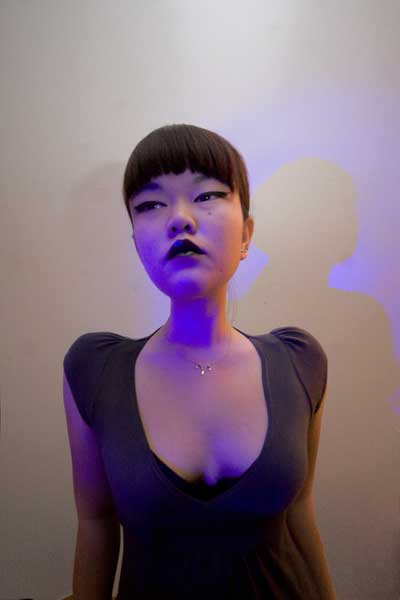
Self-portraiture figures into several of the artists’ work featured in the show. Tam Tran’s funky and intriguing photos of herself make good use of her unusual physicality and a fish-eye lens. Despite their prettiness, Zhang Chun Hong’s meticulous charcoal drawings of hers and her sisters’ hair become observations about the fetishization and objectification of the female Asian body. Hye Yeon Nam’s four-part video self-portrait, Walking, Drinking, Eating, and Sitting, something of a throwback to early lo-fi 1970s video art by Joan Jonas and Vito Acconci, uses absurd and repetitious actions to convey everyday life’s ongoing anxiety.

Cat and Carm, Shizu Saldamando, Gold leaf and oil on wood, 2008
With their sleek surfaces and liberal use of gold leaf, Shizu Saldamando’s paintings of LA baby-dyke scenesters recall both medieval illuminated manuscripts and Japanese folding screens. By treating these images of her friends as semi-sacred iconography Salamando’s portraits combine the earthly and the sublime, capturing and elevating the everyday camaraderie of her crew.
CYJO’s KYOPO Project, a series of full-length, full-color photographs of more than 200 Korean Americans, features text in their own words detailing the subject’s relationship to their Korean American-ness. At the NPG the photos were mounted one after another down the length of two walls and seen this way the entire series makes for an impressive collective portrait, with the personal stories adding humor, complexity and nuance to the project.
Shimomura Crossing The Delaware, Roger Shimomura, 2011
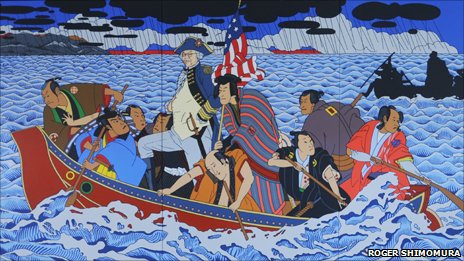
The venerable Roger Shimomura represented the older set, with his reworkings of Pikachu and Hello Kitty demonstrating his continued awareness of the ironies of U.S. cultural representations. Americans vs. Japs, is a clever rendering that locates Shimomura’s (Japanese) American visage amidst a hoard of invading Japanese stereotypes borrowed from World War II propaganda. The painting shrewdly interrogates assumptions about Asian American identity in Shimomura’s signature style, blending classical Japanese brush paintings with U.S. pop culture iconography. The show also features his epic painting Shimomura Crossing The Delaware, which is at once a display of Shimomura’s technical mastery, a cogent critique of American pop history, and a brilliant goof on its source material located just down the hall in the NPG.
While I was on the Mall I also stopped in at Colorful Realm: Japanese Bird-and-Flower Paintings by 18th-century painter Itō Jakuchū. On loan for only four weeks from Japan, the show includes some truly legendary paintings that in Japan are the equivalent of the Mona Lisa or The Last Supper. The show was packed four-deep with people on a Saturday afternoon, with a line to get in and a brisk sale of related prints, books, and postcards in the museum gift shop. In contrast, the Asian American NPG show was much more lightly attended, with plenty of room to sit and ponder the intricacies of meaning of each piece in the exhibit, but despite losing the popularity contest to the Jakuchū show’s more conventional appeal, its mere presence in the NPG, the first pan-Asian American show at the Smithsonian, surely recognizes the artistic and cultural relevance of Asians in the U.S.
The spiffy National Museum of the American Indian on the Mall opened across from the National Gallery in 2004 and the National Museum of African American History and Culture just broke ground in February 2012. The Asian American population is currently more than 5% in the U.S. and former UH Manoa professor Konrad Ng (aka Barack Obama’s brother-in-law) now heads up the Asian Pacific American Arts division of the Smithsonian. So this begs the questions: when will we Asian Americans get a national museum of our own? If the existence of high-profile Asian American art shows like Portraiture Now and the growing Asian American demographic are any indication, it seems to me that the time is now.
Portraiture Now: Asian American Portraits of Encounter
National Portrait Gallery, Smithsonian Institution
August 12, 2011 through October 14, 2012
Lovesexy: Vulgaria film review

DaDa Chen gives it her all, Vulgaria, 2012
A couple days ago I had the good fortune to run across one of my favorite movies on youtube, Once Upon A Time In Triad Society, released in 1995 and starring the inimitable Francis Ng. An outstanding black comedy that savagely skewers any romanticized notions of triad honor among thieves, it’s also an excellent example of the kind of deliriously high-energy cinema that Hong Kong used to put out on a regular basis back in the day. After watching it again I lamented to myself the current shortage of truly insane and invigorating HK movies these days, most of which have been replaced by tame and decorous, high-tone product from Mainland China (see The Bullet Vanishes).
But my faith in Hong Kong cinema has been restored with Pang Ho-Cheung’s newest release, Vulgaria, which is a throwback to the glory days of Hong Kong movies, with its mostly improvised, who-gives-a-fuck attitude, and its willingness to be loud, tasteless, and offensive. But this is no dumb and dumber—the movie is a spot-on look at the ailing Hong Kong film industry and the depths that HK moviemakers need to go to in order make a living these days, including producing tacky Category III movies, sucking up to insane Mainland financers/gangsters, and running low-rent mahjong dens complete with childcare and takeout meals.
Ronald Cheng in sequins, Vulgaria, 2012
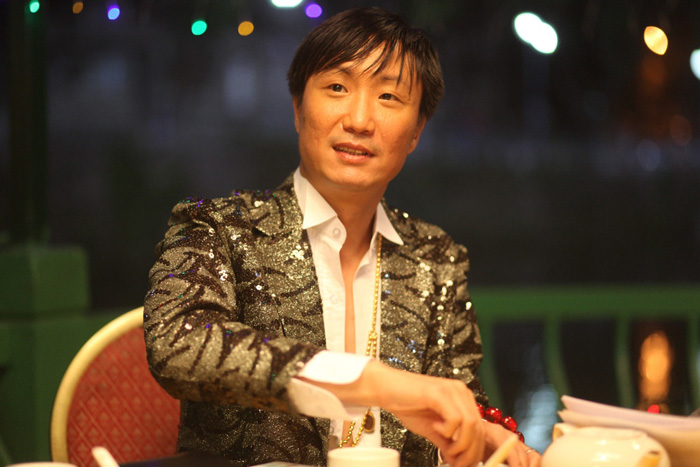
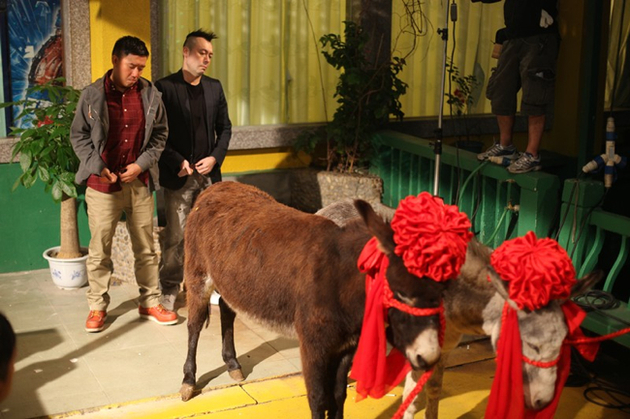
Candy-assisted blowjobs, bestiality, crazy cursing, deep-fried field mice—Vulgaria goes there and it works. The movie’s cast includes some of Hong Kong’s best comic actors, some of whom appeared in the Wong Jing stinker Marrying Mr. Perfect. In that movie they floundered, but here they’re brilliant. Chapman To rocks as a hapless film producer trying to stay afloat by any means necessary, even if it includes the possibility of interspecies sex. There’s a line that he won’t cross, however, which adds a certain poignancy to the character’s plight and which leavens the unbridled cursing, sex talk, and casual coupling that makes up the bulk of the proceedings. DaDa Chen is also great as the good-natured, well-endowed Popping Candy, so named for the particular type of fellatio she blithely practices in order to get movie roles. Ronald Cheng in spangled clothes is outstanding as the metrosexual gang leader Tyrannosaurus, and the banquet scene with himself, Lam Suet, Chapman, and Simon Lui is one of the funniest things I’ve witnessed in many a movie.
Pang’s a whip-smart director and even in this quickie, low-budget flick he effectively manipulates the cinematic lexicon, with the film’s storyline effortlessly flashing back and forward in time. Another great thing about Pang’s films is their focus on the profane joys of the Cantonese language and Vulgaria is no exception. In this one the actors seems to be especially gleeful in utilizing as many creative obscenities as possible and there’s a particularly funny running gag involving the limited Cantonese-language skills of Chapman To’s Chinese American assistant.
Chapman To, Simon Lui and mules prepare to meet their fate, Vulgaria, 2012
All in all Vulgaria is one of the most enjoyable movies I’ve seen in a long time—-it’s got life, energy, and cojones to spare. Not only is it a smart commentary on the state of Hong Kong cinema today, it’s way more creative, vigorous and fun than most of the bloated, predictable product out there. Now if only more Hong Kong movies could follow suit, it would be like 1995 all over again.
UPDATE: Vulgaria has just scooped up a trio of nominations for the Golden Horse Awards-–Chapman To for Best Actor, Dada Chen for Best Supporting Actress, and Ronald Cheng for Best Supporting Actor. No nomination for screenplay, directing, or profanities this time. Awards announced November 24.
UPDATE 2: Ronald Cheng just won the Golden Horse for Best Supporting Actor–truly well deserved, IMHO. Not many people can convincingly play a man in love with a mule and Ronald did it with style and panache. Go Vulgaria!
Vulgaria
opens Sept. 28
AMC Metreon 16
101 Fourth Street
San Francisco, CA
I Want Candy: Hong Kong Cinema & the 3rd I South Asian Film Festival

Lau Ching-Wan, badass, The Longest Nite, 1997
This weekend the Bay’s got another embarrassment of filmi riches from a pair of dueling Asian film festivals. This year’s editions of Hong Kong Cinema, and the 3rd I South Asian Film Festival both offer a ton of tasty movie treats.
The 3rd I festival, which starts Sept. 18, runs six days and features over 20 films from 9 different countries including India, Pakistan, Bangladesh, Sri Lanka, The Maldives, Canada, South Africa, UK and USA. Among the highlights is Jaagte Raho (Stay Awake), from 1956, starring my new favorite actor Raj Kapoor and co-directed by Amit Maitra and famous Bengali theater artist Sombhu Mitra. Jaagte Raho’s story follows Kapoor as a thirsty man from the country that arrives in the city longing for a drink of water. He ends up trapped in an apartment block where he’s mistaken for a thief, spending a long, sleepless night being relentlessly chased by the misguided tenants. As he hides out in various apartments he discovers the corruption and deceit amongst the residents, with adultery, gambling, drunkenness, counterfeiting, greed, and theft among their unsavory traits.

Raj Kapoor, sacrificial lamb, Jaagte Raho, 1956
Although his earlier films featured him as an angsty young romantic lead, in Jaagte Raho Raj Kapoor iterates his naïf-in-the-big-city persona that he repeated many times in his later years. Here he’s all wide eyes and pleading gestures as the country bumpkin, a stark contrast to the duplicitous, licentious lot pursuing him.

Raj and Motilal, tippling, Jaagte Raho, 1956
This is great stuff, sly and satirical, that cleverly exposes the hypocrisy of the corrupt tenants. It’s shot in shimmering black and white with a crack soundtrack with lyrics by Shailendra and music by Salil Choudhary, including the rollicking drunken ramble Zindagi Khwaab Hai. The legendary Motilal is outstanding as an inebriated bourgeois who takes in the destitute Kapoor, in an homage of sorts to City Lights—however, Jaagte Raho’s booze-driven hospitality has a much more twisted outcome than does the Chaplin film. The film concludes with a lovely cameo by Nargis, once again representing the moral center of the movie. This was the final film to star Kapoor and Nargis and coincided with the breakup of their long-time offscreen affair as well, so it’s especially bittersweet to see the famous lovers together for the last time. Jaagte Raho was a box office flop when it was first released, but it’s since been recognized as a classic. Interestingly enough, along with Meer Nam Joker, which also bombed when it first came out, Kapoor cites this as his personal favorite film.
Also of note at the 3rd I festival: Decoding Deepak, a revealing look at the modern-day guru that’s directed by Chopra’s son Gotham; Runaway (Udhao), Amit Ashraf’s slick and stylish indictment of the link between politics and the underworld; Sket, which looks at a vengeful girl gang in an East London slum; the experimental documentaries Okul Nodi (Endless River) and I am Micro; this year’s Bollywood-at-the-Castro rom-com Cocktail; and the short film program Sikh I Am: Voices on Identity.
This year’s edition of Hong Kong Cinema, the San Francisco Film Society’s annual showcase of movies from the former Crown Colony, has a bunch of outstanding product. The program includes a three-film retrospective commemorating the 1997 handover: Peter Chan Ho-sun’s Comrades: Almost A Love Story, which stars Leon Lai and Maggie Cheung as friends almost with benefits from two different sides of the HK/China border; Made In Hong Kong, Fruit Chan’s debut that’s a redux of the venerable Hong Kong gangster movie and which stars the young and skinny Sam Lee in his first role; and The Longest Nite, one of Johnny To’s nastiest crime dramas, with impeccable performances by Lau Ching-Wan and Tony Leung Chiu-Wai as (of course) an immoral cop and a vicious criminal.
These three classics are hard acts to follow but several of the other films on the docket manage to hold their own. Both Pang Ho-Cheung’s Love In The Buff, an excellent romantic dramedy with Miriam Yeung and Shawn Yue as the make-up-to-break-up lovers (full review here) and Ann Hui’s most recent feature, A Simple Life, starring Andy Lau and Deanie Ip as a man and his amah, (full review here) had extended runs in San Francisco earlier this year so this may be the last chance to see then on the big screen in the Bay Area.

Sammi & Louis, bantering, Romancing In This Air, 2012
Also good is Johnny To’s new romantic comedy Romancing In Thin Air, which To co-wrote with longtime creative partner Wai Ka-Fai and the Milkyway Image team. Set mostly at a vacation lodge in an idyllic high-altitude locale in China, the story concerns two romantically wounded individuals grappling with the peculiarities of their damaged relationships. Sammi Cheng is her usual charming self as the female lead, but although he’s likeable enough, Louis Koo as a Hong Kong movie star (!) is a bit lacking in charisma and doesn’t bring a bigger-than-life sensibility or the self-effacing humor that Andy Lau or a more engaging performer might have done.
Although the plot is seems at first to be fairly straightforward, the film gradually reveals Milkyway’s trademark weirdness. The story of Sammi’s missing husband, lost in the dense high-country woods for seven years, is a bit creepy, though I do like that when the husband courts Sammi he turns into a clumsy doofus. The film also includes a very meta movie-within-a-movie conceit and makes several sly jabs at the Hong Kong film business.

Utterly illogical, Nightfall, 2012
Less good are Derek Yee’s The Great Magician, a rambling and messy movie that’s a criminal waste of Lau Ching-Wan, Tony Leung Chiu-Wai, and Zhou Xun (full review here), and Roy Chow’s Nightfall, a turgid and ridiculous film that similarly wastes good performances by Simon Yam and Nick Cheung. I really wanted to like this movie, a wannabee intense and serious thriller, not least for its slick and attractive cinematography. But despite a gripping and violent opening scene the movie has some great gaping holes in logic and alternates between chatty exposition and absurd set pieces. Still, Nick Cheung is very good as a haunted convict with anger management issues, though Simon Yam is somewhat less good as the cop unraveling the mystery. Yam doesn’t have quite the emotional depth of Francis Ng or Lau Ching-Wan and so the payoff at the end of the film is weaker than it might have been. Michael Wong is quite bad as an abusive father, with a shrill, one-note performance and his annoying habit of speaking English at the most illogical moments. I kept imagining what Anthony Wong might have done with this part. The violence is a notch more gruesome than most mainstream Hong Kong films, especially in the opening fight sequence—looks like someone’s been watching Korean movies for tips on emulating their gory tendencies.
All in all, San Francisco Asian film fans are going to have to make some hard choices this weekend—not that that’s a bad thing by any means.
3rd i’s South Asian Film Festival
September 19-23, 2012, Roxie and Castro Theaters, San Francisco
September 30, 2012, Camera12, San Jose
September 21–23, 2012
New People Cinema, San Francisco
Finger On The Trigger: The Bullet Vanishes movie review
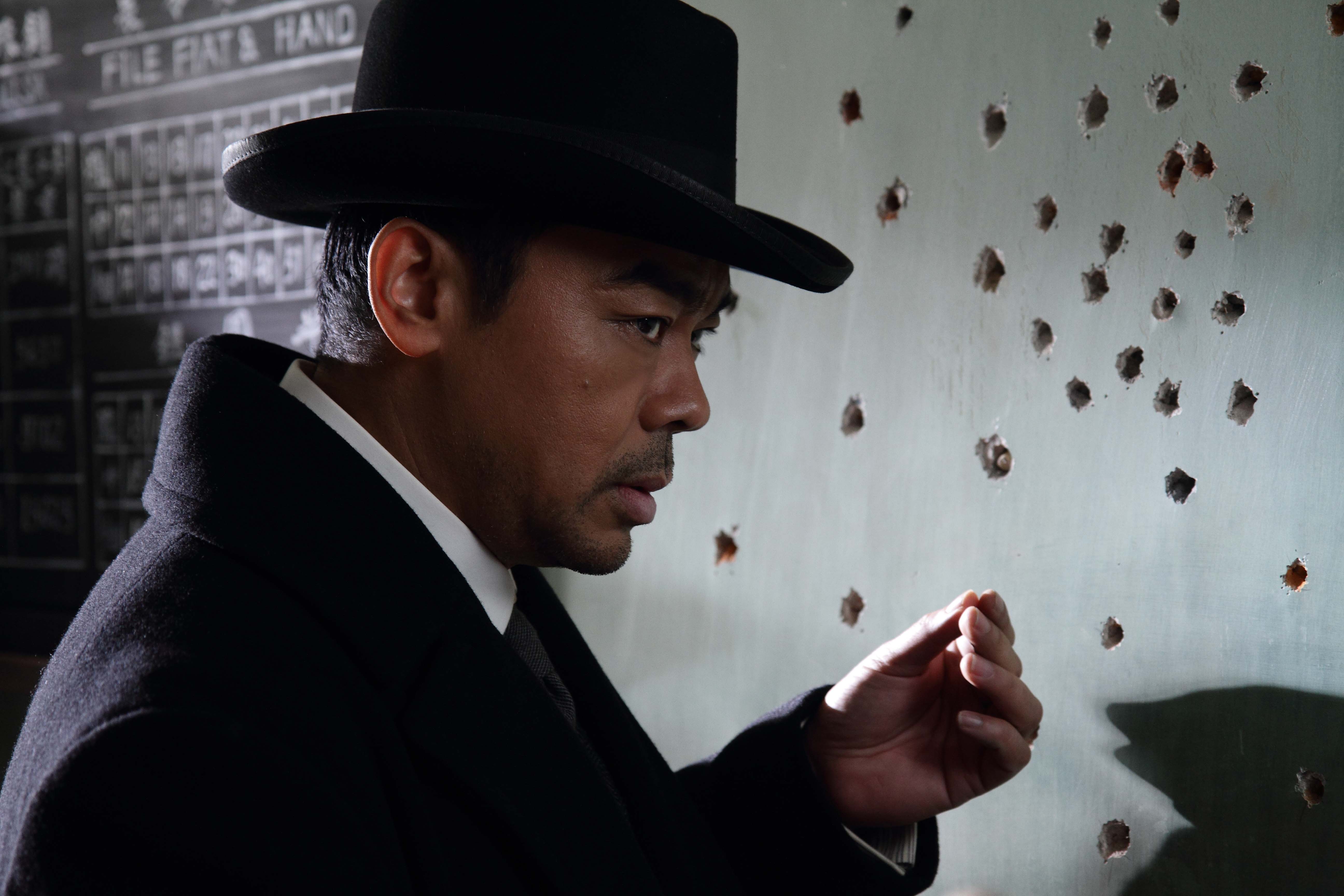
Lau Ching-Wan, supersleuth, The Bullet Vanishes
The Bullet Vanishes, which opens this week in San Francisco and other select North American cities, is China Lion’s latest almost-day-and-date release of new Chinese-language product. Part CSI, part Guy Madden Sherlock Holmes, and part Detective Dee, the movie is a classy production set in 1930s China with a lot of really nice vintage pistols. More importantly, it’s a chance to see the great Lau Ching-Wan in action, as he meticulously creates yet another intriguing character.
The story involves the investigation of a series of murders at a Shanghai bullet factory. After one of the factory workers kills herself under suspicious circumstances, several of her co-workers follow in like fashion, dying of gunshot wounds with seemingly spectral bullets. Police detectives Song (LCW) and Guo (Nicholas Tse) are assigned to figure out what’s going on, but as they delve deeper into the case they encounter more and more contradictions.
As a representative of the big-budget cinematic product currently coming out of China, the movie looks great, with its wool-and-tweed period wardrobe, thirties-throwback art direction, and expensive-looking sepia-toned cinematography. Director Lo Chi-leung keeps things moving along despite several abrupt U-turns in the plot, the action choreography includes several nice shootouts, and the movie has fun gently ribbing the primitive forensics of the 1930s detectives. The general air of respectability, however, means that the movie lacks the OTT insanity that drove so many great Hong Kong films—as a China/HK co-production the movie is more genteel than balls-to-the-wall. There’s also a very slight critique of capitalism in the film’s rendering of the evil boss who ruthlessly oppresses the workers, but Hong Kong director Lo doesn’t let it gets in the way of the real fun.
As noted extensively elsewhere, Lau Ching-Wan played a similar character in the much weirder Johnny To movie, The Mad Detective, and some of that movie’s tropes are repeated here, such as Lau’s detective character re-enacting crime scenes in order to deduce their mechanics (though without the psychic link that made the To film so kicky and fun). The Bullet Vanishes also recalls Peter Chan’s recent flick Wu Xia (or Dragon, depending on when and where you saw it), which featured Takeshi Kaneshiro as a hyper-observant detective who could suss out crimes just by brushing his hands over a tabletop. Here Nic Tse and Lau Ching-Wan split the super-detective duties, with Nic also being an expert shootist who wins several quick-draws with the bad guys.
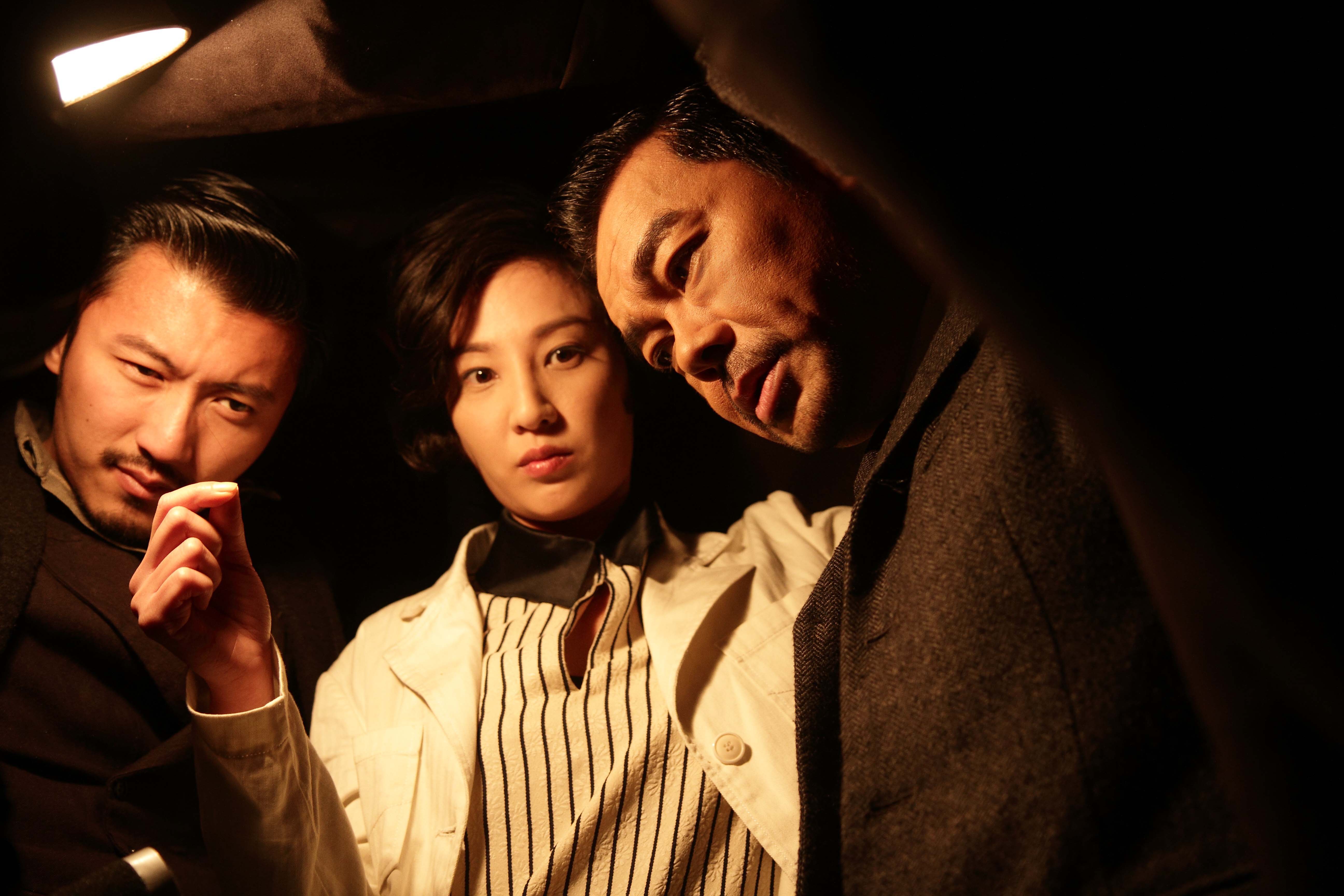
Contemplating evidence, The Bullet Vanishes
Director Lo Chi-leung keeps the twisty plot moving along pretty briskly, as the storyline doubles back on itself to reveal more and more complexity, but the narrative manages to remain pretty clear despite the excessive mendacity of the various characters. Lau carries the movie with his sad beagle eyes and off-kilter physicality, while Nic Tse underplays a bit too much. Jing Boran is cute and winsome as the new kid on the block, and various villians snarl and twich appropriately.
The movie also includes an unlikely female doctor character who is anachronistic but fun and who is a good counterbalance to Mini Yang Mi’s insipid fortune-teller/love interest. Yang Mi is not very scintillating and the romantic subplot/detour is annoying and unconvincing. She’s a performer who continues to not impress me (though I haven’t yet seen Painted Skin 2 so I’ll cut her some slack).
The Bullet Vanishes isn’t the deepest movie in the world but all the money seems to be up on the screen and everything hangs together fairly well. All in all there are much worse ways to spend a couple hours than watching Lau Ching-Wan do his thing on screen in an expensive commercial production. If this is a result of the current Chinese film industry boom, then I’m all for it.
Opens Fri. Aug. 31
101 Fourth St. San Francisco, CA 94103
AMC Cupertino 16
10123 N. Wolfe Road, Cupertino, CA 95014
Teenage kicks: Battle Royale and Girlfriend Boyfriend film reviews

Don’t make me, Battle Royale, 2001
Two very different movies about adolescent angst are now playing in the Bay Area. Kinji Fukasaku’s legendary Battle Royale (2001) has its long-delayed U.S. theatrical premiere at the San Francisco Film Society and the Taiwanese flick Girlfriend Boyfriend is rolling out in selected theaters around the country, including here in San Francisco.
My older kid was born around the time Battle Royale was first came out so I missed it back in 2001—this is the first time I’ve seen Fukasaku’s brilliant and infamous swan song. Aside from scattered festival and one-night screenings BR’s never had a theatrical release in the U.S. until now, but with the popularity of The Hunger Games (much inferior, by the way), it’s now getting a limited release. After more than a decade, Battle Royale doesn’t disappoint—it’s everything it’s cracked up to be and more. The concept may be sensationalist (a game where 15-year-old kids fight to the death) but the movie itself is much more than exploitation. This is economical storytelling at its best.
Director Fukusaku draws out great performances from his teenage cast, quickly and effectively sketching out their complicated relationships in a few rapid strokes. The fact that the students aren’t strangers but classmates with prior emotional relationships only adds to the frisson, and their adolescent dilemmas—who’s crushing on who, which girls are the top clique, how the popular and the excluded kids get on—are magnified to a fatal pitch by the movie’s premise. Most of us can totally relate to the situation, which adds another layer to the vicarious experience—who among us didn’t fantasize about taking an Uzi to a particular mean girl or mindless bully?

Emotional frisson, Battle Royale, 2001
Fukasaku is masterful in executing (sorry) each vignette and the pacing and plot are spot on. The scene where the five happy schoolgirls suddenly turn their machine-guns on each other is amazing moviemaking at its best, particularly since it’s perfectly set up. The story arc of cold-hearted beyotch Mitsuko is also particularly brilliant as her backstory slowly reveals a much deeper motivation than plain self-interest or villainy. Not just simple exploitation, this is smart, smart stuff.
Although there have been a ton of extreme movies since its first release that go far beyond BR’s violence, Battle Royale’s slaughter always has an impact because the characters are more than simple cannon fodder. What Park Chan-Wook understands and Takashi Miike still doesn’t get is that an audience’s attachment to a character heightens the effect of the gore. Which is why the fact that the plight of (mostly) unwilling killers in BR has such a great effect—their backstories add meaning and that meaning adds a punch that goes beyond the visceral to the emotional.

Three in one, Girlfriend Boyfriend, 2012
Youthful angst takes a totally different turn in Girlfriend Boyfriend (GF BF), China Lion’s latest China/U.S. day-and-date release. GF BF is a slick drama with an unusual love triangle about Taiwanese youth coming of age in the last couple decades of the 20th century. The movie is nicely restrained and avoids veering toward excess even when the narrative steers over melodramatic waters.
The opening sequence, a present-day boxer rebellion of sorts at a Taiwanese girls school, frames the main story, which takes place mostly in 1980s & 90s Taiwan. Mabel (Guey Lun-Mei ), Aaron (Rhydian Vaughn), and Liam (Joseph Chang) are best friends in high school during the waning days of KMT martial law. The movie follows them as they come of age during the Wild Lily student movement of the early 90s and through their lives as young adults. The film touches lightly on youth uprisings of the 1990s but those events are really only a backdrop to the love story and mostly serve as a metaphor for the youthful rebellion of the protagonists.
All three leads are quite good—Joseph Chang resembles a young Simon Yam (i.e., ridiculously good-looking) and is effective as the conflicted Liam. Guey Lun-Mei has been one of my favorite young actors lately and she holds her own as the pivot of the triangle. British-Taiwanese actor Rhydian Vaughn, last seen rocking a mullet as one of the gangsta boys in the ‘hood in Monga, is charming and goofy with his million-dollar smile.

Joseph Chang and Rhydian Vaugh, pretty boys, Girlfriend Boyfriend, 2012
The movie makes some interesting points about sexuality, although the story arc of one of the main characters grappling with his desire is a bit mopey for my tastes. His angsty. quasi-closeted behavior, however, is offset by the out-and-proud queerness of one of the supporting characters.
As noted by my buddy Anita, the movie was shot on film (though digitally projected) and the cinematography is aces, with some gorgeous, incandescent shots. The look of the film transmutes smoothly from the dull green utilitarianism of the 1980s Taiwanese high school to the glowing sheen of millennial Taipei. The three leads age convincingly, with the aid of various wigs and hairstyles, with Guey in particular conveying the brashness of late teenhood through a more sober early adulthood.
Shot By Both Sides: Chen Kaige’s Sacrifice

The baby in question, Sacrifice, Chen Kaige, 2011
Sacrifice, Chen Kaige’s new movie, is now playing in San Francisco and while it’s a quality production, it seems a little dated, as well as being not quite up to the standard of past Chen flicks. But since Chen directed the epic masterpiece Farewell, My Concubine (1993), the bar for his films is pretty high. Sacrifice is certainly at least as worthwhile a watch as, say, Abraham Lincoln: Vampire Hunter, and most likely less insulting to your intelligence.But Sacrifice feels like a relic, caught between the old-timey expectations of international arthouse audiences and the contemporary realities of today’s Chinese film market.
My first encounter with Chen came back in the 80s when I saw Yellow Earth in New York City’s Chinatown. Chen, along with his fellow 5th generationist Zhang Yimou (who was also Yellow Earth’s cinematographer), had just busted out internationally and Yellow Earth was a huge departure from the social-realism of the Mao era. Beautiful and visually lush, with a cogent critique of China’s political and social climate, the movie was a worldwide arthouse hit and set the tone for Chinese films of the time. Chen went on to even more acclaim with Farewell, My Concubine, which famously combined Beijing Opera, 20th century Chinese history, and the divine histrionics of the immortal Leslie Cheung.
Since then Chen has directed a slew of films, though none as popular or critically beloved as FMC. Sacrifice follows in the footsteps of Chen’s most renowned flicks, but perhaps due to this it feels staid and outdated. It’s also to Chen’s disadvantage that his reputation precedes him as the director of the masterly FMC, since his films will be inevitably compared to that classic for the rest of his career.
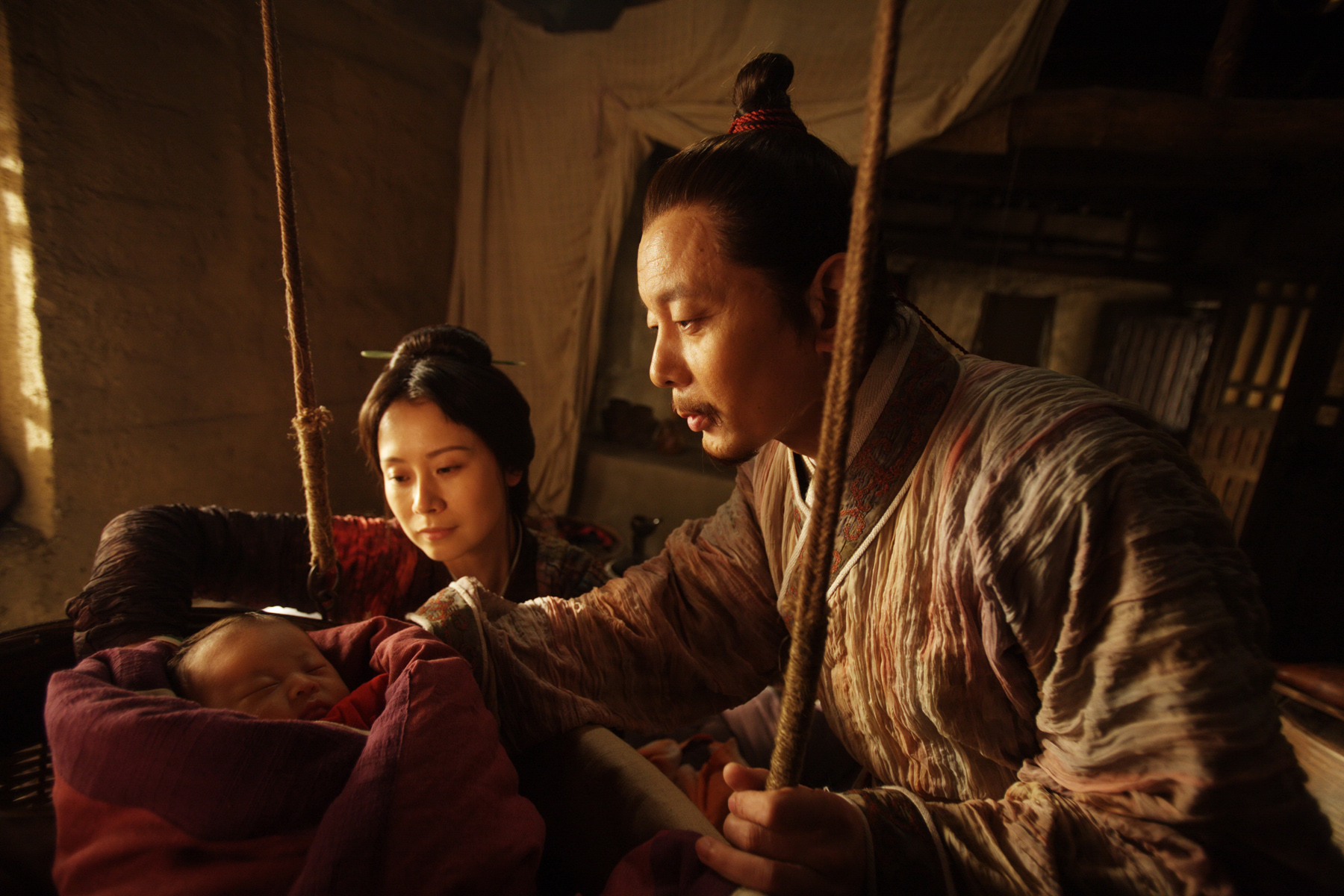
Identity theft, Sacrifice, Chen Kaige, 2011
Sacrifice is based on The Orphan of Zhao, the earliest Chinese play to be staged in Europe, and its storyline is an intricate hash of intrigue and revenge in feudal China. Set during the runup to the Warring States period, the movie follows Cheng Ying, a doctor who is caught up in court machinations. Ruthless warlord General Tu’an mercilessly slaughters his rival, General Zhao, and all 300 of Zhao’s close relatives save one, an infant son born during the chaos of the purge. Due to various byzantine plot twists, identity swaps, and other confusion, Cheng raises the surviving Zhao baby undetected in Tu’an’s court.
The first half of the movie gallops along pretty well, with court intrigue and carnage keeping things running at a brisk pace. But the film’s middle section is awfully slow and the film bogs down considerably at this point. By the end of the movie the pace picks up again, but it’s a long slog through the talky exposition in the middle section. Wang Xuiqi (who starred in Yellow Earth back in 1984) is awesome as the badass Tu’an and Ge You is also outstanding as Cheng, the doctor ground up in the court’s political gears. The secondary characters, however, are less interesting—pretty boy Huang Xiaoming (here with a decorative facial scar) is extraneous and a bit ridiculous and Fan Bing Bing adds another flower vase role to her resume. The final fight scene has some emotional heft since the characters’ relationship is well-established prior. Not so for the significant deaths earlier in the film, since those characters and their relationships are ciphers.

Wang Xiuqi, top dog, Sacrifice, Chen Kaige, 2011
The costumes, art direction, and cinematography are top-notch, but throughout the film Chen makes some janky directing and editing decisions. The identity reveal of a key character is pretty botched, and Chen somewhat clumsily employs flashbacks, dissolves, and intercutting, as well as a repeated fade-to-black motif that’s more distracting than insightful.
Sacrifice is not a bad film per se but it seems a bit old-fashioned given the current state of Chinese cinema. Here in the U.S. audiences seem to think that Chinese movies are all about ponderous costumed historical allegories like Sacrifice, but in China itself the scene is pretty different, with this year’s most popular Chinese-language films to date being Wu Er-Shan’s big-budget fantasy Painted Skin 2, the WWII action comedy Guns N’ Roses, and Mission Incredible: Adventures On The Dragon’s Trail, an animated movie about a goat.
Personally, I’m much more intrigued with Caught In The Web, Chen’s latest film now playing in Asia, that looks at China’s exploding online culture, but it probably won’t see the light of day here in the U.S. for months, if at all. One of Chen’s few modern-day movies, Caught In The Web feels timely and of-the-moment and is probably way too contemporary and edgy for the staid international arthouse demographic that follows Chen. There’s nothing inherently wrong with Sacrifice, and it’s the kind of stately historical Chinese costume drama that U.S. distributors love, but its aesthetic feels as stuffy as a Merchant-Ivory melodrama in the age of Cloverfield.
UPDATE: Looks like Caught In The Web will be playing at this year’s Toronto International Film Festival, which is great news. Here’s hoping it leads to more Stateside screenings—are you listening, SFIFF?

 beyondasiaphilia
Recent Comments