Don’t Take Your Guns To Town: Drug War film review

Breaking glass, Drug War, 2012
A new Johnnie To joint in U.S. movie theaters is an event to be celebrated and this month sees the stateside release of Drug War, To’s latest crime film. The prolific Hong Kong filmmaker has directed more than fifty movies since the 1980s and in the past ten or twelve years or so he’s become an international film festival darling, but only about a dozen of his movies have seen theatrical releases in the U.S. (the last being Vengeance in 2009). Drug War is his first crime film set in mainland China (his first ever was last year’s rom-com Romancing In Thin Air) and while it may look and feel very different from his earlier Hong Kong-based classics, in its subtle challenges to the status quo in the Chinese film industry Drug War demonstrates that To and his Milkyway Image production house are still creatively shaking things up.
The plot involves Timmy Choi (Louis Koo), a Hong Kong drug manufacturer working in China who is summarily busted in the film’s opening sequence. In order to save his skin and escape the death penalty under China’s draconian anti-drug laws, Choi agrees to aid a crew of mainland cops, lead by Zhang Lei (Sun Honglei), in organizing a sting against his compatriots. The film then follows the uneasy alliance of Choi and Zhang as they trace Choi’s fellow drug-runners up the supply chain.

Messy Louis, Drug War, 2012
Drug War is in some ways a much more a standard policier than your usual To movie. Soi Cheang (Motorway; Accident) is credited as a second unit director and might have had a hand in shaping the look of the film, but the change in milieu from To’s usual Hong Kong stomping grounds to mainland China might also account for the difference in the film’s visual texture. The movie is shot in a predominantly blue palette with mostly natural lighting that feels more Ringo Lam-like than Milkywayesque. To also uses the wide-open, smoggy spaces of industrial China and its endless six-lane highways and anonymous cities as metaphors for the blurry ethical and moral road his characters travel down.
Nowhere to be found is the surreal high-gloss sheen of To’s earlier Hong Kong-based crime films such as Exiled, Election, or PTU, which were gorgeous visual paeans to the beauty and decadence of the former Crown Colony’s criminal societies. The grit coating the economy cars and paneled trucks cruising along Drug War’s Chinese roadways contrast starkly with the glossy sleekness of the luxury vehicles speeding down the roads of nocturnal Hong Kong in Milkyway classics like The Mission. Even the perpetually glamorous and handsome Louis Koo is scuffed up, his famously tanned, square-jawed visage occluded by scabs, burns, and an unsightly white bandage across the bridge of his elegant nose.
The film also displays little of To’s previous quirkiness, possibly reflecting the reduced influence of long-time collaborator Wai Ka-Fei or the recent death of longtime Milkyway screenwriter Kam-Yeun Szeto. Although there’s some submerged humor in the spectacle of a couple coke-addled flunkies driving endlessly through the vast Chinese landscape, as well as in the inclusion of a pair of deaf-mute brothers who man a drug manufacturing plant, for the most part the movie plays it pretty straight.

Sun and gun, Drug War, 2012
There’s also much less action than in To’s previous work, but when the guns do come out the excellent shootouts demonstrate To’s easy mastery of the action genre. This is especially notable in a brief yet effective gun-battle inside a drug manufacturing plant that escalates from handguns to rifles to explosives with military precision. The film’s climactic showdown recalls the ending of Expect The Unexpected (1998), nominally directed by Patrick Yau but most likely ghost-directed by To, in which a shootout leads to bloody and indeed unexpected results.
Sun Honglei shows some range as the stoic Mainland cop who once undercover transforms into a jovial drug dealer, but in contrast to the naturalistic tone of most of the movie his performance skates dangerously close to hamminess. Louis Koo is somewhat wooden as the enigmatic Timmy Choi but this is possibly appropriate, since he’s portraying a man with a lot to hide. When Choi mourns his recently deceased wife, however, Koo’s performance lacks the pathos and depth of emotion that a more skilled thespian such as Francis Ng or Lau Ching Wan might have brought to the scene. Interestingly, the most engaging supporting characters are the seven Hong Kong character actors, including Milkyway stalwarts Lam Suet, Michelle Ye, and Gordon Lam, who make cameo appearances as drug dealers in the second half of the film. This perhaps unconsciously reflects To’s comfort zone in dealing with Hong Kong performers vs. the less familiar mainland actors.

Mirror images, Drug War, 2012
Though Drug War may not be quite as fabulous or fully realized as some of his earlier classics it’s an entirely respectable and watchable product that has a certain grim integrity. The film is one of the first that To’s made while working under SARFT (State Administration of Radio, Film, and Television), China’s infamous censorship board, yet despite the censor’s approval To manages to infuse the film with a complexity of morality not found in many commercial Chinese films. Both cops and criminals are ruthless, amoral, and obsessed, using any means necessary to achieve their respective goals, and all meet similar fates in the end. The most interesting supporting characters are the aforementioned Hong Kong criminals as well as the deaf-mute drug manufacturers who, along with Louis Koo’s Timmy Choi, are the only characters with visible family ties. In contrast, aside from Sun Honglei as Zhang and Crystal Huang as a female detective, the mainland cops blend together in an anonymous blur. Some observers claim that the film is a parable for the fraught state of Hong Kong-China relations and To himself has spoken of the way in which he used the film as an experiment to see how far he could go in transplanting his Hong Kong-style crime movies to the mainland. If To in one of his first mainland productions has managed to sneak in some sociological critique under the noses of censors and push the envelope of acceptability under SARFT regulations then that bodes well for his fortunes in China. In the future it will be interesting to see how he copes with the strictures of working on the mainland and if he can maintain his vision and aesthetic despite SARFT’s watchful eye.
Many thanks to Ross Chen, Kevin Ma, Sanney Leung, Chuck Stephens, and Shelly Kraicer for their imput and assistance in this piece, especially their vital insights into Johnnie To’s clever subversions of SARFT restrictions.
Drug War North America showtimes
Enjoy The Silence: 2013 Silent Film Festival

Workers and Geese, Unite! The House On Trubnaya Square, 1928
It’s July, the fog has swamped the city, and the Silent Film Festival (SFF) returns this week to San Francisco. Spanning an action-packed four days, the lineup includes classics, gems, and newly restored discoveries from locales around the world including Bali, Japan, Germany, Sweden, Denmark, England, Russia, and the United States. This year’s festival features legendary stars such as Louise Brooks (Prix de Beaute), Greta Garbo (The Joyless Street), Harold Lloyd (Safety Last!) and Douglas Fairbanks (The Half-Breed) and famed directors including G.W. Pabst and Yasujiro Ozu.
In contrast to the high-tone glamor found in the movies above, The House on Trubnaya Square is a sprightly little Soviet comedy that follows the misadventures of a cleaning lady in Moscow. As the cleaning lady rises through the ranks of the workers’ movement, the film satirically exposes the foibles of feudalism, capitalism, and socialism alike. As to be expected from the land of Eisenstein, the movie features great editing, along with excellent camerawork, choreography, and story structure, as well as a cheeky performance by Vera Maretskaya as the cleaning lady swept up in the social movements of the time.
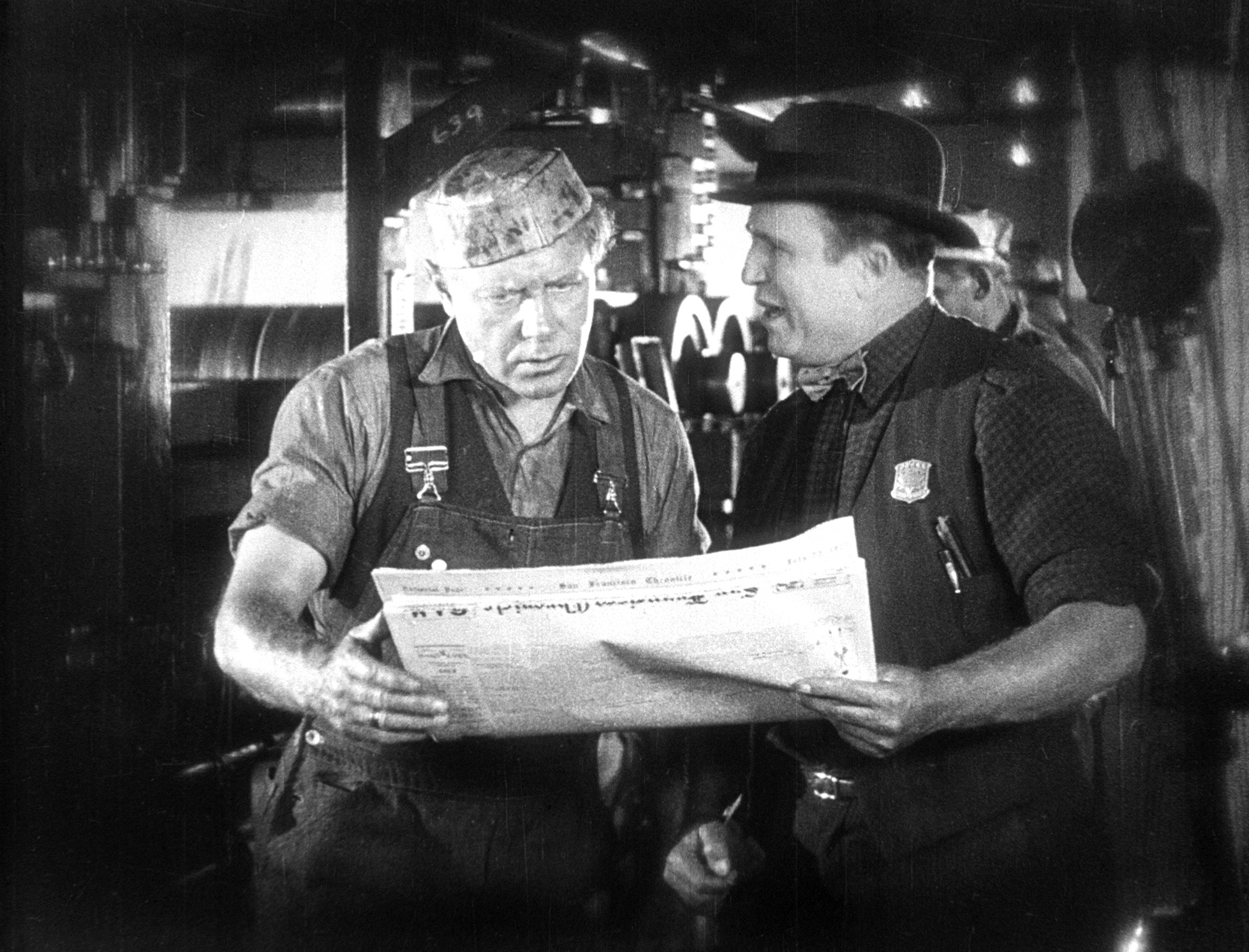
Stop the presses! The Last Edition, 1924
Another notable program is the premiere of the recent restoration of The Last Edition, an entertaining yarn shot in San Francisco in 1924. The movie looks at corruption in the newspaper publishing business, in which an unscrupulous publisher takes advantage of an overly trusting pressman. The populist film sides with the workingman against the corrupt bosses, reflecting the sentiments of the Wobblies and other early 20th-century labor organizations. The movie is especially fun for its local flava, as much of it is shot at the Chronicle Building at 5th and Mission Street and concludes with an exciting chase through the streets of San Francisco, passing by recognizable landmarks including the newly rebuilt City Hall. The film also features huge mechanical presses, typesetting trays, switchboards and rotary phones, and other industrial age machinery that will gun the engines of your inner steampunk.

Ouch!, How A Mosquito Operates, 1912
Also part of the festival is a presentation by John Canemaker on well-known newspaper cartoonist Winsor McKay that includes of illustrations from Canemaker’s bio on McKay as well as a screening of several of McKay’s brilliant animated films. Best known for his long-running comic strip Little Nemo, McKay’s animations are masterful, deft, and magical, ranging from the whimsical Little Nemo and Gertie the Dinosaur through the dramatic, realistic Sinking of the Lusitania. My personal favorite is How A Mosquito Operates, in which a prodigious bug repeatedly sinks its very sharp stinger into a sleeping man’s nose, its protuberant abdomen swelling with blood after each bite.
The Silent Film Festival is a rare opportunity to see these movies in all their big-screen glory, and it’s markedly more fun than watching DVDs by yourself at home. As per usual, all SFF screenings (at the gloriously appropriate Castro Theater) include live accompaniment.
San Francisco Silent Film Festival
July 18-21, 2013
Castro Theater
429 Castro Street (near the intersection of Castro and Market Street)
San Francisco, CA 94114
415-621-6120, castrotheatre.com
Feelin’ Good: DOMA struck down + Frameline Film Festival 2013
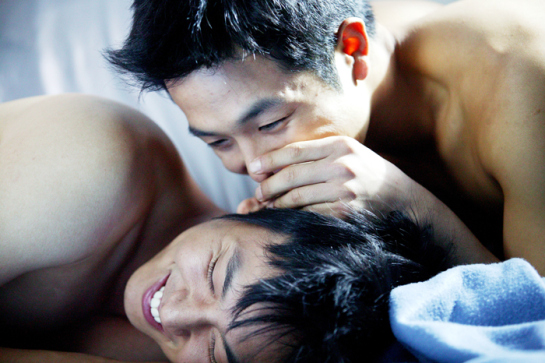
Secrets, Two Weddings and a Funeral, 2012
The week of June 24, 2013 was absolutely monumental in the LGBT community, following the Supreme Court’s landmark decision on the Defense of Marriage Act. After watching Texas State Senator Wendy Davis’ schooling of the Texas GOP on Tuesday night*, I went to bed conscious of the fact that the Supreme Court would announce its ruling on DOMA and Prop 8 on Wednesday morning at 7am PST. I woke up shortly after 7am and immediately checked my facebook and twitter feeds to find the brilliant news that DOMA had been struck down and Prop 8 invalidated. There was nothing but joy all over my newsfeeds as everyone seemed to be celebrating the glad tidings.
That night we had tickets to the Frameline Film Festival at the Castro Theater, the heart of the LGBT community in San Francisco. We arrived an hour before showtime and lucked out on parking not far from the theater, although the streets were closed off and full of ecstatic, celebratory throngs. At one point it took twenty minutes to navigate a half block down Market Street to pick up my tickets, so jam-packed was the crowd, but I didn’t mind the inconvenience. It was fun to be out and about on such a historic night and even the weather in San Francisco cooperated, as it was uncharacteristically balmy and warm until well after sundown.
After basking in the glow of the celebrating crowds in the Castro, it was great to settle in at the 37th annual Frameline Festival of LGBT Cinema. I only caught three out of the dozens of films at the fest this year, but they were interesting in the various ways they reflected current events.
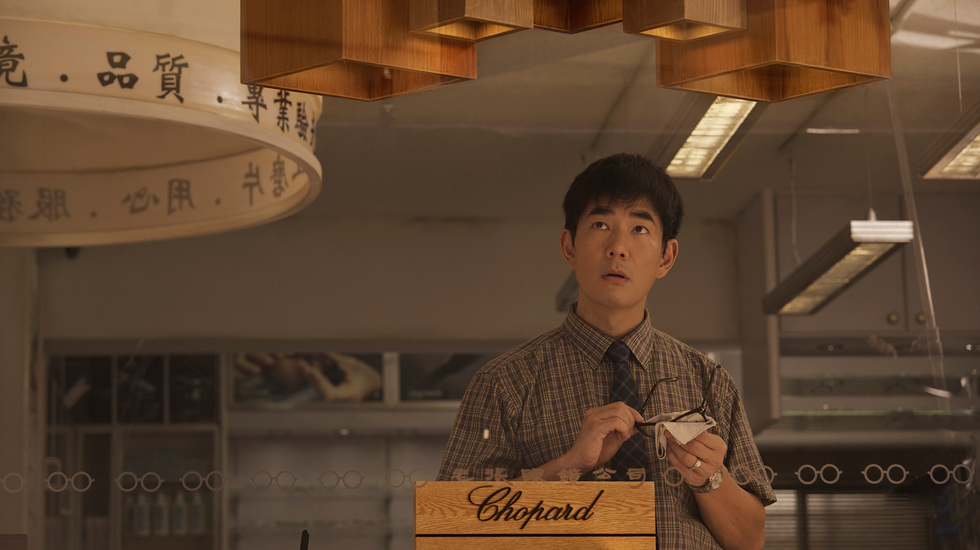
More secrets, Will You Still Love Me Tomorrow, 2012
On that historic Wednesday evening I saw Arvin Chen’s Will You Still Love Me Tomorrow? Chen grew up in the Bay Area but now lives and works in Taiwan. WYSLMT is his second feature, following his well-received debut Au Revoir, Taipei (2010)
Will You Still Love Me Tomorrow? is a charming and bittersweet tale of a man reconsidering his sexuality after nine years of marriage. Weichung (Richie Jen) has a young son on whom he dotes and a good job at an eyeglass store, and he and his wife Feng (Mavis Fan) seem content. But after Weichung’s boss abruptly leaves the steady-but-dull optician’s business to him (after happily declaring the end of his “relationship with glasses”), Weichung begins to question his satisfaction with life. Running into an old friend, the openly and happily gay wedding photographer Stephen, further catalyzes Weichung’s dissatisfaction. After a chance meeting with dreamy flight attendant Thomas, played by Hong Kong heartthrob Wong Ka Lok, Weichung has to make some hard choices about his life as a “former” gay man.
The movie is sexy in a subdued way, with unrequited lust rather than full-on passion supplying most of the erotic heat between Weichung and Thomas. In a role that’s a change of pace from the Johnnie To action films (Exiled; Breaking News; Punished) he’s known for in the West, Richie Jen is very good as the husband on the down-low. Wong Ka-Lok is beautiful and charming as Thomas, Weichung’s lovely temptation, and the rest of the cast is excellent, including glamourous Taiwanese pop star Mavis Fan playing it straight as Feng, Weichung’s earnest wife, with her real-life full-sleeve tats airbrushed in postproduction. Also outstanding is a subplot involving Weichung’s high-maintenance sister who gets cold feet a few weeks before her planned wedding to the nerdy and devoted San San (played with forlorn mopiness by Taiwanese rock star Stone). Chen directs the movie with a deft touch, with likeable characters, believable situations, and a light touch of magical realism, including a spot-on spoof of a weepy Taiwanese drama. The movie is poignant, funny, and enjoyable, with sympathetic characterizations of its many characters.
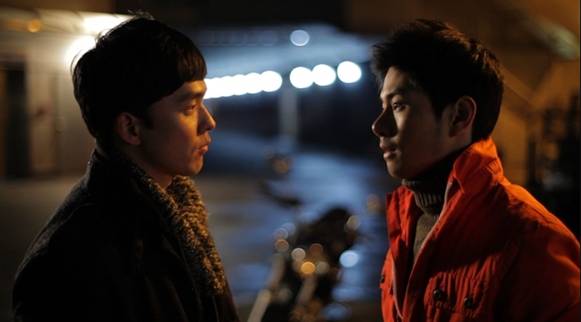
Out and about, White Night, 2012
South Korea’s White Night (2012) is slow, beautiful, and deliberate, a very different kind of movie than Chen’s brisk and buoyant film. Won-gyu (another sexy flight attendant, what?) returns to Seoul after a two-year self-imposed exile following a traumatic event. He hooks up via the interwebs with Tae Jun, a motorcycle courier, and despite their initial antagonism, the two court and spark throughout a long and eventful night on the streets of Seoul. Director Lee Song Hee-Il depicts Seoul at night as a brilliant, glittering, yet somewhat malevolent site, locating his actors on rain-slicked streets and in shadowy, cramped interiors. His actors do a good job maintaining their complex and often conflicted relationship, with Lee I-kyeong as the streetwise Tae Jun in particular showing a lot of swagga and charisma. White Night touches on relevant issues including internalized homophobia and gay bashing and possesses some great sexual heat from the two hunky leads. However, despite the effectiveness of its moody mise-en-scene, the film’s elliptical and somewhat opaque narrative leaves a few too many questions unanswered.

Pretty, White NIght, 2012
Like Will You Still Love Me Tomorrow?, Two Weddings and A Funeral (2012, South Korea) also looks at the plight of a married man living on the down-low. But in comparison to Arvin Chen’s delightful and subtle film, Two Weddings and A Funeral, though heartfelt, is a much less accomplished piece of filmmaking. The film follows a gay man who marries a lesbian co-worker in order to convince his nagging parents of his heterosexuality, with a predictable lack of success. The film includes queeny friends, gay-bashers, tearz, and contrived situations, and is fairly clumsy and overwrought, filled with overacting and unbelievable plot twists, but there are some funny and charming moments sprinkled throughout. The Frameline screening was also marred by digital artifacts in the projection, which were distracting and took the viewer out of the story. The best part of the screening, however, was Jo Gwang-soo Kim, the film’s very sweet director, announcing to cheers from the audience that he and his partner, the film’s producer, were soon to be married. The two left the stage happily holding hands, yet another reminder of the great historical moment that we were inhabiting.
*NOTE: As a prelude to the repeal of DOMA, Tuesday night brought another significant civil rights drama, played out mostly on the internet. I stayed up well past midnight to watch the awesome smackdown of the Texas GOP by State Senator Wendy Davis, as she filibustered in her neon pink running shoes for 11 hours in order to block draconian anti-abortion legislation. After watching the whole thing play out on ustream and twitter (with the cable and broadcast news channels completely ignoring this fine political theater) I went to bed satisfied, as the bill was not passed in the Texas legislature. Asshat Texas governer Rick Perry has since called a special session to try to ram through the rejected bill, but Texans are not letting him slide by so easy this time. Later that week, thousands demonstrated outside of the state capital building in 100 degree weather, keeping a watchful eye on the sneaky Republicans as they try to roll back women’s rights in Texas. More to come as it develops.
Fun and Games: Journey To The West: Conquering The Demons and The Guillotines film reviews

Don’t mess with Sun Wukong, Journey To The West: Conquering The Demons, 2012
I recently had the chance to view two of last year’s top box-office draws from China, both of which are Hong Kong/China co-productions helmed by A-list Hong Kong directors. Both Andrew Lau’s The Guillotines and Stephen Chow Sing-Chi’s Journey To The West: Conquering The Demons are flashy, expensive commercial spectacles, but one shows much more directorial flair and cohesion of vision than the other.
Although it has about as much in common with the classic Chinese text as did A Chinese Odyssey, Stephen Chow Sing-Chi’s last riff on the Monkey King legend (which is to say, not a whole lot), Journey To The West: Conquering The Demons, is still a brilliant film nonetheless. The narrative follows Zhang Wen, a callow and ineffectual demon hunter being chased by a much more competent and coincidentally beautiful demon hunter, Duan, (Shu Qi) who keeps futilely throwing herself at him. As with A Chinese Odyssey, the movie has a philosophical bent hidden under its humor, as Zhang Wen tries to balance between greater and lesser love while struggling to maintain his chastity in the face of earthly temptation (aka Duan).

Don’t mess with Shu Qi, Journey To The West: Conquering The Demons, 2012
Chow Sing-Chi is in top directorial form with this one, mixing up pathos, slapstick, crude humor, and CGI. His singular cinematic vision is in full effect, starting with a long set piece involving a fish demon that takes its cue from Jaws, Super Mario Brothers, and Bong Joon-Ho’s The Host. Stephen Chow’s great gift is his visual virtuosity, his skill with deadpan absurdity, and his ability to draw out great comic performances from his actors. Although some of the CGI animals are a bit cartoonlike, some images are sheer genius, such as the brilliant and beautiful image of a bodhisattva gazing over the curve of the earth from outer space. Shu Qi is also outstanding, by turns fierce, giddy, and charming as the demon hunter smitten by her younger colleague. She and Huang Bo, as one incarnation of the Monkey King, have an outstanding improvisational moment late in the film as Sun Wukong teaches Duan how to dance.
Journey To The West: Conquering The Demons, is essentially a very long backstory to its supposed inspiration about the Monkey King and his travels. The film has become the highest grossing Chinese-language film in China to date, so a sequel is now in the works, hopefully with some acting role for Chow as well (he doesn’t appear in this one). Quite possibly the second film will more closely follow the classic story, though with Stephen Chow that’s never a guarantee.
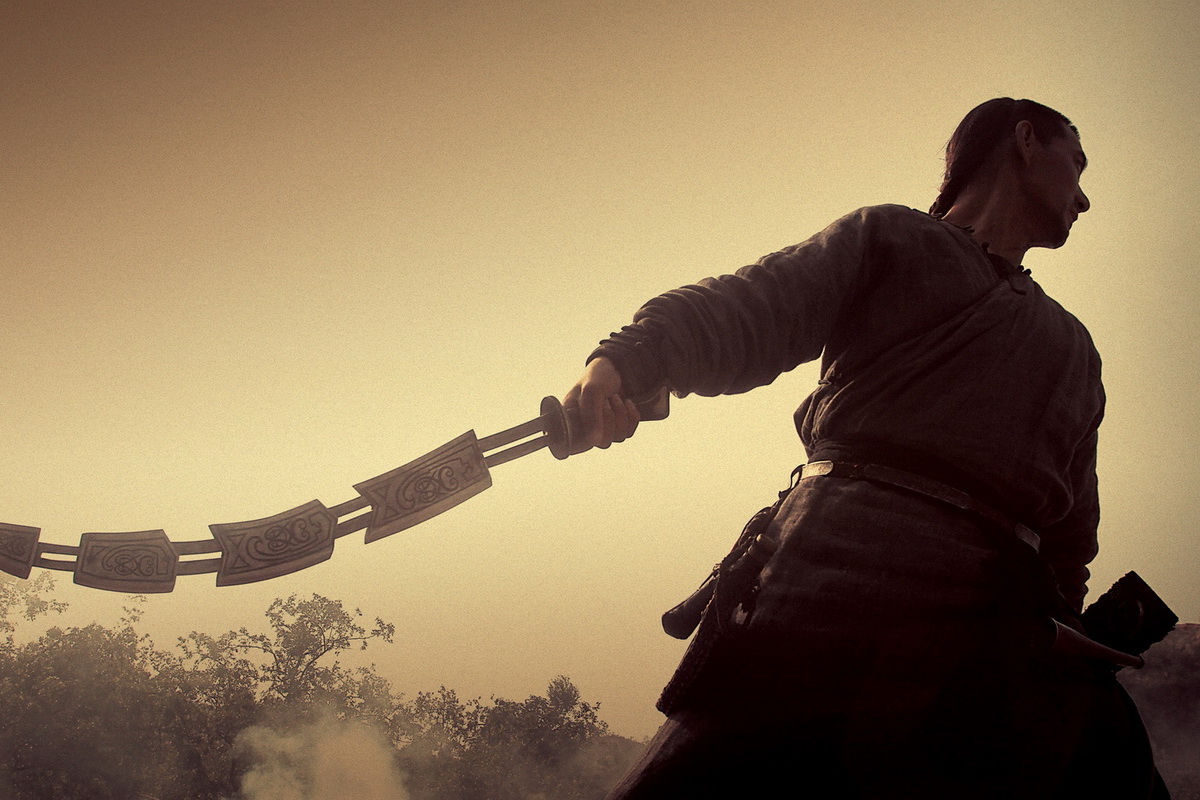
Metal mayhem, The Guillotines, 2012
The Guillotines is another redux of a classic Chinese story, this time remaking Master of the Flying Guillotine, the seminal 1970s kung fu movie that starred Jimmy Wang Yu and the titular spinning metal decapitation machine. While director Andrew Lau (Infernal Affairs) infuses the film with a dusty, gritty feel and some fun fighting sequences, the movie still somehow falls short. The Guillotines follows an elite band of Imperial assassins who find themselves entangled in court politics and who are forced to flee the vengeance of the new regime. Starring 21st century movie idol youngsters including Huang Xiaoming, Ethan Ruan, and Shawn Yue, (who hail from China, Taiwan, and Hong Kong, respectively), The Guillotines was the number one film in China for a couple weeks before rapidly dropping off the box office charts. Despite its roots as an action film the movie is a bit of a downer as, aside from the thrilling opening sequence full of blood and fancy CGI, the assassins don’t actually get to demonstrate much of their prowess with the weapon that is their namesake.
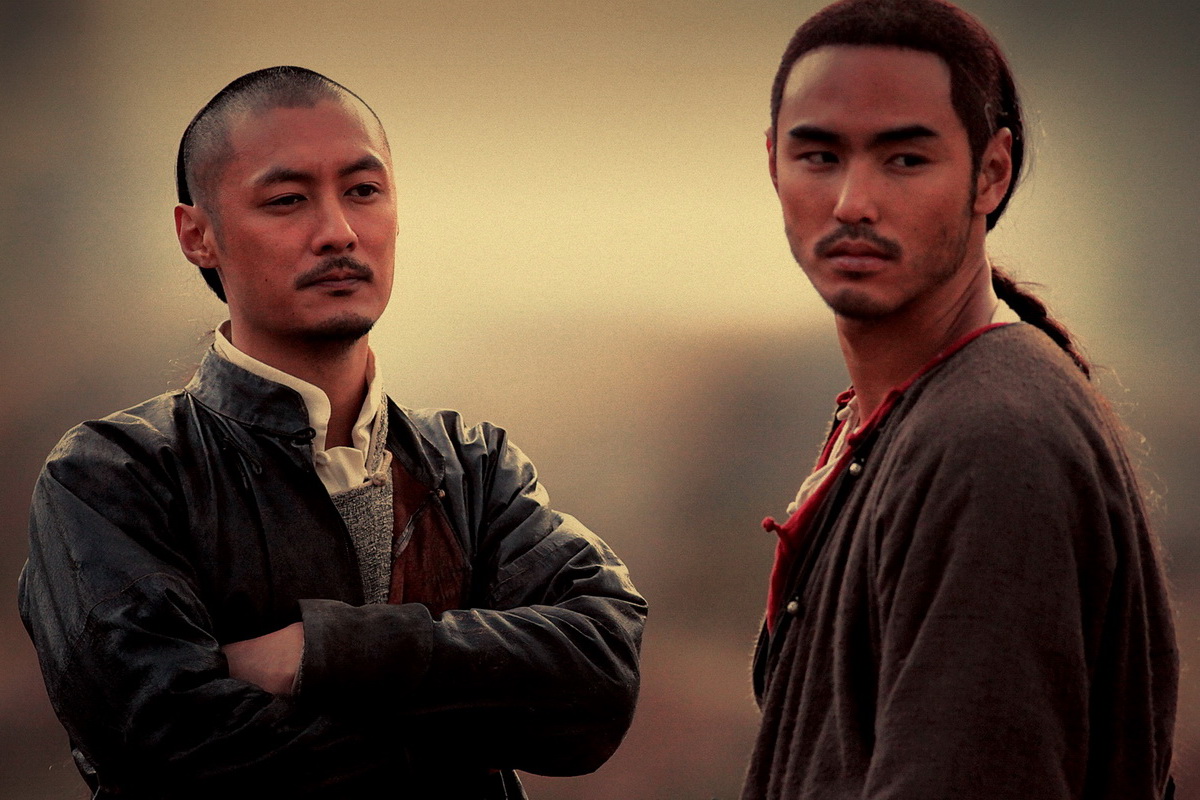
Brotherly love, Shawn Yue and Ethan Ruan, The Guillotines, 2012
Director Lau is an outstanding cinematographer and his camerawork and compositions make great use of light, shadow, and dust, but despite bromances between the various handsome and brooding characters, the film’s tale of betrayal and brotherhood is somehow less compelling than it should be. Continuing to stake his claim as the movie king of the future, Taiwanese popstar and Golden Horse award-winner Ethan Ruan shows some charisma as the Guillotine with a past. The ordinarily dapper Huang Xiaoming, recently seen as the young Chow Yun Fat counterpart in The Last Tycoon, is less effective as the renegade Guillotine, in part due to his ill-advised beard, flowing hair, and sacrificial, Christ-like demeanor. Still, the movie is an enjoyable time-pass and, with Andrew Lau’s high-caliber cinematography and production design, it’s probably pretty stunning to look at on the big screen.
Both films show the continued integration of Hong Kong and China’s commercial film interests. If mainland money means that Stephen Chow keeps making movies, then I’m all for it, since in Journey To The West he seems to have maintained a firm grip on his singular aesthetic. But the flip side of HK/China co-production is good-looking but unsatisfying big-budget movies like The Guillotines. With all of the high-end competition from commercial cinema product from Hollywood, Bollywood, China, or beyond, a movie has to have a more than slick good looks to stand out from the crowd.
Journey To The West: Conquering The Demons
Blu-ray disc now available from yesasia.com
Opens June 14
Blood Embrace: The Hitchcock 9 at the Castro Theater

Careful with that ax, Blackmail, 1929
Summer is nigh, and to whet your appetite for the upcoming Silent Film Festival (July 19-21), the Castro Theater and the SFF are showing the Hitchcock 9, the British Film Institute’s series of nine recently restored silent films by the master of suspense. While some are significant mostly to completists bent on viewing every film in Hitchcock’s oevre, the series also includes classics such as Blackmail and The Lodger, which are required viewing for British film followers, silent movie aficionados, and Hitchcock fanciers alike.

Juxtaposition, Blackmail, 1929
The series opens with the silent version of Blackmail (1929), which Hitchcock simultaneously directed as a talkie. Although Hitchcock had only began his directing career 1923, Blackmail is a fully formed Hitch film complete with transference of guilt, significant objects (knife and glove), expressionistic lighting, and a climactic chase scene at a landmark location, here the British Museum of Art, as well as the first of many Hitchcock cameos that would follow in his career. Demonstrating the director’s growing mastery of the cinematic language, the first half of the film has very few intertitles, as Hitchcock confidently reveals the narrative through evocative compositions and lighting, unusual camera angles, and other filmic devices. Every scene is a gem, utilizing vignetting, mirrors, shadows, and camera movement to underscore plot points or to emphasize a character’s state of mind. At one point, after the heroine has wandered the streets in a dazed fugue, she spies a neon sign that subliminally changes from a cartoon of cocktail shaker to silhouette of a stabbing knife. In another scene, Hitchcock tightly frames three pairs of hands in a pantomimed exchange, followed by a tilt up to the characters’ faces, thus underscoring the trio’s fraught relationship. The film’s climax at the museum includes an iconographic shot of a man descending a rope next to a huge sculptural face, presaging the Mount Rushmore chase scene in North By Northwest. It’s pretty impressive to see the progress in visual and thematic style between earlier films in the BFI series and Blackmail, as Hitchcock demonstrates that he was well on his way to mastering the cinematic form.
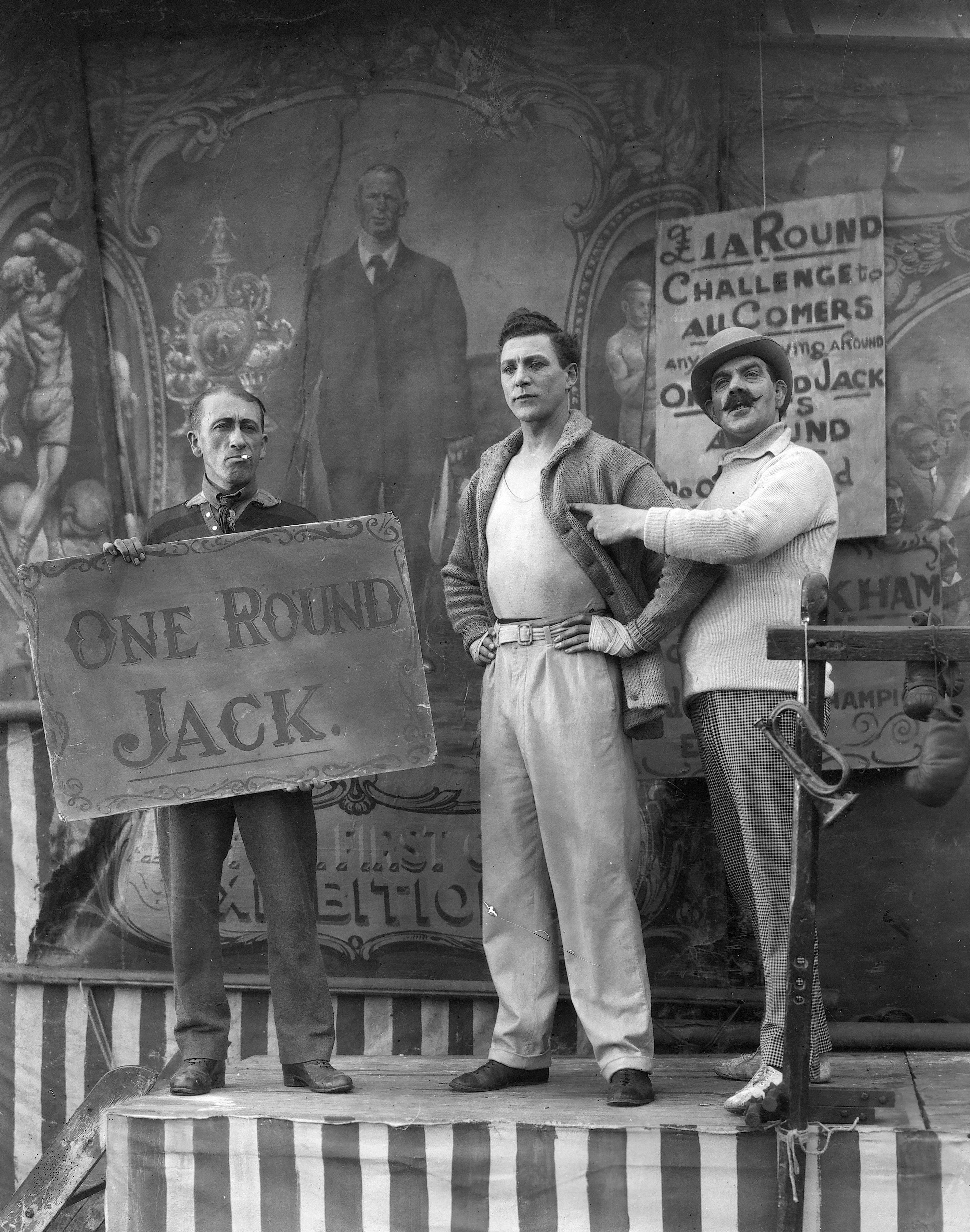
Fussin’ & fightin’, The Ring, 1927
The Ring (1927) includes more early Hitch shenanigans. The story involves a love triangle between two pugilists and a carny girl and the film also includes familiar Hitchcock motifs such as the significant object, here a heart-shaped arm bracelet, plus lots of fun camerawork, double-exposures, and other tricksy manuevers that foreshadow Hitchcock’s later cinematic virtuosity. Set in the world of carnivals and circus people, the milieu recalls Hitchcock’s midcentury classic, Strangers On A Train, with its fascination for the macabre underbelly of the amusement park. Also illustrating a theme that would reappear in Hitchcock’s later work, The Ring explores the all-consuming power of lust, passion, and jealousy as the two rivals pound on each other in the boxing ring, thus externalizing their overwhelming desire for the female object of their affections.
The series also includes more obscure work such as the rom-com Champagne, and the Noel Coward adaptation, Easy Virtue. As is standard for Silent Film Festival presentations, all screenings will include live accompaniment.
June 14-16, 2013
Castro Theater
It Takes Two: 2013 San Francisco International Film Festival & San Francisco Global Vietnamese Film Festival
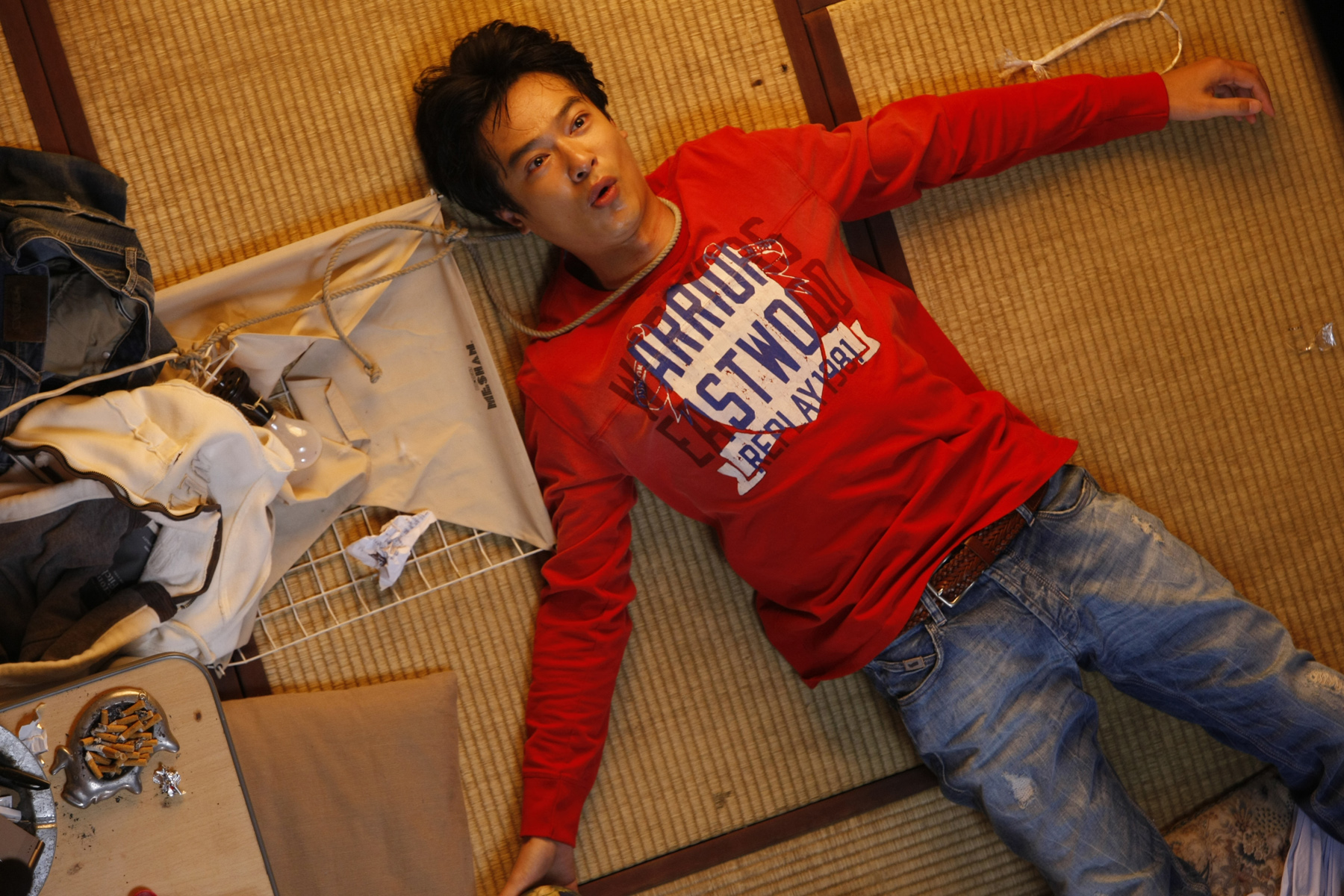
Identity crisis, Key Of Life, 2013
Spring has sprung and two film festivals are popping up this weekend here in the Bay, offering a bunch of Asian and Asian American films to pick from.
The 2013 edition of the San Francisco International Film Festival kicks off this week with a huge menu of movies from all over the planet. And the bienniel San Francisco Global Vietnamese Film Festival offers a more select but equally outstanding bill of fare.
I previewed a couple films that are a good indicator of the range and quality of the offerings this year at the SFIFF. Kenji Uchida’s Key Of Life is a fun and quirky, somewhat absurd comedy that follows a suicidal actor and a hitman who switch lives after the hitman loses his memory and the actor impulsively takes on his identity. Veteran actor Teruyuki Kagawa (Tokyo Sonata) is outstanding as Kondo, the confounded hitman, playing both bewildered amnesiac and serious-as-a-heart-attack assassin with equal conviction. Also fun is Ryoko Hirosue as Kanae, a nerdy girl desperately seeking a man to marry before her terminally ill father dies. Masako Sakai plays Sakurai, the suicidal actor who’s the third of the trio of main characters, as a hopeless slacker, yet one who rises to the occasion when in dire circumstances. Director Uchida, who’s an alumnus of San Francisco State’s Cinema Department, keeps the story briskly moving along and brings a droll touch to the twisty plot, but it’s the small details that really make this movie stand out, such as Kondo gamely donning Sakurai’s slightly too small, very nerdy clothes.
A wholly enjoyable movie to watch, Key Of Life is full of plot switchbacks that keep you guessing throughout, and the resolution of the three main characters’ various dilemmas is sweet, satisfying, and very funny. The movie is all about second chances and making the most of opportunities once life swerves from its expected route, and it’s one of the most pleasurable filmgoing experiences I’ve had in a while.

Globalization and destruction, A River Changes Course, 2013
A very different kind of movie is Kalyanee Mam’s A River Changes Course, which won the World Cinema Documentary Grand Jury Prize at this year’s Sundance Film Festival. Mam’s film is quite beautiful and moving in its examination of the corrosive effects of global capitalism on a rural Cambodia family. In the encroachment of what the farmers call “the companies,” or the multinational corporations that are buying and developing the land, the movie details a vicious cycle of forests cut or burned down, rice failing to grow due to drought, villagers contracting intestinal diseases from contaminated water, and the overfishing of the river, leading to families splitting up and the disruption of traditional ways of life.
No one smiles in this movie. After the farmers fall into debt from taking out loans to buy seed, women are forced to take factory jobs in the city sewing baby clothes for US$60 a month, and sons have to leave home to work for “the Chinese” in distant cassava fields. The film makes an strong statement about the destruction of lives and environments in Cambodia—lamenting the deforestation of the land one woman says, “We are not afraid of wild animals any more, we are afraid of people cutting down the forest.” Yet the movie does so with a delicate touch, never becoming polemical or preachy. Director Mam instead allows the grim faces of the displaced farmers and the tiny gestures of everyday life to tell the tale, as young kids endlessly gut and cut the heads off of dozens of small fish, small girls tote infant sisters to and from the fields, and endless rows of women in red bandannas bend over iron gray sewing machines in a garment factory.
The film doesn’t over-romanticize the hardships of village life, but it points out the difference between the villagers working for themselves versus toiling for “the companies,” and as such is an indictment of the destructive human cost of global capitalism’s implacable march.

Adaptation, Norwegian Wood, 2010
Also this weekend is the San Francisco Global Vietnamese Film Festival at the Roxie Theater in San Francisco. A much more intimate affair than the SFIFF, the festival nonetheless includes outstanding work including Norwegian Wood, Tran Anh Hung’s adaptation of the popular Haruki Murakami novel, Tony Nguyen’s Enforcing The Silence, a documentary exploring the political rifts within the Vietnamese American community, and several short films including Viet Le’s “sexperimental music video” Love Bang!
San Francisco International Film Festival
April 25-May 9, 2013
various venues
tickets and schedule here
San Francisco Global Vietnamese Film Festival
April 26-28, 2013
Roxie Theater
3117 16th Street
San Francisco CA 94110
Kickin’ It With The Boys: Fists of Legend movie review
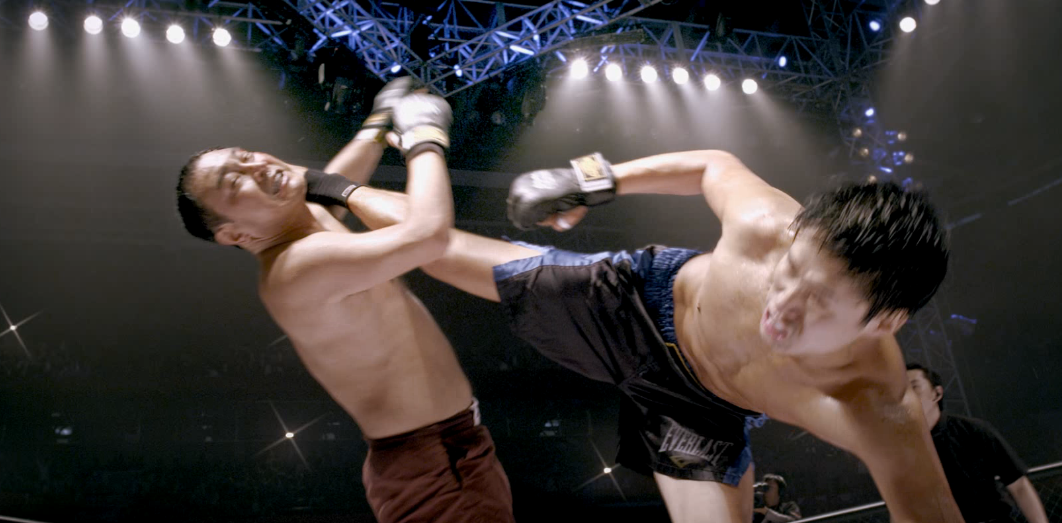
Footwork, Yoon Je-moon, Fists Of Legend, 2013
Although it’s got its share of body slams and bloody fisticuffs, Fists of Legend, (now playing in select multiplexes in the U.S.) is a nice change of pace from the typical extreme South Korean fare that shows up in U.S. movie houses. In contrast to gangland thriller New World or spy flick Berlin Files, the two most recent Korean movies to roll through town, Fists of Legend is a surprisingly gentle and warmhearted piece of filmmaking. Despite its pugilistic trappings, it’s much more than just a fight movie.
The 2.5 hour-plus movie centers around Legendary Fist, a mixed martial arts reality show that pits former teenage streetfighters, now paunchy and in their forties, against trained MMA fighters. Among the middle-aged gladiators is Lim Deok-kyu (Hwang Jung-Min), a former teenage boxer who now owns a noodle shop. His wife died long ago, his angsty teenage daughter is in trouble at school, and his noodle shop is failing, so Deok-kyu signs up for Legendary Fist for the $20,000 prize money and a chance to redeem himself in his daughter’s eyes.

Dad & daughter, Fists Of Legend, 2013
Despite its sometimes gory fistfighting scenes, Fists of Legend is not so much Thunderdome as it is a critique of contemporary South Korean social and cultural mores. The movie alternates between swaggering 1980s high school kids and their modern-day middle-aged incarnations, bouncing through bullying, father-daughter dynamics, media culture, teenage cliques, corporate corruption, and cronyism, among many other topics, in its long, sometimes meandering cinematic journey.
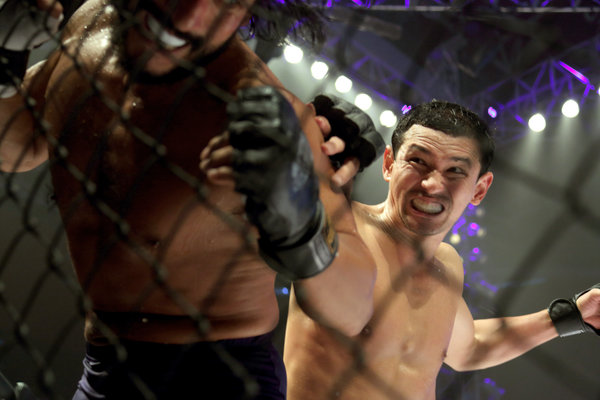
Bam! Hwang Jung-Min, Fists Of Legend, 2013
The sincere and slightly homely Hwang Jung-Min, who was outstanding as the hotheaded loose cannon in New World, is awesome as the noodle shop owner trying let go of the past. Also good is Yoon Je-moon as the corporate toady who learns to stand up for himself. The bad guys are somewhat one-dimensional but the many good guys have a lot of heart and depth. The film is also refreshingly unglamourous in its portrayal of midlife existence, although the fit and trim Hwang does have some pretty cut abs.
All in all the narrative’s bobs and weaves make for a fun and diverting way to spend 154 minutes. It’s not a classic, but it’s good, solid commercial entertainment.
NOTE: The increased number of Korean films gaining theatrical release in the U.S. is part of the resurgent Korean Wave now devouring the U.S. pop culture landscape. Following up his billion-views youtube megahit Gangnam Style, PSY’s latest MV Gentleman has as of this date reached 110 million hits and counting in the three days since its official release. The astoundingly hot Lee Byung-hun is tearing it up shirtless-style in the hit Hollywood actioner GI Joe: Redemption. Kia is apparently the trendy new auto line amongst young groovesters. And Korean Fried Chicken is the ono grind of choice among late-night post-club snackers.
More Than This: Pen-Ek Ratanaruang at Yerba Buena Center for the Arts
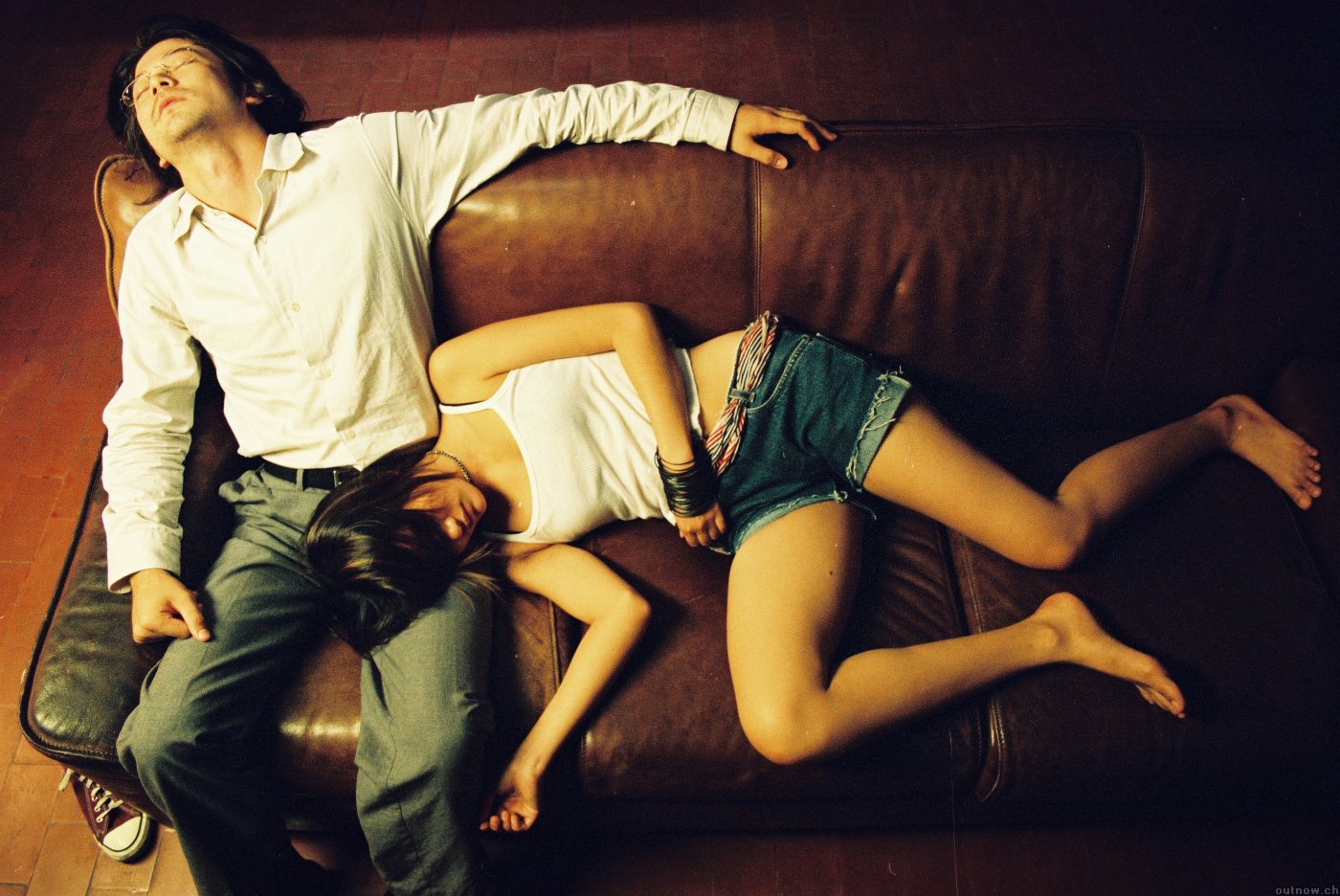
Mythic, Last Life in the Universe, Pen-ek Ratanaruang, 2003
My pal Durian Dave tipped me to an excellent upcoming film series at the Yerba Buena Center for the Arts, Thai Dreams: The Films of Pen–ek Ratanaruang. Though not quite as much the international filmi darling as his countryman Apichatpong Weerasethakul, Ratanaruang has nonetheless garnered critical attention for his unconventional, atmospheric crime films. Six of his movies will be on view at YBCA for a three-week run, with the director in person April 4 at the screening of his latest film, Headshot (2011), and at the April 7 screening of Nymph (2009).

Desultory, Last Life in the Universe, Pen-ek Ratanaruang, 2003
Ratanaruang teamed up with Japanese superstar Tadanobu Asano (Ichi The Killer; Thor) and Australian cinematographer Christopher Doyle (famed for his work with Wong Kar-Wai, among many others) for a pair of films included in the YBCA series. Last Life In The Universe (2003) follows Kenji (Asano), a Japanese librarian living in Thailand whose desultory attempts at suicide are interspersed with his equally desultory meanderings around Bangkok. Due to its overuse in describing Thai films I hesitate to use the word dreamlike, but in this case the term is quite apt. The film’s multilingual dialogue and lovely color scheme, with its burnished greens and browns, Chris Doyle’s gliding camerawork and deep-focus compositions, and the languid narrative pace possess the half-remembered structure of dreams. The film is leavened with an absurdist humor occasionally punctuated by brief bursts of violence, but the real story is the development of Kenji’s relationship with Noi, a woman he meets during one of his suicide attempts. After a tragic accident, the two retire to Noi’s incredibly cluttered and filthy beach house, which starkly contrasts with Kenji’s meticulously kept apartment, and slowly develop a friendship. Here Ratanaruang shows a pleasantly light touch, combining Doyle’s keen eye for color and composition with a delicate narrative sensibility. There is a quite beautiful sequence where Noi’s house cleans itself, with books and papers flying through the air like the toys in Mary Poppins’ nursery, suggesting the mystic quality of Noi’s relationship with Kenji. Sporting a pageboy haircut and glasses, Tadanobu Asano is suitably restrained in his librarian role, with only a few brief glimpses of his full-back tat suggesting a history of violence.

On the lam, Invisible Waves, Pen-ek Ratanaruang, 2007
Ratanaruang’s second film with Asano and Doyle, Invisible Waves (2006), proceeds in a similarly languid fashion. Passive hitman Kyochi (Asano) poisons his girlfriend, who is also the mistress of his mobster boss, then goes on the lam across Southeast Asia, which as shown here is much less exciting than it sounds. Kyochi endures a Kafka-esque boat ride in a janky cruise ship cabin and briefly wanders through Phuket, getting mugged in a fleabag hotel before the boss’s boys catch up with him. Asano’s quiet charisma anchors the film, along with a dark, fatalistic humor and Christopher Doyle’s brilliant compositions. A bit more linear than Last Life, the film nonetheless meanders similarly through its narrative without a huge amount of action. Mysterious blood smears, a cute baby, karaoke-loving hatchet men, and cameos by Hong Kong performers Maria Cordero and Eric Tsang populate the stark scenario.
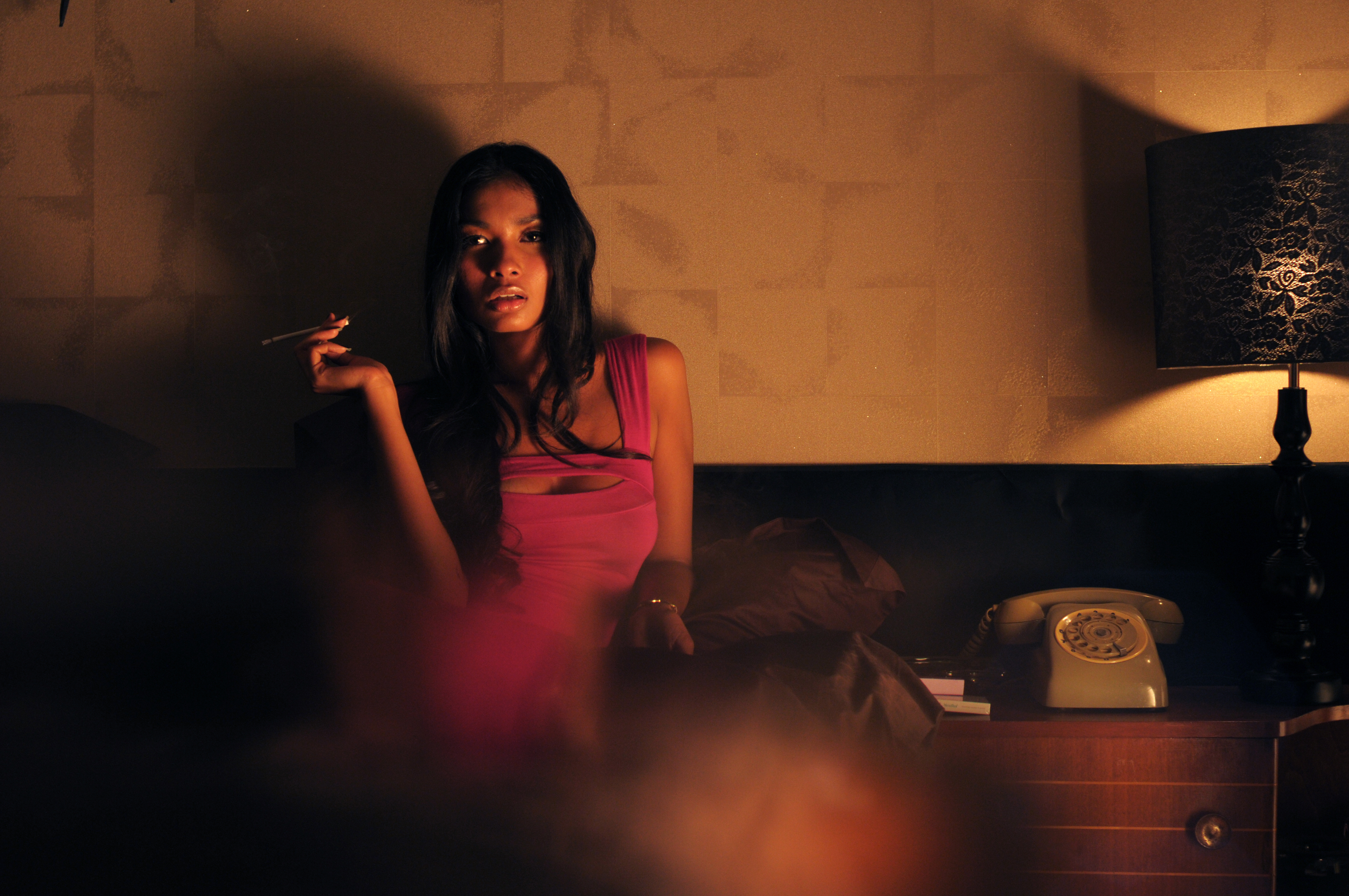
Merit-making, Headshot, Pen-ek Ratanaruang, 2011
Headshot, Ratanaruang’s most recent film, follows Tul, a morose and disillusioned cop who becomes a hitman, mixes it up with various bad guys, falls for prostitute, and becomes a monk, not necessarily in that order. Unversed as I am in Buddhism, the film’s references to that belief system were very opaque to me—perhaps to another less philistine viewer they would have more resonance. Not quite as sublime as Last Life or Invisible Waves, Headshot wavers between violent action and long expository sequences, but the film’s non-linear narrative and Tul’s existential search for a moral higher ground elevates the film above a standard genre exercise.
Also included in the YBCA series are the black comedy 6ixty9ine (1999); Ploy (2007), which looks at love, desire, and betrayal; and Nymph, a surreal stroll through a haunted Thai jungle.
Thai Dreams: The Films of Pen–ek Ratanaruang
Yerba Buena Center for the Arts
April 4-21, 2013
Full schedule and tickets here.
U Got The Look: CAAMfest 2013
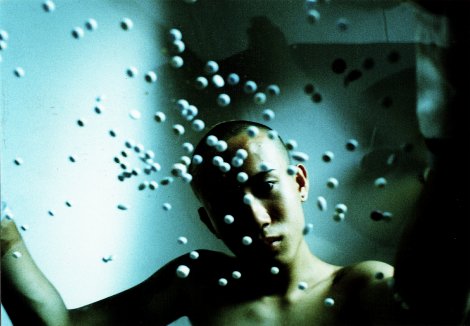
Teen dream, 15, dir. Royston Tan, 2003
Another year, another San Francisco Asian American International Film Festival, except now it’s been rebranded as CAAMfest, which certainly rolls off the tongue more easily than the previous moniker. The festival has added a tagline (film, music, food) that’s a nod to the increased presence of the audio and gustatory arts, but it doesn’t mean that movies are taking a backseat. As per usual there are more than a hundred new Asian and Asian American flicks in this year’s festival—below are a few preview picks.

Jeremy being Jeremy, Linsanity, dir. Evan Jackson Leong, 2013
Linsanity
I don’t need to tell you that this is a great Cinderella story, but filmmaker Evan Jackson Leong has taken the familiar material and shaped a charming and inspiring documentary about everyone’s favorite Asian American underdog. Jeremy Lin turns out to be funny, self-aware, and loquacious and Leong uses his longstanding access to his subject (he started shooting the film when Lin was at Harvard) to great effect. Interviews with Lin’s friends and family members, home videos of the budding basketball prodigy, and great coverage of the actual Linsanity phenomenon makes this a super-fun, captivating movie. The movie also touches on the racism and discrimination faced by Lin, the NBA’s first Asian American superstar, as well as Lin’s devout Christianity, but Lin is such a self-effacing guy and Leong so skillfully handles these elements that they work seamlessly into the whole picture.
Graceland
A solid film noir set in Manila and directed by Filipino American Ron Morales (Santa Mesa, 2008), Graceland looks at the repercussions of the kidnapping of a pair of young girls. Dark and moody, the film questions the morality of its various characters and, like the best noirs, no one is above scrutiny, everyone is guilty, and everyone has something to hide. The cast is lead by a nervous, sweaty performance by Arnold Reyes as the desperate father trying to save his daughter and who has many hard choices to make. The film also indicts the sex trade, corrupt policemen, and shady politicians—this is classic hardboiled stuff and well worth a look.
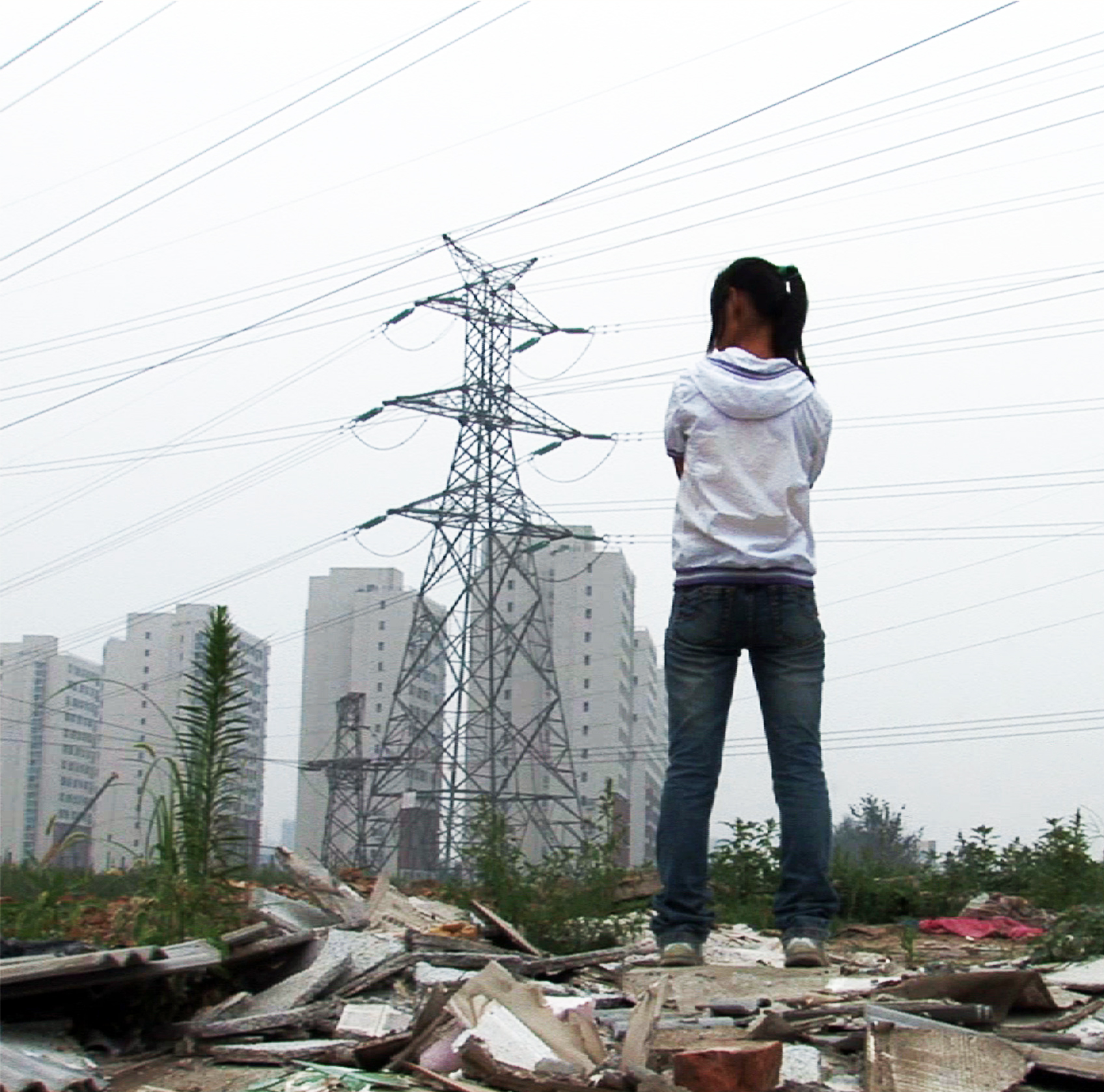
Hard times, When The Bough Breaks, dir. Ji Dan, 2012
When The Bough Breaks
Ji Dan’s verite documentary about a poor Chinese family living in a hovel on the outskirts of Beijing examines the effects of China’s rapidly expanding economy, which has ironically left many in dire economic and social straits. The father is a laborer, the daughters are adolescents trying to find money for themselves and/or their preteen brother to go to a decent school (one “sponsor,” a sick elderly man, offers to fund their education if they’ll sleep with him), and upward mobility is nowhere to be found. As if that wasn’t enough, Dad is a tyrannical drunk who verbally abuses his family at any opportunity, Mom is angry and fed up, and the teenagers are already learning to psychologically torment each other. Plus, the family’s eldest daughter has gone missing for some years after being lured into prostitution by the false promise of a factory job folding cardboard boxes. Overlong, somewhat shapeless, and leaning toward poverty porn, the film is interesting nonetheless due to the tenacity of the two younger daughters who grimly soldier on in the face of a bleak existence.
When Night Falls
Another film set in China, this narrative examines the notorious case of a young man who is driven to commit murder by that country’s oppressive police force. Ai Wei Wei made a documentary about the same case, but this film focuses on travails of the man’s mother as she tries to unravel her son’s unfortunate fate. The movie is composed primarily of long, stationary shots that emphasize the delicate action within the frame, lending a sense of oppression, immediacy, and intimacy to the film.
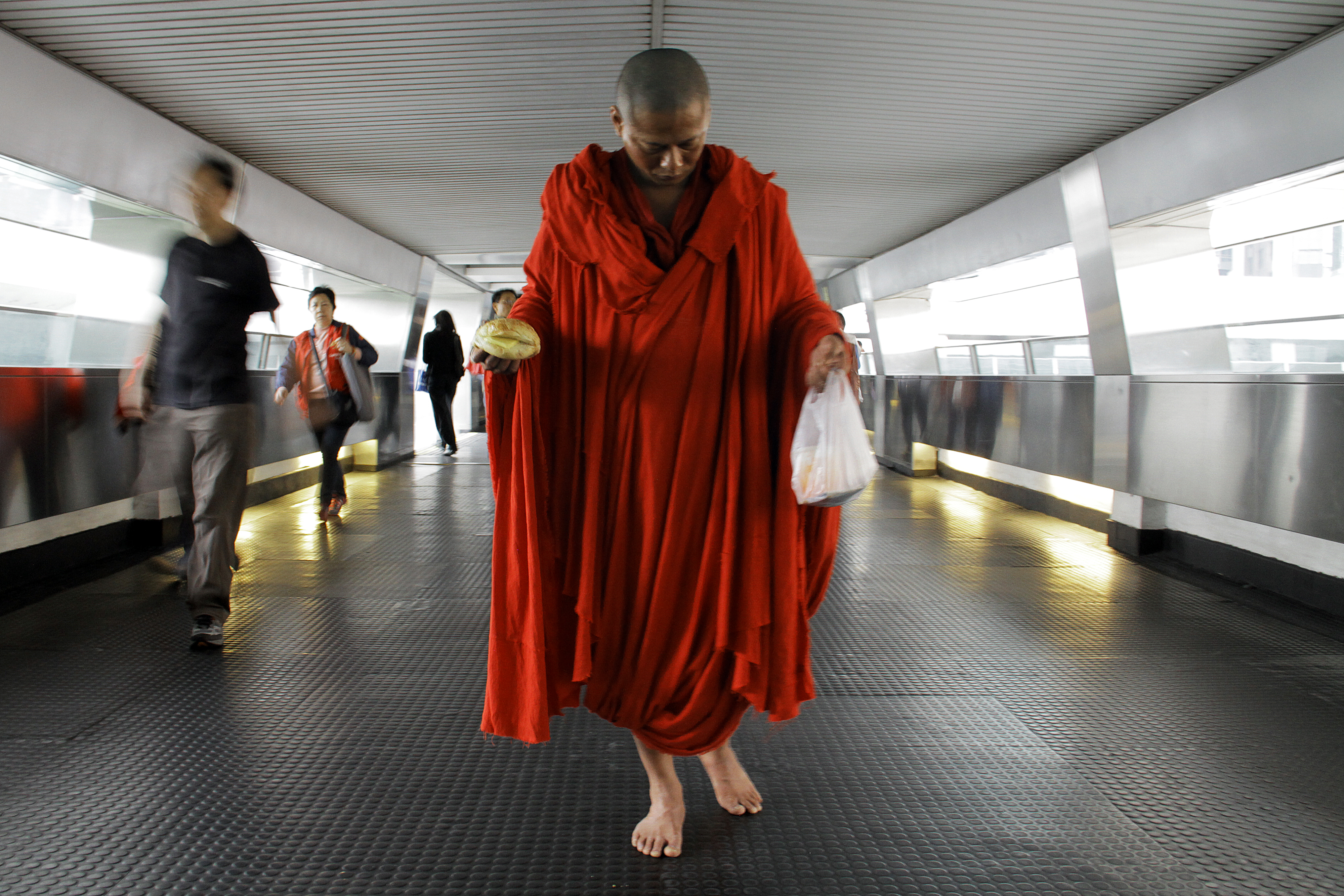
Walker, Beautiful 2012, dir. Tsai Ming-Liang, 2012
Also of note in the fest: Debbie Lum’s sharp and observant documentary, Seeking Asian Female, which is all about white dudes with yellow fever (full review here); The Land of Hope, Sion Sono’s second feature set in the Fukashima tsunami zone (full review here); the omnibus film Beautiful 2012, which includes Hong Kong director Ann Hui’s short narrative My Way, starring Francis Ng as a transgendered woman (!) (full review here), and Apichatpong Weerasethakul’s latest dreamwork, The Mekong Hotel. The festival is also presenting a brief retrospective of director Royston Tan, including Old Romances, his documentary elegy to old-time Singapore, the maniacal musical 881, and his debut feature 15, which looks at teenage angst, Singaporean-style. I’ll be interviewing the director onstage live at the Pacific Film Archive following the screening of 15, so be there!
CAAMfest
March 14-24, 2013
San Francisco and Berkeley, CA
full schedule and ticket information here.
I’ll Be Your Mirror: Rising Dragon and This/That at the San Jose Museum of Art

Manananggoogle, Mail Order Brides, 2013
Just attending the vernissage for a couple of excellent new shows at the San Jose Museum of Art. It was a bit of a drive from my San Francisco homebase but both exhibitions were well worth the gas and time traveled to get there.
Rising Dragon: Contemporary Chinese Photography is a survey of work from Chinese artists that looks at the rapidly changing social, cultural, and political landscape of the world’s most populous nation. As I was just in Southern China last fall I was particularly looking forward to seeing the show, and it didn’t disappoint. Ranging from street photography to portraiture to manipulated digital images, the show is a good cross-section of recent work that includes artists from urban centers such as Beijing, Guangzhou, and Shanghai as well as those from farther-flung provinces like Sichuan and Fujian.

Yao Lu, New Landscape I-V, Clear Cliff Shrouded in Floating Clouds, 2007
Much of the work in the show addresses China’s rapidly changing society, looking at toxic waste, overdevelopment, industrial pollution, westernization, cultural appropriation, and the reclamation of Chinese history and culture amidst the onslaught of modernization. Several of Rising Dragon’s artists deal head-on with China’s environmental degradation and destruction. Yao Lu’s New Landscapes series depicts what at first glance appears to be traditional Chinese landscape paintings, with pastoral scenes of mountains enshrouded by mist and clouds. Upon closer examination, however, these images turn out to be photographs of the massive mounds of garbage covered in green netting that can be found throughout China.
Similarly, Wen Fen’s series Sitting On The Wall documents the impact of China’s accelerated urbanization. Shot in the same location over the course of more than a decade, Wen’s photographed a schoolgirl sitting on a wall overlooking the once-distant Haikou cityscape. As the years pass the skyscrapers become larger and move closer to the girl until the wall is torn down and the nearest building sits right on the edge of the frame.

Liyu + Liubo, Failing to Steal Anything, a Thirteen-year-old girl Sets Fire to Classmate’s Home, 2006
Liyi + Liubo’s photographs take a more whimsical look at China’s social landscape, with their staged tableaux inspired by headlines from China’s infamously sensationalist tabloid newspapers. Self-explanatory titles include Failing to Steal Anything, a Thirteen-year-old girl Sets Fire to Classmate’s Home; Karaoke Hostess Forced To Drink Intoxicant, Now Under Police Investigation; and An Escapee Being Chased Dropped Through The Top Floor of a Building and Scared Everyone.
An unintended irony of the exhibition is the siting of Rising Dragon in Silicon Valley—the high-tech industry has outsourced much of its manufacturing to China, thus possibly contributing to the overly rapid industrialization that has lead to the destruction of China’s environment and the breakdown of its social structures. By addressing these and other aspects of 21st-century China, the show is a good primer on new photography from that country and demonstrates the ongoing vitality and innovation of its art scene.

The MOB invades Silicon Valley, San Jose Museum of Art, 2013
Also on view at the SJMA is New Stories From The Edge of Asia: This/That, a show of Asian American artists organized by SJMA’s senior curator Monica Ramirez-Montagut. Included in this exhibition is a mini-retrospective of work by San Francisco’s own MOB/Mail Order Brides, aka Jenifer Wofford, Eliza O. Barrios, and Reanne Estrada, aka Baby, Neneng, and Imaculata. The MOB were there in person to introduce their newest project, Manananggoogle, that links the world of Silicon Valley women with the manananggal, the Filipino mythological creature that, among other things, eats the hearts of human fetuses. The MOB attempt to reclaim the myth of the manananggal by parallelling its often-misunderstood image with misogynistic stereotypes of female corporate executives. As always, the Brides exploit their singular brand of humor, irony, and cosplay to examine what it means to be pinay.

Landless in Second Life, Tran T. Kim-Trang, 2010
Also notable is Landless In Second Life, Tran T. Kim-Trang’s three-channel video project that utilizes the popular online platform to look at biculturalism and filial piety. In a kind of virtual version of hell bank notes, Tran builds an online dream home for her deceased mother, populating it with avatars from her immediate family and with icons from both the U.S. and Vietnam.
The show also includes an installation of The Heart’s Mouth by Erica Cho, a sleek narrative film about love, gender, and identity, and some of Mike Lai’s continued explorations of his Bruce Lee fetish. This included a performance piece during the opening reception that pitted Aztec dancers against Lai’s oversized Bruce Lee Fists of Fury puppets in a volleyball/dodgeball tournament played out on a floor-sized map of the United States.
All in all the two shows nicely complement each other. Each deals with culture, politics, identity, and race from both sides of the Pacific, with wit, style, and humor.

 beyondasiaphilia
Recent Comments