Posts tagged ‘movies’
De Paisano A Paisano: An Interview with 9500 Liberty’s Eric Byler and Annabel Park

Proofed in Prince William County, 9500 Liberty, 2010, Eric Byler & Annabel Park
I had the chance last week to sit down with Eric Byler and Annabel Park, the directors of the new documentary 9500 Liberty that’s now playing across the country. 9500 Liberty outlines the 2007 battle in Prince William County, Virginia, over legislation that legalized racial profiling of “illegal immigrants” and the ways in which that battle polarized the tight-knit community.
I know Eric Byler as the director of Charlotte Sometimes and Tre, two seminal Asian American feature narratives dealing with angsty interpersonal relationships among several Asian Americans, but lately Eric’s been devoting his time and creativity to producing activist shorts. He and Annabel are the instigators of the youtube channel 9500 Liberty, of which the feature doc now in theaters is an offshoot. Both Eric and Annabel are articulate, committed, and smart as a whip, and they’re very passionate about changing the ways that political discourse is conducted in this country. Given the aggravating and idiotic screeds that pass for political expression these days it’s great to talk with thoughtful and creative people who are looking for alternative solutions to some of the tough issues facing the U.S. today.
Here are some excerpts from the almost-hourlong talk I had with them—the full interview can be heard below.
on the dangers of election season
Eric Byler: What we observed in Prince William County is that, in an election season, information is not as important as ammunition, and so people decide what they believe, say and repeat based on whether it helps their side win, not whether it’s true.
I think what certain insurgency tacticians have learned is that, because their positions are so radical and so far outside the mainstream, the only way they can assert their will is to use these tactics that alienate the average American from the political process and shrink participation down to a level that’s easier to manipulate.
So that’s what happened in Prince William County–they organized around deeply negative emotions. By combining racial antagonism with political partisanship they created an environment where only people who really thrive on conflict and who are comfortable with racial tension were going to those board meetings and were daring to speak on these issues.

Messaging, 9500 Liberty, 2010, Eric Byler and Annabel Park
I think that’s why Annabel and I were so concerned when we saw that become a national political strategy and instead of a blog amplifying the most negative emotions you find an entire news network to amplify not only the most negative emotions but those people they had assembled.
on button-pushing
EB: If you can make the election about some sort of social issue that really pushes emotional buttons–there are too many Mexicans in Arizona is basically the underlying theme of this election—that’s a really polarizing issue. Extreme candidates introduce extreme laws that get extreme reactions that create the kind of political landscape that favors the extreme candidate. So it’s not a surprise. And it always happens a certain number of months before the election because you’re lighting a fuse that’s gonna blow up.
on the use of intimidation tactics
EB: The week before the election (in Prince William County) was the scariest time for us. The racial tension in the county was more palpable than I ever expected to see in this century and I hope I never see again. People would drive by Liberty Wall and throw things at us—people would drive by and yell racial slurs. Those kind of climates are deliberately created for election season. Whether you’re a Democrat or a Republican you can respond really negatively to this kind of politics—we all can be intimidated, we all can be afraid.

Annabel Park in situ, 9500 Liberty, 2010, Eric Byler and Annabel Park
on film and the internets as a means of empowerment
EB: Given that there are people who are going to use as a political strategy organizing around the most negative emotions known to humankind then what we have to do is to populate our democracy with people who are willing to be responsible and fact-based and solutions-oriented. That’s what the Coffee Party and 9500 Liberty both seek to do is enlist those people who might otherwise be intimidated into silence because of these kinds of tactics and show them two examples of people who are prepared to engage even in a political process that’s been mightily toxified and frightfully polarized, because we have that much at stake, and to convince them that they have something at stake.
on hearing the news of the anti-immigrant laws in Arizona
Annabel Park: I got really emotional—I started crying! It was almost like a flashback to northern Virginia 2007. It was traumatic!
EB: It’s just such an unnecessary tragedy—the economic hardship that this kind of policy caused, the social toxification, the damage to public safety, was all so unnecessary, and really the only ones who benefit are very extreme politicians who cater to a really tiny fraction of out population.
on creating a more civil political discourse
AP: Politics is about us making collective decisions, and democracy is a method for making collective decisions–it’s not meant to be a fight with two sides. It’s supposed to be a situation where we thrive on differences and diversity but we need to be able to talk to one another. We have to create opportunities for people to talk to one another. That’s the first step in a democracy, that open dialogue—it has to be civil, there has to be real information exchanged. In a way it’s a very simple thing—asking people to protect and practice democracy, and by using social media, to create not only a communication network but by having this idea go viral—let’s go viral with this idea that we have to participate in democracy, and to give them portals for doing it.
on making a difference
AP: The (9500 Liberty) youtube channel did have impact on the community. We just showed (the movie) in Phoenix and in parts of Arizona and I think we made some progress there. I think there are people who are now ready to have dialogue at least. Just saying “Illegal Is Illegal” is just not really a starting point for dialog. It doesn’t help us formulate policy, it’s just grandstanding—it shuts down conversation.
on optimism and inevitability
EB: I feel very optimistic. 9500 Liberty is a microcosm of what’s happening in Arizona and Arizona is a microcosm of what’s happening across the country. The reason why we’re seeing these insurgency tactics, these desperation tactics coming from the right is that they’re afraid of the changes that really are inevitable. They feel that they’re actually delaying those changes by using these extreme tactics but I believe they’re actually accelerating these changes.
Every year another crop of kids turn 18 and registers to vote and during that same time unfortunately we have to say goodbye to our grandparents and aunts and uncles who grew up during the pre-civil rights era and who aren’t really as comfortable with the 21st century as those of us who are younger. So these kinds of cultural issues where a group of very extreme politicians are asking us to hate another group more than they love our country, are gonna cease to be effective, and that’s really when this will stop, when it can be shown, and maybe it will be in November, that this kind of fear politics is not effective.
on the relationship between love stories and political activism
EB: Both Tre and Charlotte Sometimes are essentially love stories where I made the choice to cast both mixed race and full-blooded Asian Americans. And I didn’t realize it but, because it’s an identity issue and identity is very much something that informs my artistic choices, for me it became a political choice. As Annabel likes to say, politics and identity are essentially the same thing.
Eventually I had to become comfortable talking about politics because I was talking about race and identity, and so the transition isn’t as unexpected or as dramatic as you might expect. Identity issues are at the core of American politics right now.
The short answer is I think I decided that in this era of American history, when so many important decisions are being made that are going to affect the rest of this century, that just making love stories, albeit love stories that do have social and political commentary, was not enough of a contribution—I wanted to do more.
(Now) I feel like I could make a movie about Weimar Germany. I could do one of those futuristic movies about a war. I now know what it feels like when you have politicians laying the groundwork for war and you have agitators essentially systematically dehumanizing a population so they can directly take action against them

Looking illegal, 9500 Liberty, 2010, Eric Byler and Annabel Park
on “looking illegal”
EB: I think that in some ways Asian Americans were given a pass on this issue in a weird way, even though many Asian Americans are undocumented—it’s a culture war directed at Latinos, let’s face it. And so I’m the one that actually looks Latino (laughs), being the halfer–
During that time, everything was about looking around and trying to figure out who looks illegal–the police are now being directed to try to tell who looks illegal, the government is basing policy on who looks illegal and who citizens say are illegal, because they went to the emergency room and saw a lot of Latinos—so they must’ve been illegal! So everything’s about who looks illegal– And y’know, some days I wake up I look more “ethnic” and my hair’s messy or curly or something. When you live in a climate like that you wake up in the morning and you see yourself in the mirror and you say, “Oh my god—I look illegal today!”
on the role of film and participation politics
AP: Being filmmakers doesn’t give us a special status not any more than being elected gives us a special status. We all have to be part of this democratic process or it’s just gonna fail. To me that one thing that’s a given—if people don’t participate it’s not a democracy.
There are enough people who have been silent who now have an opportunity to say, “Y’know what, I don’t want to be silent any more, I’m sick of this, enough is enough, let’s come together as a community, let’s stop being Democrats and Republicans and start being Americans and figure out what we have in common and have some of these tough conversations about our future. How much money are we spending on the military? How long can we sustain these two wars? What does it mean to be an American at this point? What unites us as a people in a meaningful way beyond the fact that we live in the same land mass?
on the dire need for civility and the role of the Coffee Party
AP: We’ve got to leave our ideology aside in order to come together. Otherwise you’re submitting to these forces that are in every society that want divide people and separate and secede and balkanize—that’s always there. If we don’t step up and counter that with the force of unity and peace and harmony then we’re headed for a very, very bleak future.
With the rise of the Tea Party there was this narrative that the Tea Party represented America, and there’s a lot of frustration with the government, but their point of view is not representative of America. To me it’s a marginalized view of minorities who know how to engage in political theater.
What happened with the Coffee Party is that I started this fanpage on facebook that just exploded. We want to find another way of engaging. We have these problems but I don’t want to be out there denouncing the government or Obama.
I want to be out there trying to figure out how to improve the government and to feel like we’re on the right path so that ordinary people are being represented and we’re on the path to not destroy one another but to work together.
So people are sort of just self-organizing—we have local chapters across the country. In the Bay Area there’s a cluster of them that are very active—in LA, too. There are local chapters–they function largely autonomously. We have national campaigns—like we’re having one right now where we ask people to discuss campaign finance and corporate personhood.
We’re trying to give people ways of connecting to the political process that isn’t alienating, isn’t negative, it isn’t about fighting people but it’s about dialogue and bringing people together–and really insisting on civility.
I don’t know how true this is but I’ve heard people say that people in the Tea Party, it’s had an impact on them. They’ve been much more conscious of their tactics and whether or not they’re going to be judged as being uncivil or not. I think I just like having civility become a viral idea.
Are we gonna being screaming at our politicians and at each other, or are we gonna say, “Okay, we need reform–how do we get there? Let’s work together.”
9500 Liberty (81 minutes)
Co-Directed by Eric Byler and Annabel Park
UPDATE: 9500 Liberty will have its cable television premiere this month on MTV Networks. It will show on Sunday, September 26th at 8pm (ET/PT) on MTV2, mtvU (MTV’s 24-hour college network), and Tr3s: MTV, Música y Más (formerly MTV Tr3s) as part of Hispanic Heritage Month. You go, Eric & Annabel!
Here’s the extended trailer for the film:
Here’s the full interview (trt: 52 min.)
Picture This: 2010 San Francisco International Asian American Film Festival

Illuminated curtain, Great Star Theater, A Moment In Time, Ruby Yang, 2010
I’m not sure that the nice Chinese American ladies sitting behind me during the screening of James Hong & Yin-Ju Chen’s Lessons Of The Blood, shown last Tuesday as part of the San Francisco International Asian American Film Festival (SFIAAFF), knew exactly what they had signed up for when the bought their tickets. They had been behind me in line outside of the Sundance Kakuki Cinema, chatting amiably in English and Toi San, and I heard them mention that the film was “about the Nanking massacre” and that it had “won some kind of award in Europe.” As the film progressed and drew the audience deeper into its horrific tale, the ladies began to gasp and groan in dismay since Hong & Jin’s movie is not for the faint of heart and tells its story in chilling detail. Not unlike when I see a particularly brilliant horror flick, I found myself overwhelmed with dread and anxiety by the end of the movie, all the more so since its story is drawn from facts and history.

Germ warfare victim, Lessons Of The Blood, James Hong & Yin-Ju Chen, 2010
The film outlines the infamous series of war crimes commonly known as ‘the rape of Nanking,” but as told by Hong & Chen it’s quite a bit more. Unflinchingly graphic in its description of the various atrocities committed by the Japanese military in Nanjing during World War II, it also included several stomach-turning closeups of festering wounds found on the now-elderly survivors of the germ warfare unleashed by the Japanese Imperial Army in the 1940s. Lessons Of The Blood, however, is more than sensationalized propaganda or simple polemics. It’s also an impressively crafted film, using found footage from propaganda films, newsreels, Hollywood movies, television news, and other filmic detritus, as well as a disturbing and ominous soundtrack, coupled with modern-day interviews with Chinese wartime survivors (who willingly reveal their various scars and disfigurations). The result is a haunting condemnation of both the historical crimes as well as the modern-day complicity that implicates us all. Needless to say, watching this movie was hella intense.
Lessons Of The Blood was one of the strongest films from this year’s action-packed SFIAAFF. Although once again I spent more time at the parties than watching movies (in part because so many shows sold out), I managed to catch A Moment In Time, Ruby Yang & Lambert Yam’s luminous elegy to San Francisco Chinatown movie houses. The film is a comprehensive look at the ways the Great Star, the World, the Bella Union, and the Mandarin theaters were in days of yore the glue that held together the Chinese community, beginning in the 1920s and continuing until their collective demise in the mid-1990s. I myself had the privilege of seeing several classic Hong Kong films with my buddy Patrick at both the World and the Great Star (including a strange and awesome double bill of the violent shoot’em up Big Bullet and the weepy melodrama Comrades: Almost A Love Story) and I can attest to the downscale utilitarianism of both of those movie houses. But there’s nothing like seeing a Chinese-language film with a roomful of Chinese people who are eating cuttlefish, smoking, and chattering incessantly in Cantonese during the show, and Yang and Lam’s movie captures that sensation exactly. One patron interviewed described his entire family including young children attending 9.30p Saturday night shows for 25 cents total, the kids running up and down the aisles and the parents gossiping and eating chicken wings and melon seeds until all hours.

Cell phone a-go-go, Tehran Without Permission, Sepedeh Farsi, 2008
I also caught a screening of Tehran Without Permission, shot surreptitiously on a cell phone in the months running up to the 2009 presidential election in Iran. Although I was dog-tired from attending my own world premiere and reception for The Oak Park Story earlier that day, Sepedeh Farsi’s verite documentary held my attention throughout its 80-minute run time. Through subtle and succinct vignettes the film captures the mood and attitude of citizens of Tehran, with small details and comments presaging the upheavals that would occur in a few months hence.

Deepika Padukone & Saif Ali Khan, just another impossibly gorgeous Bollywood couple, Love Aaj Kal, 2009
I also made time to see the festival’s annual Bollywood at the Castro movie, Love Aaj Kal, although it was the fourth film of a long day of movie-going. I have a soft spot for this program since it was at last year’s festival that I caught my very first Shah Rukh Khan movie, Rab Ne Bana Di Jodi, which spurred my obsessive love for SRK in particular and for Bollywood movies in general. Love Aaj Kal, alas, does not star Shah Rukh Khan but the hot and charming Saif Ali Khan makes an acceptable substitute. Paired with the doe-eyed and astoundingly pretty Deepika Padukone, Saif plays dual roles as a modern-day commitment-phobic NRI in Britain and a noble and lovestruck suitor in the 1960s Punjab. The film deftly shuttles back in forth in time between these two stories, drawing parallels and distinctions between the romances from each period. A well-made and satisfying love story with some excellent dance sequences, the film is a great example of high-quality Hindi-language commercial moviemaking—in other words, a fun and rewarding bit of Bollywood entertainment.
I also passed by a rush line full of excited teens waiting for the special appearance of youtube darlings kevjumba, wong fu, nigahiga and timothy delaghetto. The youth were madly texting and tweeting as they waited to see their favorite internet stars in the flesh, but tickets were, alas, impossible to come by since the show had sold out as soon as it was announced. It was nice to see the next generation of SFIAAFF fans out in force, which hopefully augers well for the continued health and well-being of Asian American filmmaking.

Filmmakers Felicia Lowe & the late, great Loni Ding, 2009. photo: Jay Jao
NOTE: This year’s fest was dedicated to the memory of the force of nature known as Loni Ding, the legendary Asian American filmmaker and educator who a few weeks ago died at age 78 from complications from a serious of strokes. Loni was one of the fiercest and most amazing people on the planet and her energy, dedication, and sheer determination guided her filmmaking, which included seminal documentaries like Ancestors In America and The Color of Honor. She always had a kind word and a smile for younger filmmakers like myself and made us feel like we were doing something significant in our work. She was the moral center of the Asian American film community and she will be sorely missed.



Why Can’t We Be Friends? Barry Jenkin’s Medicine For Melancholy
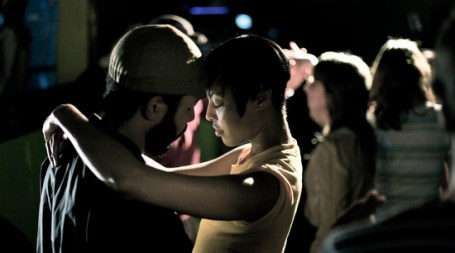
Wyatt Cenac and Tracy Heggens get friendly, Medicine for Melancholy, Barry Jenkins, 2008
I recently caught Barry Jenkin’s debut indie feature, Medicine for Melancholy (2008), and although it’s been a few weeks, this modest little movie has stuck with me. Set in San Francisco, the film begins with a supremely uncomfortable opening sequence as two people wake up together in a bed and a house not their own, although they clearly know each other intimately–at least in the Biblical sense. Apparently the pair had a bit too much to drink at a party the night before and ended up getting busy without first learning each other’s names. They go out to a mostly silent breakfast together and share a taxi to their respective homes, but the female in question is obviously discomfited by their brief encounter and blows off her recent bed partner upon exiting the cab.
This tidy little fifteen minutes sets the tone for the rest of the movie, which is a deft romance that follows a day and a night in the life of these two unlikely partners. They tool around San Francisco, experience some more quality time, and ultimately come to an understanding of each other and their awkward relationship.

Jo & Micah contemplate Afrocentricity, Medicine for Melancholy, Barry Jenkins, 2008
What’s pretty interesting to me about the film is that Micah and Jo, the unlikely couple, are both African American. The movie presents an outstanding alternative to conventional representations of African American life, with no gangstas, mamas, buppies, or thugs. Interwoven with the film’s romantic escapades are some cogent points about African Americans in San Francisco, where the black population has dwindled steadily since the 1960s “urban renewal” (aka “Negro removal”) decimated the Fillmore. San Francisco’s population now has the lowest percentage of African Americans of any major American city.
Although the film frankly discusses racial identity, racism, interraciality and other hot cultural identity topics, it presents these issues in a breezy, lighthearted frame. Both Wyatt Cenac and Tracy Heggens, who play the two leads, are attractive and winsome actors and Jenkins coaxes engaging, low-key performances out of them. Cenac in particular spouts some pretty flagrant identity-politics dialog while managing to remain charming and appealing.
The film also makes excellent use of its San Francisco locations, shooting mainly at night and avoiding the usual touristy exteriors, and the city sparkles like a jewel in the fog. Although they seem almost too groovy and hip to be true (Micah designs aquariums for a living; Jo is an art rep), it’s fun to see them wander from nightclubs (The KnockOut!) to taco trucks to MOAD to Rainbow Grocery on their fixies, smoking pot and sporting Timbuktu bike messenger bags. It seemed very fitting to be watching the film at Craig Baldwin’s Other Cinema, which is housed at Artists Television Access, the longstanding gallery and screening venue in the heart of boholandia in the Mission District. I half-expected Micah and Jo to show up on their bikes and hang out smoking hand-rolled cigarettes with the rest of the audience after the show.
Although some of the plot points are a glossed over or outlandish (why is Jo so quick to step out on her absent boyfriend?) the movie as a whole fulfills its modest expectations. Jenkins stated in the Q&A that, after suffering a failed romance, he wanted to capture the sense of being lonely, African American and male in San Francisco, and the film succeeds in doing so.
The film manages to look at some tough issues of race and culture without becoming didactic, dull, or overwrought. In that way it’s similar to another low-budget indie African American debut film, one that was released more than twenty years before Medicine For Melancholy. Like Spike Lee’s first feature, She’s Gotta Have It, this film uses the romantic lives of its quirky black characters to take on much bigger and broader concerns. Though not quite as brilliant and exhilarating as Spike’s freshman joint, Jenkins’ film does what it sets out to do in an energetic, refreshing way. Here’s hoping Jenkins can maintain his light touch in his future endeavors.

Interraciality, Tall Enough poster, Barry Jenkins, 2009
NOTE: At the same Other Cinema program, Jenkins also screened several of his other projects, including Tall Enough, an intriguing short financed by Bloomingdale’s department store (!) in New York City. The movie looked at an interracial romance between an African American female and an Asian American male. The part where the Chinese American guy speaks in Mandarin to his sleeping lover tilts toward yellow fever, and the film’s title is a little strange (what exactly is tall enough, anyways? are you saying Asian men are, y’know, short somewhere?), but the portrayal is a step towards eradicating Asian male emasculation in media. It’s nice to see an Asian American man as an romantic figure and an object of desire, especially when that idiotic dickwad media ho Jon Gosselin is threatening to set back Asian American male representation 100 years.
For an good discussion by Prometheus Brown, go here.
Medicine For Melancholy is now available on DVD from amazon.com.
Constant Sorrow: Tracing Shadow film review
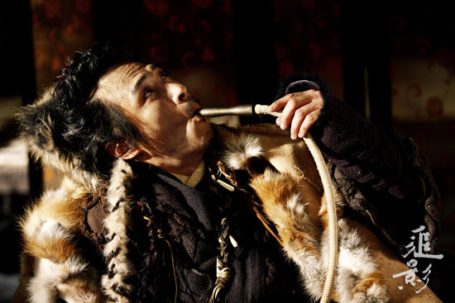
Francis Ng contemplates filmmaking, Tracing Shadow, 2009
Dear Francis,
Just wanted to let you know that I saw your new movie, Tracing Shadow, and I’m sorry to say that I didn’t really like it very much. Although it had some killer martial arts sequences, the art direction was divine, and you yourself looked quite lovely in your braided hair extensions and little mustache, the movie as a whole really stank. Unfortunately, since you’re the director as well as the star of the film, there’s no one else to blame for the slipshod pacing, unimaginative blocking and framing, egregious mugging and overacting (Xie Na being the absolute worst offender on that account), and aggravating, abrupt shifts in tone and mood throughout the movie. You yourself put in a less-than-thrilling performance, which I didn’t think you were capable of doing. And both you and your love interest, Pace Wu, have really nice cheekbones, but there isn’t a whole lot of chemistry between the two of you otherwise.

Pace Wu and bone structure, Tracing Shadow, 2009
Ever since it was announced several months ago I’ve been looking forward to this film, since you’re my favorite actor and your last wuxia movie, The White Dragon, is a great little flick. But somewhere along the way something went terribly wrong. It’s a shame, since the movie has the bones of a much better film. The storyline is classically drawn, with martial-arts masters converging on a village in search of a lost treasure map. But the film’s execution is so off-kilter and confused that it feels bad regional theater. At times it seemed like two or three different pictures competing for screen time—the slapstick comedy, the martial-arts action film, the dramatic mystery—with none given enough time or attention to cohere successfully. I felt myself wishing that you’d stuck to a straight-ahead dramatic treatment of the material, ala the film’s supposed inspiration, King Hu’s classic Dragon Inn, instead of using the story for laughs.
Your past directorial efforts, although flawed, showed flashes of brilliance and promise. But all three of your other movies were small-scale affairs rather than big-budget extravaganzas like Tracing Shadow. 9413 was an intense crime drama that showed a feel for mood and intensity as well as some cinematic chops. What Is A Good Teacher brought out some good, quirky moments from its youthful cast. Dancing Lion had some great improvisational set pieces. But all of those also had top-drawer actors, yourself included, to move things along, whereas the cast of Tracing Shadow–a TV show hostess, a model, and the son of a famous man–is, to put it delicately, pretty weak.

Xie Na and Jaycee Chan mug for the camera, Tracing Shadow, 2009
I’m truly sorry that the film turned out so badly. I really wanted you to achieve your dream of directing a successful movie. I don’t know exactly why things went so wrong–I’m not sure if it was the strain of holding together a big-budget costume picture, the complexity of mixing so many genres, or the pressure of living up to the hype of a high-profile project. I wonder if there was pressure from your financial backers (Huayi Brothers) to make the film as accessible, i.e., lowbrow, as possible, too, or if that decision was yours. At any rate, I hope that you get another chance to direct a film and that you’re more successful next time. This time I’m afraid you lost your way.
Sincerely,
your biggest fan
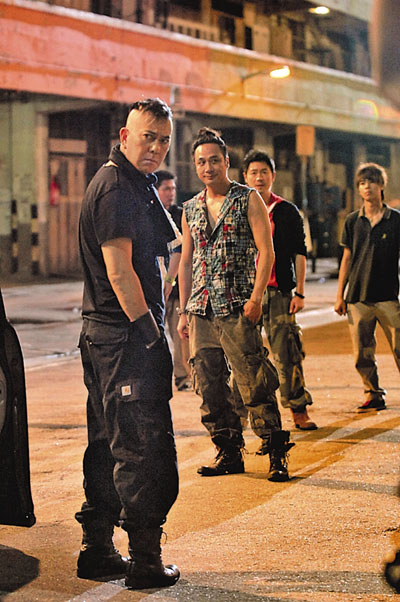
Anthony Wong with Francis Ng in happier times, Laughing Gor: Turning Point, 2009
PS: Congratulations on Laughing Gor: Turning Point—I’ve heard that it’s really good and that it’s doing great box office, too, which hopefully takes some of the sting out of Tracing Shadow’s disappointing ticket sales.
UPDATE: Go here for a much nicer, more positive review of the movie.
One Time, One Night: Fangirl Extra and Shah Rukh Khan, My Name Is Khan
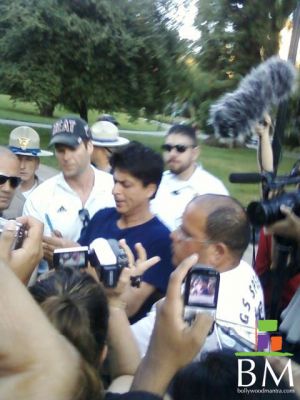
Shah Rukh Khan and friends, My Name Is Khan location, San Francisco, 2009
I’ve known for a while that Shah Rukh Khan’s newest movie, My Name Is Khan (MNIK), would be filming in California this summer and I was amused to think that the King of Bollywood, as well as his equally fabulous co-star, Kajol, would possibly be within a few hundred miles of me sometime this month.
When the movie shoot finally arrived here I realized that, according to various Bollywood fansites, MNIK was not only filming in California but in San Francisco, within miles of my house. Like the good otaku that I am, I tried to track down the production in hopes of possibly seeing SRK up close and in person.
Shah Rukh Khan smoking, Market Street, My Name Is Khan location, San Francisco, 2009
At first I tried to trace SRK’s whereabouts via twitter, but the news was always a little too late—I found out he was at the Palace of Fine Arts a day after the shoot there; he was at Dolores Park on a Friday but I read about it the following Sunday; the movie crew was in the South Bay for a couple days but it was impossible and insane for me to drive two hours in the hopes of crashing a closed set to catch a glimpse of him. Then by chance I ran into an Indian couple at my excellent local video store, Four-Star Video, and chatted with them in front of the store’s newly inaugurated Bollywood section (full disclosure: I helped Ken Shelf, the store’s awesome proprietor, pick out several of the movies therein and wrote the blurbs for him, too). The Indian couple mentioned that they’d just been extras on MNIK and that the production was probably still seeking people for the last couple days of filming. So I raced home and looked up the information about becoming an extra, emailed the casting agency, and within a couple hours had received a call back to work on the very last day of the shoot.
It sounded great at first, but then I found out that the location was in Healdsburg, which is about 1.5 hours north of where I live, and the call time was 6 pm, with shooting to possibly go up to 4 am. Would I be able to keep my eyes open? (I hadn’t pulled an all-nighter in many a year, especially without extreme chemical assistance). Would my kids freak out if I was gone that long? Where the hell would I sleep once the shoot was over?
In a panic I posted on facebook—what to do? As expected nearly everyone who responded urged me to do it, but I was still undecidedly fretting about it the next day. Finally I figured out the logistics (take a nap earlier that day, don’t let the kids know I’d be gone all night, sleep at a friend’s place), but when I called the casting agency back, they’d already filled their quota for extras! Ah, the irony! but they put me on the backup list in case there was a cancellation. I sulked for a few hours, then the casting folks called back and told me I was in.
So at 6 pm the next day, after fighting holiday rush hour traffic up Highway 101, I signed in at the location with 300 other extras and settled down with a book (The Golden Compass) and my iPhone (to live-tweet the whole event) and waited the extra wait. As anyone knows who’s worked as talent on a movie, there’s a whole lot of sitting around interspersed by brief bursts of shooting activity, then more sitting around, repeated ad infinitum. True to form, the extras weren’t bussed to the set until three hours after we’d arrived—by then filming had started and things were jumping.
Kajol texting, My Name Is Khan location, Healdsburg, 2009
Myself and a few other eagle-eyed fans quickly spotted Kajol, MNIK’s beautiful, violet-eyed lead actress, near the edge of the shoot as she hung out shooting the breeze with the natty, baby-faced Karan Johar, the film’s director. I was disappointed to see that Kajol had tweezed her famous unibrow but she looked great nonetheless. Since this was one of the last days of filming there was much back-slapping and souvenir picture-taking amongst the cast and crew. I managed to fire off a couple of surreptitious, fuzzy pictures on my iPhone and post them on twitter before one of Kajol’s handlers asked me to stop.
Back of Kajol, Karan Johar & friend, My Name Is Khan location, Healdsburg, 2009
More waiting around, then we extras, or “background,” in Bollywood parlance, were pressed into action. I was envious of the fancy lighting rig, including a huge, helium-filled china-ball lantern that floated many feet above the crowd, and two twenty-by-thirty foot scrims to diffuse the giant lights that lit the scene. This was a top-notch, high-end production, with a crew of about 200, and as complex and professionally run as any Hollywood set I’ve been on (which, admittedly, have been very few).
After a while filming without any of the principle actors, I was standing near the edge of the set when a ripple went through the crowd. And there he was, cigarette in hand, strolling up the path with an entourage of about 15 people, five feet from where I stood. He was wearing a white caftan and looked quite kingly, in a casual sort of way. Needless to say I was overcome by fangirl recklessness and, with a tiny shriek, called out, “Shah Rukh!” SRK waved lazily in our general direction and continued on his way. As he passed by us another, much louder series of screams and calls came from the other side of the plaza where we were shooting and I realized that a good-sized crowd had formed at the perimeter of the location, held back by several wary-looking security guards and a ring of caution tape. Apparently every Indian in Sonoma County had gotten wind of the filming and had trekked to Healdsburg in hopes of spying Shah Rukh Khan, and now that the man himself had arrived they were very vocal in expressing their delight.
The crowd, seemingly consisting of entire families, stayed on until well past midnight. At one point SRK waved directly at the eager onlookers and they shrieked in admiration, but whenever the AD called “Silence!” (Bollywood-speak for “quiet on the set”), they quickly fell into rapt quiescence. Amongst the extras, however, the majority were unfamiliar with SRK—a few people asked me who he was and which of his films they should watch (all of them!). There were some clued-in folks, though, including one (non-Indian) couple who had driven down from Washington State to be near their idol, and many others who kept up a constant low chatter in Hindi and boldly snapped photos of King Khan and Kajol despite the ADs stern admonitions not to do so.

Back of Shah Rukh Khan's head, very far away, My Name Is Khan location, Healdsburg, 2009
At one point SRK stood about ten feet from me in the crowd, but I was too cowed by the constantly prowling ADs to try to take a picture, for fear of being thrown off the set. But I did live-tweet most of the night and early on, before I lost my nerve, I shot and posted some blurry photos. This was quite fun and helped me to stave off boredom, especially when several people began following and tweeting back for more information.
In person SRK looked exactly like he does onscreen, though perhaps a bit more slender and compact. He’s also very focused when he’s performing, though between takes he was pretty chill, taking lots of ciggie breaks and chatting with assorted paparazzi. Likewise, Kajol didn’t have any diva moments and hung out on set most of the time with the rest of us peons instead of hiding in her trailer. Altogether it was a pretty tightly run ship, without any star-drama or untoward extra-abuse. We were allowed to watch the filming, sit down, or wander about between takes, we got decently fed at the appropriate hour, and no one on the crew yelled at us just to vent their emotions.

Blurry but close Shah Rukh Khan, My Name Is Khan location, Healdsburg, 2009
When we finally wrapped at about 2.30 am, the extras were instructed to head toward the bus that would take us back to our staging area a few blocks away. But about fifty people bolted in the opposite direction, swarming after the departing Shah Rukh Khan as he left the set. Security tried in vain to divert us but the extras, many of whom were South Asian, weren’t about to miss their chance after standing in the cold for six-and-a-half hours. Luckily SRK was really cool and allowed several people to take pictures with him, as well as signing many autographs. I got a couple of blurry but reasonable photos of him, though I was hampered by the lack of a zoom lens or a flash on my iPhone. And so my fangirl night was complete—
UPDATE: Ironically, Shah Rukh Khan was just detained by while trying to enter the U.S. at the Newark (New Jersey) airport for almost two hours for unclear reasons. Speculation is that his last name (which is common among Muslim Indians) set off alarm bells at the airport.
According to the New York Daily News, after the incident SRK texted to reporters, “I was really being hassled, perhaps because of my name being Khan. These guys wouldn’t let me through.”
I can just imagine the exchange in the Customs interrogation room:
SRK: I’m the biggest movie star in India!”
Customs: Mmmmhmmm.
SRK: I’m here as to lead a parade celebrating Indian independence!
Customs: Sure you are.
SRK: A billion people recognize me by sight!
Customs: But we don’t. So tell us the real reason you’re coming to America, MISTER Khan.
Although his travel papers were in order, at first Shah Rukh Khan wasn’t permitted to use his cell phone and, despite being recognized by several fellow travelers, he was only released after he was allowed to call the Indian embassy and an official vouched for him.
There’s a huge discussion on twitter about it and some wags speculate that it’s all a publicity stunt to promote MNIK. Whatever the truth may be, you can be sure that the shrewd and canny SRK will be milking for all it’s worth.
Thanks to dleedlee and Sunny for tipping me to this while I’m on vacation, otherwise I might have missed it.
Violence Grows: Kinatay and the Abduction of Melissa Roxas

Kinatay, still from movie, 2009, Brillante Mendoza
When I first read the description of Pilipino director Brillante Mendoza’s new film Kinatay (Butchered) I thought, “That sounds kind of wack.” Shot on HD video with a budget of $100,000, it’s a down-and-dirty, graphic representation of the rape, murder and dismemberment of a prostitute in the Philippines through the eyes of an idealistic, greenhorn cop. The controversial film just won the Best Director award at the 2009 Cannes Film Festival, where the announcement of the award was greeted by boos and gasps of shock. Roger Ebert calls it “the worst film in the history of the Cannes Film Festival,” and extensively details his disdain for the picture in his blog.
But after I read a few interviews with Mendoza about the film, I started to change my opinion of it (though still sight-unseen; the film will probably receive pretty limited distribution in the U.S., if at all). Mendoza claims that the movie is based on a true-life event and that it reflects the rampant police corruption and unchecked military violence in the Philippines. “This is not just entertainment, these kinds of stories are real,” Mendoza said after winning his award at Cannes.

Surface Melissa Roxas, online poster, 2009
This was borne out by an email blast I received on the same day that Kinatay won at Cannes. On May 19 Pilipino American Melissa Roxas, a poet and human rights activist from BAYAN-USA, a non-government organization (NGO), was kidnapped along with two co-workers while doing volunteer health work in the Tarlac Province in the Philippines. The email I received stated that BAYAN-USA was mounting a campaign to demand the Pilipino government aid in searching for and surfacing her. Thankfully, Roxas surfaced after a week of captivity, although her compatriots are still missing. What’s interesting in light of the accolades that Kinatay received is that Roxas and BAYAN-USA have claimed that she was abducted and tortured by the Pilipino police and military and that this event is the latest in a series of abuses against political activists by government agencies in the Philippines. The New York Times notes:
“According to the human rights group Karapatan, more than 200 Filipino activists have been kidnapped and never heard from since 2001, the year President Gloria Macapagal Arroyo came to power. Others have turned up dead or showing signs of torture.”
If the claims by Roxas, Karapatan, and BAYAN-USA are true, then Mendoza’s film takes on an added significance. Most of the film’s detractors criticized it for its graphic, unvarnished depiction of violence and brutality, with Ebert in particular scorning its rough-hewn soundtrack and cinematography. What Ebert might not understand is that Mendoza is making a conscious decision not to sanitize the film’s violent events. Movie violence is nothing new, but it’s usually presented with a patina of glamour and unreality, an aestheticization that distances the viewer and sanctions the viewing of the violence, making it an acceptable form of entertainment.
By denying his film the glossy sheen of conventional filmic violence, Mendoza forces viewers out of their complacent moviewatching habits, taking them out of their comfort zone and making them realize that, as in the case of Melissa Roxas and many others around the globe, violence is not a form of entertainment but a dire part of everyday life. In this case, Mendoza is working toward the same goal as Roxas—to expose and eradicate the corruption and human-rights abuses of the power structure in the Philippines.
UPDATE: Here’s the transcript of Melissa Roxas’ June 28 press conference in which she describes her ordeal.
Geek Love: Star Trek and Hybridity Revisited
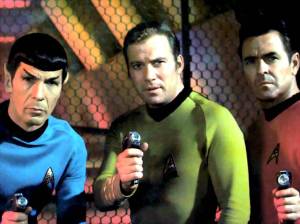
OGs, Star Trek, 1968
Here’s the kind of Star Trek geek that I am—I went to Star Trek conventions back at the dawn of time before the movies were made. In the lean years between the cancellation of the original series (TOS) in 1969 and the release of Star Trek: The Motion Picture in 1979, only the most hardcore dorks attended Star Trek conventions and I was right there with them. I was in junior high back then and had discovered TOS in syndication, on some UHF channel in San Francisco. In typical obsessive fashion I watched every episode religiously, so when the annual Star Trek conventions came to the Bay Area I was totally there.

Star Trek convention habitues
At that time the conventions were shaggy, grassroots affairs, with socially inept misanthropes attending in their homespun costumes clutching hand-rigged tricorders. The TV show’s stars were also pretty desperate then, since they’d been typecast in the original series and couldn’t get work once it went off the air. The show was probably the biggest sci-fi cult item at the time, though that still only put it a few notches above Dark Shadows, but its glory days as a billion-dollar franchise were yet to come. So I was able to witness William Shatner recite “Rocket Man” in person at the Oakland Convention Center and I also got Walter Koenig’s autograph (I think I asked him what sign he was).
When Paramount revived the franchise in 1979 and the movies and the new TV series started to take off again, I dutifully followed along, but as the sequels and spinoffs multiplied, my interest gradually waned. It’s not that I didn’t like and enjoy some of the new shows and characters but there were eventually so many of them that I couldn’t properly keep track. Plus by the time Star Trek 6 rolled around in 1991, the original cast was getting mighty long in the tooth and it felt a bit unseemly for them to be running around all over creation in their unsightly hairweaves.
So the new Star Trek reboot is a rare treat for this geekster, as it features actors who are actually young and vigorous enough to be convincingly roaming all over the galaxy in high-powered starships. I saw the movie in its opening weekend and was pleased with its faithful yet innovative reworking of the original series’ mythology.
I was also keenly interested in seeing how John Cho fared as Lt. Sulu, since as previously noted in earlier posts, good roles for Asian American males are few and far between in Hollywoodland. Cho as Sulu acquitted himself just fine, but surprisingly enough, it was the new young Spock that really grabbed my attention.
Spock’s always been coded as “other” in Star Trek lore—Leonard “Bones” McCoy shamelessly let fly with many a culturalist epithet such as, “You green-blooded (mumble mumble),” or “you pointy-eared . . . .” In TOS, Spock’s mixed heritage provided plenty of dramatic tension as he played out a toned-down version of the tragic mulatto trope.
The new old Spock, Star Trek, 2009
In the current film, Spock seems to have been given a new dimension, as a sexy young thing who snags the hottest woman on the starship (no spoilers here but it’s a mighty fine, unexpected and yet completely feasible pairing). The filmmakers seem to realize that Spock’s constant need to suppress his hereditary Vulcan rage as well as his human emotions makes the character into a smoldering mass of brooding antihero. Compared to this angsty creature, Kirk’s breezy rebel seems juvenile and shallow.
I’m hoping Spock’s latest incarnation in the new Trek alternaverse further develops the character’s intriguing cultural possibilities. Instead of a conflicted half-breed, maybe Spock can become a new and improved representative of the joys of hybrid vigor, embracing and celebrating his dual heritage rather than constantly lamenting it. It would be so 21st-century to go beyond the last couple hundred years of beating ourselves up over race-mixing, miscegenation and other supposedly unnatural acts. I for one am wholeheartedly rooting for it.
Thanks to Barbara Jane Reyes and Wei Ming Dariotis for helping me to incubate the ideas herein.
All For The Winner: 28th Hong Kong Film Awards

Crocodile tears? Xu Jiao wins Best New Performer for CJ7
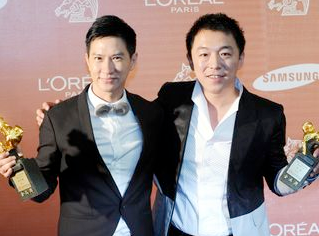
Just a quick note about this year’s Hong Kong Film Awards, which took place this Saturday. Wilson Yip’s biopic Ip Man, about the martial arts legend, took Best Picture, with Ann Hui winning Best Director for The Way We Are, her docudrama about the New Territories town of Tin Shui Wai. The Way We Are, with its mostly non-professional cast, also won three other awards including Best Actress, Best Supporting Actress, and Best Screenplay. Nick Cheung (The Beast Stalker) nabbed his first Best Actor statue, adding it to his award from the Hong Kong Film Critics’ Society. Cute little girl Xu Jiao won Best New Performer for her crossdressing turn as Stephen Chow Sing-Chi’s son in Chow’s sci-fi blockbuster CJ7. Unfortunately, according to the Golden Rock’s liveblog she gave a horribly fake acceptance speech that included fake crying. I guess child stars are the same all over the world.

Carina Lau & Tony Leung burn up the red carpet, HKFA 2009
Interestingly, in a repeat of the Golden Horse Awards last year, John Woo’s lavish epic Red Cliff was shut out of the major acting and directing awards (including Tony Leung Chi-Wai’s failure to win his sixth Best Actor award). Red Cliff did clean up in several creative categories such as Best Art Direction and Best Visual Effects, winning five awards. Apparently this year’s nominations were only for Red Cliff 1—Red Cliff 2 will be eligible again next year so maybe then it will make out a little better in the major awards. Ironically, Red Cliff is probably the only film among the award winners that will receive international distribution.

Simon Yam in brown satin, Hong Kong Film Awards, 2009
Poor Simon Yam, nominated for Best Actor for Johnnie To’s Sparrow, went home empty-handed again. But he got to wear a natty two-toned sharkskin suit, white spats, and a spider-motif tie, and looked way too dashing for a man in his fifties. Sadly, Sparrow also lost (to Red Cliff) for Best Film Score, which just goes to show that not everyone appreciated its awesome Martin Denny/Michel Legrand/Henry Mancini homage.
For a full listing of the awards go here.
For lots more pix of celebrity finery go here.
For a great liveblog of the event go here.
And here’s the trailer for Sparrow, for a sample of its excellent soundtrack:
10,000 maniacs + gratuitous Francis Ng pix

Walking softly and carrying a big sword, Francis Ng, Chasing Shadows, 2009
Hey! This blog just got it’s ten-thousandth hit (thanks, Edison) so in honor of reaching that milestone I’m posting some gratuitous pictures of the reason I started blogging in the first place. So here’s a recent publicity still from Chasing Shadows, Francis Ng’s upcoming wuxia movie which is now in postproduction. Note the excellent updo that Francis is sporting, which suggests a touch of goth in the art-direction mix.

Going out for snacks, Francis Ng & friend
Francis has been getting into some extracurricular trouble lately with “production assistants” and “music consultants” while editing Chasing Shadows in Beijing. He’s been spied wandering around late at night with women who are not his wife (who just gave birth back in October), supposedly walking with his arm around one of them and suspiciously playing loud music in his apartment at all hours of the night. It’s all conjecture and speculation, of course, but it makes for good tawdry unsubstantiated gossip so the Chinese press is all over it. Look out for those telephoto lenses, Francis, the next time you visit the 7/11 at midnight!

Francis gets caught with his hand in the cookie jar, 2007
Francis is apparently getting a rep for being a playa in Hong Kong entertainment circles. A couple years ago he was caught on video canoodling in a karaoke bar (video below) with Ellen Chen, who played a sexy prostitute alongside Francis in Exiled. At first he denied it but when confronted with the videotaped evidence he ‘fessed up. Luckily he managed to get his wife to publicly forgive him.
Last year he attempted some damage control by releasing a series of pictures of said wife, then pregnant, and himself in marital bliss, with Francis dutifully following her around Hong Kong while she window-shopped. It was also noted that he cooked special soup for her during her pregnancy.
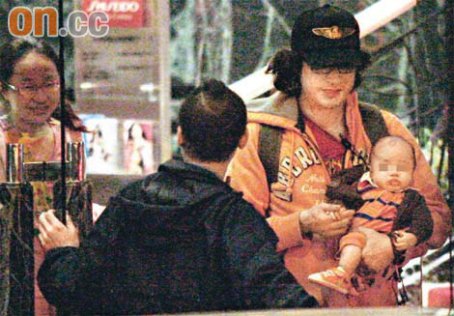
Two of a kind, Francis & Feynman Ng, 2009
Some other conveniently shot pictures from this February showed Francis, wife, and infant son Feynman (named for the physicist) tooling around Hong Kong, with father and son in matching orange outfits.

Method acting, Francis & co-star
But Francis’ attempts to salvage his rep have taken a hit these past couple weeks with the gossip about his purported shenanigans in Beijing. Reports also mention his close personal relationship with starlet Jiang Yi-Yan, who played his mistress in Deadly Delicious. Apparently the two prepped for their make-out scenes by drinking together, which lead to some pretty convincing love scenes.
It’s none of my business what celebrities do in their personal lives but I’m always surprised when they get caught on film or video messing where they shouldn’t be messing. It should be patently obvious that when you’re a movie star, you’re living in a fishbowl and you should be on guard at all times against sneaky papparrazi with hidden cameras. There have been rumors for a long time that a couple of the Heavenly Kings are gay (you get to guess which ones) but there has never been a scrap of supporting evidence to prove it, even with Hong Kong’s notorious media machine constantly on the prowl. So there are three probable scenarios at work here:
1. Francis Ng has really poor judgment.
2. Francis Ng has really lax handlers.
3. Francis Ng has nothing to be guilty about and he just likes having business meetings with his production staff in the middle of the night in his private apartment.
You make the call.
Note: Thanks to dleedlee for the translation help and advice. You rock.
UPDATE: Thanks to the hkmdb for more Francis Ng damage control. How many times can he trot out his wife & kid to show he’s a happily married man? Sorry for the cynicism but it seems awfully calculated to me. That said, I do hope it works because one of the greatest pleasures in my life is watching Francis Ng act on the screen and I’d hate to see his career flounder, for whatever reason. Luckily Edison Chen is providing a much better distraction for the HK press & public so hopefully Francis will get a pass.
Bonus video: Francis Ng & Ellen Chen get busy. Canoodling starts around :46. Warning: bad karaoke singing.
UPDATE 2: Francis has been cast in a couple new Hong Kong flicks, Laughing Gor, which is based on the popular Michael Tse television character, and Most Wanted Terrorist, Dante Lam’s follow-up to Beast Stalker. There’s also the upcoming summer release of Tracing Shadow, which Francis stars in and co-directed, so I guess his peccadillos haven’t hurt his career too badly. Edison Chen should probably get a special award for running interference for everyone these days in Hong Kong.

 beyondasiaphilia
Recent Comments