No Blood For Oil: ChevWrong poster bombs

I will not complain about my asthma, downloadable poster, ChevWrong Inhumane Energy series, truecostofchevron.com, 2009
Just a quick shoutout to a couple well-placed guerilla art pieces spied around town here in San Francisco in the past week or so. In anticipation of the May 27 Chevron shareholders meeting in San Francisco last week, some enterprising artist/activists last week bombed the city with printouts of the downloadable subvertisements from truecostofchevron’s ChevWrong Inhumane Energy ads. The poster brigade, which plastered the city with hundreds of the alternate ads, decided to take matters into their own hands after CBS Outdoor refused to sell billboard space to truecostofchevron, claiming that it didn’t accept “negative” advertising. The Inhumane Energy series cleverly skewers Chevron’s current greenwashing ad campaign that speciously utilizes earth-friendly taglines such as “I will leave the car at home more,” “I will finally get a programmable thermostat,” and “I will replace 3 light bulbs with CFLs.” As if.

I will ignore the toxic waste pits in my village, downloadable poster over Chevron ad, ChevWrong Inhumane Energy series, truecostofchevron.com, 2009
Truecostofchevron’s slick little numbers nimbly mimic Chevron’s fakey feel-good sentiments with lines including, “I will not breathe when outside,” “I will try not to get cancer,” and “I will not complain about my asthma,” coupled with facts and statistics about Chevron’s environmentally unsound activities in Nigeria, the U.S., Burma, Ecuador, Iraq and other sites worldwide. As with any good detournement, the series simultaneously critiques, neutralizes and repurposes its source material, in this case simulating Chevron’s high-powered happy-smiley corporate propaganda in order to expose and deride the oil giant’s own hypocrisy.

No Blood For Oil, stencil, Bay Bridge lower deck, 2009
I’ve also been appreciating the rawer but no less effective commentary on the link between big oil and the destruction of the planet that’s cropped up on the eastbound approach to the Bay Bridge. Stenciled onto a couple pillars on the Bridge’s lower deck is a simple image of a tank’s silhouette spouting a single a drop of blood. Direct, visual and to the point, the graphic needs no embellishment to gets its message across, even to the distracted driver speeding along the freeway. And though it may be ephemeral, its placement in the line of sight of thousands of drivers a day brings its message to where it’s most needed and where it can’t be ignored. Which is the most that anyone can hope for in combating the baldfaced corporate misinformation that bombards us every day.
Fresh Fruit For Rotting Vegetables: Bill Basquin’s Photographs at the Dump
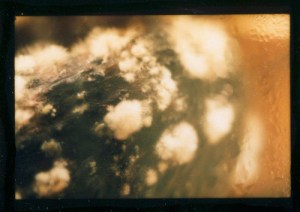
Moldy Avocado, from the series Fruits Uneaten, Bill Basquin, 2009, c-print, 20" x 30"
Surprisingly, the Tunnel Road dump smelled a little ripe when I visited there last week to check out The Way of All Flesh, Bill Basquin’s photo exhibit. My husband is a contractor so I’ve been to a few dumps in my time and in my experience the Norcal Solid Waste Transfer and Recycling Center on Tunnel Road in San Francisco is actually one of the least odiferous ones. Colma’s a bit stinkier and don’t even get me started on the big landfill near Dixon on Highway 113. But Tunnel Road is curiously fragrance-free most of the time, perhaps due to some errant breezes blowing off the ocean a little ways away.

Carrot Triptych: 0 weeks, 6 weeks, 4 weeks, Bill Basquin, 2009, c-prints in frames built from reclaimed wood
Anyways, Bill Basquin’s show was the end product, so to speak, of his four-month residency at the Tunnel Road dump, sponsored by San Francisco’s Recycling & Disposal Artist-In-Residence program. The dump’s AIR program, which has been in operation since 1990, hosts several local artists each year in a nice big studio with a woodshop and all of the trash they can handle. Artists get a monthly stipend and are free to use whatever they can dig out of the adjacent dump site to make art. I’ve seen several shows there, including Donna Keiko Ozawa’s extra-cool crank-handle sculptures (way back in 2001) and Paul Cesewski’s bicycle-powered circus installation (just last year) and each artist transforms the space in his or her own way. By repurposing the waste stream and finding usefulness in discards, the SF Recycling & Disposal AIR program’s undercurrent of anticonsumerism is all too relevant in these days of late capitalism gone awry.
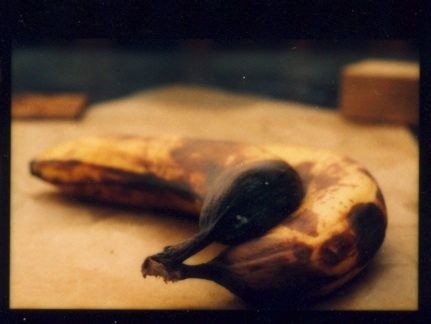
Banana Pair, O weeks, Bill Basquin, 2009, c-print, 8" x 10"
Bill’s exhibit mainly consisted of images of the rotting produce that he composted on-site, then photographed up close and personal. The resulting large-scale color prints, in frames constructed from wood scavenged from the dump, are both fascinating and repellent, with each fruit or vegetable’s decaying carcass so closely rendered you can almost smell them. Some of the photos, like “Banana Pair, O weeks,” keep a wary distance from the subject, while others, such as “Moldy Avocado,” bring the viewer so close that the prosaic subject matter becomes a furry mass of color and texture. But while the fruits and veggies have lost their original shape and form, both through decomposition as well as through Basquin’s intimate portraiture, the photos never sink to simple abstraction. Each desiccated corpus pretty much retains its connection to its origins as a living plant, though some are much farther along than others. Bill Basquin grew up on a farm in the Midwest and his photography reflects an awareness of the planet’s oscillations perhaps less evident to the urban dweller. His loving close-ups of moldy plant matter serve as microcosmic reminders of the cycle of degeneration and rebirth that we city folk too often forget.
Geek Love: Star Trek and Hybridity Revisited

OGs, Star Trek, 1968
Here’s the kind of Star Trek geek that I am—I went to Star Trek conventions back at the dawn of time before the movies were made. In the lean years between the cancellation of the original series (TOS) in 1969 and the release of Star Trek: The Motion Picture in 1979, only the most hardcore dorks attended Star Trek conventions and I was right there with them. I was in junior high back then and had discovered TOS in syndication, on some UHF channel in San Francisco. In typical obsessive fashion I watched every episode religiously, so when the annual Star Trek conventions came to the Bay Area I was totally there.

Star Trek convention habitues
At that time the conventions were shaggy, grassroots affairs, with socially inept misanthropes attending in their homespun costumes clutching hand-rigged tricorders. The TV show’s stars were also pretty desperate then, since they’d been typecast in the original series and couldn’t get work once it went off the air. The show was probably the biggest sci-fi cult item at the time, though that still only put it a few notches above Dark Shadows, but its glory days as a billion-dollar franchise were yet to come. So I was able to witness William Shatner recite “Rocket Man” in person at the Oakland Convention Center and I also got Walter Koenig’s autograph (I think I asked him what sign he was).
When Paramount revived the franchise in 1979 and the movies and the new TV series started to take off again, I dutifully followed along, but as the sequels and spinoffs multiplied, my interest gradually waned. It’s not that I didn’t like and enjoy some of the new shows and characters but there were eventually so many of them that I couldn’t properly keep track. Plus by the time Star Trek 6 rolled around in 1991, the original cast was getting mighty long in the tooth and it felt a bit unseemly for them to be running around all over creation in their unsightly hairweaves.
So the new Star Trek reboot is a rare treat for this geekster, as it features actors who are actually young and vigorous enough to be convincingly roaming all over the galaxy in high-powered starships. I saw the movie in its opening weekend and was pleased with its faithful yet innovative reworking of the original series’ mythology.
I was also keenly interested in seeing how John Cho fared as Lt. Sulu, since as previously noted in earlier posts, good roles for Asian American males are few and far between in Hollywoodland. Cho as Sulu acquitted himself just fine, but surprisingly enough, it was the new young Spock that really grabbed my attention.
Spock’s always been coded as “other” in Star Trek lore—Leonard “Bones” McCoy shamelessly let fly with many a culturalist epithet such as, “You green-blooded (mumble mumble),” or “you pointy-eared . . . .” In TOS, Spock’s mixed heritage provided plenty of dramatic tension as he played out a toned-down version of the tragic mulatto trope.

The new old Spock, Star Trek, 2009
In the current film, Spock seems to have been given a new dimension, as a sexy young thing who snags the hottest woman on the starship (no spoilers here but it’s a mighty fine, unexpected and yet completely feasible pairing). The filmmakers seem to realize that Spock’s constant need to suppress his hereditary Vulcan rage as well as his human emotions makes the character into a smoldering mass of brooding antihero. Compared to this angsty creature, Kirk’s breezy rebel seems juvenile and shallow.
I’m hoping Spock’s latest incarnation in the new Trek alternaverse further develops the character’s intriguing cultural possibilities. Instead of a conflicted half-breed, maybe Spock can become a new and improved representative of the joys of hybrid vigor, embracing and celebrating his dual heritage rather than constantly lamenting it. It would be so 21st-century to go beyond the last couple hundred years of beating ourselves up over race-mixing, miscegenation and other supposedly unnatural acts. I for one am wholeheartedly rooting for it.
Thanks to Barbara Jane Reyes and Wei Ming Dariotis for helping me to incubate the ideas herein.
The Myth of Chinese Restaurants, Part Three: Indigo Som’s Chinese Restaurant Project

Wonderful House, Rock Springs, Wyoming, 2002, iris print, 34"x34", Indigo Som
Regarding Chinese restaurants of a different sort, Indigo Som has an installation from her Chinese Restaurant Project in Present Tense Bienniel: Chinese Character, at the Chinese Cultural Center in San Francisco. Indigo’s project is manifold and ongoing, but its three main parts basically attempt to document and capture the gestalt of Chinese eateries in the U.S. and look at the ways in which these omnipresent establishments reflect and represent Chinese American culture, both real and imagined.
My brother and his wife once went on a driving trip that took them through a sparsely populated part of Idaho. On the way they stopped at a roadside restaurant and when they walked in, the Chinese proprietor spotted them immediately. As soon as he saw that my brother was Chinese, a huge grin broke out on his face. My brother must’ve been the first Chinese person outside of his own family that the owner had seen in a mighty long time. Indigo’s project reminds me of this incident in that it demonstrates both the pervasiveness and the isolation of these solitary outposts. Living in the Bay Area, which is clogged with Asians of every make and model, it’s pretty easy to forget that Asian Americans still only make up about 4% of the total U.S. population. The Chinese Restaurant Project captures some of the melancholy of life outside of urban centers for many Asians in this country.

Woo's Pagoda, Eau Claire, Wisconsin, 2003, inkjet print, 34x34", Indigo Som
Some of you might be familiar with the large-scale color prints of Chinese restaurant facades that Indigo’s exhibited extensively in the past few years—she’s been selectively documenting Chinese restaurants across the U.S. for a while now, shooting hordes of images of this multifarious architectural phenomenon with a plastic, fixed-focus Holga camera. Many of the pictures were taken in locations far from sizable Chinese American communities and are plaintive reflections on the sometimes funky, in-between state of being Chinese in America.
The other two parts of the Chinese Restaurant Project are Indigo’s blog documentation of her travels across the country in search of Chinese restaurants and her quixotic attempt to collect a menu from every one of the thousands of Chinese restaurants in the U.S.
Indigo’s project captures the absurdity of attempting to define “Chinese American culture” in this modern world. Signage from most of the restaurants uses “ching-chong” script, or what Indigo calls the “Evil Chinky Font,” the one that poorly emulates classical Chinese calligraphy; names for the restaurants usually involve pagodas, jade, bamboo and other tiresome “Chinese” signifiers. Her menu collection also demonstrates the ways in which these restaurants have adapted Chinese cuisine to suit the tastes of the mainstream American palate, such as the weird pervasiveness of Crab Rangoon, those nasty little deep-fried cream cheese and surimi wontons that in all likelihood were invented in the 1950s at Trader Vic’s, that tiki torch lounge heaven in San Francisco.

Chinese Menus, Present Tense Bienniel, 2009, Indigo Som
On display as part of Present Tense Bienniel is a floor-to-ceiling installation of all of Indigo’s current collection of Chinese menus, which number in the hundreds. Covering a pretty big corner of the gallery, it’s still only a tease of what the piece will be when Indigo has, say, a thousand Chinese restaurant menus papering an entire gallery. Knowing her capacity for obsessive activity and her dedication to her goal, I have no doubt that one day we’ll see an entire floor of the deYoung Museum covered over with menus sporting the Evil Chinky Font from all over the country. But until then, this little snippet will more than suffice.
Present Tense Biennial: Chinese Character – an exhibition of
contemporary artwork by 31 artists that reflect and reinterpret China
Curated by Kevin Chen
May 1 – August 23, 2009
Tuesdays-Saturdays, 10am to 4pm; Sundays, 12 to 4pm
Chinese Culture Center, 750 Kearny Street, 3rd Floor (inside the Hilton Hotel), between Clay & Washington Streets in San Francisco CA
Admission is free.
Kinda Like A Big Deal: The Beast Stalker, Full Alert and Greatness in Hong Kong Movies

Nick Cheung and wonky eye, The Beast Stalker, 2008
Just saw The Beast Stalker (Dante Lam, 2008) at the San Francisco International Film Festival and, although it held up pretty well and wasn’t an embarrassment, it wasn’t quite all that. Introduced by the Film Festival as “perhaps the best Hong Kong action film since Johnnie To’s Election,” this gritty thriller demonstrates that the former Crown Colony can still crank out hard-ass crime dramas. But the field has been mighty thin in Hong Kong of late and in other, more fruitful years, The Beast Stalker might’ve been just one of the crowd.
Former teen heartthrob Nicolas Tse plays a tough cop (!) haunted by the death of a child hostage he accidentally kills in a chaotic shootout/car crash involving malevolent gangsters, innocent bystanders and much shattered glass. Nick Cheung plays a kidnapper-for-hire in charge of snatching the dead girl’s twin sister whose lawyer mother is involved in prosecuting the crime. Their meshing stories play out in a dizzying spiral of guilt, honor, fate and obligation.
The Beast Stalker has several full-on child-in-extreme-danger moments and the cast realistically sports facial scars and other mementos of mortal peril, but somehow the film falls short of greatness. Nic Tse, further distancing himself from his youthful idol years, shrieks angrily at his subordinates, but he still can’t nail the crying scenes. Likewise, Nick Cheung, who won Best Actor statues from both the Hong Kong Film Critics’ Association and the Hong Kong Film Awards for this role, glowers menacingly but doesn’t quite bring the extra layer of pathos and complexity that might have deepened his portrayal. As my pal Laura, aka redbean, aka longtime Hong Kong movie fanatic, noted, “Anthony Wong would’ve eaten this role alive.” Unfortunately Anthony wasn’t cast and in this case Nick Cheung only makes a so-so substitute.
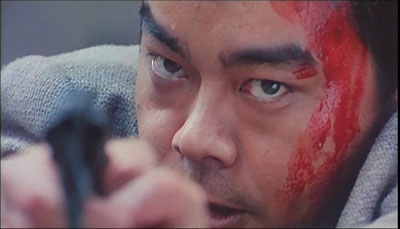
Lau Ching-Wan shoots straight, Full Alert, 1997
I recently purchased a copy of Ringo Lam’s brilliant crime thriller Full Alert (1997), which bears some similarities to The Beast Stalker in its depiction of the complex relationship between a cop and a criminal. But Full Alert has the inestimable actors Lau Ching-Wan and Francis Ng in the lead roles and their sublime skills breathe life into their stock characters and make the film’s cat-and-mouse story vibrant and believable. Francis brilliantly creates a strangely sympathetic yet reprehensible character and Lau Ching-Wan’s finely tuned fits of anger and frustration show a cop dangerously on the edge of sanity. The final confrontation between these two driven characters beautifully brings their fraught relationship to a stunning conclusion. On the other hand, The Beast Stalker’s antagonistic pair never fully reach the heights suggested by their intertwined destinies and their anticipated showdown is merely a tease.

Nick & Nic mix it up, The Beast Stalker, 2008
Full Alert and The Beast Stalker both have magnificent car chases as their centerpieces, the work of car-choreography specialist Bruce Law. The action direction in The Beast Stalker, however, unfortunately succumbs to the closeups and nausea-inducing jerky camerawork now in fashion, whereas Ringo Lam understood the need for distance and framing in an action sequence. Attesting to its greatness, Full Alert more than stands the test of repeated viewings, even more than a decade after its release. The Beast Stalker is a exciting, smartly-made movie but if, as several critics have suggested, this is one of the best of recent Hong Kong films, then the bar has been seriously lowered.
Dante Lam will soon have another chance to make a great Hong Kong movie. His next project, Most Wanted Terrorist, has just announced its cast, which includes the dream team of Lau Ching-Wan, Anthony Wong and Francis Ng, along with Nick Cheung. Hopefully Nick Cheung can keep pace with his illustrious co-stars, as they’re widely held to be among the best actors of their generation. He did just fine opposite Anthony and Francis in Exiled, and even in The Beast Stalker he showed glimmers of potential. but if he’s not careful the rest of the cast is going to blow him out of the water.
Interestingly, Dante Lam has indicated that he will forgo any Mainland Chinese financing for Most Wanted Terrorist in order to preserve a Hong Kong sensibility in the film. Several recent HK/China co-productions, including Sammi Cheng’s recent Lady Cop and Papa Crook, have suffered from the restrictions of Mainland film censors, so Lam’s decision to avoid PRC money is an interesting one. With Hong Kong film financing languishing due to the economic recession it’s a bold and risky move, but Lam is determined to retain his artistic freedom without having to answer to the Mainland government.
Let’s hope Most Wanted Terrorist gives everyone involved the chance to strut their stuff to their fullest capabilities. With its killer cast and seasoned director, if all goes well, we could once again see greatness in Hong Kong films next year.
The Beast Stalker opens Friday, May 15 at one of the last places in the Bay Area to see Hong Kong movies on the big screen, the 4-Star Theater, 23rd Avenue and Clement Street, San Francisco.
The Myth of Chinese Restaurants, Parts One & Two
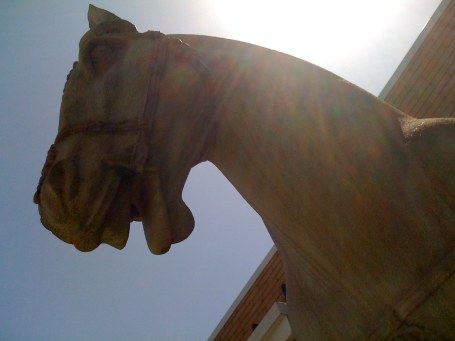
Faux-terracotta horse, PF Chang's
Part One
My mother-in-law loves PF Chang’s so we took her there this weekend for Mother’s Day. I’m not really complaining since it beats the hippie breakfast place we usually go to, where the food is stuck in an aryuvedic-lite 1970s time warp without spice, garlic, butter or anything else that makes food worth eating. But since we live in the Bay Area, where there are a plethora of outstanding Chinese eateries of every stripe and price point, it seems a bit odd to me to willingly frequent a place like PF Chang’s. However, my mother-in-law is eighty and she isn’t Chinese or a very adventuresome eater so to take her to, say, Fook Yuen or Koi Palace for shark fin soup and sea cucumber would probably be a wasted effort. Hell, I don’t even like sea cucumber and as far as I know I’m full-blooded Chinese.

Miley & buddies show their cultural sensitivity
Amusingly enough, PF Chang’s seems to be a favorite of idiotic teen idol Miley Cyrus, who held the afterparty for the premiere of her recent Hannah Montana flick at a Los Angeles Chang’s and who takes her boytoys to the one in Burbank as well. However, Miley’s a fickle customer, recently claiming on Jay Leno’s show that the wonton soup at Chang’s tasted like soap. Maybe some of the kitchen help were staging a bit of payback for Cyrus infamously pulling the “chink eye” a few months back?
Anyways, I’m sure if I were in some part of the world where Chinese people and our accompanying restaurants were few and far between, I might swoon for the sight of PF Chang’s. The menu actually does include some decent dishes and the tea selection isn’t bad. It’s not unlike the drive-thru Starbucks on the interstate—you wouldn’t normally be caught dead inside a ‘Bucks in a coffee-snob-land like San Francisco but when you come across one in the vast wasteland of Highway 5, you’re damn grateful for that mocha frappuccino. Likewise, if I were in the middle of non-Asian America and really wanted a plate of potstickers and some passable dandan noodles, I’d be more than happy to eat at PF Chang’s. But I’m also pretty glad that I don’t have to do that very often, since I live in the heart of Chinese restaurant heaven—now if only I could get my mother-in-law to like fatty pork and bitter melon.

39 million pounds a year sold, Orange Chicken, Panda Express
Part Two
I had a brush with the legend of another famous quasi-Chinese restaurant when I was in Southern California last week for the Los Angeles Asian Pacific Film Festival, which was kind enough to screen my latest short experimental video, Snapshot: Six Months of the Korean American Male. I stayed with my pal Gary, whom I’ve known for a couple decades since our misadventures as grad students at the Art Institute in Chicago. Gary wisely dropped out after a semester and eventually moved to LA, where he’s now working in television as a 1st AD and producer. His most recent assignment was interviewing the divine Hugh Jackman, whom Gary confirmed was both astoundingly hot and extremely nice as a person.
Anyways, Gary told me that Andrew and Peggy Cherng, the founders of Panda Express, owned a townhouse in the very same complex that I was now visiting and that, up until recently, one of the Cherng’s daughters had lived in the unit. One day a couple years ago Gary came home to find his street clogged with police cruisers—apparently Mr. Cherng had been by to visit and had surprised a couple kidnappers in the midst of abducting his daughter. Luckily the fiftysomething Cherng had managed to fight off the perps and save his daughter from an evil fate.

Paul Muni, non-Chinese, The Good Earth, 1937
Soon after that the daughter moved out, but Gary thinks the Cherngs might have kept the place as a rental property, despite having a net worth in the millions (the Panda Express in Honolulu brings in $4 million annually). Weirdly enough, I wouldn’t be surprised if this were true. My dad always told me that real estate is the best type of investment (thank god he didn’t live to see the subprime meltdown), and didn’t the husband in The Good Earth keep ranting about the significance of “the land” all the time? Maybe the Cherngs are just hedging their bets in case some disaster befalls their fast food empire someday.
Da Hil Sa’Yo: The Passing of Al Robles
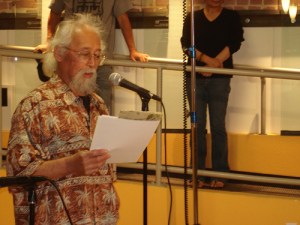
Al Robles brings it, Manilatown Heritage Foundation
I’d only met Al Robles once or twice, but his voice was one that I’d known and carried with me for years. He was prominently featured in The Fall of the I-Hotel, Curtis Choy’s seminal documentary about the long fight to preserve low-income housing in San Francisco’s Manilatown against the onslaught of business interests and developers. The film showed Al alongside his fellow manongs as an organizer and activist in the struggle, and one of the movie’s highlights is his reading of his sublime and evocative poem International Hotel Night Watch, just before all hell breaks loose in the midnight eviction of the I-Hotel tenants. At one point Al’s mellow, emotional voice sings a line from Da Hil Sa’Yo (Because of You), which Choy uses as an ironic refrain throughout the film. I’ve shown The Fall of the I-Hotel every semester for more than a dozen years in my Asian American Film History class and even now I can hear Al’s voice singing that song in my head. Because I’ve seen the film so many times I’ve learned the song by heart, though I speak no Tagalog, and it moves me every time I hear it.
As we all know, after the 1977 eviction the original I-Hotel was demolished in 1981, but through their tireless vigilance community activists, including Al Robles, managed to block the construction of a commercial building and a parking lot on the site. Due to these ceaseless efforts, in 2005 a new International Hotel finally opened, with the Manilatown Heritage Foundation (MHF) on the ground floor and 105 units of low-income housing above. Though nearly three decades had passed since the eviction, two former tenants of the original I-Hotel moved into the new building, along with other low-income senior citizens.
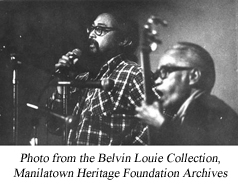
Poet Al, ca. 1975
Last year I took one of my classes to the MHF and there was Al, big as life, chatting with the art gallery staff. I immediately recognized his bushy ponytail and beard, but it was his distinctive voice that confirmed to me his identity. My students and I were a bit starstruck and no one wanted to approach him and say hello, but after a while some of them got up the nerve to introduce themselves and ask him what event he was there for. “Nothing special, I’m just hanging out,” Al genially replied, smiling broadly and shaking everyone’s hands. He went on to explain that he stopped by pretty often just to visit and check in with what was going on at the MHF. After so many years of struggle, maybe he was still savoring the fact that in this case the good guys had won, and that we could chalk up one on the side of justice. Al was an integral part of that victory, through his poetry, his advocacy, and his activism. I’m glad I’ll always have his voice with me.
Update: Here are some nice tributes to Al at various blogs.
RJ talked to Al about being a writer.
Barbara has several poems she wrote for Al.
Mark documented Al’s memorial at MHF.
Theo’s podcast for Al
Alana Robles has a central site for remembrances of Al.
UPDATE 2: Just because it’s divine, here’s Nat “King” Cole’s version of Da Hil Sa’Yo, live in Manila c. 1961. Listening to King Cole’s silken voice tickle this song is heavenly.
UPDATE 3: Briefly stopped in at the massive Al Robles memorial on Sunday at the SOMARTS Gallery and I’m happy to report that Phil Chavez performend “Da Hil Sa’Yo” on his ukelele. Phil noted that this song and “Over The Rainbow,” which Phil also sang, were two of Al’s favorites. It was nice to see folks out in force at the memorial despite the 90 degree heat in San Francisco.
Da Hil Sa’Yo (English translation)
Because of you, there’s a joy in living
Because of you, ‘till death (you) must realize
In my heart I know there is only you
And ask my heart, you’ll know that this is true
Long have I endured in my life
The pain and sorrows from love arise
Then you came and redeemed me, my dear,
My only hope in my darkest fears
Because of you, I found happiness
That to you I offer this love that is so blessed
Though indeed I may be a slave for loving you so true
It matters not to me, ‘cause everything’s because of you
Da Hil Sa’Yo (original tagalog)
Dahil Sa’yo
Sa buhay ko’y labis
Ang hirap at pasakit, ng pusong umiibig
Mandin wala ng langit
At ng lumigaya, hinango mo sa dusa
Tanging ikaw sinta, ang aking pag-asa.
Dahil sa iyo, nais kong mabuhay
Dahil sa iyo, hanggang mamatay
Dapat mong tantuin, wala ng ibang giliw
Puso ko’y tanungin, ikaw at ikaw rin
Dahil sa iyo, ako’y lumigaya
Pagmamahal, ay alayan ka
Kung tunay man ako, ay alipinin mo
Ang lahat ng ito, dahil sa iyo
Hawai’ian Eye: Asian American Studies conference

AAAS conference back porch, 2009
Just got back from the Association of Asian American Studies annual conference, which this year was held in Honolulu, HI. Needless to say it was a very well-attended event, taking place a block from the beach in Waikiki. I myself confess that the percentage of time I spent swimming in the ocean vs. attending panels and roundtables was pretty much skewed toward boogie boards and sandcastles, but I’d brought my kids along so I had an excuse.
I did manage to tear myself away from skimming stones and walking in the sea foam to attend a few presentations, however, and participated in a couple as well. UC Berkeley’s Elaine Kim organized a great panel, Bollywood, Believing Women, and the Female Bin-Laden, which included Huma Dar’s pointed critique of Hindi-language films that demonize Muslim men and exoticize Muslim women. Filmmaker and scholar Irum Sheikh displayed several images of “disappeared” individuals who have been detained by the U.S. government, many held for years on flimsy or nonexistent charges in the “war on terror” perpetuated by the Bush regime. Her straightforward and unvarnished presentation made an unimpeachable case against a foreign policy gone horribly awry.

Dawn Mabalon & Allyson Tintiangco-Cubales, fedora'ing
I also ran into several former students, now all grown up, including Sudarat Musikawong, who’s a prof at Willamette University, Mitch Wu, now teaching at SUNY Hunter, Carolyn Tran, about to enter grad school at the New School for Social Research, Margaret Rhee, poet & PhD candidate at UC Berkeley, and Celine Parrenas-Shimizu, who’s a superstar professor at UC Santa Barbara and whose latest tome, The Hypersexuality of Race, won one of conference’s book awards this year. Plus, as at any good Asian American gathering, I spotted several people in felted hats, further supporting my contention that Asian Americans love stylish headwear.
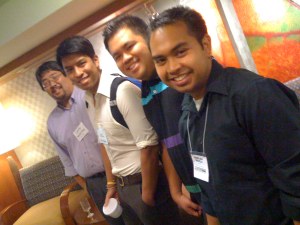
Lawrence Hashima, Pahole Sookkasikon, Kevin Lim & RJ Quiambao rock the house, AAAS 2009
I also took along a couple grad students from SFSU to present their research on a panel called Assimilation, Rice Queens, Porn, and the Mainstream: Constructing Media Images, which, in keeping with scholarly tradition, wordily includes a term from all of the panelists’ papers in its title. Pahole and RJ from SFSU and Kevin from UH Manoa rocked their presentations and made me feel like a proud mother fawning over her young. It ain’t easy covering topics ranging from “The King and I,” Asian & Hawai’ian women in online porn, and a new framework for Asian American cinema, but the guys pulled it off with flair. Larry Hashima provided excellent feedback and tied together the panel in style.
I also organized a panel called Art and the Academy: Working Artists In Asian American Studies wherein I talked about the legacy of creative work in SFSU’s Asian American Studies Department and outlined the production of POP! Producing Our Power: Presenting Asian American Culture, a student-run show at SFSU that asks the age-old question, “What is Asian American culture and how can we express it on stage?” Also presenting their awesome social practice projects were brilliant artist-scholars Ming-Yuen S. Ma, who talked about his amazing video art bus tours through Los Angeles, and Gaye Chan, chair of the Art Dept. at UH Manoa, who described her guerilla gardening project, Eating In Public. Both projects are unapologetic blows against the empire that conclusively prove that artists are indispensible in the battle against tyranny and injustice.
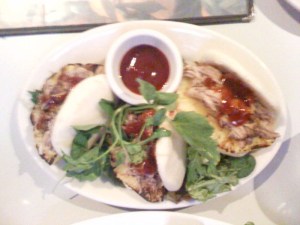
Sliders, Hawai'ian style, Sidestreet Inn, Honolulu
On the recreational tip, I managed to have shave ice nearly every day, though the Waikiki version is pretty tepid. The killer stuff is found on the North Shore in Haleiwa, at Matsumoto’s, where the sour lemon, lilekoi, and coconut combo I tried was stunning. Back in Honolulu, good eats were to be had at Sidestreet Inn, a formica-table sports/karaoke bar that serves up some of the best Hawai’ian food around, including excellent ahi poke, kahlua pig sliders, and fried chicken wings.
So despite my struggle to resist the lure of the beach and do my academic duty, the trip was pretty fun. I’m glad to be back in my cool grey city of love, but I sure do miss swimming in the tropical sea every day.
All For The Winner: 28th Hong Kong Film Awards

Crocodile tears? Xu Jiao wins Best New Performer for CJ7
Just a quick note about this year’s Hong Kong Film Awards, which took place this Saturday. Wilson Yip’s biopic Ip Man, about the martial arts legend, took Best Picture, with Ann Hui winning Best Director for The Way We Are, her docudrama about the New Territories town of Tin Shui Wai. The Way We Are, with its mostly non-professional cast, also won three other awards including Best Actress, Best Supporting Actress, and Best Screenplay. Nick Cheung (The Beast Stalker) nabbed his first Best Actor statue, adding it to his award from the Hong Kong Film Critics’ Society. Cute little girl Xu Jiao won Best New Performer for her crossdressing turn as Stephen Chow Sing-Chi’s son in Chow’s sci-fi blockbuster CJ7. Unfortunately, according to the Golden Rock’s liveblog she gave a horribly fake acceptance speech that included fake crying. I guess child stars are the same all over the world.
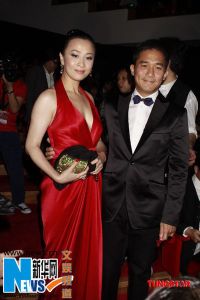
Carina Lau & Tony Leung burn up the red carpet, HKFA 2009
Interestingly, in a repeat of the Golden Horse Awards last year, John Woo’s lavish epic Red Cliff was shut out of the major acting and directing awards (including Tony Leung Chi-Wai’s failure to win his sixth Best Actor award). Red Cliff did clean up in several creative categories such as Best Art Direction and Best Visual Effects, winning five awards. Apparently this year’s nominations were only for Red Cliff 1—Red Cliff 2 will be eligible again next year so maybe then it will make out a little better in the major awards. Ironically, Red Cliff is probably the only film among the award winners that will receive international distribution.

Simon Yam in brown satin, Hong Kong Film Awards, 2009
Poor Simon Yam, nominated for Best Actor for Johnnie To’s Sparrow, went home empty-handed again. But he got to wear a natty two-toned sharkskin suit, white spats, and a spider-motif tie, and looked way too dashing for a man in his fifties. Sadly, Sparrow also lost (to Red Cliff) for Best Film Score, which just goes to show that not everyone appreciated its awesome Martin Denny/Michel Legrand/Henry Mancini homage.
For a full listing of the awards go here.
For lots more pix of celebrity finery go here.
For a great liveblog of the event go here.
And here’s the trailer for Sparrow, for a sample of its excellent soundtrack:
10,000 maniacs + gratuitous Francis Ng pix

Walking softly and carrying a big sword, Francis Ng, Chasing Shadows, 2009
Hey! This blog just got it’s ten-thousandth hit (thanks, Edison) so in honor of reaching that milestone I’m posting some gratuitous pictures of the reason I started blogging in the first place. So here’s a recent publicity still from Chasing Shadows, Francis Ng’s upcoming wuxia movie which is now in postproduction. Note the excellent updo that Francis is sporting, which suggests a touch of goth in the art-direction mix.

Going out for snacks, Francis Ng & friend
Francis has been getting into some extracurricular trouble lately with “production assistants” and “music consultants” while editing Chasing Shadows in Beijing. He’s been spied wandering around late at night with women who are not his wife (who just gave birth back in October), supposedly walking with his arm around one of them and suspiciously playing loud music in his apartment at all hours of the night. It’s all conjecture and speculation, of course, but it makes for good tawdry unsubstantiated gossip so the Chinese press is all over it. Look out for those telephoto lenses, Francis, the next time you visit the 7/11 at midnight!
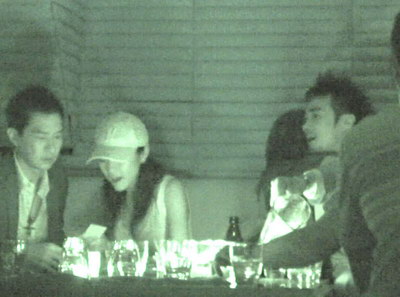
Francis gets caught with his hand in the cookie jar, 2007
Francis is apparently getting a rep for being a playa in Hong Kong entertainment circles. A couple years ago he was caught on video canoodling in a karaoke bar (video below) with Ellen Chen, who played a sexy prostitute alongside Francis in Exiled. At first he denied it but when confronted with the videotaped evidence he ‘fessed up. Luckily he managed to get his wife to publicly forgive him.
Last year he attempted some damage control by releasing a series of pictures of said wife, then pregnant, and himself in marital bliss, with Francis dutifully following her around Hong Kong while she window-shopped. It was also noted that he cooked special soup for her during her pregnancy.
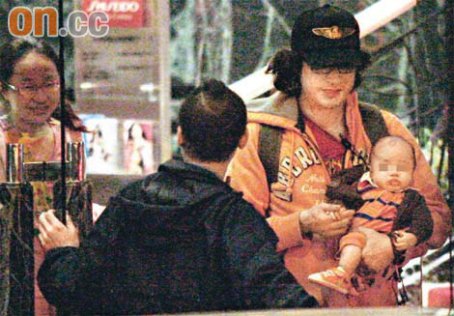
Two of a kind, Francis & Feynman Ng, 2009
Some other conveniently shot pictures from this February showed Francis, wife, and infant son Feynman (named for the physicist) tooling around Hong Kong, with father and son in matching orange outfits.

Method acting, Francis & co-star
But Francis’ attempts to salvage his rep have taken a hit these past couple weeks with the gossip about his purported shenanigans in Beijing. Reports also mention his close personal relationship with starlet Jiang Yi-Yan, who played his mistress in Deadly Delicious. Apparently the two prepped for their make-out scenes by drinking together, which lead to some pretty convincing love scenes.
It’s none of my business what celebrities do in their personal lives but I’m always surprised when they get caught on film or video messing where they shouldn’t be messing. It should be patently obvious that when you’re a movie star, you’re living in a fishbowl and you should be on guard at all times against sneaky papparrazi with hidden cameras. There have been rumors for a long time that a couple of the Heavenly Kings are gay (you get to guess which ones) but there has never been a scrap of supporting evidence to prove it, even with Hong Kong’s notorious media machine constantly on the prowl. So there are three probable scenarios at work here:
1. Francis Ng has really poor judgment.
2. Francis Ng has really lax handlers.
3. Francis Ng has nothing to be guilty about and he just likes having business meetings with his production staff in the middle of the night in his private apartment.
You make the call.
Note: Thanks to dleedlee for the translation help and advice. You rock.
UPDATE: Thanks to the hkmdb for more Francis Ng damage control. How many times can he trot out his wife & kid to show he’s a happily married man? Sorry for the cynicism but it seems awfully calculated to me. That said, I do hope it works because one of the greatest pleasures in my life is watching Francis Ng act on the screen and I’d hate to see his career flounder, for whatever reason. Luckily Edison Chen is providing a much better distraction for the HK press & public so hopefully Francis will get a pass.
Bonus video: Francis Ng & Ellen Chen get busy. Canoodling starts around :46. Warning: bad karaoke singing.
UPDATE 2: Francis has been cast in a couple new Hong Kong flicks, Laughing Gor, which is based on the popular Michael Tse television character, and Most Wanted Terrorist, Dante Lam’s follow-up to Beast Stalker. There’s also the upcoming summer release of Tracing Shadow, which Francis stars in and co-directed, so I guess his peccadillos haven’t hurt his career too badly. Edison Chen should probably get a special award for running interference for everyone these days in Hong Kong.

 beyondasiaphilia
Recent Comments