Just got back from a week in Hong Kong, where I experienced a full-on immersion in Asian films. Officially I was there to present a paper (A God And A King: Chow Yun-Fat and Shah Ruhk Khan) at the Asian Cinema Studies Conference at Hong Kong University, but I also attended the Hong Kong-Asia Film Financing Forum (HAF) and saw a slew of Asian movies. For seven days I talked about, watched, and pondered the state of Chinese-language films in the 21st century. It was pretty much a perfect vacation for an Asian movie otaku like me.
Prior to this trip I hadn’t been to Hong Kong in particular or Asia in general for at least twenty years, but as soon as I got off the plane I was hit with the familiar smell of equatorial humidity. After seeing countless Hong Kong films over the past couple decades it was quite exciting to set foot back in the motherland. Not literally, of course, since my family comes from Guangzhou and Toisan, but close enough as makes no difference. When I got to my hotel room the movie on the TV was An Autumn’s Tale (1987), director Mabel Cheung’s bittersweet story of two Hong Kong transplants living in New York City. It was curious to watch a movie while in Hong Kong about the Chinese diasporic experience–I felt like I’d reversed that journey in some way, going from the U.S. to Hong Kong.
Weekend, Causeway Bay
Interestingly enough, at the ACS conference I later met Stacilee Ford, the author of a monograph on An Autumn’s Tale. A historian by training, Ford also writes about Hong Kong film and she was kind enough to give a copy of her book along with a DVD of Cheung’s film. She was one of the many stellar Asian film scholars attending the conference–the legendary Gina Marchetti said nice things about my presentation; Stephen Teo politely listened to me fangirlishly blather at him; I chatted with Julia LeSage over tea and sandwiches. It was fun to wade knee-deep in Asian film studies with such an illustrious crew and to parse and analyze the movies that I spend so much of my time watching. I felt invigorated and inspired after attending the conference, as well as slightly starstruck by the company I got to keep.
I stayed in Causeway Bay, which was quite fun in an insanely busy and overcrowded way. The streets were packed until late into the night and the walls of the shopping malls were covered in massive adverts both still and moving. Although there have been tensions between mainlanders and Hongkongers in the past few months, that hasn’t prevented Huang Xiaoming’s gorgeous face from gracing huge billboards all over Causeway Bay. Other movie star faces plastered around town include Angelababy, Nicholas Tse, and Aaron Kwok (in various states of undress).
Random food, Hong Kong 2012
During my stay I ate several outstanding meals, from spicy lamb hot-pot with my buddy Jay (new discovery: fried fish skin), to street food dished into Styrofoam boxes on the corner of Jaffe and Fleming Street, to way too many egg custard tarts from the endless tiny bakeries lining Wan Chai Street. When I wasn’t at the conference or watching movies I walked for hours a day, up and down Hennessy Street and through Causeway Bay, taking the MTR to the insanity that is Mongkok on a weekend night, to Victoria Park on a Sunday morning with the picnicking Indonesian and Filipino domestic workers on their day off. By the fourth day the overwhelming bus fumes and secondhand cigarette smoke started to irritate my lower respiratory tract–now I understand why so many people in Asian cities sport surgical masks when they go outside.
Domestic workers picnicking, Victoria Park
I managed to navigate the city fairly easily, in part because English is still one of Hong Kong’s official languages, although I did spend one tedious hour wending my way through a particularly confusing set of overpasses and bridges near the Hong Kong Convention Center. Hong Kong’s public transit system is excellent and multifarious, with subway, trams, buses, and the Star Ferry all rapidly and efficiently moving its 7.1 million residents to and fro–even the escalators in the MTR stations run at a breakneck pace. While much of the city is pretty urban, its underlying natural beauty still shines through. The view from the top of the double-decker bus careening down the hill from Hong Kong University to Causeway Bay one evening was quite lovely, with the white neon lights amidst gracefully drooping banyan trees providing a enchanting contrast.
Triad Simon on the hotel TV
The last night I was in town, after another tasty meal, I was channel-surfing in my hotel room when I came across a random Simon Yam/Lau Ching-Wan/Roy Cheung triad movie on TV. Yam, Lau, and Cheung have of course starred in many classic Hong Kong crime films but this alas was not one of them. But the best part about watching the movie was that one of the film’s fight scenes takes place outside the President Theater, where I’d just seen Ann Hui’s new movie the day before. Those little pleasurable and surreal moments happened all week, where I came across movie locations in real life, thus heightening my fondness for Hong Kong cinema all the more. Now that I’ve been to Hong Kong after so long, I surely won’t wait another couple decades to go back again.
POSTSCRIPT
While waiting at the Hong Kong airport for my plane home I make a horrible discovery. I’m scamming on the free airport wi-fi and surfing the net when I randomly find out that Francis Ng is scheduled to be at the press conference for Ann Hui’s short film My Way at the Hong Kong Film Festival AND I CAN’T GO! I’m getting on a plane in 20 minutes to go back to San Francisco. I feel like a character in a TV melodrama–I should abandon my flight and run back to Hong Kong in slow motion. The plane has been delayed–maybe if I’m lucky it will be cancelled and I can stay another night. Alas for the inflexibilities of modern air travel. Wonder if there is a later flight–
(I did not take a later flight, in part because immigration wouldn’t have let me back into the airport that same day, and I did not get to see Francis Ng in person. Yet another reason to come back to Hong Kong sooner rather than later, in order to more efficiently plan my stalking of Hong Kong movie stars.)
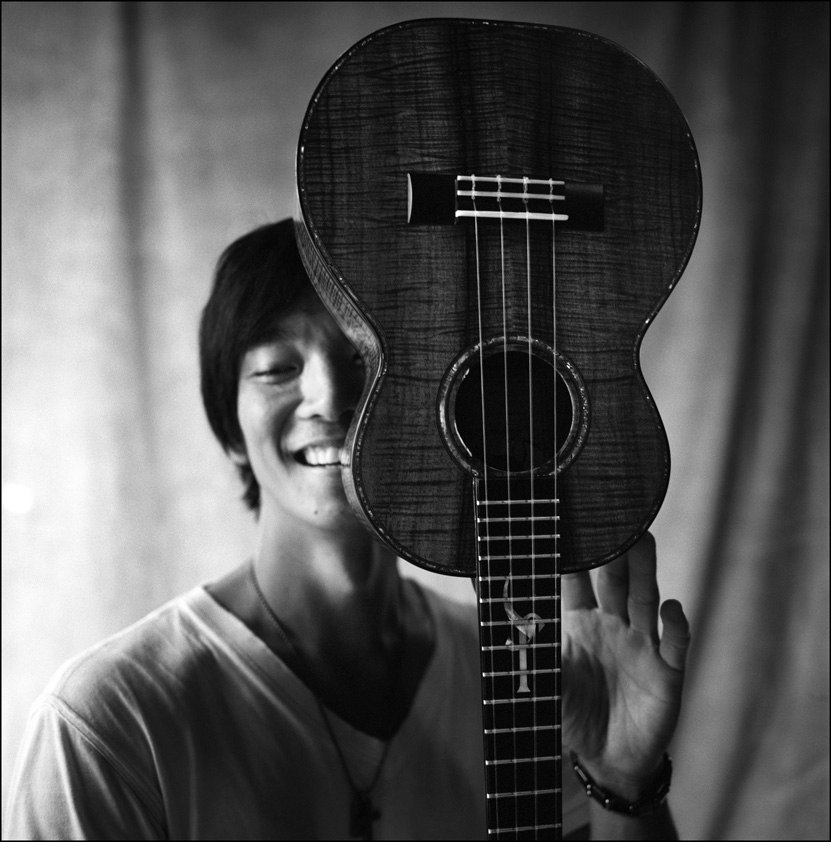
A man and his ukelele, Jake Shimabukuro Documentary, 2012
Now in its thirtieth year, the San Francisco International Asian American film festival offers several treats this year, with some brand new narrative films from Asian American directors. These include features by some familiar names and one remarkable debut by a newcomer that is astoundingly assured and original, demonstrating the continued growth and expansion of Asian American cinema.
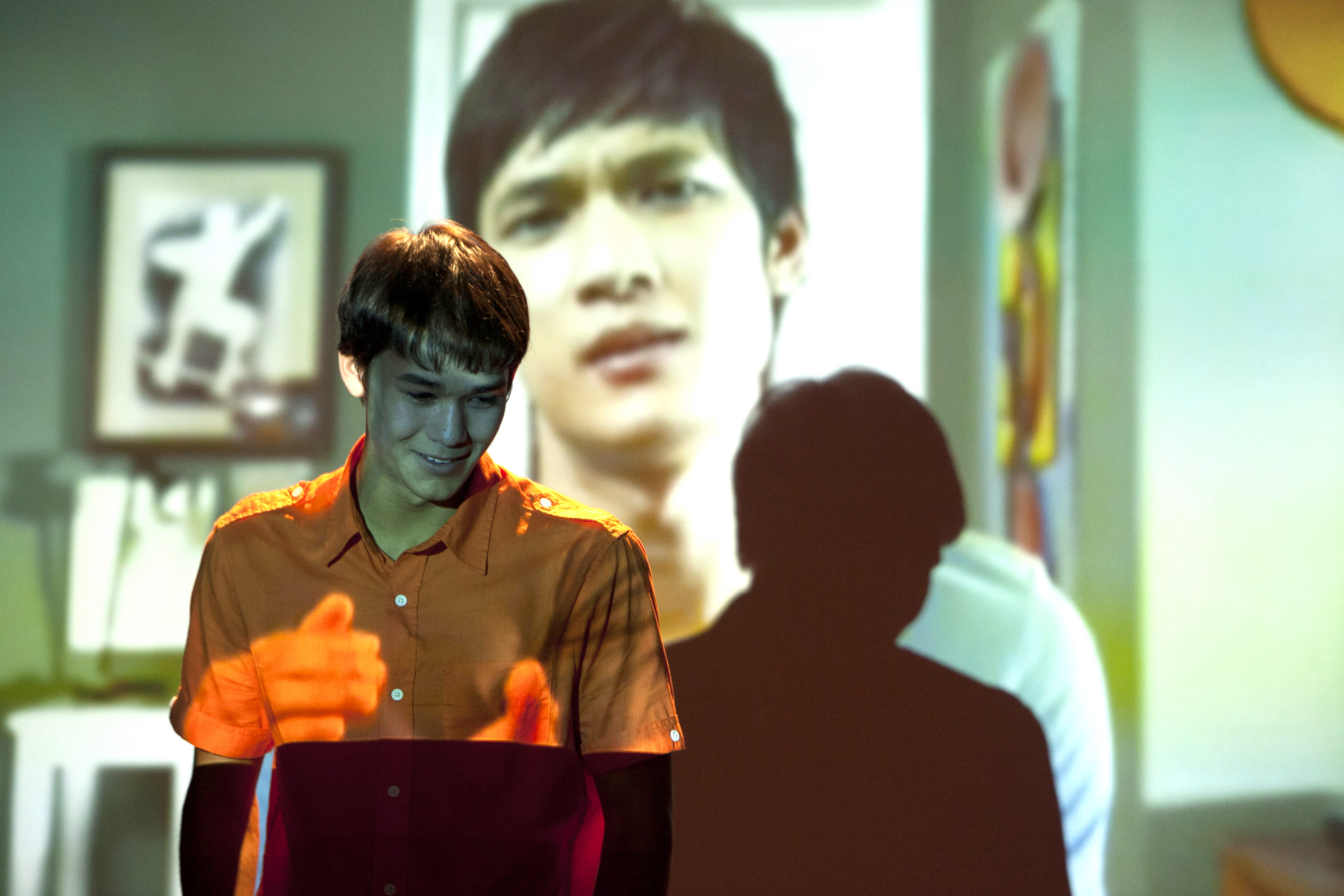
The lucky Kimberly-Rose Wolter with foxy Sung Kang, Knots, 2012
Michael Kang’s Knots is a fast-paced rom-com with great comic performances and a decidedly un-cloying script. As in his debut film, the offbeat adolescent comedy The Motel, Kang has an eye for strange yet engaging characters coping with the bizarre dynamics of dysfunctional family life. Lead actress and screenwriter Kimberly-Rose Wolter is a marriage-phobe whose weird mom and sisters are wedding planners in Hawai’i. Sung Kang (Fast & Furious; Better Luck Tomorrow) is the dreamy love interest.
Yes, We’re Open, directed by Richard Wong (Colma: The Musical) is an entirely agreeable, sleek and charming timepass, with a clever and engaging script (by Colma’s star and screenwriter H.P. Mendoza) and winsome performances from its cast. Lynn Chen and Parry Shen play a comfortable yet slightly bored couple whose relationship has lost its groove, until they meet another couple that tantalizes them with the possibility of an open relationship. The film does a good job capturing the feel of non-tourist San Francisco, with locations at Green Apple Books, the Alemany Farmers’ Market, the Roxie Cinema, and other neighborhood locations, as well as gently lampooning foodies, hipsters, and tech geeks. I haven’t seen Parry Shen in a movie since Better Luck Tomorrow and he does a great job as the slightly neurotic male lead who is somewhat lacking in self-awareness. Lynn Chen is funny and endearing as the other half of the conflicted couple. The movie is not unlike Annie Hall or some of Woody Allen’s other earlier romantic comedies in its young urban groovester milieu, its reliance on a specific cityscape (here San Francisco instead of New York) and its lighthearted take on the foibles of contemporary relationships.
BooBoo on the spectrum, White Frog, 2012
Quentin Lee turns up the melodrama with White Frog, a family tale of a teenager with Asperger’s syndrome dealing with tragic circumstances. Led by a strong performance by BooBoo Stewart (Twilight: Breaking Dawn), the cast also includes some of the best-looking teenagers I’ve seen since Beverly Hills 90210, yet the actors overcome the handicap of their beauty by turning in convincing performances. The story makes a plea for tolerance and understanding of difference, and while it tilts toward maudlin at times, director Lee’s strong direction steers it back toward steady ground. He modulates the somewhat overwrought twists of the narrative by drawing out believable and sympathetic turns from his actors, including BD Wong as the conflicted father and Joan Chen at her dreamy and vulnerable best.
Although it also delves the family dynamics of coping with a tragic loss, Patrick Wang’s In The Family is a horse of a different color. Subtle and smart, the film offers a new way of seeing that diverges radically from the classic Hollywood style of filmmaking–it clocks in at nearly 3 hours, and the majority of the film is shot in long, deep-focus master shots. However, its formal style is in no ways mannered or pretentious. The film begins with a series of long, static scenes that simply explicate the quotidian lives of Joey and Cody, an interracial gay couple living in Martin, Tennessee with their energetic and precocious young son Chip. The long lockdown takes emphasize the normalcy of their everyday life despite a family structure that falls outside of the heteronormative frame. The time that the film takes to establish their deep emotional bonds pays off later in the film as tragic circumstances as well as societal pressure conspire to destroy their idyllic home life. With a reliance on long single takes the acting had better be good and here it’s stellar, anchored by actor-director Wang as the humble yet passionate and devoted father.
Stillness and movement, In The Family, 2012
In The Family is not only one of the best Asian American films I’ve seen in a long time, it’s one of the best films, period, that I’ve seen in a long time. Not to overstate the point but Wang’s compositions and his confidence in the power of the action within the frame are reminiscent of Taiwanese auteur Hou Hsiao-Hsien or Japanese master Yasujiro Ozu. Although touching on several hot-button issues the film deftly sidesteps polemics and instead presents a subtly shaded, morally complex story.
Also of note: Tad Nakamura’s Jake Shimabukuro Documentary, his first feature-length film that centers on the Okinawan-Hawai’ian ukelele wizard. The film follows up Tad’s short docs Pilgrimage,Yellow Brotherhood, and A Song For Ourselves and, although there were no advance screeners of the film, it promises to be as brilliant and moving as Tad’s earlier work. It’s great to know that not all Asian American filmmakers aspire to making narrative films, and Tad is following in the footsteps of Loni Ding, Steve Okazaki, Renee Tajima-Pena, Christine Choy, and his own parents, Bob Nakamura and Karen Ishizuka, all seminal Asian American filmmakers whose documentaries are the gold standard for Asian American cinema. The film festival will feature a program with Tad and his parents, A Conversation with the Nakamura Family, on Saturday, Mar. 10 at 3.30p, where science will surely be dropped.
Bonus: here’s a clip of Jake Shimabukuro from the upcoming documentary playing Queen’s Bohemian Rhapsody.
The San Francisco Independent Film Festival opens tonight at the Roxie Theater and as usual it’s a great chance to see movies that might never again get local theatrical screenings. The festival has gotten more global since its modest inception back in 1998, and this year’s lineup includes three Asian-themed features that demonstrate the SFIFF’s wide range of programming.
From India, director Q’s Gandhu (which roughly translates as “asshole,” “loser,” or “idiot’) is a punk rock, black-and-white opus that follows the daily misadventures of the title character. Gandhu wanders the mean streets of Kolkata with a perpetual scowl, existing in a nihilistic limbo as he fails to connect with most of humanity. Interspersed throughout the movie are short musical rants where Gandhu rails against the injustices in his life and generally blows off steam. Billed as “anti-Bollywood,” the movie is a fun, scruffy alternative to the glitzy, monolithic Hindi-language film industry.
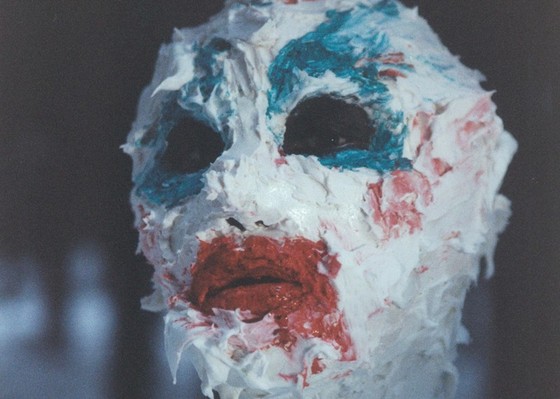
Cake frosting or psychosis? Monsters Club, 2011
Monsters Club deals with a crazed Japanese Unabomber who sees dead people. Bad boy filmmaker Toyoda Toshiaki became interested in Ted Kaczynski’s manifesto and out of that interest grew this dark meditation on life, death, suicide, technology, society and the state. Main character Ryuichi lives in an isolated, snow-covered mountain cabin where he bathes in an icy outdoor shower, cooks spartan meals of cabbage and brown rice, and builds deadly bombs in cigar boxes that he mails to entertainment and journalism CEOs. Yet despite its focus on a mad bomber the film isn’t action-packed—rather, it’s more like a voayge inside the head of the disturbed protagonist. After a visit from his younger sister Ryoichi begins to have visions of his dead brothers, one of whom committed suicide and the other who died in a motorcycle accident. The film’s stark white snowy landscape reflects the vastness of Ryoichi’s psychic anomie as he tries to come to grips with his own violent reaction to what he perceives as the corruption of modern society.
Girljock, No Look Pass, 2011
No Look Pass (dir. Melissa Johnson) follows Emily Tay, Burmese American basketball star for the Harvard women’s team, as she deals with pressures both on and off the court. Included in these are living up to the expectations of her immigrant Burmese parents, who hope she’ll marry rich and settle down after college. Emily’s got other plans, however, including romances with a cheerleader and a female soldier she meets in Germany while playing in the European leagues after graduation. The movie starts strong as Emily deals with the various challenges of her last year in college, but loses steam once she graduates and the narrative moves to Europe. The film also gives short shrift to the Asian American aspects of Emily’s story–at one point she states, “If it were up to me I’d rather be white,” but this startling statement isn’t really followed up. The film also discusses her Burmese parents’ flight from their homeland but doesn’t do much significant investigation into how their refugee experience might impact their aspirations for their children. Instead we see them as stereotypically demanding Asian parents, with (tiger) mom always scowling disapproval despite her daughter’s amazing accomplishments. There are, however, some excellent behind-the-scenes sports moments as we get to witness Emily’s Harvard coach and her coach in Germany both screaming profanities at their respective teams, a tactic that they apparently use to motivate their players.
Although I love the overwrought histrionics of commercial cinema (see Agneepath), that’s certainly not the only way to make a movie. Two films that have been on a lot of last year’s top ten lists have recently made their way to San Francisco cinemas. Nuri Bilge Ceylan’s Once Upon A Time In Anatolia and Asghar Farhadi’s A Separation are both riveting pieces of work that deal with the ambiguity and shades of gray found in complex moral situations
Despite a title that harkens back to Sergio Leone’s expressionistic spaghetti Westerns, Ceylan’s Anatolia is an understated, masterfully told story that sidesteps the conventions of most genre films. The film follows a group of local police through a long night on the Anatolian steppes as they search for the grave of a murdered man. The cops are reluctantly assisted by two perps whose memory of the crime wavers in and out of focus throughout the night.
Moral complexity, Once Upon A Time In Anatolia, 2011
As they drive around western Turkey’s vast landscape the police amiably debate the benefits of sheep versus buffalo yogurt, meticulously tot up mileage for reimbursement, and gossip about who among them might have prostate issues, among other mundanities. The narrative unfolds naturalistically, without a soundtrack, with some of the dialogue seemingly improvised or loosely scripted. Themes and plot points emerge slowly and sometimes indirectly—a character’s offhanded comment in one scene takes on great relevance later in the film. Such restraint and respect for the audience’s intelligence is a welcome change from the hamhandedness of most films, where exposition is a blunt instrument used to club the viewer into submission.
The film presents realistic, complex characters, with killers that weep remorsefully, cops that show compassion for criminals, and men who are overawed by the beauty of a young woman simply serving tea by candlelight. Ceylan’s direction brings a deft and subtle touch to the film—the movie concludes with a matter-of-fact autopsy with the unsettling sounds of the procedure, including cracking breastbones and dripping fluids, emphasizing the operation’s dehumanizing effect. Overall Ceylan’s direction is a lovely thing to behold, as he uses the policemen’s wanderings through the Anatolian countryside as a metaphor for the imprecision and ambiguity of humanity’s moral landscape.
While it also looks at the unclarity of human morality, A Separation’s briskly paced and intense storyline takes a different tack than Anatolia’s slower, more naturalistic tale. Farhadi’s political allegory/family drama starts in medias res, with a middle-class Iranian couple arguing their case directly to the camera (standing in for the off-screen judge). Simin, the wife wants a divorce in order to move to the United States against the wishes of Nader, her husband, who feels a duty and an obligation to remain in Iran to care for his Alzheimer’s-afflicted father. Simin pleads the urgency of going abroad in order to improve the life of their adolescent daughter Termeh, although the details of this necessity are not made clear. The judge dismisses her suit, and Simin decides to move to her mother’s house rather than stay with her husband. The film follows the aftermath of her decision, with this seemingly small action leading to unexpected, ever-broadening repercussions.
The film features an outstanding ensemble cast including Leila Hatami and Peyman Moaadi, who won Best Actress and Actor awards at the 2011 Berlin Film Festival for their portrayals of the conflicted couple. However the rest of the performances are also excellent, including Sareh Bayat as the devout woman that Nader hires to care for his father, and Shahab Hosseini as her hotheaded husband.
Divided, A Separation, 2011
Director Farhadi makes great use of his locations’ architecture, confining his characters in small, enclosed spaces that stifle communication and hinder movement. He also effectively utilizes windows and doors, often framing the actors separated or trapped behind panes of glass. Several times his characters slam or pound on a rattling, fragile stained-glass door, yet it resolutely resists shattering. The door thus becomes a symbol for the delicate yet impenetrable separations of class, religion, and gender that divide Iranian society.
Farhadi also successfully conveys the illogic of government bureaucracy in a chaotic trial that takes place in a cramped, crowded judge’s chambers. Witnesses shout at each other without hesitation, various people come and go, and criminal charges quickly escalate from theft to battery to murder based on hearsay, conjecture, and unproven accusations.
The film ultimately hinges on 11-year-old Termeh’s choice—which parent will she stay with? Her indecision becomes the crux of the film, symbolizing the impossibility of neatly resolving most human conflicts.
Like Once Upon A Time In Anatolia,A Separation eschews a Hollywood ending—loose ends dangle, storylines are unresolved, and characters remain in limbo. As in real life, clear and easy resolutions aren’t a part of the picture.
UPDATE: As expected, A Separation won for Best Foreign-language Picture at this year’s Oscars, following a similar award at the Golden Globes and, as expected, with Israel on the verge of bombing its irascible neighbor, (with the tacit approval of the U.S. government), the film’s increased profile is being spun by all sides. Although director Farhadi used his Oscar acceptance speech to make a plea for tolerance and understanding, the Iranian government claimed the award was a blow against “the Zionist lobby,” while Iranian hard-liner Masoud Ferasati called the film “the dirty picture (of Iran that) westerners are wishing for.” No doubt more mud will be slung on both sides of the propaganda war.
A funny thing happened on the way to the multiplex last week—both of the number one movies in China and in India were playing simultaneously at Bay Area theaters. The Viral Factor, director Dante Lam’s latest actioner, and Agneepath, a remake of a classic 1990s Bollywood revenge drama, both made their way to the U.S. with day-and-date releases in the U.S. and their respective countries of origin.
Agneepath, starring the remarkably hot and handsome Bollywood star Hrithik Roshan, set a record for highest opening day grosses in India and is on its was to joining the 100 crores club, along with blockbusters like Aamir Khan’s Three Idiots and Ghajini, Shahrukh Khan’s Ra.One and Don 2, and Salman Khan’s Bodyguard and Dabangg.
The flick is an old-school vengeance story with new-school stars, including the aforementioned Hrithik, pouty-lipped former Miss World Priyanka Chopra, and hulking villain Sanjay Dutt. It also features an item number with another rising star, Katrina Kaif, who shows off her amazing articulated torso in a fast-paced dance sequence.
The original Agneepath is a cult classic in India and stars OG bad boy Amitabh Bachchan. Both the original and the remake take their title from a well-known poem written by Bachchan’s father, Harivansh Rai Bachchan, and it’s featured prominently in both films. Agneepath roughly translates as “the path of fire,” referring to persevering in the face of great struggle.
Sanjay Dutt, evil, Agneepath, 2012
In the new Agneepath the intensity is turned to up eleven for the duration as first-time director Karan Malhotra brings the high melodrama on a grand scale, including child slavery, beatings and hangings, tattooed villains both bald and hairy, machete-wielding transvestites, and a bride who gets gunned down on her wedding day. Not to mention Hrithik Roshan’s smoldering green eyes simmering with rage throughout the movie. At the plex where I watched the show with a mixed crowd of both desi and non-desi audience members, the stoned teenager in the projection booth had jacked up the theater’s volume to “deafening,” but this only suited the movie’s thundering score and accentuated the general more-ness of the storyline.
In contrast to the theatrics of the plot, Hrithik turns in a subtle, intense performance as the tortured hero bent on avenging his father’s wrongful death. Despite being astoundingly hot, as always Hrithik’s on-screen persona is fairly low-key, downplaying his tousled hair and perfect profile. He’s the dreamboat with a heart of gold who is incredibly handsome, cut and toned, yet remarkably unassuming. At the show I attended, Roshan’s first appearance thirty minutes into the movie was greeted by an elated fan calling out, “I love you, baby!” Her sentiment was quickly echoed by a happy murmur from most of the female viewers in the audience.
Producer Karan Johar’s Sirkian aesthetic is all over this one, thought it’s nominally directed by Karan Malhotra. The film’s emotional palette is completely saturated, with every scene staged for maximum dramatic effect. Yet despite the overall fever pitch, some sequences manage to stand out, including a harrowing lynching that sets the dark and violent tone of the film, and a gorgeous orange-toned set piece that takes place during the Ganesh Chaturthifestival. Malhotra makes excellent use of the festival’s spectacle, skillfully intercutting the riotously colorful celebration with a cat-and-mouse assassination attempt. The film’s sleek production values, its gorgeous and charismatic leading man, and its bloody tale of violent retribution make it a good candidate for crossover success in the U.S. and worldwide.
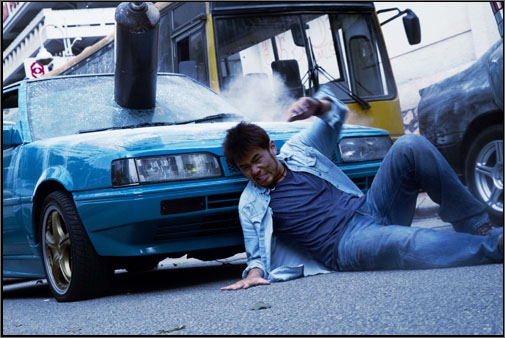
Nic Tse, misunderstood, The Viral Factor, 2012
The Viral Factor, China’s number one movie last week, is a horse of a slightly different color. Part intense and violent actioner, part family melodrama, and part reunification allegory, the film boasts an amazing amount of property and vehicle destruction, and copious quantities of flying bullets, sheared-off limbs, and characters leaping from high ledges. In other words, it’s a typical Dante Lam movie.
The story concerns a pair of estranged brothers, one raised in Hong Kong by his father, and one raised in China by his mother, who of course end up on opposite sides of the law. Fai, the cop, stiffly played by Taiwanese pop superstar Jay Chou, and Yeung, the thief, more energetically rendered by Hong Kong pop superstar Nicholas Tse, meet cute after Yeung busts out of police custody in Malaysia. Intertwined with their nascent reunion is a plot involving a mutant smallpox virus, corrupt cops, and a sleek English-speaking gangster clumsily played by Andy On (here billed as Andy Tien).
Jay Chou, cornered, The Viral Factor, 2012
Director Lam keeps the pace cracking throughout, starting with a blistering car chase and shootout in the streets of Jordan—clearly someone’s been watching The Hurt Locker. Yet in true Hong Kong style the action sequences, smartly choreographed by Chin Kar-lok, are interspersed with a melodramatic family subplot. The hoary cop-criminal brothers theme has a long and venerable history in Hong Kong action movies, perhaps most notably essayed by Chow Yun-Fat and Leslie Cheung in A Better Tomorrow. Here the conflict is much less dramatically rendered, in part because neither Jay Chou nor Nic Tse possess the passion, chops, or sheer charisma of either Chow or Cheung, and as such the brotherly relationship is more friendly than fraught. Tse manages to be convincing as the hotheaded criminal, despite his slight and wiry stature, but Chou doesn’t bring a lot to his role as the cop. Without much fraternal tension the familial dynamics don’t possess a huge amount of urgency, so the storyline’s resolution ultimately lacks impact.
But the action sequences more than make up for this dramatic slackness, and veteran director Lam makes excellent use of enclosed spaces full of whizzing bullets, hand grenades, and sharp objects. As with his two previous films, The Beast Stalker and The Stool Pigeon (both of which also star Nic Tse), all of the lead characters suffer grievous bodily harm from car wrecks, gunfire, blunt force, and other physical trauma, with each eventually sporting the facial scars that have lately become Lam’s signature. Although he handles the fancier set pieces effectively, including a helicopter chase that weaves through a dense jungle of skyscrapers, Lam seems most at home down in the mean streets of Kuala Lumpur. It’s there that the film really gains some traction, with corrupt cops and scraggly gangsters populating neon-lit outdoor food stalls not unlike those found in Lam’s native Hong Kong. Along with Herman Yau, Lam is one of the few directors in the former Crown Colony still making streetwise commercial cinema, and the success of The Viral Factor both at home and abroad will hopefully enable him to find future financing for his gritty, kinetic Hong Kong-style movies.
Bonus beats: Here’s a clip of Chikni Chameli from Agneepath with Katrina Kaif and her amazingly flexible abs. Props for lighting a match on her forearm. Also includes nice cutaways of Hrithik brooding prettily and Sanjay Dutt getting his mean on.
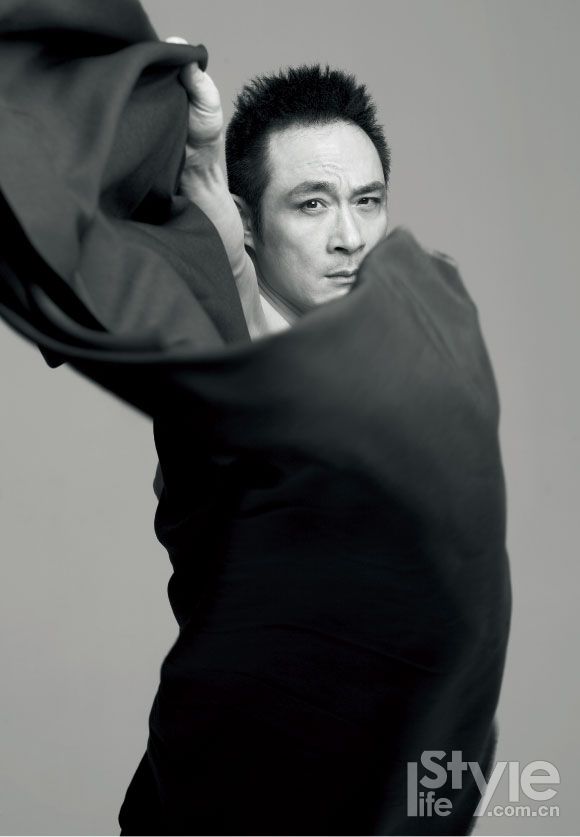
Just a quick fangirl shout-out to Francis Ng Chun-Yu, whose fiftieth birthday is this week. Francis has had a remarkably long and vigorous career that spans four decades (!), from his humble beginnings as a bit player at TVB back in the 1980s through various villainous and supporting roles in the early 90s to his current status as one of Hong Kong’s most popular and well-known actors. He’s part of an amazing generation of male Hong Kong acting talent that came of age in the 1990s, many of whom are also turning fifty this year or in the next few years. Andy Lau Tak-Wah and Anthony Wong Chau-Sang were also both born in 1961—soon to follow are Tony Leung Chiu-Wai (b. 1962), Stephen Chow Sing-Chi (b. 1962), Jet Li (b. 1963) and Lau Ching-Wan (b. 1964). Tony Leung Kar-Fai and Simon Yam each turned fifty a few years ago. All of these actors are still working today, although some of their output has decreased since the heyday of Hong Kong cinema back in the 1990s, and all of them are at the top of their game in terms of skill, talent, charisma, and screen presence.
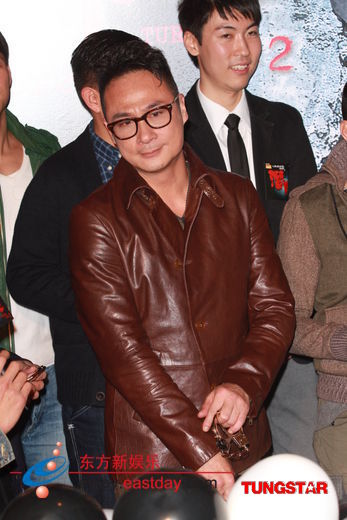
Francis in naugahyde, Laughing Gor 2 premiere, Dec. 20, 2011
What’s perhaps less evident from this list is the dearth of similar talent in the generation of Hong Kong actors following them. The decline in Hong Kong film production in the past fifteen years since the 1997 handover has mightily impacted the development of stars of note, as indicated by the diminishing talent pool among younger actors. Of Hong Kong movie stars in their forties only Louis Koo Tin-Lok is a legitimate leading man, and his acting chops are nowhere near as masterful as the aforementioned group. Of actors in their thirties Daniel Wu and Nicholas Tse Ting-Fung ably fill the movie star niche, but their range and output have yet to reach the scale and impact of the class of 1961-64.
What’s also notable is that, although all of the abovementioned fiftyish movie kings are actively working today, only a handful of their female counterparts are likewise gainfully employed. Most female Hong Kong stars of the same generation have either retired (Brigitte Lin Ching-Hsia; Joey Wang; Chingmy Yau), or moved to television (Anita Yuen; Cheung Man). Anita Mui Yim-Fong died of cervical cancer in 2003. Of those female stars who came of age in the 1990s only Maggie Cheung Man-Yuk, Carina Lau Ka-Ling, Sandra Ng Kwan-Yu, and Michelle Yeoh are still working, although Maggie hasn’t really starred in a film since 2004.
Micheal Tse & Francis Ng meet the press, Laughing Gor 2 premiere, Dec. 20, 2011
So hats off to Francis on the anniversary of his solstice birth—show business is a cruel mistress and it’s a testament to his talent, determination, and savvy that he’s survived so long as a top star. Fingers crossed that he’s on the silver screen for at least four more decades to come.
UPDATE: Okay, I just realized that I accidentally left off Donnie Yen (b. 1963) in my above list. I’m not a huge Donnie fan but he is a big deal now so he’s gotta be included. But it also points out the glaring hole in the martial arts movie world–who will follow Donnie? Wu Jing? Andy On? Collin Chou, for god’s sake? Slim pickin’s–
Today is the third anniversary of the launch of this blog as well as being my birthday, and this year I got an early birthday present. About three weeks ago I was notified that I’d received a Creative Capital/Andy Warhol Foundation Art Writer’s Grant for this little ongoing online experiment (along with a nice cash prize that will ease the pain a bit in the coming year). Although I didn’t start out writing about visual arts or activism those topics have become pretty significant elements in the blog, so it’s great to get some recognition from organizations like Creative Capital and the Warhol Foundation. Needless to say there aren’t a lot of places to go for support, monetary or otherwise, for either blogging or writing about art so it’s awesome that someone is giving it up for us art bloggists.
Back in the day when I started out as a fledgling artist there was a reasonable amount of funding, both public and private, for artists, experimental filmmakers, and other folks working in the creative arts. Very few people actually made a living from grants and fellowships but there was enough modest funding out there that a person had a decent shot at getting a few bones for a short film, a performance piece, or some time in the studio. Although I didn’t rely on grants to do my art I received enough support to help me make the work—when I was fresh out of grad school I got $1,500 from the Film Arts Foundation to make my next experimental video, which absolutely gave me the encouragement to continue in my artmaking endeavors. I subsequently got some shekels from now-defunct granting organizations like the Rocky Mountain Film Center, Art Matters, and New Langton Arts, all of which in turn had gotten some federal funding to support their grants programs. Not that I advocate a complete dependency on feeding from the public trough in order to create artwork, but in many ways those little bits of money here and there were just enough to keep me going and to help me to finish some projects than I otherwise might not have had I gone without.
But in the twenty years or so since my days as a young artist public arts funding institutions like the National Endowment for the Arts have been under constant attack by Republican philistines such as Sen. Jesse Helms and his minions. At its height in the 1990s the NEA’s total budget was about $190 million—peanuts compared to the Pentagon’s 1994 budget of $240 billion, but even back then the right-wing clearly understood the threat to their master narrative that unfettered arts funding posed.
The NEA’s 2009 budget was $160 million, which is about $92 million in 1990s dollars, or less than half its 1990 budget. This reduction has in turn has created a domino effect on arts funding large and small. I sat on the Board of Directors of two different media arts organizations (both of which in their heydays in the 1990s had memberships in the thousands) that have in the past decade become defunct due to greatly reduced federal, state, and private arts funding in this country. Although the worldwide economic recession and the end-times of late capitalism have contributed to its decline, the right-wing’s vendetta on the arts has certainly played a huge part in the atrophy of its funding in the U.S. It’s no secret that the Republican Party has been gunning for arts funding for decades since, unlike the left, it totally understands the significant role that culture plays in shaping public opinion and framing the national debate.
So it’s great that Creative Capital and the Warhol Foundation continue to stand up for fringe elements like arts writers and other troublemakers who insist on stirring things up and questioning the status quo. Their support is a small but significant salvo in the continuing ideological war for this country’s cultural heart and soul.
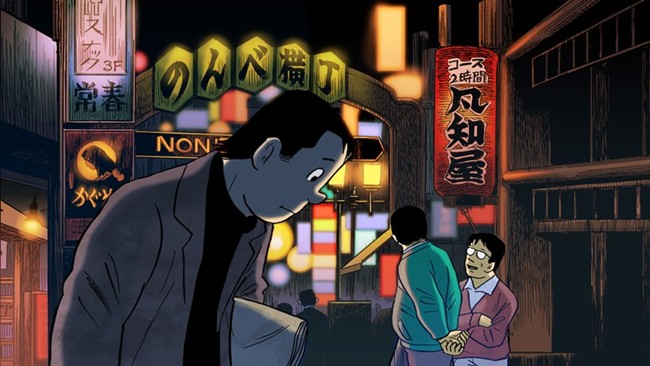
Tatsumi, 2011 San Francisco International Animation Festival
After World War Two Japan was a wreck, economically, physically, and psychologically, yet from those unquiet times came much brilliant and innovative creative work. The legendary Japanese comics artist Yoshiro Tatsumi emerged from this milieu, remaking the manga field and creating a new type of comics, gekiga, that was aimed at the adults rather than children.
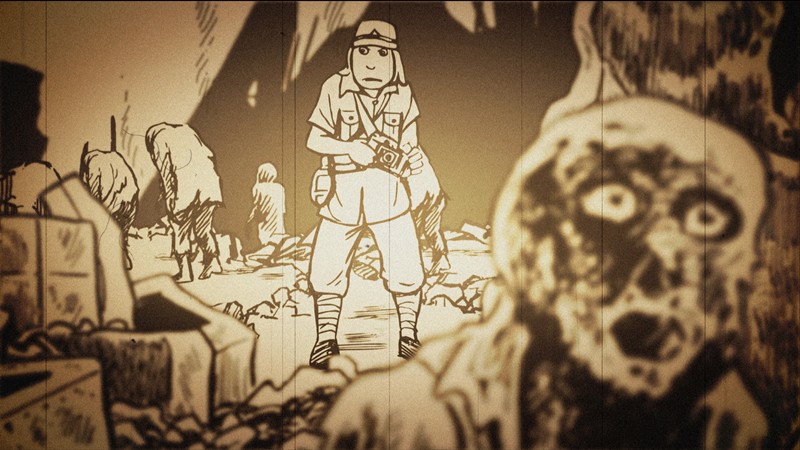
Tatsumi, Eric Khoo’s intriguing feature-length documentary about the master comics artist, screens this weekend as part of the San Francisco International Animation Festival. The film is an interesting hybrid as it both documents Tatsumi’s life as well as adapts several of his manga into short movies with the movie.
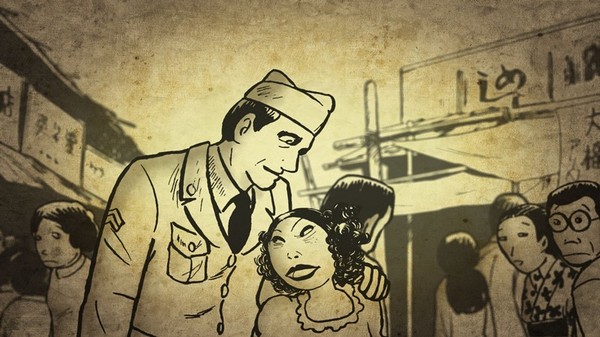
Tatsumi, 2011 San Francisco International Animation Festival
Tatsumi’s raw and gripping, beautiful manga are credited with revolutionizing the form in Japan in the 1950s. Post-World War Two Japan provides the backdrop for his stories and the spectre of a destroyed society attempting to rebuild constantly informs the tone of the work, with sorrow, inhumanity, and alienation the overriding themes. The five short stories animated in Tatsumi are mostly dark tales of human suffering, with protagonists who grapple with oppressive forces beyond their control. “Hell,” which looks at the horrors of the atomic bomb as well as the darkness within one person’s soul, “Beloved Monkey,” a parable about an ordinary man’s descent into misery and “Good-bye,” a tale of an emotionally and physically traumatized woman in postwar Japan, are all terribly sad and yet deeply compassionate stories. At the same time Tatsumi’s stories are leavened with a dark humor that acknowledges the foibles of everyday human existence, most notably in “Occupied,” a black comedy about a children’s book author with a taste for pornographic graffiti who falls into moral disgrace.
Khoo skillfully interweaves these bleak and sometimes harrowing tales with dramatized animated scenes from Tatsumi’s life that in some ways parallel the grim despair of his manga. Although he found some success as an artist as a young man, Tatsumi still grappled with the difficulties of everyday life in postwar Japan and his early career was shadowed by a jealous, bedridden brother who also had artistic aspirations.
Tatsumi, 2011 San Francisco International Animation Festival
Khoo worked closely with his subject on several aspects of the film, consulting with Tatsumi on the film’s color design and other elements of the project. Khoo also used a voiceover of Tatsumi himself recounting his life and work that is laid over animation based on the renowned artist’s visual style. In addition, Khoo took most of movie’s framing directly from the original manga panels, adding some layering and coloring effects but otherwise remaining true to Tatsumi’s compositions.
The result is an engrossing look at one of Japan’s most influential twentieth-century artists, one who used a popular medium to comment and reflect on some of the painful realities of Japan’s postwar existence. Tatsumi’s work is an excellent example of the way in which pop culture can serve both as a catharsis for and a critique of society’s ills.
San Francisco International Animation Festival
November 10–13, 2011
SF Film Society | New People Cinema
1746 Post Street, San Francisco CA 94115
Information: 415-525-8600
Full schedule, film descriptions, and tickets here.
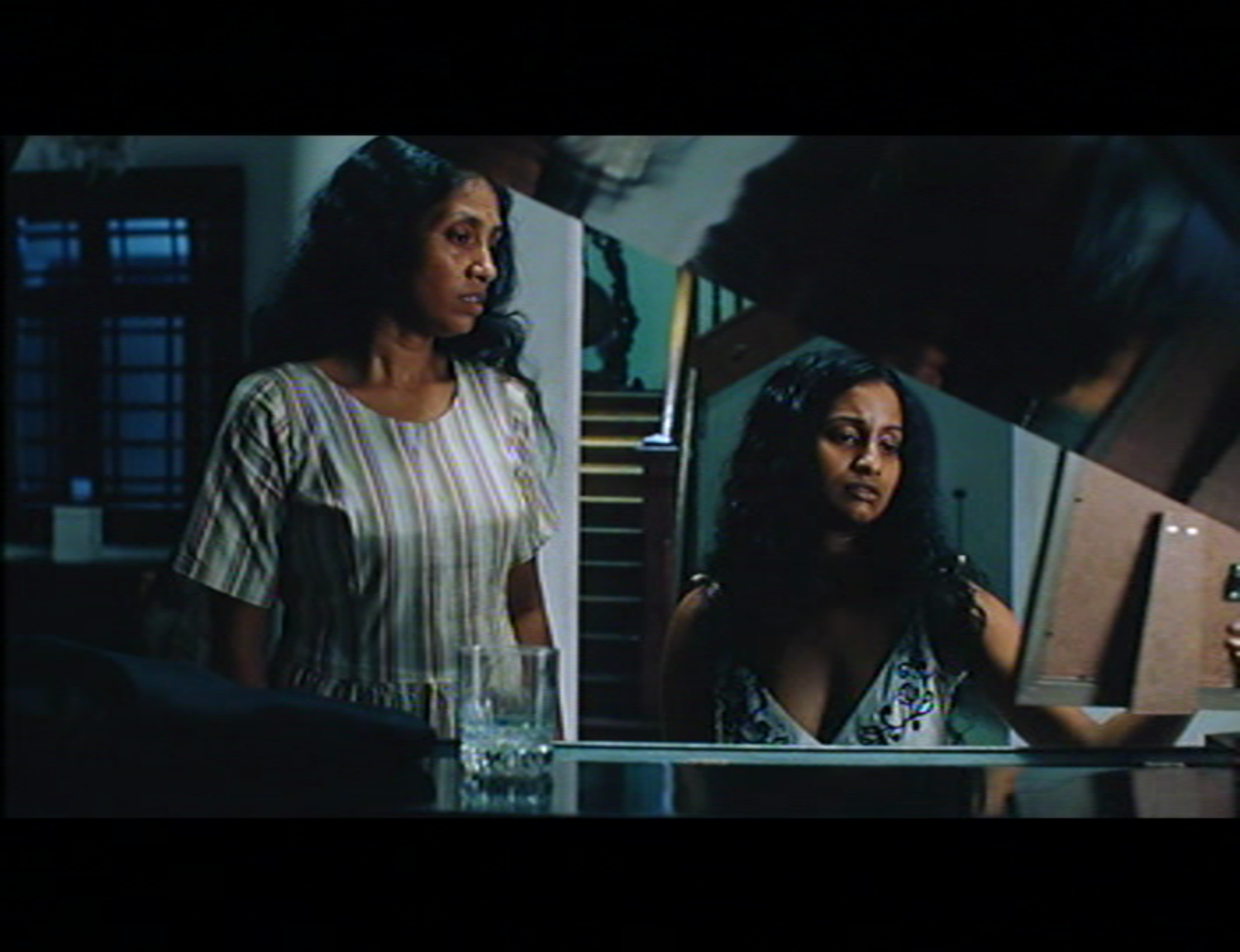
A Letter of Fire, 2011 Third I South Asian Film Festival
This Wednesday sees the opening of the 2011 Third I South Asian Film Festival here in San Francisco, which is one of the best chances to see local theatrical screenings of films from India, Bangladesh, Sri Lanka, Tibet, and the South Asian diaspora. The festival primarily focuses on movies outside of Bollywood’s massive scope, including documentary, narrative, experimental and short films.
According to 2010 U.S. census data, South Asians are the fastest growing Asian American subgroup and have surpassed Filipino Americans as the second-largest Asian American ethnicity. In California the Indian American community grew an amazing 68% between 2000 and 2010, to more than half a million people statewide. This population growth is reflected in the increasing desi flava in pop culture, from banal TV sitcoms like Outsourced to Das Racist showing up on the cover of Spin magazine.
Not to conflate an entire subcontinent’s creative outlet, but since Slumdog Millionaire won big at the Academy Awards back in 2009, the profile of South Asian films has also increased here in the US. Of course Indian-centric theaters such as the Big Cinemas multiplex in Fremont have been showing Indian movies for years, but since Slumdog ran the table at the Oscars, Hindi-language movies have been making more appearances at mainstream cinemas. Just last week, Shah Rukh Khan’s deliriously escapist sci-fi superhero movie Ra.One opened in select theaters across the U.S. and scored the highest per-screen gross of any film that weekend, beating out Puss In Boots and other Hollywood releases.
The Third I festival brings an eclectic mix of films to the Roxie and Castro Theaters. Opening night film Big In Bollywood is a fun, energetic documentary that captures some of the star mania of the commercial Indian movie industry. The movie looks at the experiences of Indian American actor Omi Vaidya, whose meteoric rise to fame in India follows a supporting role in Aamir Khan’s 3 Idiots, the highest grossing film of all time in India. Vaidya’s small but popular role allowed him a taste of the fanatical devotion Indians have for their film stars as the documentary follows Vaidya from his home in Los Angeles to the Mumbai premiere of 3 Idiots. The doc captures the rapid escalation of Vaidya’s public profile as the film smashes Indian box office records. At one point Vaidya makes an appearance to what looks like about 5,000 cheering fans lining several city blocks, reprising some of his lines from the film as the massive throng wildly cheers him on.
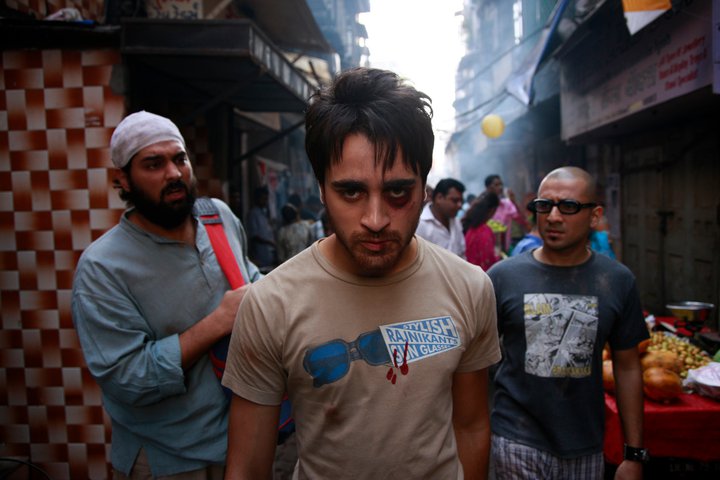
Disheveled Imran Khan, Delhi Belly, 2011 Third I South Asian Film Festival
The festival’s centerpiece movie, Delhi Belly, exemplifies a new breed of Bollywood movies far removed from the conventional Hindi-language film industry. A hilarious, fast-paced, and vulgar flick, Delhi Belly follows the misadventures of three twenty-something slackers as they chase down jewel smugglers, gangsters, and other marginal denizens in India’s capital city, with one of the main characters fighting the severe gastrointestinal dysfunction that gives the movie its name. Running a tidy two hours, the film has none of the song-and-dance numbers for which Bollywood is reknowned (except for one tongue-in-cheek OTT production over the end credits that guest-stars executive producer Aamir Khan) and owes more to The Hangover than Dilwale Dulhania Le Jayenge.
Indian American actor-director Ajay Naidu debut feature Ashes gives a desi spin to the venerable gangster genre. Set in New York City, the film follows a small-time pot dealer (also portrayed by Naidu) as he struggles care for his mentally ill brother while trying to resist falling deeper into the vortex of New York’s underworld.
Dhanush & friend, Pudhupettai, 2011 Third I South Asian Film Festival
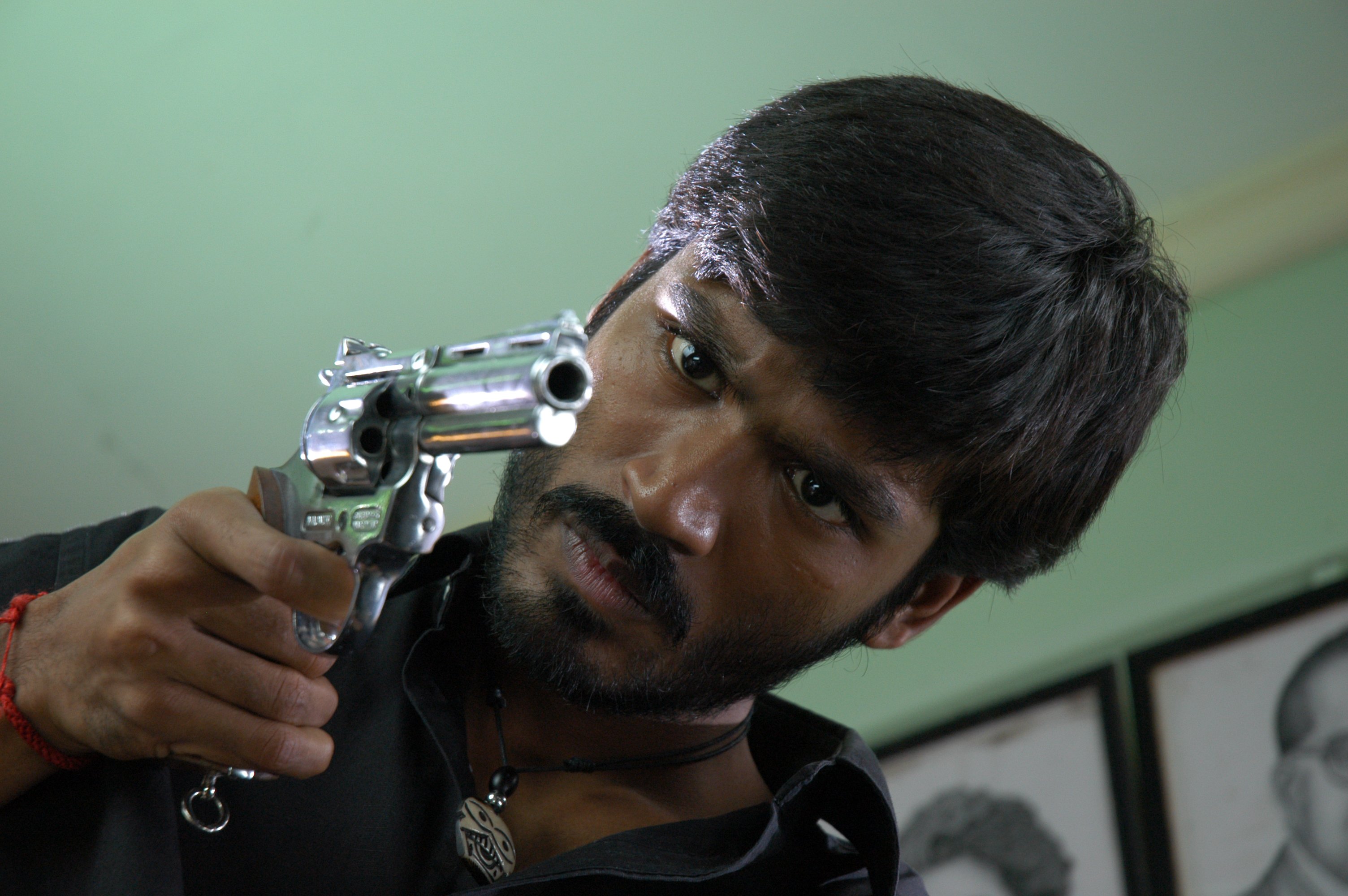
Closing the festival is the awesome-looking Tamil-language crime thriller Pudhupettai, starring the intense and feral Dhanush, which follows the rise of a Chennai gang lord. As seen in the clip below, the film manages to be gritty and realistic while also including outstanding dance numbers. Also notable are Vipin Vijay’s surreal feature length experimental narrative The Image Threads, and A Letter of Fire, Asoka Handagama’s gorgeous drama of a wealthy, twisted family in Sri Lanka. The festival also features two programs, The Boxing Ladies + Shorts: Gender/Sexuality in Frame, and The Family Circus: Local Shorts, which showcase often-overlooked short films.
While South Asian films have yet to completely break through to the mainstream in the U.S., the Third I festival is an excellent opportunity to see the wide range of production from the region and beyond, reflecting the growing desi influence in this country’s cultural landscape.
The 9th Annual 3rd I San Francisco South Asian Film Festival (SFISAFF),
November 10-13, 2011
Roxie Cinema & Castro Theater
Tickets, complete schedule, and film descriptions here.
Brilliant dance number from Pudhupettai, 2011 Third I South Asian Film Festival
My current bank (but not for long), Oakland, Nov. 2, 2011
Nov. 2, 2011: Spent a good part of the afternoon at the general strike demonstrations in Oakland today. I’d fully meant to get in a good day’s work editing my new film but once I got on the twitter feed my good intentions went out the window. The revolution was happening just across the Bay Bridge and I realized that my creative process would probably benefit most from the knowledge that I could glean from what was going on in the streets, not from wrangling with the intricacies of Final Cut Pro.
So after sketching out a couple ideas I decided to skive off the rest of the day and head over to Oakland to show my support for Occupy Oakland. As noted in my last post, OO got worked over pretty good last week by the Oakland Police Department, with help from outside agencies including seventeen different regional police departments and a rumored assist from Homeland Security. After that mess the folks at Occupy Oakland’s general assembly voted for a general strike, which took place in spectacular fashion today.
Keeping it clean, Ogawa/Grant Plaza, Oakland
When I emerged from BART into the warm autumn sunshine at Frank Ogawa/Oscar Grant Plaza this afternoon the area was full of excited but peaceful demonstrators. I met up with fellow Asian American Studies @ SFSU prof Eric Pido and we took a quick spin around the plaza, checking out the various speakers and performances both scheduled and impromptu, as well as the happy line of people waiting for free grindz dished up by the Food Bank and other kindly folks. The outdoor kitchen included an orderly cleanup station that included compost bins and recycling (!)
Marching, Oakland, Nov. 2, 2011
We circled back to the main intersection in time to hook up with a large march headed up Harrison Street toward Grand, passing by the Caltrans building where curious workers stood on the sidewalk watching the demonstration pass by. At one point I observed a couple office ladies confer with each other, then gleefully join the march as it continued up Grand Avenue. I headed back to San Francisco shortly thereafter and followed the rest of the protest on twitter as tens of thousands of people shut down the Port of Oakland and effectively prevented any activity there.
Gift economy, Oakland, Nov. 2, 2011
As I write this around 11pm there are still many hundreds, if not thousands, of people peacefully massing at Ogawa/Grant plaza. The police are keeping their distance, although I’m sure they’re chomping at the bit for any excuse to brutalize the demonstrators. Here’s hoping that things will stay calm, and that this amazing day will continue into the night.
Memory Is Solidarity, diptych, Kenji Liu, 2011
NOTE: Oakland writer and artist Kenji Liu has produced an excellent diptych of posters, Memory Is Solidarity, that connects the dots between Frank Ogawa and Oscar Grant, whose names grace the downtown Oakland plaza that is the hub of Occupy Oakland. He eloquently explains why he thinks that we should remember both Ogawa and Grant, since both were victims of institutional racism–Ogawa was imprisoned at the Topaz internment camp during World War Two, and Grant of course was murdered by BART policeman Johannes Mehserle in 2009. Liu also notes the importance of other significant place-names including Wall Street, which was indeed originally a wall that separated European Americans from the indigenous Lenape people in lower Manhattan. It’s great that the Occupy movement is spawning so much thoughtful and interesting debate–a true sign of a successful campaign.
UPDATE: 11.53p: About 300 police have shown up at Ogawa-Grant plaza. Protestors chanting “Oscar Grant! Oscar Grant!” Teargas and rubber bullets fired–livestream here: http://www.livestream.com/globalrevolution
UPDATE 2: 12.14p. Alameda County sheriffs have just moved on the occupiers in Oakland. Teargas, rubber bullets, and flash grenades being used on protestors. All went down just after the television news crews packed up and went home. Luckily an intrepid cameraman has been livestreaming the entire event. Don’t let this unbridled show of police brutality go unwitnessed.
Alameda County sheriff’s officers prepare to attack peaceful protestors, Nov. 3, 2011
Here’s what I gleaned from the livefeed: Protestors were dancing in the streets just before midnight. Some had occupied a foreclosed building adjacent to the square. A couple hundred police in riot gear arrived and without warning or a dispersal order fired tear gas and rubber bullets into the crowd, which had dwindled quite a bit from earlier that day. Several of the police, who appeared to be from the Concord Police Department among other agencies, had masking tape covering their names and badge numbers. When challenged about this I heard one cop say, “Go home,” to a demonstrator, who then said, “I have a right to peacefully protest.” A hostile bystander then replied, “He has a right to kill you.” When I finally succumbed to fatigue around 1am the police and protesters were still in a standoff.
UPDATE 3: OakFoSho has corrected my belief that a cop said, “I have a right to kill you.” Apparently it was a heckler standing nearby who said it. Fixed.
UPDATE 6: The Occupy movement, and attendant police violence, has spread to the UC Berkeley campus. asiansart.org has a great on-the-ground description of the demo yesterday, including videos of UC police beating on peaceful student protestors.












 beyondasiaphilia
Recent Comments