Posts filed under ‘Uncategorized’
Da Hil Sa’Yo: The Passing of Al Robles
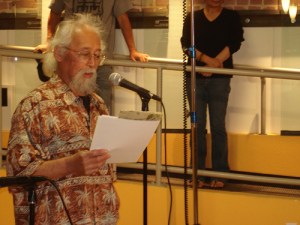
Al Robles brings it, Manilatown Heritage Foundation
I’d only met Al Robles once or twice, but his voice was one that I’d known and carried with me for years. He was prominently featured in The Fall of the I-Hotel, Curtis Choy’s seminal documentary about the long fight to preserve low-income housing in San Francisco’s Manilatown against the onslaught of business interests and developers. The film showed Al alongside his fellow manongs as an organizer and activist in the struggle, and one of the movie’s highlights is his reading of his sublime and evocative poem International Hotel Night Watch, just before all hell breaks loose in the midnight eviction of the I-Hotel tenants. At one point Al’s mellow, emotional voice sings a line from Da Hil Sa’Yo (Because of You), which Choy uses as an ironic refrain throughout the film. I’ve shown The Fall of the I-Hotel every semester for more than a dozen years in my Asian American Film History class and even now I can hear Al’s voice singing that song in my head. Because I’ve seen the film so many times I’ve learned the song by heart, though I speak no Tagalog, and it moves me every time I hear it.
As we all know, after the 1977 eviction the original I-Hotel was demolished in 1981, but through their tireless vigilance community activists, including Al Robles, managed to block the construction of a commercial building and a parking lot on the site. Due to these ceaseless efforts, in 2005 a new International Hotel finally opened, with the Manilatown Heritage Foundation (MHF) on the ground floor and 105 units of low-income housing above. Though nearly three decades had passed since the eviction, two former tenants of the original I-Hotel moved into the new building, along with other low-income senior citizens.

Poet Al, ca. 1975
Last year I took one of my classes to the MHF and there was Al, big as life, chatting with the art gallery staff. I immediately recognized his bushy ponytail and beard, but it was his distinctive voice that confirmed to me his identity. My students and I were a bit starstruck and no one wanted to approach him and say hello, but after a while some of them got up the nerve to introduce themselves and ask him what event he was there for. “Nothing special, I’m just hanging out,” Al genially replied, smiling broadly and shaking everyone’s hands. He went on to explain that he stopped by pretty often just to visit and check in with what was going on at the MHF. After so many years of struggle, maybe he was still savoring the fact that in this case the good guys had won, and that we could chalk up one on the side of justice. Al was an integral part of that victory, through his poetry, his advocacy, and his activism. I’m glad I’ll always have his voice with me.
Update: Here are some nice tributes to Al at various blogs.
RJ talked to Al about being a writer.
Barbara has several poems she wrote for Al.
Mark documented Al’s memorial at MHF.
Theo’s podcast for Al
Alana Robles has a central site for remembrances of Al.
UPDATE 2: Just because it’s divine, here’s Nat “King” Cole’s version of Da Hil Sa’Yo, live in Manila c. 1961. Listening to King Cole’s silken voice tickle this song is heavenly.
UPDATE 3: Briefly stopped in at the massive Al Robles memorial on Sunday at the SOMARTS Gallery and I’m happy to report that Phil Chavez performend “Da Hil Sa’Yo” on his ukelele. Phil noted that this song and “Over The Rainbow,” which Phil also sang, were two of Al’s favorites. It was nice to see folks out in force at the memorial despite the 90 degree heat in San Francisco.
Da Hil Sa’Yo (English translation)
Because of you, there’s a joy in living
Because of you, ‘till death (you) must realize
In my heart I know there is only you
And ask my heart, you’ll know that this is true
Long have I endured in my life
The pain and sorrows from love arise
Then you came and redeemed me, my dear,
My only hope in my darkest fears
Because of you, I found happiness
That to you I offer this love that is so blessed
Though indeed I may be a slave for loving you so true
It matters not to me, ‘cause everything’s because of you
Da Hil Sa’Yo (original tagalog)
Dahil Sa’yo
Sa buhay ko’y labis
Ang hirap at pasakit, ng pusong umiibig
Mandin wala ng langit
At ng lumigaya, hinango mo sa dusa
Tanging ikaw sinta, ang aking pag-asa.
Dahil sa iyo, nais kong mabuhay
Dahil sa iyo, hanggang mamatay
Dapat mong tantuin, wala ng ibang giliw
Puso ko’y tanungin, ikaw at ikaw rin
Dahil sa iyo, ako’y lumigaya
Pagmamahal, ay alayan ka
Kung tunay man ako, ay alipinin mo
Ang lahat ng ito, dahil sa iyo
All For The Winner: 28th Hong Kong Film Awards

Crocodile tears? Xu Jiao wins Best New Performer for CJ7
Just a quick note about this year’s Hong Kong Film Awards, which took place this Saturday. Wilson Yip’s biopic Ip Man, about the martial arts legend, took Best Picture, with Ann Hui winning Best Director for The Way We Are, her docudrama about the New Territories town of Tin Shui Wai. The Way We Are, with its mostly non-professional cast, also won three other awards including Best Actress, Best Supporting Actress, and Best Screenplay. Nick Cheung (The Beast Stalker) nabbed his first Best Actor statue, adding it to his award from the Hong Kong Film Critics’ Society. Cute little girl Xu Jiao won Best New Performer for her crossdressing turn as Stephen Chow Sing-Chi’s son in Chow’s sci-fi blockbuster CJ7. Unfortunately, according to the Golden Rock’s liveblog she gave a horribly fake acceptance speech that included fake crying. I guess child stars are the same all over the world.
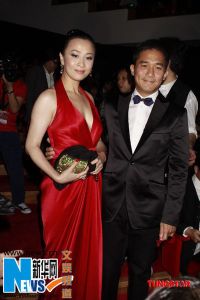
Carina Lau & Tony Leung burn up the red carpet, HKFA 2009
Interestingly, in a repeat of the Golden Horse Awards last year, John Woo’s lavish epic Red Cliff was shut out of the major acting and directing awards (including Tony Leung Chi-Wai’s failure to win his sixth Best Actor award). Red Cliff did clean up in several creative categories such as Best Art Direction and Best Visual Effects, winning five awards. Apparently this year’s nominations were only for Red Cliff 1—Red Cliff 2 will be eligible again next year so maybe then it will make out a little better in the major awards. Ironically, Red Cliff is probably the only film among the award winners that will receive international distribution.

Simon Yam in brown satin, Hong Kong Film Awards, 2009
Poor Simon Yam, nominated for Best Actor for Johnnie To’s Sparrow, went home empty-handed again. But he got to wear a natty two-toned sharkskin suit, white spats, and a spider-motif tie, and looked way too dashing for a man in his fifties. Sadly, Sparrow also lost (to Red Cliff) for Best Film Score, which just goes to show that not everyone appreciated its awesome Martin Denny/Michel Legrand/Henry Mancini homage.
For a full listing of the awards go here.
For lots more pix of celebrity finery go here.
For a great liveblog of the event go here.
And here’s the trailer for Sparrow, for a sample of its excellent soundtrack:
10,000 maniacs + gratuitous Francis Ng pix

Walking softly and carrying a big sword, Francis Ng, Chasing Shadows, 2009
Hey! This blog just got it’s ten-thousandth hit (thanks, Edison) so in honor of reaching that milestone I’m posting some gratuitous pictures of the reason I started blogging in the first place. So here’s a recent publicity still from Chasing Shadows, Francis Ng’s upcoming wuxia movie which is now in postproduction. Note the excellent updo that Francis is sporting, which suggests a touch of goth in the art-direction mix.

Going out for snacks, Francis Ng & friend
Francis has been getting into some extracurricular trouble lately with “production assistants” and “music consultants” while editing Chasing Shadows in Beijing. He’s been spied wandering around late at night with women who are not his wife (who just gave birth back in October), supposedly walking with his arm around one of them and suspiciously playing loud music in his apartment at all hours of the night. It’s all conjecture and speculation, of course, but it makes for good tawdry unsubstantiated gossip so the Chinese press is all over it. Look out for those telephoto lenses, Francis, the next time you visit the 7/11 at midnight!

Francis gets caught with his hand in the cookie jar, 2007
Francis is apparently getting a rep for being a playa in Hong Kong entertainment circles. A couple years ago he was caught on video canoodling in a karaoke bar (video below) with Ellen Chen, who played a sexy prostitute alongside Francis in Exiled. At first he denied it but when confronted with the videotaped evidence he ‘fessed up. Luckily he managed to get his wife to publicly forgive him.
Last year he attempted some damage control by releasing a series of pictures of said wife, then pregnant, and himself in marital bliss, with Francis dutifully following her around Hong Kong while she window-shopped. It was also noted that he cooked special soup for her during her pregnancy.

Two of a kind, Francis & Feynman Ng, 2009
Some other conveniently shot pictures from this February showed Francis, wife, and infant son Feynman (named for the physicist) tooling around Hong Kong, with father and son in matching orange outfits.

Method acting, Francis & co-star
But Francis’ attempts to salvage his rep have taken a hit these past couple weeks with the gossip about his purported shenanigans in Beijing. Reports also mention his close personal relationship with starlet Jiang Yi-Yan, who played his mistress in Deadly Delicious. Apparently the two prepped for their make-out scenes by drinking together, which lead to some pretty convincing love scenes.
It’s none of my business what celebrities do in their personal lives but I’m always surprised when they get caught on film or video messing where they shouldn’t be messing. It should be patently obvious that when you’re a movie star, you’re living in a fishbowl and you should be on guard at all times against sneaky papparrazi with hidden cameras. There have been rumors for a long time that a couple of the Heavenly Kings are gay (you get to guess which ones) but there has never been a scrap of supporting evidence to prove it, even with Hong Kong’s notorious media machine constantly on the prowl. So there are three probable scenarios at work here:
1. Francis Ng has really poor judgment.
2. Francis Ng has really lax handlers.
3. Francis Ng has nothing to be guilty about and he just likes having business meetings with his production staff in the middle of the night in his private apartment.
You make the call.
Note: Thanks to dleedlee for the translation help and advice. You rock.
UPDATE: Thanks to the hkmdb for more Francis Ng damage control. How many times can he trot out his wife & kid to show he’s a happily married man? Sorry for the cynicism but it seems awfully calculated to me. That said, I do hope it works because one of the greatest pleasures in my life is watching Francis Ng act on the screen and I’d hate to see his career flounder, for whatever reason. Luckily Edison Chen is providing a much better distraction for the HK press & public so hopefully Francis will get a pass.
Bonus video: Francis Ng & Ellen Chen get busy. Canoodling starts around :46. Warning: bad karaoke singing.
UPDATE 2: Francis has been cast in a couple new Hong Kong flicks, Laughing Gor, which is based on the popular Michael Tse television character, and Most Wanted Terrorist, Dante Lam’s follow-up to Beast Stalker. There’s also the upcoming summer release of Tracing Shadow, which Francis stars in and co-directed, so I guess his peccadillos haven’t hurt his career too badly. Edison Chen should probably get a special award for running interference for everyone these days in Hong Kong.
A God And A King: Chow Yun-Fat and Shah Rukh Khan
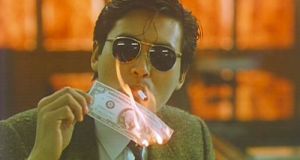
Chow Yun-Fat sparks it up, A Better Tomorrow, 1986
After viewing Rab Ne Bana Di Jodi, my first Shah Rukh Khan film, at this year’s San Francisco International Asian American Film Festival, I’ve been happily watching as many of his films as I can get my hands on. Since I’ve been living under a rock since my first daughter was born in 2000 I’d never had the pleasure of viewing one of Khan’s movies, though I’d heard of him before. His dominance in the Hindi-language film market reminds me of the heyday of Chow Yun-Fat, another flamboyant and charismatic actor who in his prime ruled supreme over his film industry and who in the 1980s and 90s was the undisputed lord of Chinese-language cinema. However, Shah Rukh Khan’s fate may be very different than Chow’s, as he’s so far chosen a different career trajectory than his suave Chinese counterpart.

King Khan looking suave, 2009
Khan, also know as SRK or King Khan to his fans, is the reigning monarch of Bollywood, India’s Hindi-language commercial film business that turns out movie musical extravaganzas by the hundreds every year and that’s one of the biggest film industries in the world. Khan is by nature an exuberant, flashy actor who’s also able to turn in more subtle performances as befits the role he’s playing. Like most Bollywood stars he’s also an excellent dancer and he’s got great comic timing as well. Not to mention dramatically arched eyebrows, dimples to die for and a recently buffed-out bod featuring a killer six-pack. Shah Rukh Khan’s first name literally translates as “face of the king” so it’s fitting that he’s the top actor in Bollywood. The 43-year-old performer has appeared in over sixty films since breaking into the scene in 1992, including Dilwale Dulhania Le Jayenge, which has been running continuously in Mumbai theaters for a record-breaking 700 weeks since its release in 1995. Khan’s won seven Filmfare Best Actor statues as well as many other Indian film awards and his name is a virtual guarantee of box-office success throughout the subcontinent and beyond.

CYF in his prime, The Killer, 1989
Similarly, from 1976-1995 Chow Yun-Fat appeared in more than 70 films in his native territory of Hong Kong and he was the standard-bearer for the heyday of Hong Kong cinema in the 1980s and 90s. His easy charm and screen presence, graceful athleticism and overall hotness garnered him huge critical and popular acclaim in classics like A Better Tomorrow, Hard-Boiled, and The Killer (all directed by John Woo), as well as City On Fire, Prison On Fire, and Full Contact (Ringo Lam), God of Gamblers and God of Gamblers Returns (Wong Jing), and An Autumn’s Tale (Mabel Cheung) and All About Ah-Long (Johnnie To). He was nominated ten times for Best Actor at the Hong Kong Film Awards, with three wins, for A Better Tomorrow (1986), City On Fire (1987), and All About Ah-Long (1989). Like Shah Rukh Khan, his name on the bill meant surefire ticket sales, not only in Hong Kong but throughout most of Asia. At that time the native film industries of Korea, Thailand, Vietnam and other Asian territories had not yet fully developed and audiences depended on Hong Kong imports for much of their cinematic fare. Chow was Asia’s biggest movie star and was commonly known as the “God of Actors.”

Thai Chow, Anna and the King, 1999
In 1997, Chow decided to try his luck in Hollywood, hoping to parlay his huge popularity in Asia into a successful career in the West. Things initially looked promising, with the Los Angeles Times declaring him “the coolest actor in the world,” before he had even appeared in a Hollywood movie. But his first U.S. films, including The Replacement Killers, The Corruptor, and Anna and the King, were less than successful and since then the roles he’s gotten have been a mixed bag. Hollywood has never really figured out what to do with Chow, as evidenced by his relatively paltry output of only nine movies in the twelve years since his trek across the Pacific (compared to his starring in ten films in Hong Kong in both 1986 and 1987 each). He’s been in a few successful films, including Ang Lee’s Crouching Tiger, Hidden Dragon, but his highest-grossing Hollywood film to date has been Pirates Of The Caribbean: At World’s End, where he played a sinister Fu Manchu-type character that was such a stereotypical caricature that the Chinese government trimmed ten minutes of his performance “for vilifying and defacing the Chinese” before allowing the film to screen in China.
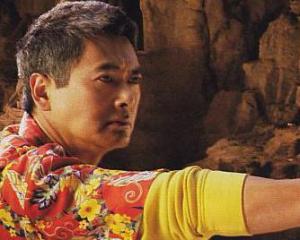
Chow Hawai'ian, Dragonball: Evolution, 2009
CYF’s most recent film, Dragonball: Evolution, is a supporting, Mr. Miyagi-type role that’s a far cry from the towering heroes of his prime. Chow is obviously cognizant of his disappointing travails in Hollywood. In a recent tour of Asia in support of Dragonball: Evolution, he noted, “American audiences know only Chinese kung-fu movies and nothing else about us, and I am not a kung-fu actor. We (Asian actors) don’t get any non-kung-fu or non-gangster/fighting offers. We only get Asian-specific roles. They don’t offer anything non-ethnic to us, not like they would do for Denzel Washington or Will Smith.” Chow has recently returned to Hong Kong cinema, appearing in Ann Hui’s The Postmodern Life of My Aunt (2006). His next role is the lead in the Chinese biopic of Confucius, the seminal Chinese philosopher and scholar, which began shooting this week.
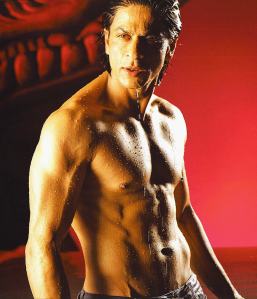
Buff, toned and cut Shah Rukh Khan, Om Shanti Om, 2008
At 43 years old Shah Rukh Khan is now about the same age as was Chow Yun-Fat when he left Hong Kong in 1997 to try to conquer Hollywood. Khan is at the top of his game both as an actor and as a producer, with his Red Chillies Entertainment putting out hit movies like 2008’s Om Shanti Om, which is the second-highest grossing Bollywood film of all time. In 2008 Newsweek named him one of the 50 most influential people in the world (Barack Obama topped the list).
With his fluent English and charisma to burn it might seem like SRK could be a crossover performer, yet when asked if he’s likely to try his hand breaking into Hollywood, Khan is philosophical, noting, “It’s not like Steven Spielberg is waiting with a script for me. I don’t think I’ll ever be offered a great international film in my lifetime, so I’d rather be a king here.” However, SRK fans spotted him paired as a presenter with Slumdog Millionaire star Freida Pinto at the last Golden Globe Awards and in front of an international television audience he came off like a champ.
Khan may also be approaching Hollywood from a different angle, as a mogul rather than as a performer. At one point there were reports that Walt Disney Productions planned to invest $30 million in Khan’s Red Chillies production house. This might ultimately give him more creative control over any roles he might take in Hollywood, since money talks in Tinseltown.
I can’t help but think that SRK has learned something by observing Chow Yun-Fat’s frustrating attempts to break into the top ranks of Hollywood. Other Hong Kong actors also seem to have been watching Chow’s painful efforts and are either approaching Hollywood with caution or are sidestepping it altogether. Comedy superstar Stephen Chow Sing-Chi so far has simply re-packaged his HK product for the U.S. market (Shaolin Soccer; Kung Fu Hustle), though at one point he was slated to star in and direct the big-screen version of The Green Hornet. Instead of braving Hollywood, Francis Ng has polished up his Mandarin and is mostly taking roles in Mainland China productions. And the numbers of Asian American actors who have had to flee from the U.S. to Asia to find success are legion, including Daniel Wu, Daniel Henney, and of course Bruce Lee. Although times are changing and Slumdog Millionaire won Oscar’s Best Picture this year, roles for Asian lead actors are still non-existent in Hollywood (sorry, John Cho). If Chow Yun-Fat, God of Actors, with his mind-blowing charisma, talent, and good looks, has had to struggle to make it in the U.S. and is relegated to crappy films like Bulletproof Monk, why should lesser mortals expect any better?
NOTE: Thanks to my colleague Marlon Hom for the Chow Yun-Fat interview translation.
UPDATE: Rumor alert! I just heard that Chow Yun-Fat is possibly slated to portray Sun Yat-Sen in the new Peter Chan-produced HK blockbuster, Bodyguards & Assassins. No link yet–will update when confirmed.
UPDATE 2: Alas, rumors about CYF playing Sun Yat-Sen were inaccurate. He decided to take the part in Confucius instead. Though I’m sure he would’ve been great as both Chinese icons. Now Leon Lai Ming is rumored to be Sun Yat-Sen, which would probably suck, since Lai Ming is boring, can’t act and has no charisma. But he’s tall, so maybe that’s all that matters.
UPDATE 3: Maybe SRK is heeding Hollywood’s siren song after all. Reports state that he’s angling to meet “serious” film director Deepa Mehta in hopes of landing a role in one of her arthouse flicks, the better to possibly attract the attention of Oscar voters in the near future. If this is indeed true, let’s hope that King Khan fares better than CYF in his dalliance with Hollywood.
UPDATE 4: Go here to read about my night with Shah Rukh Khan, as an extra on his latest film, My Name Is Khan.
Here are a couple Shah Rukh Khan musical numbers for your viewing pleasure.
Dard E Disco (Pain of Disco), from Om Shanti Om:
Suraj Hua Maddham, from Kabhi Kushi Kabhie Gham, with Kajol:
No Regrets: San Francisco International Asian American Film Festival, part two

Xun Zhou abuses her lungs, The Equation of Love and Death, 2008
I’m sick as a dog this week with a pernicious chest cold and I blame it all on the San Francisco International Asian American Film Festival. I’d just started recovering from version one of this malaise when the Film Fest started last Thursday. But I had so much fun at the Opening Night party, the screenings, the receptions and the afterparties that I made myself thoroughly ill again. So now I’ve got version two, with a hacking cough that won’t go away. I’m chugging Wal-Tussin straight from the bottle and using up all of my Tiger Balm to try to get some sleep at night. But I’ve got no regrets, even when I’m coughing uncontrollably at three in the morning.
The SFIAAFF was especially good this year, with an embarrassment of riches of Asian American and international features, documentaries and shorts. I previewed several programs before the festival but I also went to see a bunch during the festival itself. It’s a testament to the depth and quality of the programming that the festival could only find a slot at noon on Saturday for an excellent film like Cao Baoping’s The Equation of Love and Death, starring chain-smoking A-list Chinese actress Xun Zhou, which in other years or at other festivals might have been an Opening Night movie. It’s equally telling that the screening at the cavernous Castro Theater was crowded with viewers despite its off-hour scheduling. It was like that for every show that I went to, including a Wednesday night short film program, the romantically inclined It’s Easy Because You’re Beautiful, which included Object Loss, A. Moon’s excellent, wistfully sad meditation on adoption, loss and patterns of behavior, as well as several slick Korean shorts that played like miniature versions of Coffee Prince.

Anushka Sharma & Shak Rukh Khan get down, Rab Ne Bana Di Jodi, 2008
I also had the pleasure of experiencing my very first Shah Rukh Khan film, Rab Ne Bana Di Jodi, which has made me a fervent fan of the sexy and charismatic King of Bollywood. I’m a sucker for men who can dance and Shah Rukh Khan brings it on that count in spades.
The parties, social events, and casual meet-ups with old friends make up the other half of the festival and they were especially fun this year–sometimes the SFIAAFF feels like one big frenetic Asian American filmmaking convention. I talked to a half-dozen people who had specifically planned their vacations around attending the festival, including journalist, author and muckracker Pratap Chatterjee, who showed me his string of tickets to about two dozen festival shows.

Trending
I also noticed the latest trend in headgear for fans of Asian American cinema. Everywhere I went there were stylin’ dudes sporting porkpie hats—at one party I counted twelve wearers of this little topper, including two of the bartenders.
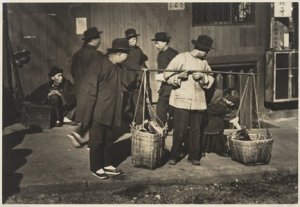
Queues and toppers, San Francisco Chinatown, Arnold Genthe, 1895
Of course porkpies and other fashionable hatwear go way back in Asian American history. Turn-of-the-century San Francisco Chinatown was full of men in queues and felted hats.
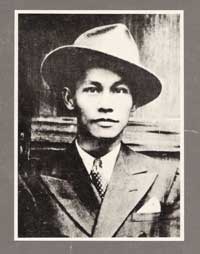
Carlos Bulosan, fashion plate
Famed Pinoy author and poet Carlos Bulosan often wore a tasteful fedora in his publicity stills, and the porkpie was favored by other manongs as well.

Kaba hat, 2008
And Kaba Modern brought the porkpie to last year’s edition of America’s Best Dance Crew on MTV.
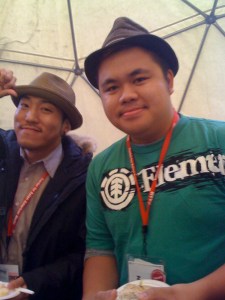
Tad Nakamura and Kevin Lim, porkpiers
So it shouldn’t be a surprise that the porkpie has found favor in the Asian American scene. Here’s a couple natty porkpie wearers at the festival.

Mas porkpie, Temple Nightclub, SFIAAFF Closing Night Party, 2009
And here’s the picture I wished I’d taken that I cribbed from the festival’s Best Photo contest website.
So I’m laid up with a cold this week, rewatching my collection of Francis Ng dvds and trying to keep up with my responsibilities like feeding my children and editing my film. But even though I overdid it, the festival only comes around once a year and I’m glad to have been able to participate in such an excellent, significant event. As someone once observed, Chuck D. claimed that rap music is the CNN of the black community and filmmaking has become the Asian American equivalent. Maybe it’s because it’s a little less scary for Asian American parents if their kids want to make movies instead of, say, becoming performance artists or abstract painters, but the Asian American film community is alive and kicking and the SFIAAFF’s continued health and well-being is a testament to that fact. Here’s hoping it continues to successfully channel our cinematic glories for many more years to come.
Update: Xun Zhou just won Best Actress at the Asian Film Awards in Hong Kong, for The Equation of Love and Death.
Get It While It’s Hot: The 2009 San Francisco International Asian American Film Festival

Hee Yeon Kim and Song Hee, Treeless Mountain, 2009
The 2009 version of the San Francisco International Asian American Film Festival starts next week (March 12) and runs until March 22 in San Francisco, Berkeley, and San Jose. Herein follows some of the movies I previewed from the festival, which is in its 27th year and will include 108 films in its ten-day run. The SFIAAFF is the biggest and one of the oldest of its type and kicks off the season for Asian American festivals around the country. Even if you don’t see something you like described below there are plenty of other treats to be had—go to the SFIAAFF website for more details. And buy your tickets early—shows sell out fast and some of these movies will never have another theatrical screening in the Bay Area again.

Ha Jung-Woo and Jeon Do-Yeon duke it out, My Dear Enemy, 200
My Dear Enemy, Lee Yoon-Ki
Powered by a charming, engaging performance by the talented Ha Jung-Woo, who may be becoming one of my favorite actors, this romantic drama follows two former lovers as they travel the streets of Seoul trying to settle a debt. Ha plays a ne’er-do-well ladies man and unemployed gambler whose fed-up ex-girlfriend (Jeon Do-Yeon, recent Best Actress winner at the 2007 Cannes Film Festival) finds him at the racetrack and demands repayment of a loan she’d made him before their breakup. The film skips lightly from one situation to the next, along the way commenting on life, relationships, intimacy, and dreams. One memorable scene features a newlywed couple whose husband is obsessed with his wife’s past lovers; another takes place at a barbeque party with a Korean motorcycle club. Throughout the film Ha and Jeon maintain a wary relationship with each other, trying to resist falling into old patterns while keeping from strangling each other.

Kim Yoon-Suk has a rough night, The Chaser, 2008The Chaser, Na Hong-Jin
A Korean movie of a completely different sort than My Dear Enemy, The Chaser also starts the versatile and charismatic Ha Jung-Woo, this time as a psychotic serial killer on the loose in Seoul. Brutally violent, with a touch of horror film layered on its crime-drama scenario, the film is a cat-and-mouse game between Ha’s nasty murderer and Kim Yoon-Suk’s world-weary pimp. The film features some gorgeous night-photography and good performances from its two lead actors but with a bit too much fetishized violence even for me, as well as too much psychosexual posturing, The Chaser doesn’t manage to transcend its genre into greatness.

Balmy Alley, Fruit Fly, 2009
Fruit Fly, HP Mendoza
Mendoza’s follow-up to the divine Colma: The Musical, and his directorial debut, Fruit Fly follows the story of Bethesda, a nice Filipina performance artist from Maryland (duh) who’s looking for her biological parents. Set amongst San Francisco’s queer boho crowd, the film lacks Colma’s poignancy and sympathetic characters, as well as Colma director Richard Wong’s cinematic flair. Fruit Fly makes good use of its San Francisco setting, including scenes in Balmy Alley, Dolores Park and various other real-life, non-touristy locations, and it has a great title sequence and nice graphics throughout, but it doesn’t quite have the urgency of Colma’s coming-of-age story, with Bethesda’s search for her birth mother shunted to the side in favor of backstage antics involving a vain magician and a few too many musical numbers with the quirky patrons of a gay bar.
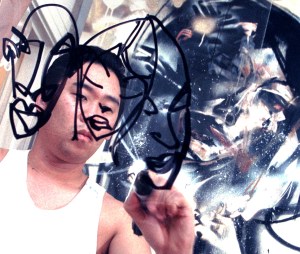
David Choe, insane, Dirty Hands, 2009
Dirty Hands: The Art and Crimes of David Choe, Harry Kim
A lively and comprehensive portrait of batshit-crazy bad-boy Korean American artist David Choe, Dirty Hands follows Choe from his beginnings as a grafitti artist and tagger in Los Angeles to his current status as a blue-chip gallery artist. Choe is an insane mo-fo, but in a productive, creative way, channeling his self-described kleptomaniac, sex-addict, bipolar, OCD personality into a highly successful career as an illustrator and painter. Choe energetically narrates his own story, describing his experiences as an illustrator for porn magazines, his stint in a Japanese jail (for punching a plain-clothes cop), his discovery of and subsequent disillusionment with God, and his various trips to the Congo and other non-industrialized parts of the world. The doc goes easy on its wacky subject, skimming over the misogyny and messed-up violence in Choe’s art in favor of portraying him as a happy lunatic, but it’s a compelling portrait nonetheless. We also meet his long-suffering girlfriend, his family, and his friends, all of whom think Choe is the best thing since sliced bread. The focus is a bit too Giant Robot-hipster-Asiaphile-friendly to be a truly great film but it does a good job of capturing Choe’s insane outlook on life. As he succinctly notes, “If I’m normal in real life it fucks up my art.”

Que paso? Nuevo Dragon City, 2008
The Secret Lives Of Urban Space
This program of short films includes a couple intriguing selections. Sergio de la Torre’s Nuevo Dragon City focuses on a group of Mexican Chinese teens who gradually barricade themselves in an appliance store. Shot without dialog with beautiful cinematography, their mysterious actions lead to serenity. No answers are given for their inexplicable acts but the imagery is lovely and the mood is profound.
Chris Chong’s Block B is a single static long shot of a high-rise housing project in Malaysia, moving from darkness to daylight and back through to night. The film’s bare-bones structure forces the viewer to focus on small mundanities during its twenty-minute running time—a woman drops a piece of laundry from a balcony and it flutters down the side of the building. Children run from one side of the frame to the other. Conversations in Malay emerge and retreat. At some point fireworks go off. Though some might find it incomprehesible, the film is beautiful and intriguing and truly challenges the way that we are accustomed to watching the moving image.

Two good kid actors, Children of Invention, 2008
Children of Invention, Tse Chun; Treeless Mountain, So Yong Kim
One of two “recession dramas” that I previewed, this engaging film looks at the tribulations of a Chinese American family in Boston falling through the cracks of the economic crisis. A single mom with two young kids gets caught up in “multi-level marketing,” a fancy name for a pyramid scheme that preys on immigrants and poor people. After mom gets thrown in jail as a material witness, the two kids are forced to fend for themselves. As the Top Ramen runs out and no adults are in sight, what will happen to our young protagonists? The movie has good, non-cloying performances by its two kid actors, following their fate in a realistic, unsentimental way.
A similar fate faces the two kids in the second recession drama, Treeless Mountain, So Yong Kim’s follow-up to her subtle and intriguing debut film In Between Days. Set in South Korea, the film follows two young sisters whose mother leaves them with an alcoholic auntie when she can no longer support them. Said auntie turns out to be an indifferent caretaker and the girls eventually end up catching, roasting and selling grasshoppers to local schoolkids to assuage their hunger and to make ends meet. Then things really start to go downhill. The movie is grim and beautiful, with an observational style that never veers into melodrama or histrionics, and its conclusion demonstrates the redemption of small kindnesses in the face of hardship.

The late, great Chris Iijima, A Song For Ourselves, 2009
A Song For Ourselves, Tad Nakamura
This short documentary centers on Chris Iijima, the seminal sansei musician who, along with Charlie Chin and Nobu Miyamoto, recorded A Grain of Sand, one of the most significant albums from the 1970s Asian American movement. Layered and emotional, the film looks at Iijima’s community activism, his music, and his later career as a lawyer and professor in Hawaii until his untimely death in 2005. Nakamura follows up on the promise of his earlier docs, Yellow Brotherhood and Pilgrimage, investigating the ties of family, friends, community, and creativity in a moving, resounding portrait of a singular personality.

Lam Yiu-Sing, future idol? High Noon, 2008
High Noon, Heiward Mak
24-year-old Heiward Mak brings it in her debut feature that follows a group of teenage Hong Kong schoolboys as they do drugs, chase girls, fight, eat and get into trouble. Shot on video, with frenetic computer graphics, the movie nicely captures the disposable lifestyle of post-millennial youth. The movie gets bonus points for featuring a sex scandal spread virally via cellphones (the internet is so five years ago). As the characters’ mischief escalates into more serious business, Mak’s strong visual sense and her sure direction of her peers makes the film a quintessential look at teenagers slamming up against their own mortality. Interestingly, Mak almost won the Hong Kong Film Critics Society’s 2008 Best Director award for this flick, nearly upsetting 30-year-veteran Ann Hui for the distinction. Side note: As I watched the movie I couldn’t help wondering which of the cute boys would be picked for this year’s idol status by the relentless Hong Kong media machine. Probably the dreamy one with the orange hair, though lead actor Lam Yiu-Sing has a quiet charm as well.
How Can I Miss You When You Won’t Go Away? Edison Chen Sex Scandal

Edison and Ah Gil, cropped, 2008
After several months of quiescence, the Edison Chen sex photo scandal has reared its salacious head again. I’ve resisted writing about it because God knows you can get plenty of information about it elsewhere, but recently this blog has been slammed with hits from people searching “edison chen sex photos” and related terms, even though a previous post only briefly mentioned our boy Edison. It’s probably not significant traffic but it shows that the the subject is still one of the hottest ones on the internets even a year after the whole scandal broke in January 2008. Last year in China Edison Chen was most-searched subject on google and yahoo, ahead of the Beijing Olympics, facebook and iphone. Suffice to say that the Hong Kong public and the media were pretty overexcited by the whole event since it involved pop stars, nudity, adultery, and sex.
Now that Edison’s in a Vancouver court starting to spill the beans about the incident, his fellow erstwhile naked Hong Kong celebrities Gillian Chung and Cecilia Cheung have also started to surface and blab about the whole thing again. Full details as well as hundreds of images from the scandal can be easily found elsewhere but needless to say that last winter the Hong Kong media had a field day when naked sex pictures of several of their beloved idols flooded the internet, all from the misappropriated laptop of rising pretty-boy actor Edison Chen. After about a monthlong firestorm during which a seemingly endless number of the amateur-porny pictures popped up on the web, the whole incident climaxed (sorry) with a grim-faced Chen announcing his retirement from Hong Kong entertainment in order to devote time to “charity work” in Canada. Not to mention fleeing the pissed-off Hong Kong triad members who wanted to chop off one of his hands for killing the careers of several of golden-egg layers like Gillian and Cecilia.
Gillian, aka Ah Gil, aka one half of the phenomenally popular Cantopop girl group The Twins, is now testing the waters for a comeback after last year’s sleazy & unflattering pictures of her and little Edison in flagrante delicto annihilated her image as a squeaky clean Jade Girl. At a recent fashion shoot several smart-ass Hong Kong truck drivers heckled her as she left the photo studio, calling her “naïve Gil.” Maybe she needs to wait a bit longer until things die down some more.

Cecilia talks Edison, February 2009
Meanwhile, Cecilia Cheung, aka 2003 Hong Kong Film Awards Best Actress, aka wife of fellow superstar Nic Tse, has come out of hiding with a high-profile interview on Hong Kong television in which she calls Edison a fake, a hypocrite and a liar. Hey, Cece, what do you really think about him?
For his part, Edison has claimed that he would do “anything” to protect “the ladies” involved, though exactly what that might entail is sketchy. In the meantime he’s publically named five of his partners in the pictures for the first time and claimed that several of the photos were actually taken by the women in question. Way to blame the victim, dude.

Edison cleans up his image, Singapore, February 2009
He’s also been quietly trying to revive his acting career–his 2008 movie The Sniper, which was delayed after last year’s naughty pictures surfaced, is playing at the Hong Kong International Film Festival next month and he recently made an appearance at a Singapore Carl’s Jr., though of course he’ll be donating all proceeds “to charity.” Edison’s mom has also spoken up in support of her boy, saying that Edison would rather go to jail to protect “the girls.” Huh, no kidding.
Anyways, I doubt that a media ho like Edison will be able to resist the spotlight for long. We’ll see how the Hong Kong public responds and if fans forgive and forget, or if they continue to excoriate poor Edison and his compatriots. Either way I guarantee the Hong Kong media will be all over this story until we’re all heartily sick of it.
More on this as it develops, or not, depending on how intense and tedious the media hype becomes.
UPDATE: A quick shout-out to the venerable Hong Kong Movie Database Daily News forum, which provided most of the links and images in this posting. Thanks for being you.

Anthony Wong says, "Keep clear of Hong Kong, Edison"
UPDATE 2: Okay, a quick update after a flurry of useless overreporting. Some killjoy has sent Edison Chen a bullet via the US Mail accompanied by a death threat stating, “We hope Edison Chen will take this warning seriously, otherwise his personal safety will be threatened,” and goes on to make more unfriendly remarks about Edison and his well-being. The ever-sensible Anthony Wong Chau-Sang, who is Edison’s godfather, commented, “This time they send a bullet, next time they send a bomb?… When I meet Edison for a meal he will have to wear a bullet-proof vest and helmet!” Anthony had previously warned Edison to stay out of Hong Kong or he’d kick his ass. Tough love from the Bunman.
81st Academy Awards: Slumdog Takes It

Azharuddin Mohammed Ismail, Slumdog Millionaire, 2008
Crazy as this may seem, tonight I was rooting for a movie I have yet to see. And when Slumdog Millionaire won Best Picture I was jumping-out-of-my-seat happy. Identity politics at its worst? Maybe—but for me it was the joy of seeing Bollywood invade Hollywood, and Asians in the inner circle at last. (My heart was broken a couple years ago when Brokeback Mountain lost to Crash, not only because Brokeback was a much superior film but because I feared that homophobia as well as racism might’ve contributed to its defeat.)
The night started with a series of small wins for The Curious Case Of Benjamin Button and I fretted that it might be business as usual on Oscar night again, with the bland, big-budget, eurocentric Hollywood product taking the evening’s prizes. But at some point in the evening Slumdog started to pick up some awards and I started to feel a bit more hopeful. Then when composer A.R. Rahman won for Best Score and gave his acceptance speech in English and Tamil, followed shortly by Slumdog’s Danny Boyle taking Best Director (plus the film’s five other subsequent awards), I sensed the tide was turning. And, though it had nothing to do directly with Slumdog, when Sean Penn won an upset Best Actor victory against favorite Mickey Rourke, and gave a shout-out to our “elegant’ new President as well as calling shame on those who supported Prop. 8, I knew there was a paradigm shift in the making. Slumdog won the big prize immediately afterwards and the evening was complete.
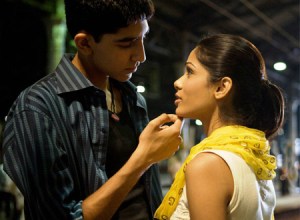
Dev Patel & Freida Pinto looking pretty, Slumdog Millionaire, 2008
So tonight was a great win for Asian cinema, even though Slumdog is directed by an Englishman and strictly speaking, isn’t a Bollywood product. But its subject matter, stars, themes, and aesthetic are decidedly South Asian and the fact that the Academy chose to honor it over Brad Pitt’s conventionally Hollywood star vehicle seems somehow significant to me. Dare I say that it reminds me of Barack Obama and the barriers he’s shattered with his election? Some might argue that equating the Best Picture Oscar with the election of the U.S. President is a bit of stretch, but I’m in the business of cultural criticism and I think Slumdog’s victory is pretty relevant. It was thrilling to see the huge Slumdog contingent, British, Indian, and everything in between, up on the stage at the Academy Awards, which is the primary symbol and celebration of Hollywood’s cultural hegemony. So, yeah, I need to watch Slumdog soon, but because of its big win tonight, I feel like I’ve already seen what I need to see. In some small way, tonight the margins have moved a bit closer to the center.

The Slumdog crew at the Oscars, 2009
UPDATE: Breaking it down, via The Inspired Economist–a good, measured discussion of Slumdog, including a mention of the the film’s “poverty porn.”
The Tyranny of Beauty: transPOP! Korea Vietnam remix

Area Park, Three second-frozen defectors from North Korea, 2006, transPOP! Korea Vietnam Remix
Just got back from the symposium attached to the awesome art exhibition, transPOP! Korea Vietnam remix, which is at the Yerba Buena Center for the Arts in San Francisco through March 15. The show looks at the intersections between Korean and Vietnamese pop culture through the eyes of several visual artists from Korea, Vietnam & the U.S. It’s definitely worth a visit for any fans of Korean dramas, Vietnamese movies and Asian pop stars.
Anyways, the symposium today was held at UC Berkeley’s Institute of East Asian Studies and featured heavy hitters like deconstructionist film queen and scholar Trinh T. Minh Ha (who I missed because I had to make pancakes for my kids) and Korean American artist and transPOP co-curator Yong Soon Min. I attended the roundtable discussion about the links between Korean and Vietnamese pop culture, which was pretty great and featured an excellent mashup of Korean and Viet films and dramas that concluded with a music video by The Wonder Girls.

transPOP! Korea Vietnam remix
What I loved most, though, was the same moment occurred that almost always happens when I talk with my fellow academics and scholars about Hong Kong films, or Korean soap operas, or any other form of Asian pop culture. At some point the academic/scholar/intellectual will start to talk about his or her favorite drama/film/idol and will get that same dreamy-eyed look as an adolescent girl when she’s discussing Jay Chou or Takeshi Kaneshiro. It’s usually very brief and it’s followed by a fleeting, giddy smile, then the conversation will quickly return to emotional transnationalism or the crisis of modernity or gender politics. But it always proves to me that we academics are people too, and we’re just as vulnerable to the allure of a beautiful face as anyone else.
Salty Pork Hand
Learned a new phrase today that I love—salty pork hand. It’s the literal translation of the term for pervert in Cantonese and it’s been featured in the latest television idol kerfuffle in Hong Kong, wherein a blind gossip item has implicated a mysterious male TVB “artiste” in groping a couple female starlets. It’s got the internets abuzz over there, with top male stars like Joe Ma and Moses Chan avidly denying that they are the salty pork hand in question.
So who else is a salty pork hand?

Edison, Bobo Chun, and little edison, 2007
Edison Chen? For being a raging exhibitionist and non-consensually exposing his many girlfriends’ ungroomed pudenda to international scrutiny?
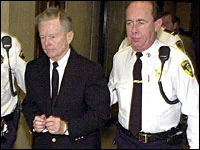
Father Geoghan busted, 1991
Father John Geoghan and too many of his fellow priests, for serially molesting little boys?

Sen. Larry Craig mugs for the camera
Sen. Larry Craig, for denying he likes sex in public toilets?

R. Kelly, prisonwear
R. Kelly, for liking it like that with underaged girls?
Who’s your nominee for salty pork hand?
UPDATE: Looks like whistleblower Kingdom Yuen (gotta love those English names the HK stars pick) has backed down from her original accusations and that TVB is trying to sweep the whole salty pork hand incident under the rug. Which means the speculation can continue unabated, of course, since Hong Kong pop culture loves a sex scandal. But it seems like without solid incriminating evidence this one may not get as much mileage as last year’s Edison Chen sex picture incident, which was the best scandal to come along in decades.
UPDATE 2: If anyone knows the Cantonese etymology for the term “salty pork hand,” please let me know. We are all dying to find out.
UPDATE 3: Looks like TVB’s Salty Pork Hand is Ellesmere Choi.
And my friend Jay Chan in Hong Kong translates the term as “salty wet hands.” Eeeewww.
UPDATE 4: Another “salty pork hand” has emerged on the Hong Kong scene, through another mysterious blind item. The start of a trend?
UPDATE 5: Wongsaurus over at LoveHKFilm breaks it down like this:
Not familiar with “salty pork” only “salty wet” but this sexual harassmen thing is obviously about non-consensual touching and groping.
Salty = Hom
Wet = Sup
Sow/Sou = Hand
Hom + Sup = Compound word (slangy) for Horny, Dirty (as in sexually dirty), pornographic, lewd and lascivious. [There are other more proper terminology for tawdry and sexual nasties and one example is uttered in the movie Crazy “N The City during the double-decker bus scene with Eason Chan, Chloe Chiu, and the masturbating pervert passenger.]
Please note that my romanization of Cantonese may not be accurate Yale or Wade-Giles.
Thus Hom + Sup + Sou suggests that someone did some nasty fondling. We’re all adults here so we leave it to your imagination.

 beyondasiaphilia
Recent Comments