Posts filed under ‘Uncategorized’
Body and Soul: Pahole Sookkasikon’s Art and Activism

Only For Pretend, ink on paper, 18″x24″, Pahole Sookkasikon, 2009
As of last Saturday night, I’m the proud owner of a t-shirt emblazoned with artwork by artist/activist Pahole Sookkasikon. Pahole’s solo show, Only For Pretend, opened at My Trick Pony in San Francisco last weekend, a smart little gallery space that also is a purveyor of custom t-shirts based on designs by the artists featured at the shop.
Pahole’s show is made up of several of his beautiful, impressionistic pen-and-ink drawings on paper. Delicate and dreamlike, the images flow gracefully across the page, with faces and shapes emerging amidst the swirling lines.
In addition to exhibiting the original artwork, My Trick Pony has also made up graphics of Pahole’s drawings for transfer onto nice, non-sweatshop t-shirts from American Apparel in a variety of colors and styles.
The shop’s adaptations of Pahole’s black-and-white drawings are available in several colors, including many metallic options.
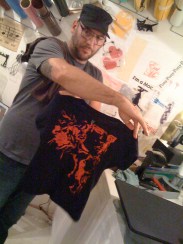
Matteo in action, My Trick Pony
Pahole’s pictures take beautifully to the to the t-shirt medium, with their lacy imagery gaining an added layer of feathery abstraction when rendered in metallic glitter.
Gallery proprietor Matteo is masterful on the hot-press, with a keen eye for the proper placement of the picture on each individual shirt.
At the show’s reception he whipped through the creation of several dozen shirts in the space of a couple hours, expertly applying Pahole’s ethereal drawings onto each garment.
Pahole’s exhibit continues through June. Stop by for your own custom t-shirt; visit My Trick Pony’s website for more information.
Pahole has also been tirelessly advocating for the Wat Mongkolratanaram Thai Buddhist Temple in Berkeley in its struggle for religious and cultural self-determination. For more than a year the Temple has been in conflict with some of its immediate neighbors who object to the smell, congestion, and lack of parking during the Wat’s Sunday food sharing, which has been taking place since 1994.
Part of the Buddhist tradition of merit-making, the food sharing raises operating funds for the Temple and supports the monks in residence. The Temple has made numerous concessions to the neighbors’ demands, including reducing by half the hours of the food offerings, providing alternate parking spaces for visitors, and increasing trash pickup on Sundays.
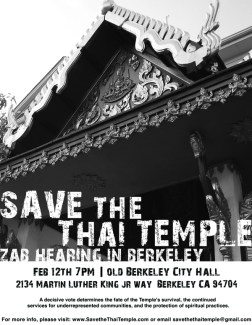
Save The Thai Temple poster, 2009
Neighbors claim that the Temple is running an unlicensed restaurant on its grounds, but the Temple maintains that the food offerings are an important part of its religious traditions. As outlined in a recent Wall Street Journal article:
Abbot Tahn Manas, who has lived at the temple for 22 years, says the event is critical to the Buddhist religious practice of “earning merit.” Monks are forbidden by their religion from earning money or accumulating earthly goods on their own. Providing for monks and temples is the religious duty of Buddhists of the Theravada school; it helps them build goodwill for later in life or for the next life. In Thailand, they earn merit by giving money to monks in the street. Berkeley Buddhists earn merit by volunteering at brunch, thereby serving the temple.
“Our Sunday activity is pretty much like Christians going to church every Sunday,” says Abbot Manas. “Without it, it would be very difficult for us to continue merit making.”
There’s also more than a bit of cultural insensitivity in the neighbors’ complaints, including the accusation that the glorious scent of Thai food is intrusive and offensive. As Veena Dubal notes in Asian Week,
“It smells like coconut milk!” Dubal said. “When I heard those remarks, I felt a tinge of pain. That kind of … xenophobic rhetoric has no space in this diverse community.”
About 20 neighbors continue to pursue their actions against the Temple; in contrast, more than 2000 people have signed a petition in support of the Temple and its facebook group has more than 1400 members.
The Temple hopes to build a new sanctuary on its site, for which it recently has received approval from the Berkeley Zoning Adjustments Board (ZAB). However, the Temple faces an appeals hearing before the Berkeley City Council meeting in July 2009, during which the Council can approve or deny the ZAB ruling. The exact time and date for the hearing will be posted on the Save The Thai Temple website as soon as that information is known.
Violence Grows: Kinatay and the Abduction of Melissa Roxas

Kinatay, still from movie, 2009, Brillante Mendoza
When I first read the description of Pilipino director Brillante Mendoza’s new film Kinatay (Butchered) I thought, “That sounds kind of wack.” Shot on HD video with a budget of $100,000, it’s a down-and-dirty, graphic representation of the rape, murder and dismemberment of a prostitute in the Philippines through the eyes of an idealistic, greenhorn cop. The controversial film just won the Best Director award at the 2009 Cannes Film Festival, where the announcement of the award was greeted by boos and gasps of shock. Roger Ebert calls it “the worst film in the history of the Cannes Film Festival,” and extensively details his disdain for the picture in his blog.
But after I read a few interviews with Mendoza about the film, I started to change my opinion of it (though still sight-unseen; the film will probably receive pretty limited distribution in the U.S., if at all). Mendoza claims that the movie is based on a true-life event and that it reflects the rampant police corruption and unchecked military violence in the Philippines. “This is not just entertainment, these kinds of stories are real,” Mendoza said after winning his award at Cannes.

Surface Melissa Roxas, online poster, 2009
This was borne out by an email blast I received on the same day that Kinatay won at Cannes. On May 19 Pilipino American Melissa Roxas, a poet and human rights activist from BAYAN-USA, a non-government organization (NGO), was kidnapped along with two co-workers while doing volunteer health work in the Tarlac Province in the Philippines. The email I received stated that BAYAN-USA was mounting a campaign to demand the Pilipino government aid in searching for and surfacing her. Thankfully, Roxas surfaced after a week of captivity, although her compatriots are still missing. What’s interesting in light of the accolades that Kinatay received is that Roxas and BAYAN-USA have claimed that she was abducted and tortured by the Pilipino police and military and that this event is the latest in a series of abuses against political activists by government agencies in the Philippines. The New York Times notes:
“According to the human rights group Karapatan, more than 200 Filipino activists have been kidnapped and never heard from since 2001, the year President Gloria Macapagal Arroyo came to power. Others have turned up dead or showing signs of torture.”
If the claims by Roxas, Karapatan, and BAYAN-USA are true, then Mendoza’s film takes on an added significance. Most of the film’s detractors criticized it for its graphic, unvarnished depiction of violence and brutality, with Ebert in particular scorning its rough-hewn soundtrack and cinematography. What Ebert might not understand is that Mendoza is making a conscious decision not to sanitize the film’s violent events. Movie violence is nothing new, but it’s usually presented with a patina of glamour and unreality, an aestheticization that distances the viewer and sanctions the viewing of the violence, making it an acceptable form of entertainment.
By denying his film the glossy sheen of conventional filmic violence, Mendoza forces viewers out of their complacent moviewatching habits, taking them out of their comfort zone and making them realize that, as in the case of Melissa Roxas and many others around the globe, violence is not a form of entertainment but a dire part of everyday life. In this case, Mendoza is working toward the same goal as Roxas—to expose and eradicate the corruption and human-rights abuses of the power structure in the Philippines.
UPDATE: Here’s the transcript of Melissa Roxas’ June 28 press conference in which she describes her ordeal.
Blood Red and Going Down: Tank Man In Tiananmen Square, part 2

Tank Man - lone citizen vs. PLA tanks, Tiananmen Square, 1989, Jeff Widener
I confess to being taken by melancholy this week as I recalled the events on June 4, 1989 in Tiananmen Square in Beijing. But it’s a good opportunity to think back on those fateful days from a perspective of twenty years later.
In the six weeks prior to when things all went to hell on June 4 two decades ago, students and workers were peacefully occupying the Square and sympathy was growing across China for their demands for reforms to China’s political and economic systems. Sometime during those six weeks I remember talking on the phone with my friend Rebecca. We thought we were witnessing a revolution in the works and that the Chinese people’s voices would surely be heeded.
Terribly, things turned out differently than we’d hoped and the insurrection was violently crushed by the tanks and guns of the People’s Liberation Army. More horribly, the numbers of the dead were never confirmed, as many bodies were burned in mass cremations, and many other demonstrators were taken elsewhere for execution. China’s official tally of those killed was a ridiculously lowball count of 241 people, most of whom were deemed by the government to be “ruffians” and “armed thugs” who weren’t actually students. The government also claimed that no one was killed in the Square itself. Other estimates by NGOs on site range from 500 to 7,000 people killed that day.
This morning Rebecca forwarded me a link to a project by artist Michael Mandiberg that utilizes the famous image of the Tank Man, the anonymous protestor who blocked a column of tanks the day after the PLA cleared Tiananmen Square of demonstrators. Four years ago Mandiberg conducted an experiment in which he sent copies of the Tank Man image to a dozen commercial artists in China and asked them to paint a replica of the picture. The responses from the artists suggest that some if not all of them were unaware of the image and its historical context, and few knew its source.

Tiananmen Square: You can add the person to painting when you get it, 2005, Michael Mandiberg
Mandiberg notes:
“Of the dozen requests I sent, most were returned with a price and the universal salutation “it is a pleasure to do business with you.” A few painters suggested I just leave the man and the lamp post out, often for unclear reasons: political or aesthetic? One person outright declared that he could not paint the image.”
In the West the image of the Tank Man is well-known, as photographs and video footage of his actions that day were widely disseminated throughout the media at the time. However, in China the image is largely unrecognized, due to the government’s attempts to erase the June 4 events from public memory.
The government has achieved this in part through its severe restrictions on Internet access. In recent days, in an attempt to prevent the Chinese citizenry from getting to online discussions of the Tiananmen Square killings, the Chinese government blocked access to twitter, facebook, and other social networking sites, as well as blogging sites such as wordpress, xanga and blogspot.
But before we go too far in excoriating the Chinese government for its erasure of June 4, let’s remember that historical amnesia is not unique to China. Many World War II Nazi concentration camps sites in Europe have been razed or otherwise obliterated. The Japanese government still hasn’t acknowledged the Rape of Nanking. And lest we start to feel too pleased with ourselves here in the U.S. let’s not forget the Bush Administration’s multiple attempts to rewrite reality, from un-defining waterboarding as torture to linking Iraq to the destruction of the World Trade Center.
So on this grim anniversary it’s vitally important to remember the untold numbers of demonstrators who were silenced twenty years ago on Tiananmen Square. But it’s also significant to note that the Chinese government doesn’t stand alone in its disregard for facts and that our constant vigilance is required to keep ignorance and the obliteration of history at bay.
UPDATE: Thanks to dleedlee for sending along the following information, which fills in some of the backstory of the Tank Man photos and video.
FYI, Frontline is rebroadcasting its The Tank Man program this week.
Also, a New York Times blog posted this interesting piece on the various versions of the ‘tank man’ photo(s).
http://lens.blogs.nytimes.com/2009/06/03/behind-the-scenes-tank-man-of-tiananmen/
And artist Michael Mandiberg sent me a further link to his flickr site, which contains all of the images from his series:
http://www.flickr.com/photos/theredproject/sets/72157619172370116/
Twenty years ago today: Tank Man in Tiananmen Square
I don’t know if I need to add too much to this. It’s an image and a moment that should never be forgotten.
Tank man, June 5, 1989, Tiananmen Square, Beijing
No Blood For Oil: ChevWrong poster bombs

I will not complain about my asthma, downloadable poster, ChevWrong Inhumane Energy series, truecostofchevron.com, 2009
Just a quick shoutout to a couple well-placed guerilla art pieces spied around town here in San Francisco in the past week or so. In anticipation of the May 27 Chevron shareholders meeting in San Francisco last week, some enterprising artist/activists last week bombed the city with printouts of the downloadable subvertisements from truecostofchevron’s ChevWrong Inhumane Energy ads. The poster brigade, which plastered the city with hundreds of the alternate ads, decided to take matters into their own hands after CBS Outdoor refused to sell billboard space to truecostofchevron, claiming that it didn’t accept “negative” advertising. The Inhumane Energy series cleverly skewers Chevron’s current greenwashing ad campaign that speciously utilizes earth-friendly taglines such as “I will leave the car at home more,” “I will finally get a programmable thermostat,” and “I will replace 3 light bulbs with CFLs.” As if.

I will ignore the toxic waste pits in my village, downloadable poster over Chevron ad, ChevWrong Inhumane Energy series, truecostofchevron.com, 2009
Truecostofchevron’s slick little numbers nimbly mimic Chevron’s fakey feel-good sentiments with lines including, “I will not breathe when outside,” “I will try not to get cancer,” and “I will not complain about my asthma,” coupled with facts and statistics about Chevron’s environmentally unsound activities in Nigeria, the U.S., Burma, Ecuador, Iraq and other sites worldwide. As with any good detournement, the series simultaneously critiques, neutralizes and repurposes its source material, in this case simulating Chevron’s high-powered happy-smiley corporate propaganda in order to expose and deride the oil giant’s own hypocrisy.

No Blood For Oil, stencil, Bay Bridge lower deck, 2009
I’ve also been appreciating the rawer but no less effective commentary on the link between big oil and the destruction of the planet that’s cropped up on the eastbound approach to the Bay Bridge. Stenciled onto a couple pillars on the Bridge’s lower deck is a simple image of a tank’s silhouette spouting a single a drop of blood. Direct, visual and to the point, the graphic needs no embellishment to gets its message across, even to the distracted driver speeding along the freeway. And though it may be ephemeral, its placement in the line of sight of thousands of drivers a day brings its message to where it’s most needed and where it can’t be ignored. Which is the most that anyone can hope for in combating the baldfaced corporate misinformation that bombards us every day.
Fresh Fruit For Rotting Vegetables: Bill Basquin’s Photographs at the Dump
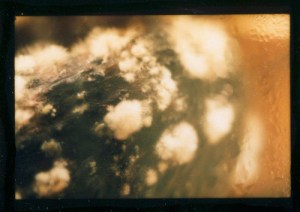
Moldy Avocado, from the series Fruits Uneaten, Bill Basquin, 2009, c-print, 20" x 30"
Surprisingly, the Tunnel Road dump smelled a little ripe when I visited there last week to check out The Way of All Flesh, Bill Basquin’s photo exhibit. My husband is a contractor so I’ve been to a few dumps in my time and in my experience the Norcal Solid Waste Transfer and Recycling Center on Tunnel Road in San Francisco is actually one of the least odiferous ones. Colma’s a bit stinkier and don’t even get me started on the big landfill near Dixon on Highway 113. But Tunnel Road is curiously fragrance-free most of the time, perhaps due to some errant breezes blowing off the ocean a little ways away.

Carrot Triptych: 0 weeks, 6 weeks, 4 weeks, Bill Basquin, 2009, c-prints in frames built from reclaimed wood
Anyways, Bill Basquin’s show was the end product, so to speak, of his four-month residency at the Tunnel Road dump, sponsored by San Francisco’s Recycling & Disposal Artist-In-Residence program. The dump’s AIR program, which has been in operation since 1990, hosts several local artists each year in a nice big studio with a woodshop and all of the trash they can handle. Artists get a monthly stipend and are free to use whatever they can dig out of the adjacent dump site to make art. I’ve seen several shows there, including Donna Keiko Ozawa’s extra-cool crank-handle sculptures (way back in 2001) and Paul Cesewski’s bicycle-powered circus installation (just last year) and each artist transforms the space in his or her own way. By repurposing the waste stream and finding usefulness in discards, the SF Recycling & Disposal AIR program’s undercurrent of anticonsumerism is all too relevant in these days of late capitalism gone awry.
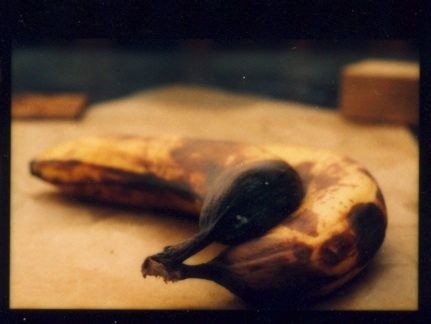
Banana Pair, O weeks, Bill Basquin, 2009, c-print, 8" x 10"
Bill’s exhibit mainly consisted of images of the rotting produce that he composted on-site, then photographed up close and personal. The resulting large-scale color prints, in frames constructed from wood scavenged from the dump, are both fascinating and repellent, with each fruit or vegetable’s decaying carcass so closely rendered you can almost smell them. Some of the photos, like “Banana Pair, O weeks,” keep a wary distance from the subject, while others, such as “Moldy Avocado,” bring the viewer so close that the prosaic subject matter becomes a furry mass of color and texture. But while the fruits and veggies have lost their original shape and form, both through decomposition as well as through Basquin’s intimate portraiture, the photos never sink to simple abstraction. Each desiccated corpus pretty much retains its connection to its origins as a living plant, though some are much farther along than others. Bill Basquin grew up on a farm in the Midwest and his photography reflects an awareness of the planet’s oscillations perhaps less evident to the urban dweller. His loving close-ups of moldy plant matter serve as microcosmic reminders of the cycle of degeneration and rebirth that we city folk too often forget.
Geek Love: Star Trek and Hybridity Revisited
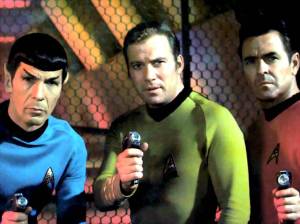
OGs, Star Trek, 1968
Here’s the kind of Star Trek geek that I am—I went to Star Trek conventions back at the dawn of time before the movies were made. In the lean years between the cancellation of the original series (TOS) in 1969 and the release of Star Trek: The Motion Picture in 1979, only the most hardcore dorks attended Star Trek conventions and I was right there with them. I was in junior high back then and had discovered TOS in syndication, on some UHF channel in San Francisco. In typical obsessive fashion I watched every episode religiously, so when the annual Star Trek conventions came to the Bay Area I was totally there.

Star Trek convention habitues
At that time the conventions were shaggy, grassroots affairs, with socially inept misanthropes attending in their homespun costumes clutching hand-rigged tricorders. The TV show’s stars were also pretty desperate then, since they’d been typecast in the original series and couldn’t get work once it went off the air. The show was probably the biggest sci-fi cult item at the time, though that still only put it a few notches above Dark Shadows, but its glory days as a billion-dollar franchise were yet to come. So I was able to witness William Shatner recite “Rocket Man” in person at the Oakland Convention Center and I also got Walter Koenig’s autograph (I think I asked him what sign he was).
When Paramount revived the franchise in 1979 and the movies and the new TV series started to take off again, I dutifully followed along, but as the sequels and spinoffs multiplied, my interest gradually waned. It’s not that I didn’t like and enjoy some of the new shows and characters but there were eventually so many of them that I couldn’t properly keep track. Plus by the time Star Trek 6 rolled around in 1991, the original cast was getting mighty long in the tooth and it felt a bit unseemly for them to be running around all over creation in their unsightly hairweaves.
So the new Star Trek reboot is a rare treat for this geekster, as it features actors who are actually young and vigorous enough to be convincingly roaming all over the galaxy in high-powered starships. I saw the movie in its opening weekend and was pleased with its faithful yet innovative reworking of the original series’ mythology.
I was also keenly interested in seeing how John Cho fared as Lt. Sulu, since as previously noted in earlier posts, good roles for Asian American males are few and far between in Hollywoodland. Cho as Sulu acquitted himself just fine, but surprisingly enough, it was the new young Spock that really grabbed my attention.
Spock’s always been coded as “other” in Star Trek lore—Leonard “Bones” McCoy shamelessly let fly with many a culturalist epithet such as, “You green-blooded (mumble mumble),” or “you pointy-eared . . . .” In TOS, Spock’s mixed heritage provided plenty of dramatic tension as he played out a toned-down version of the tragic mulatto trope.

The new old Spock, Star Trek, 2009
In the current film, Spock seems to have been given a new dimension, as a sexy young thing who snags the hottest woman on the starship (no spoilers here but it’s a mighty fine, unexpected and yet completely feasible pairing). The filmmakers seem to realize that Spock’s constant need to suppress his hereditary Vulcan rage as well as his human emotions makes the character into a smoldering mass of brooding antihero. Compared to this angsty creature, Kirk’s breezy rebel seems juvenile and shallow.
I’m hoping Spock’s latest incarnation in the new Trek alternaverse further develops the character’s intriguing cultural possibilities. Instead of a conflicted half-breed, maybe Spock can become a new and improved representative of the joys of hybrid vigor, embracing and celebrating his dual heritage rather than constantly lamenting it. It would be so 21st-century to go beyond the last couple hundred years of beating ourselves up over race-mixing, miscegenation and other supposedly unnatural acts. I for one am wholeheartedly rooting for it.
Thanks to Barbara Jane Reyes and Wei Ming Dariotis for helping me to incubate the ideas herein.
The Myth of Chinese Restaurants, Part Three: Indigo Som’s Chinese Restaurant Project

Wonderful House, Rock Springs, Wyoming, 2002, iris print, 34"x34", Indigo Som
Regarding Chinese restaurants of a different sort, Indigo Som has an installation from her Chinese Restaurant Project in Present Tense Bienniel: Chinese Character, at the Chinese Cultural Center in San Francisco. Indigo’s project is manifold and ongoing, but its three main parts basically attempt to document and capture the gestalt of Chinese eateries in the U.S. and look at the ways in which these omnipresent establishments reflect and represent Chinese American culture, both real and imagined.
My brother and his wife once went on a driving trip that took them through a sparsely populated part of Idaho. On the way they stopped at a roadside restaurant and when they walked in, the Chinese proprietor spotted them immediately. As soon as he saw that my brother was Chinese, a huge grin broke out on his face. My brother must’ve been the first Chinese person outside of his own family that the owner had seen in a mighty long time. Indigo’s project reminds me of this incident in that it demonstrates both the pervasiveness and the isolation of these solitary outposts. Living in the Bay Area, which is clogged with Asians of every make and model, it’s pretty easy to forget that Asian Americans still only make up about 4% of the total U.S. population. The Chinese Restaurant Project captures some of the melancholy of life outside of urban centers for many Asians in this country.

Woo's Pagoda, Eau Claire, Wisconsin, 2003, inkjet print, 34x34", Indigo Som
Some of you might be familiar with the large-scale color prints of Chinese restaurant facades that Indigo’s exhibited extensively in the past few years—she’s been selectively documenting Chinese restaurants across the U.S. for a while now, shooting hordes of images of this multifarious architectural phenomenon with a plastic, fixed-focus Holga camera. Many of the pictures were taken in locations far from sizable Chinese American communities and are plaintive reflections on the sometimes funky, in-between state of being Chinese in America.
The other two parts of the Chinese Restaurant Project are Indigo’s blog documentation of her travels across the country in search of Chinese restaurants and her quixotic attempt to collect a menu from every one of the thousands of Chinese restaurants in the U.S.
Indigo’s project captures the absurdity of attempting to define “Chinese American culture” in this modern world. Signage from most of the restaurants uses “ching-chong” script, or what Indigo calls the “Evil Chinky Font,” the one that poorly emulates classical Chinese calligraphy; names for the restaurants usually involve pagodas, jade, bamboo and other tiresome “Chinese” signifiers. Her menu collection also demonstrates the ways in which these restaurants have adapted Chinese cuisine to suit the tastes of the mainstream American palate, such as the weird pervasiveness of Crab Rangoon, those nasty little deep-fried cream cheese and surimi wontons that in all likelihood were invented in the 1950s at Trader Vic’s, that tiki torch lounge heaven in San Francisco.

Chinese Menus, Present Tense Bienniel, 2009, Indigo Som
On display as part of Present Tense Bienniel is a floor-to-ceiling installation of all of Indigo’s current collection of Chinese menus, which number in the hundreds. Covering a pretty big corner of the gallery, it’s still only a tease of what the piece will be when Indigo has, say, a thousand Chinese restaurant menus papering an entire gallery. Knowing her capacity for obsessive activity and her dedication to her goal, I have no doubt that one day we’ll see an entire floor of the deYoung Museum covered over with menus sporting the Evil Chinky Font from all over the country. But until then, this little snippet will more than suffice.
Present Tense Biennial: Chinese Character – an exhibition of
contemporary artwork by 31 artists that reflect and reinterpret China
Curated by Kevin Chen
May 1 – August 23, 2009
Tuesdays-Saturdays, 10am to 4pm; Sundays, 12 to 4pm
Chinese Culture Center, 750 Kearny Street, 3rd Floor (inside the Hilton Hotel), between Clay & Washington Streets in San Francisco CA
Admission is free.
Kinda Like A Big Deal: The Beast Stalker, Full Alert and Greatness in Hong Kong Movies

Nick Cheung and wonky eye, The Beast Stalker, 2008
Just saw The Beast Stalker (Dante Lam, 2008) at the San Francisco International Film Festival and, although it held up pretty well and wasn’t an embarrassment, it wasn’t quite all that. Introduced by the Film Festival as “perhaps the best Hong Kong action film since Johnnie To’s Election,” this gritty thriller demonstrates that the former Crown Colony can still crank out hard-ass crime dramas. But the field has been mighty thin in Hong Kong of late and in other, more fruitful years, The Beast Stalker might’ve been just one of the crowd.
Former teen heartthrob Nicolas Tse plays a tough cop (!) haunted by the death of a child hostage he accidentally kills in a chaotic shootout/car crash involving malevolent gangsters, innocent bystanders and much shattered glass. Nick Cheung plays a kidnapper-for-hire in charge of snatching the dead girl’s twin sister whose lawyer mother is involved in prosecuting the crime. Their meshing stories play out in a dizzying spiral of guilt, honor, fate and obligation.
The Beast Stalker has several full-on child-in-extreme-danger moments and the cast realistically sports facial scars and other mementos of mortal peril, but somehow the film falls short of greatness. Nic Tse, further distancing himself from his youthful idol years, shrieks angrily at his subordinates, but he still can’t nail the crying scenes. Likewise, Nick Cheung, who won Best Actor statues from both the Hong Kong Film Critics’ Association and the Hong Kong Film Awards for this role, glowers menacingly but doesn’t quite bring the extra layer of pathos and complexity that might have deepened his portrayal. As my pal Laura, aka redbean, aka longtime Hong Kong movie fanatic, noted, “Anthony Wong would’ve eaten this role alive.” Unfortunately Anthony wasn’t cast and in this case Nick Cheung only makes a so-so substitute.
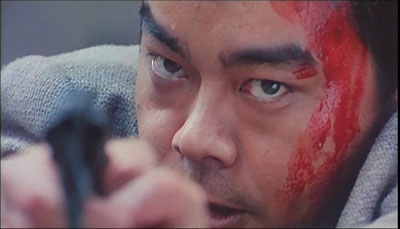
Lau Ching-Wan shoots straight, Full Alert, 1997
I recently purchased a copy of Ringo Lam’s brilliant crime thriller Full Alert (1997), which bears some similarities to The Beast Stalker in its depiction of the complex relationship between a cop and a criminal. But Full Alert has the inestimable actors Lau Ching-Wan and Francis Ng in the lead roles and their sublime skills breathe life into their stock characters and make the film’s cat-and-mouse story vibrant and believable. Francis brilliantly creates a strangely sympathetic yet reprehensible character and Lau Ching-Wan’s finely tuned fits of anger and frustration show a cop dangerously on the edge of sanity. The final confrontation between these two driven characters beautifully brings their fraught relationship to a stunning conclusion. On the other hand, The Beast Stalker’s antagonistic pair never fully reach the heights suggested by their intertwined destinies and their anticipated showdown is merely a tease.

Nick & Nic mix it up, The Beast Stalker, 2008
Full Alert and The Beast Stalker both have magnificent car chases as their centerpieces, the work of car-choreography specialist Bruce Law. The action direction in The Beast Stalker, however, unfortunately succumbs to the closeups and nausea-inducing jerky camerawork now in fashion, whereas Ringo Lam understood the need for distance and framing in an action sequence. Attesting to its greatness, Full Alert more than stands the test of repeated viewings, even more than a decade after its release. The Beast Stalker is a exciting, smartly-made movie but if, as several critics have suggested, this is one of the best of recent Hong Kong films, then the bar has been seriously lowered.
Dante Lam will soon have another chance to make a great Hong Kong movie. His next project, Most Wanted Terrorist, has just announced its cast, which includes the dream team of Lau Ching-Wan, Anthony Wong and Francis Ng, along with Nick Cheung. Hopefully Nick Cheung can keep pace with his illustrious co-stars, as they’re widely held to be among the best actors of their generation. He did just fine opposite Anthony and Francis in Exiled, and even in The Beast Stalker he showed glimmers of potential. but if he’s not careful the rest of the cast is going to blow him out of the water.
Interestingly, Dante Lam has indicated that he will forgo any Mainland Chinese financing for Most Wanted Terrorist in order to preserve a Hong Kong sensibility in the film. Several recent HK/China co-productions, including Sammi Cheng’s recent Lady Cop and Papa Crook, have suffered from the restrictions of Mainland film censors, so Lam’s decision to avoid PRC money is an interesting one. With Hong Kong film financing languishing due to the economic recession it’s a bold and risky move, but Lam is determined to retain his artistic freedom without having to answer to the Mainland government.
Let’s hope Most Wanted Terrorist gives everyone involved the chance to strut their stuff to their fullest capabilities. With its killer cast and seasoned director, if all goes well, we could once again see greatness in Hong Kong films next year.
The Beast Stalker opens Friday, May 15 at one of the last places in the Bay Area to see Hong Kong movies on the big screen, the 4-Star Theater, 23rd Avenue and Clement Street, San Francisco.
The Myth of Chinese Restaurants, Parts One & Two
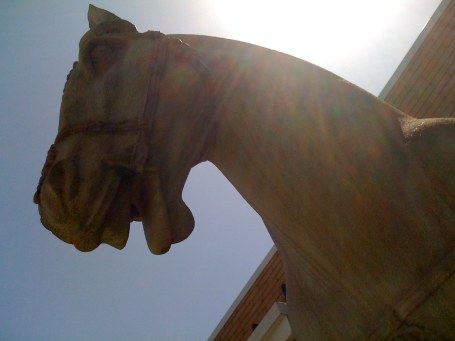
Faux-terracotta horse, PF Chang's
Part One
My mother-in-law loves PF Chang’s so we took her there this weekend for Mother’s Day. I’m not really complaining since it beats the hippie breakfast place we usually go to, where the food is stuck in an aryuvedic-lite 1970s time warp without spice, garlic, butter or anything else that makes food worth eating. But since we live in the Bay Area, where there are a plethora of outstanding Chinese eateries of every stripe and price point, it seems a bit odd to me to willingly frequent a place like PF Chang’s. However, my mother-in-law is eighty and she isn’t Chinese or a very adventuresome eater so to take her to, say, Fook Yuen or Koi Palace for shark fin soup and sea cucumber would probably be a wasted effort. Hell, I don’t even like sea cucumber and as far as I know I’m full-blooded Chinese.

Miley & buddies show their cultural sensitivity
Amusingly enough, PF Chang’s seems to be a favorite of idiotic teen idol Miley Cyrus, who held the afterparty for the premiere of her recent Hannah Montana flick at a Los Angeles Chang’s and who takes her boytoys to the one in Burbank as well. However, Miley’s a fickle customer, recently claiming on Jay Leno’s show that the wonton soup at Chang’s tasted like soap. Maybe some of the kitchen help were staging a bit of payback for Cyrus infamously pulling the “chink eye” a few months back?
Anyways, I’m sure if I were in some part of the world where Chinese people and our accompanying restaurants were few and far between, I might swoon for the sight of PF Chang’s. The menu actually does include some decent dishes and the tea selection isn’t bad. It’s not unlike the drive-thru Starbucks on the interstate—you wouldn’t normally be caught dead inside a ‘Bucks in a coffee-snob-land like San Francisco but when you come across one in the vast wasteland of Highway 5, you’re damn grateful for that mocha frappuccino. Likewise, if I were in the middle of non-Asian America and really wanted a plate of potstickers and some passable dandan noodles, I’d be more than happy to eat at PF Chang’s. But I’m also pretty glad that I don’t have to do that very often, since I live in the heart of Chinese restaurant heaven—now if only I could get my mother-in-law to like fatty pork and bitter melon.
39 million pounds a year sold, Orange Chicken, Panda Express
Part Two
I had a brush with the legend of another famous quasi-Chinese restaurant when I was in Southern California last week for the Los Angeles Asian Pacific Film Festival, which was kind enough to screen my latest short experimental video, Snapshot: Six Months of the Korean American Male. I stayed with my pal Gary, whom I’ve known for a couple decades since our misadventures as grad students at the Art Institute in Chicago. Gary wisely dropped out after a semester and eventually moved to LA, where he’s now working in television as a 1st AD and producer. His most recent assignment was interviewing the divine Hugh Jackman, whom Gary confirmed was both astoundingly hot and extremely nice as a person.
Anyways, Gary told me that Andrew and Peggy Cherng, the founders of Panda Express, owned a townhouse in the very same complex that I was now visiting and that, up until recently, one of the Cherng’s daughters had lived in the unit. One day a couple years ago Gary came home to find his street clogged with police cruisers—apparently Mr. Cherng had been by to visit and had surprised a couple kidnappers in the midst of abducting his daughter. Luckily the fiftysomething Cherng had managed to fight off the perps and save his daughter from an evil fate.

Paul Muni, non-Chinese, The Good Earth, 1937
Soon after that the daughter moved out, but Gary thinks the Cherngs might have kept the place as a rental property, despite having a net worth in the millions (the Panda Express in Honolulu brings in $4 million annually). Weirdly enough, I wouldn’t be surprised if this were true. My dad always told me that real estate is the best type of investment (thank god he didn’t live to see the subprime meltdown), and didn’t the husband in The Good Earth keep ranting about the significance of “the land” all the time? Maybe the Cherngs are just hedging their bets in case some disaster befalls their fast food empire someday.

 beyondasiaphilia
Recent Comments