Constant Sorrow: Tracing Shadow film review
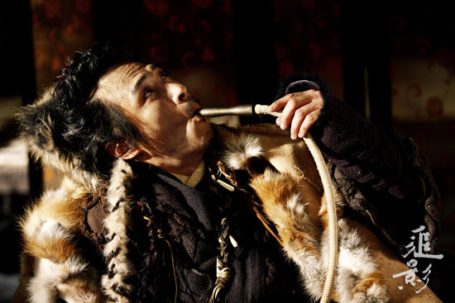
Francis Ng contemplates filmmaking, Tracing Shadow, 2009
Dear Francis,
Just wanted to let you know that I saw your new movie, Tracing Shadow, and I’m sorry to say that I didn’t really like it very much. Although it had some killer martial arts sequences, the art direction was divine, and you yourself looked quite lovely in your braided hair extensions and little mustache, the movie as a whole really stank. Unfortunately, since you’re the director as well as the star of the film, there’s no one else to blame for the slipshod pacing, unimaginative blocking and framing, egregious mugging and overacting (Xie Na being the absolute worst offender on that account), and aggravating, abrupt shifts in tone and mood throughout the movie. You yourself put in a less-than-thrilling performance, which I didn’t think you were capable of doing. And both you and your love interest, Pace Wu, have really nice cheekbones, but there isn’t a whole lot of chemistry between the two of you otherwise.

Pace Wu and bone structure, Tracing Shadow, 2009
Ever since it was announced several months ago I’ve been looking forward to this film, since you’re my favorite actor and your last wuxia movie, The White Dragon, is a great little flick. But somewhere along the way something went terribly wrong. It’s a shame, since the movie has the bones of a much better film. The storyline is classically drawn, with martial-arts masters converging on a village in search of a lost treasure map. But the film’s execution is so off-kilter and confused that it feels bad regional theater. At times it seemed like two or three different pictures competing for screen time—the slapstick comedy, the martial-arts action film, the dramatic mystery—with none given enough time or attention to cohere successfully. I felt myself wishing that you’d stuck to a straight-ahead dramatic treatment of the material, ala the film’s supposed inspiration, King Hu’s classic Dragon Inn, instead of using the story for laughs.
Your past directorial efforts, although flawed, showed flashes of brilliance and promise. But all three of your other movies were small-scale affairs rather than big-budget extravaganzas like Tracing Shadow. 9413 was an intense crime drama that showed a feel for mood and intensity as well as some cinematic chops. What Is A Good Teacher brought out some good, quirky moments from its youthful cast. Dancing Lion had some great improvisational set pieces. But all of those also had top-drawer actors, yourself included, to move things along, whereas the cast of Tracing Shadow–a TV show hostess, a model, and the son of a famous man–is, to put it delicately, pretty weak.

Xie Na and Jaycee Chan mug for the camera, Tracing Shadow, 2009
I’m truly sorry that the film turned out so badly. I really wanted you to achieve your dream of directing a successful movie. I don’t know exactly why things went so wrong–I’m not sure if it was the strain of holding together a big-budget costume picture, the complexity of mixing so many genres, or the pressure of living up to the hype of a high-profile project. I wonder if there was pressure from your financial backers (Huayi Brothers) to make the film as accessible, i.e., lowbrow, as possible, too, or if that decision was yours. At any rate, I hope that you get another chance to direct a film and that you’re more successful next time. This time I’m afraid you lost your way.
Sincerely,
your biggest fan
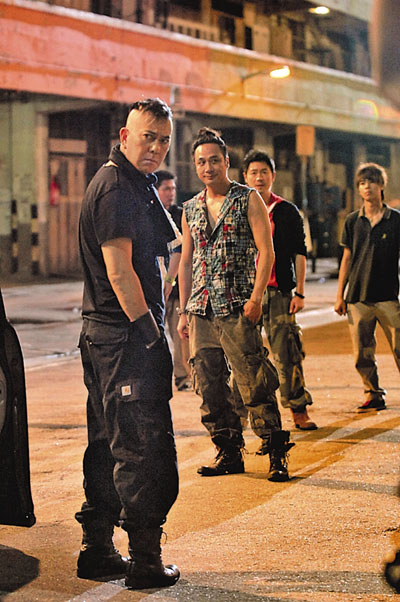
Anthony Wong with Francis Ng in happier times, Laughing Gor: Turning Point, 2009
PS: Congratulations on Laughing Gor: Turning Point—I’ve heard that it’s really good and that it’s doing great box office, too, which hopefully takes some of the sting out of Tracing Shadow’s disappointing ticket sales.
UPDATE: Go here for a much nicer, more positive review of the movie.
That’s Not My Name: Lord, It’s The Samurai! intervention

Altered poster, Lord, It's the Samurai!, 2009
Just got tipped to an excellent new intervention critiquing the San Francisco Asian Art Museum’s latest orientalist extravaganza, Lords of the Samurai. My anonymous source sent me the link to Lord, it’s the Samurai!, a brilliant goof on this year’s summer blockbuster which replicates the show’s official website with a twist—it offers a detailed, pointed, and well-researched deconstruction of the problematic exhibition. The faux-site points out the less-than-savory aspects of samurai culture that the AAM conveniently glosses over, including the militarism, slavery, pederasty and misogyny inherent in the “code of the warrior.”
The ersatz site also recognizes the dangers of the exhibit’s glamorization of violence, noting,
No myth here, and it hasn’t changed since the times of the samurai: it’s universal and real, how war dehumanizes everyone.
Aestheticizing violence, normalizing war.
The museum may not want you to see it, but there is blood on those swords.
The faux-site also calls out the AAM’s ongoing Asian fetish with its hilarious tagline (Where Asian Still Means Oriental) and a fun little word-scramble that mixes up past titles from AAM exhibits to form an amalgamation of exotic Asiaphilic fantasies.
The imitation site also makes a cogent connection between the Museum’s soft-peddling of Japanese nationalism and the U.S. government’s interest in remilitarizing Japan, which would aid the U.S. in maintaining the upper hand in Asia. The faux-site also notes that it’s not the first time the AAM has backed up a superpower’s questionable point of view, as seen in Tibet: Treasures from the Roof of the World, the 2005 show that gave credence to the PRC’s claim that Tibet is really just the back door of China.

Hard-copy flyers, Lord, It's the Samurai!, 2009
All told, this little fakey website is a fine, funny, and extremely effective critique that packs in a copious number of links and information. It’s a companion piece to hard-copy flyers that have been distributed in public brochure racks in San Francisco’s Japantown. Someone upstairs at the AAM must have twigged to the switch since, as noted in the site, the counterfeit flyers have been systematically removed and replaced with the AAM’s own brochures almost as soon as they’ve been distributed. The fake site’s gmail address was also disabled shortly after sending out its first email blast. If the museum’s functionaries are so freaked out that they’re furiously trying to eradicate it, then I’d have to say that the intervention is working.
UPDATE: After just a couple days it appears that Lord, It’s The Samurai! has gone viral. This very blog entry has outstripped the site’s previous champion Shah Rukh Khan (and his six-pack) as the top post of the week and news of the faux-site has travelled far and wide around the blogosphere. Here are a few links:
mrpoopypants’ post (scroll down to the comments where an AAM employee defends the museum)
8asians post (wherein the bloggers confess to being pwned by the faux-site)
Interview with the anonymous creators of the site here.
UPDATE 2: The Asian Art Museum itself has posted an entry on its blog about the intervention. I’m de-linking it, though, since they’ve selectively refused trackbacks (including mine) from sites critical of their position. Another example of systematic exclusion on their part.
And Japanese history scholars weigh in with their approval of the site, calling it “an instant classic.” There are also some great observations on the significance of museum shows as well as a shout-out to the scholarly rigor of Lord, It’s The Samurai!
UPDATE 3: Found this nice manifesto about social art intervention on John Jota Leanos’ site and thought I’d toss it out there, since it’s relevant to the conversation at hand. You can check out his art and other relevant information there, too. Plus his significant other was my kid’s kindergarten teacher.
UPDATE 3: Myself and a representative from asiansart.org, the folks who put together the parody website, were on Hard Knock Radio on KPFA-FM this week talking about the intervention. Go here for the stream, or download the interview here.
UPDATE 4: Ken Baker, art critic for the San Francisco Chronicle, weighs in here. Mostly positive, with some great dialogue in the user comments (aside from some obvious cluelessness). Viraling!
UPDATE 5: Continued fallout some nine months later as Asian Art Museum director Jay Xu talks in the LA Times about how “painful” it was to be pwned by asiansart.org’s intervention. Maybe getting a clue would ease some of the pain, Jay. asianarts.org talks back here.
Working Day & Night: Run-up to The Oak Park Story WIP screenings
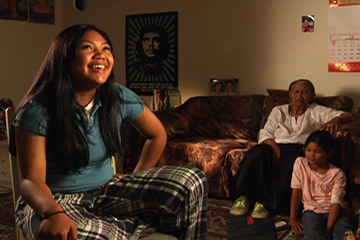
Veasina Thang & Khlot Ry break it down, The Oak Park Story, 2009
I’ve been on a little blogging hiatus for a few weeks because I’ve been furiously working on my latest movie, a documentary called The Oak Park Story. Filmmaking is my primary creative outlet, and in the past I’ve produced a bunch of experimental videos and short documentaries, although I’ve been less prolific since having kids. I’ve managed to put together a few micro-shorts since entering parenthood, but this new flick is the longest and most involved project I’ve worked on in many a year. The film just had two work-in-progress screenings almost back-to-back, so I’ve been cranking on the Final Cut Pro full time for more than a month.
I was lucky enough to get a residency this year from the San Francisco Film Society’s Filmhouse program, which provides free office space for selected film projects. They gave me a nice sunny little room down on the Embarcadero near Pier 39 where I’ve parked my iMac, my scanner, and my collection of hard drives for the past five months or so. It’s great to have a room of my own, away from my messy house, with a free parking space and ready access via streetcar to the Ferry Plaza building. I’m afraid I’ve spent way too much money on Taylor’s Automatic Refresher’s divine hamburgers and sweet potato fries, Out The Door’s excellent wonton noodle soup, and Blue Bottle’s outstanding drip coffee. But I’ve also managed to be pretty productive as far as my movie is concerned and I was able to knock out a reasonable facsimile of a film in time for both screenings.

Khlot Ry, Oak Park tenant, The Oak Park Story, 2009
The documentary is all about an amazing coalition of tenant-activists at the Oak Park Apartments in Oakland’s San Antonio district who rose up against their exploitative landlord. Undocumented immigrants from Mexico, refugees from Cambodia, and faith-based activists who lived at Oak Park for more than a decade all came together to fight back against the negligent landlord and the crummy living conditions he foisted on them. After a three-year battle the tenants won a landmark settlement of nearly a million bucks. My collaborator, Russell Jeung, was one of the live-in activists at Oak Park and was in residence there for ten years. He and I interviewed nearly twenty people, and collected hours of archival footage and reams of documents, photographs and other ephemera from Oak Park and since April we’ve been stitching it all together in the editing studio.
In the two or three weeks leading up to the screenings I was in the studio non-stop from morning to night. I made myself stand up and do triangle pose every so often to battle the muscular damage I was causing by endlessly sitting hunched over my computer screen. I blew out the speakers in my 20-year-old Sony NTSC monitor, no doubt hastening its demise by running it continuously for too many hours on end. Sometime around the end of last week, just before the second of our W-I-P screenings, my neck got a permanent crick in it and I had to take Advil to get to sleep at night. My massage therapist told me that I’d twisted my vertebrae out of alignment from cranking my head in one direction too long (note: she fixed it).
But the movie is shaping up pretty well, and the feedback from both of the screenings was invaluable. After working on the film for so long and so intensively I had very little perspective left, so hearing responses from an impartial audience was great. I got rid of some of the confusing parts, added some more backstory, and otherwise was able to tighten up the movie considerably after hearing what people had to say at the screenings.

Camilo Landau & Carne Cruda sing it
I also got a big boost from Camilo Landau’s awesome advice and help with the soundtrack. Camilo is a former student of mine (when he was in high school!) who’s now a grown-up and a professional musician and producer. He’s based in Oakland and, along with his uncle Greg Landau, runs Round Whirled Records, which puts out music by a bunch of great local bands including Fuga, Quetzal, Omar Sosa, and Carne Cruda, Camilo’s own combo. Camilo’s been a brilliant resource and I was able to use lots of the music he sent my way on the film’s soundtrack.
We’re in the home stretch with the film, and we have a couple of grant applications out there that will cover some of our postproduction, if we get them (which is always iffy, considering the perennially tough competition for indie movie funding). So we’re also soliciting our social networks and asking family, friends, associates and anyone who wants to support a good cause to contribute to the completion of the movie. We’ve even got fiscal sponsorship, so any donation is tax-deductible. So if anyone wants to help out a worthy project, please think about giving us some support. We’ve got some nifty premiums (t-shirts, dvds, tickets to the premiere) just like public television, though no coffee mugs or tote bags.
Okay, shameless pitch and self-promotion over. Back to regularly scheduled programming soonest.
For donations, here’s the link to the paypal information. You can also send a check—in either case be sure to note that the money is for The Oak Park Story.
UPDATE: Here’s a brief clip from the film:
Which Side Are You On? 2009 APALA Convention
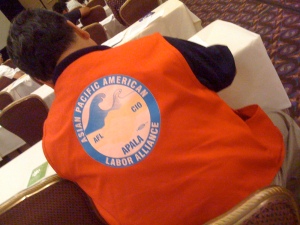 Sergeant-at-arms, 2009 APALA convention, Las Vegas
Just got back from a long weekend in Vegas, but I didn’t do any gambling, see any shows or go to the Liberace Museum (though I did eat at a couple buffets). Instead I spent most of my time consorting with a crowd of fired-up labor union activists at the Asian Pacific American Labor Alliance (APALA) convention. Equal parts awards ceremony, strategy session, and revival meeting, the APALA convention rocked the old-school trade unionist rhetoric with more than 300 delegates from across the country. I got a crash course in union acronyms—represented at the convention were IBEW (International Brotherhood of Electrical Workers), SEIU (Service Employees International Union), AFSCME (American Federation of State, County, and Municipal Employees), IFPTE (International Federation of Professional and Technical Employees), and CWU (Culinary Workers Union), to name just a few. I met homecare workers, teachers, electricians, lab techs, hotel and restaurant workers, longshoremen, nurses, ironworkers (not to be confused with steelworkers, who were also in the house), and straight-up union organizers, all of whom were dedicated to the cause of uplifting and honoring the worker and making sure we all get paid a living wage.
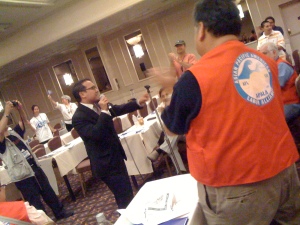
John Delloro brings 'em to their feet, 2009 APALA convention, Las Vegas
Some of the convention’s most interesting aspects were the various forms of creative expression, both subtle and overt, that repeatedly surfaced during the weekend. Songs and poetry by labor unionists go way back, and one of the convention’s speakers, Johanna Puno Hestor, referenced this long history by quoting from a poem by famed Pinoy farmworker and organizer Philip Vera Cruz. Chants and unions also go together hand in glove and one of my favorite moments was when John Delloro of the Dolores Huerta Labor Institute let rip with a full-throated rendition of the old picket-line chant, “We Are The Union,” getting the whole convention to swing it with him. Several other times during the proceedings a speaker would spontaneously bust out with a rousing chant in various languages including Spanish, Tagalog, and Mandarin as well as English.
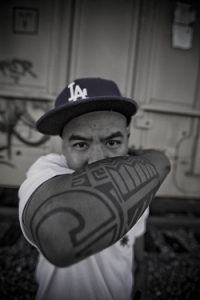
APALA convention presenter Kiwi and tats
The connections between art and activism were further explicated throughout the convention. Rapper Kiwi, formerly of Native Guns, and Geo Quibuyen, aka Geologic, aka Prometheus Brown, blogger and a member of Seattle’s isangmahal arts kollective and one-half of the rap duo Blues Scholars, led a standing-room-only workshop entitled “Cultural Activism and The Fight For Workers’ Rights,” which looked at the work of sansei singer/songwriter Chris Iijima, Pilipino filmmaker Lino Brocka, Tupac Shakur, and writer Carlos Bulosan, linking their creative work to issues of human rights and social justice. Rick Rocamora gave a slide show of his luminous and evocative black-and-white photographs from “Filipino World War II Soldiers: America’s Second-Class Veterans,” his book about the Pinoy soldiers’ struggle to receive benefits from the U.S. government. On the filmmaking tip, Tam Tran screened “Lost And Found,” her poignant short documentary (see below) about Stephanie Solis, a UCLA undergraduate and undocumented immigrant who entered the U.S. as a child. Both Tran and Solis spoke in support of the DREAM (Development, Relief and Education for Alien Minors) Act, which would facilitate legal status for many young people who are, due to the peculiarities of U.S. immigration law, in permanent non-citizen limbo.
All in all the convention was pretty informative and enlightening, with much more lively speeches than the dry-as-dust presentations I’m used hearing at, say, your standard academic conference. I enjoyed the convocation being referred to as “sisters and brothers” and it was fun to hear the boos and gasps of shock when particularly nefarious employers were called on the carpet for their various transgressions (ten-hour work day! no lunch break! no overtime!). The topics discussed were particularly relevant to me since my own union, the California Faculty Association, just voted on whether or not to accept work furloughs equaling a 10% pay cut. Trade unions may seem outdated and retro but with the Republican policies of the last presidential administration resulting in the current economic meltdown, maybe there’s something to be said for fairer labor practices and a return to honoring workers instead of exploiting them. In the end, it’s all about doing right by as many people as possible instead of only looking out for yourself, which really isn’t a bad thing at all.
A few fun facts:
Only 12% of U.S. workers are union members, with only 9% of the private sector unionized.
All of the hotels on the Vegas strip save one (The Venetian, boooo!) are union shops.
It took more than six years to unionize the MGM Grand Hotel.
Here’s Tam Tran’s short about Stephanie Solis and the DREAM Act.
UPDATE: May 16, 2010: Terrible news–Tam Tran was just killed in a car accident in Maine today when a pickup truck crossed the meridian and crashed head on into a car she was riding in. I’d only met Tam once, after she showed the above video, and she was a promising young filmmaker and activist. All thoughts to her family and friends.
UPDATE 2: June 6, 2010. More incredibly bad news–just found out today that John Delloro died of a heart attack yesterday. This is quite shocking to me since John was an incredibly vibrant person who was literally bursting with life. I’d only met him once, at the APALA convention last year, but I was more than impressed with his incredible energy, dedication, and optimism. The Asian American community has lost a a potentially great leader who has passed long before his time. We can only hope that in his memory we will all continue his work toward peace, justice, and the betterment of the world for all.
———————-
And for good measure, the lyrics to Which Side Are You On?, written by Florence Reece in 1931 during a strike by the United Mine Workers of America in which her husband, Sam Reece, was an organizer.
Which Side Are You On?
Come all you good workers,
Good news to you I’ll tell
Of how the good old union
Has come in here to dwell.
CHORUS:
Which side are you on?
Which side are you on?
Which side are you on?
Which side are you on?
My daddy was a miner,
And I’m a miner’s son,
And I’ll stick with the union
‘Til every battle’s won.
They say in Harlan County
There are no neutrals there.
You’ll either be a union man
Or a thug for J. H. Blair.
Oh workers can you stand it?
Oh tell me how you can?
Will you be a lousy scab
Or will you be a man?
Don’t scab for the bosses,
Don’t listen to their lies.
Us poor folks haven’t got a chance
Unless we organize.
One Time, One Night: Fangirl Extra and Shah Rukh Khan, My Name Is Khan

Shah Rukh Khan and friends, My Name Is Khan location, San Francisco, 2009
I’ve known for a while that Shah Rukh Khan’s newest movie, My Name Is Khan (MNIK), would be filming in California this summer and I was amused to think that the King of Bollywood, as well as his equally fabulous co-star, Kajol, would possibly be within a few hundred miles of me sometime this month.
When the movie shoot finally arrived here I realized that, according to various Bollywood fansites, MNIK was not only filming in California but in San Francisco, within miles of my house. Like the good otaku that I am, I tried to track down the production in hopes of possibly seeing SRK up close and in person.
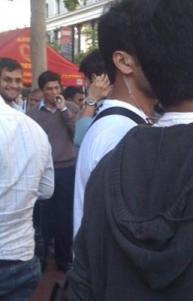
Shah Rukh Khan smoking, Market Street, My Name Is Khan location, San Francisco, 2009
At first I tried to trace SRK’s whereabouts via twitter, but the news was always a little too late—I found out he was at the Palace of Fine Arts a day after the shoot there; he was at Dolores Park on a Friday but I read about it the following Sunday; the movie crew was in the South Bay for a couple days but it was impossible and insane for me to drive two hours in the hopes of crashing a closed set to catch a glimpse of him. Then by chance I ran into an Indian couple at my excellent local video store, Four-Star Video, and chatted with them in front of the store’s newly inaugurated Bollywood section (full disclosure: I helped Ken Shelf, the store’s awesome proprietor, pick out several of the movies therein and wrote the blurbs for him, too). The Indian couple mentioned that they’d just been extras on MNIK and that the production was probably still seeking people for the last couple days of filming. So I raced home and looked up the information about becoming an extra, emailed the casting agency, and within a couple hours had received a call back to work on the very last day of the shoot.
It sounded great at first, but then I found out that the location was in Healdsburg, which is about 1.5 hours north of where I live, and the call time was 6 pm, with shooting to possibly go up to 4 am. Would I be able to keep my eyes open? (I hadn’t pulled an all-nighter in many a year, especially without extreme chemical assistance). Would my kids freak out if I was gone that long? Where the hell would I sleep once the shoot was over?
In a panic I posted on facebook—what to do? As expected nearly everyone who responded urged me to do it, but I was still undecidedly fretting about it the next day. Finally I figured out the logistics (take a nap earlier that day, don’t let the kids know I’d be gone all night, sleep at a friend’s place), but when I called the casting agency back, they’d already filled their quota for extras! Ah, the irony! but they put me on the backup list in case there was a cancellation. I sulked for a few hours, then the casting folks called back and told me I was in.
So at 6 pm the next day, after fighting holiday rush hour traffic up Highway 101, I signed in at the location with 300 other extras and settled down with a book (The Golden Compass) and my iPhone (to live-tweet the whole event) and waited the extra wait. As anyone knows who’s worked as talent on a movie, there’s a whole lot of sitting around interspersed by brief bursts of shooting activity, then more sitting around, repeated ad infinitum. True to form, the extras weren’t bussed to the set until three hours after we’d arrived—by then filming had started and things were jumping.
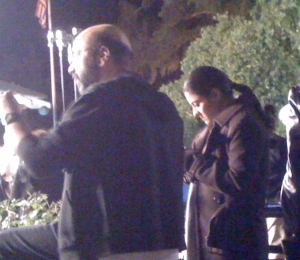
Kajol texting, My Name Is Khan location, Healdsburg, 2009
Myself and a few other eagle-eyed fans quickly spotted Kajol, MNIK’s beautiful, violet-eyed lead actress, near the edge of the shoot as she hung out shooting the breeze with the natty, baby-faced Karan Johar, the film’s director. I was disappointed to see that Kajol had tweezed her famous unibrow but she looked great nonetheless. Since this was one of the last days of filming there was much back-slapping and souvenir picture-taking amongst the cast and crew. I managed to fire off a couple of surreptitious, fuzzy pictures on my iPhone and post them on twitter before one of Kajol’s handlers asked me to stop.
Back of Kajol, Karan Johar & friend, My Name Is Khan location, Healdsburg, 2009
More waiting around, then we extras, or “background,” in Bollywood parlance, were pressed into action. I was envious of the fancy lighting rig, including a huge, helium-filled china-ball lantern that floated many feet above the crowd, and two twenty-by-thirty foot scrims to diffuse the giant lights that lit the scene. This was a top-notch, high-end production, with a crew of about 200, and as complex and professionally run as any Hollywood set I’ve been on (which, admittedly, have been very few).
After a while filming without any of the principle actors, I was standing near the edge of the set when a ripple went through the crowd. And there he was, cigarette in hand, strolling up the path with an entourage of about 15 people, five feet from where I stood. He was wearing a white caftan and looked quite kingly, in a casual sort of way. Needless to say I was overcome by fangirl recklessness and, with a tiny shriek, called out, “Shah Rukh!” SRK waved lazily in our general direction and continued on his way. As he passed by us another, much louder series of screams and calls came from the other side of the plaza where we were shooting and I realized that a good-sized crowd had formed at the perimeter of the location, held back by several wary-looking security guards and a ring of caution tape. Apparently every Indian in Sonoma County had gotten wind of the filming and had trekked to Healdsburg in hopes of spying Shah Rukh Khan, and now that the man himself had arrived they were very vocal in expressing their delight.
The crowd, seemingly consisting of entire families, stayed on until well past midnight. At one point SRK waved directly at the eager onlookers and they shrieked in admiration, but whenever the AD called “Silence!” (Bollywood-speak for “quiet on the set”), they quickly fell into rapt quiescence. Amongst the extras, however, the majority were unfamiliar with SRK—a few people asked me who he was and which of his films they should watch (all of them!). There were some clued-in folks, though, including one (non-Indian) couple who had driven down from Washington State to be near their idol, and many others who kept up a constant low chatter in Hindi and boldly snapped photos of King Khan and Kajol despite the ADs stern admonitions not to do so.

Back of Shah Rukh Khan's head, very far away, My Name Is Khan location, Healdsburg, 2009
At one point SRK stood about ten feet from me in the crowd, but I was too cowed by the constantly prowling ADs to try to take a picture, for fear of being thrown off the set. But I did live-tweet most of the night and early on, before I lost my nerve, I shot and posted some blurry photos. This was quite fun and helped me to stave off boredom, especially when several people began following and tweeting back for more information.
In person SRK looked exactly like he does onscreen, though perhaps a bit more slender and compact. He’s also very focused when he’s performing, though between takes he was pretty chill, taking lots of ciggie breaks and chatting with assorted paparazzi. Likewise, Kajol didn’t have any diva moments and hung out on set most of the time with the rest of us peons instead of hiding in her trailer. Altogether it was a pretty tightly run ship, without any star-drama or untoward extra-abuse. We were allowed to watch the filming, sit down, or wander about between takes, we got decently fed at the appropriate hour, and no one on the crew yelled at us just to vent their emotions.

Blurry but close Shah Rukh Khan, My Name Is Khan location, Healdsburg, 2009
When we finally wrapped at about 2.30 am, the extras were instructed to head toward the bus that would take us back to our staging area a few blocks away. But about fifty people bolted in the opposite direction, swarming after the departing Shah Rukh Khan as he left the set. Security tried in vain to divert us but the extras, many of whom were South Asian, weren’t about to miss their chance after standing in the cold for six-and-a-half hours. Luckily SRK was really cool and allowed several people to take pictures with him, as well as signing many autographs. I got a couple of blurry but reasonable photos of him, though I was hampered by the lack of a zoom lens or a flash on my iPhone. And so my fangirl night was complete—
UPDATE: Ironically, Shah Rukh Khan was just detained by while trying to enter the U.S. at the Newark (New Jersey) airport for almost two hours for unclear reasons. Speculation is that his last name (which is common among Muslim Indians) set off alarm bells at the airport.
According to the New York Daily News, after the incident SRK texted to reporters, “I was really being hassled, perhaps because of my name being Khan. These guys wouldn’t let me through.”
I can just imagine the exchange in the Customs interrogation room:
SRK: I’m the biggest movie star in India!”
Customs: Mmmmhmmm.
SRK: I’m here as to lead a parade celebrating Indian independence!
Customs: Sure you are.
SRK: A billion people recognize me by sight!
Customs: But we don’t. So tell us the real reason you’re coming to America, MISTER Khan.
Although his travel papers were in order, at first Shah Rukh Khan wasn’t permitted to use his cell phone and, despite being recognized by several fellow travelers, he was only released after he was allowed to call the Indian embassy and an official vouched for him.
There’s a huge discussion on twitter about it and some wags speculate that it’s all a publicity stunt to promote MNIK. Whatever the truth may be, you can be sure that the shrewd and canny SRK will be milking for all it’s worth.
Thanks to dleedlee and Sunny for tipping me to this while I’m on vacation, otherwise I might have missed it.
Higher Ground: twitter, youtube, and the Iranian election

Unidentified protestor, Tehran, June 2009
I’m tearing myself away from twitter right now to note that, since the aftermath of the disputed election in Iran last week, the much-maligned social networking site has all of a sudden become the most significant media outlet for information about the protests in that country. Search #iranelection and you get dozens of tweets and retweets every minute from Iranians on the ground reporting live in first person about the civil unrest there. Although Iranian security forces are trying to track and shut down tweeters, news is still pouring out of the country via the social media site much faster than it can be traced and eliminated. “it was a nightmare, I can barely breath & my face is burning, Masood got shot in the arm & Shayan’s brother is missing,” reads one tweet. “we ran as fast as we could in the opposite direction, at the same time basiji bastards started to hit fleeing people,” states another.
Mainstream media sources like msnbc.com and the BBC are suddenly the followers, not the leaders, of online, first-person news sources—the U.K. Telegraph, cnn.com and time.com are reporting on the latest twitter updates
Simultaneously, youtube has become the best up-to-the-minute source for raw, unmediated video from Iran. I just watched a clip of destruction of the headquarters of the Basij, the Iranian paramilitary force, which was posted almost immediately after its occurrence a few hours ago. A video of the death of a young woman who was shot by the Basij has been viewed by thousands since it was posted earlier today, further galvanizing protestors in Iran and worldwide.
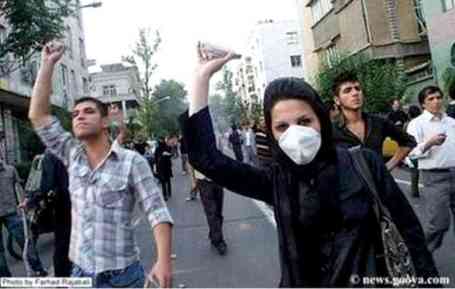
Protestors with rocks, Tehran, June 2009
Underscoring the influence of new media on what’s going on in Iran, embattled opposition leader Mir Hossein Mousavi released his most recent statement to his supporters not through a traditional news source but as a status update to his facebook page. The message reads simply, “Today you are the media, it is your duty to report and keep the hope alive,” suggesting that Mousavi is cognizant of the power of Iranians using the Internet to keep the outside world informed.
It’s impossible to predict how events will play out in Iran but it’s interesting that this is all taking place close on the heels on the 20th anniversary of the suppression of protestors in Tiananmen Square. With the world’s new ability to watch in real time and with more ready access to eyewitness accounts, will things turn out differently than they did two decades ago? Thus informed, will we be able to take action when we need to, or will we be paralyzed by our fascination with the spectacle? Will the arc of the universe bend towards justice this time?
Thanks to al rodgers at dailykos.com for the photos: many more here.
UPDATE: Go here for a list of tweeters to follow, plus much more.
UPDATE 2: New York Times article about Iran/twitter here.
UPDATE 3: Since first publishing this post three days ago some of the people I’ve been following on twitter, notably change_for_iran, have stopped updating. I suspect this is due to increasing limitations on internet traffic from Iran; I hope it’s not a sign of something more ominous. However, there are still several good sources to be found from the list in the first update, plus a great nightly English translation of significant Farsi tweets here.
Meanwhile, #iranelection has become somewhat useless as it’s jammed with spammers and other irrelevant tweets. But it’s probably still more current than, say, cnn or the New York Times right now.
UPDATE 4: June 24–possible bad news about another twitterer I’ve been following, persiankiwi. The last few tweets have been quite frightening & as of four hours ago have ended altogether. One of the last tweets: “we must go – dont know when we can get internet – they take 1 of us, they will torture and get names – now we must move fast.”
UPDATE 5: July 17–change_for-iran is back online. still no word from persiankiwi. Go here for good updates in English.
Body and Soul: Pahole Sookkasikon’s Art and Activism

Only For Pretend, ink on paper, 18″x24″, Pahole Sookkasikon, 2009
As of last Saturday night, I’m the proud owner of a t-shirt emblazoned with artwork by artist/activist Pahole Sookkasikon. Pahole’s solo show, Only For Pretend, opened at My Trick Pony in San Francisco last weekend, a smart little gallery space that also is a purveyor of custom t-shirts based on designs by the artists featured at the shop.
Pahole’s show is made up of several of his beautiful, impressionistic pen-and-ink drawings on paper. Delicate and dreamlike, the images flow gracefully across the page, with faces and shapes emerging amidst the swirling lines.
In addition to exhibiting the original artwork, My Trick Pony has also made up graphics of Pahole’s drawings for transfer onto nice, non-sweatshop t-shirts from American Apparel in a variety of colors and styles.
The shop’s adaptations of Pahole’s black-and-white drawings are available in several colors, including many metallic options.
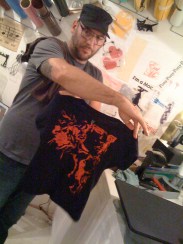
Matteo in action, My Trick Pony
Pahole’s pictures take beautifully to the to the t-shirt medium, with their lacy imagery gaining an added layer of feathery abstraction when rendered in metallic glitter.
Gallery proprietor Matteo is masterful on the hot-press, with a keen eye for the proper placement of the picture on each individual shirt.
At the show’s reception he whipped through the creation of several dozen shirts in the space of a couple hours, expertly applying Pahole’s ethereal drawings onto each garment.
Pahole’s exhibit continues through June. Stop by for your own custom t-shirt; visit My Trick Pony’s website for more information.
Pahole has also been tirelessly advocating for the Wat Mongkolratanaram Thai Buddhist Temple in Berkeley in its struggle for religious and cultural self-determination. For more than a year the Temple has been in conflict with some of its immediate neighbors who object to the smell, congestion, and lack of parking during the Wat’s Sunday food sharing, which has been taking place since 1994.
Part of the Buddhist tradition of merit-making, the food sharing raises operating funds for the Temple and supports the monks in residence. The Temple has made numerous concessions to the neighbors’ demands, including reducing by half the hours of the food offerings, providing alternate parking spaces for visitors, and increasing trash pickup on Sundays.
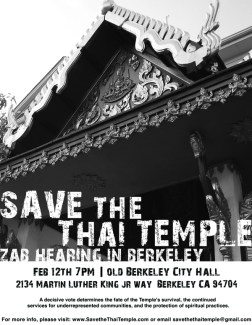
Save The Thai Temple poster, 2009
Neighbors claim that the Temple is running an unlicensed restaurant on its grounds, but the Temple maintains that the food offerings are an important part of its religious traditions. As outlined in a recent Wall Street Journal article:
Abbot Tahn Manas, who has lived at the temple for 22 years, says the event is critical to the Buddhist religious practice of “earning merit.” Monks are forbidden by their religion from earning money or accumulating earthly goods on their own. Providing for monks and temples is the religious duty of Buddhists of the Theravada school; it helps them build goodwill for later in life or for the next life. In Thailand, they earn merit by giving money to monks in the street. Berkeley Buddhists earn merit by volunteering at brunch, thereby serving the temple.
“Our Sunday activity is pretty much like Christians going to church every Sunday,” says Abbot Manas. “Without it, it would be very difficult for us to continue merit making.”
There’s also more than a bit of cultural insensitivity in the neighbors’ complaints, including the accusation that the glorious scent of Thai food is intrusive and offensive. As Veena Dubal notes in Asian Week,
“It smells like coconut milk!” Dubal said. “When I heard those remarks, I felt a tinge of pain. That kind of … xenophobic rhetoric has no space in this diverse community.”
About 20 neighbors continue to pursue their actions against the Temple; in contrast, more than 2000 people have signed a petition in support of the Temple and its facebook group has more than 1400 members.
The Temple hopes to build a new sanctuary on its site, for which it recently has received approval from the Berkeley Zoning Adjustments Board (ZAB). However, the Temple faces an appeals hearing before the Berkeley City Council meeting in July 2009, during which the Council can approve or deny the ZAB ruling. The exact time and date for the hearing will be posted on the Save The Thai Temple website as soon as that information is known.
Violence Grows: Kinatay and the Abduction of Melissa Roxas

Kinatay, still from movie, 2009, Brillante Mendoza
When I first read the description of Pilipino director Brillante Mendoza’s new film Kinatay (Butchered) I thought, “That sounds kind of wack.” Shot on HD video with a budget of $100,000, it’s a down-and-dirty, graphic representation of the rape, murder and dismemberment of a prostitute in the Philippines through the eyes of an idealistic, greenhorn cop. The controversial film just won the Best Director award at the 2009 Cannes Film Festival, where the announcement of the award was greeted by boos and gasps of shock. Roger Ebert calls it “the worst film in the history of the Cannes Film Festival,” and extensively details his disdain for the picture in his blog.
But after I read a few interviews with Mendoza about the film, I started to change my opinion of it (though still sight-unseen; the film will probably receive pretty limited distribution in the U.S., if at all). Mendoza claims that the movie is based on a true-life event and that it reflects the rampant police corruption and unchecked military violence in the Philippines. “This is not just entertainment, these kinds of stories are real,” Mendoza said after winning his award at Cannes.

Surface Melissa Roxas, online poster, 2009
This was borne out by an email blast I received on the same day that Kinatay won at Cannes. On May 19 Pilipino American Melissa Roxas, a poet and human rights activist from BAYAN-USA, a non-government organization (NGO), was kidnapped along with two co-workers while doing volunteer health work in the Tarlac Province in the Philippines. The email I received stated that BAYAN-USA was mounting a campaign to demand the Pilipino government aid in searching for and surfacing her. Thankfully, Roxas surfaced after a week of captivity, although her compatriots are still missing. What’s interesting in light of the accolades that Kinatay received is that Roxas and BAYAN-USA have claimed that she was abducted and tortured by the Pilipino police and military and that this event is the latest in a series of abuses against political activists by government agencies in the Philippines. The New York Times notes:
“According to the human rights group Karapatan, more than 200 Filipino activists have been kidnapped and never heard from since 2001, the year President Gloria Macapagal Arroyo came to power. Others have turned up dead or showing signs of torture.”
If the claims by Roxas, Karapatan, and BAYAN-USA are true, then Mendoza’s film takes on an added significance. Most of the film’s detractors criticized it for its graphic, unvarnished depiction of violence and brutality, with Ebert in particular scorning its rough-hewn soundtrack and cinematography. What Ebert might not understand is that Mendoza is making a conscious decision not to sanitize the film’s violent events. Movie violence is nothing new, but it’s usually presented with a patina of glamour and unreality, an aestheticization that distances the viewer and sanctions the viewing of the violence, making it an acceptable form of entertainment.
By denying his film the glossy sheen of conventional filmic violence, Mendoza forces viewers out of their complacent moviewatching habits, taking them out of their comfort zone and making them realize that, as in the case of Melissa Roxas and many others around the globe, violence is not a form of entertainment but a dire part of everyday life. In this case, Mendoza is working toward the same goal as Roxas—to expose and eradicate the corruption and human-rights abuses of the power structure in the Philippines.
UPDATE: Here’s the transcript of Melissa Roxas’ June 28 press conference in which she describes her ordeal.
Blood Red and Going Down: Tank Man In Tiananmen Square, part 2

Tank Man - lone citizen vs. PLA tanks, Tiananmen Square, 1989, Jeff Widener
I confess to being taken by melancholy this week as I recalled the events on June 4, 1989 in Tiananmen Square in Beijing. But it’s a good opportunity to think back on those fateful days from a perspective of twenty years later.
In the six weeks prior to when things all went to hell on June 4 two decades ago, students and workers were peacefully occupying the Square and sympathy was growing across China for their demands for reforms to China’s political and economic systems. Sometime during those six weeks I remember talking on the phone with my friend Rebecca. We thought we were witnessing a revolution in the works and that the Chinese people’s voices would surely be heeded.
Terribly, things turned out differently than we’d hoped and the insurrection was violently crushed by the tanks and guns of the People’s Liberation Army. More horribly, the numbers of the dead were never confirmed, as many bodies were burned in mass cremations, and many other demonstrators were taken elsewhere for execution. China’s official tally of those killed was a ridiculously lowball count of 241 people, most of whom were deemed by the government to be “ruffians” and “armed thugs” who weren’t actually students. The government also claimed that no one was killed in the Square itself. Other estimates by NGOs on site range from 500 to 7,000 people killed that day.
This morning Rebecca forwarded me a link to a project by artist Michael Mandiberg that utilizes the famous image of the Tank Man, the anonymous protestor who blocked a column of tanks the day after the PLA cleared Tiananmen Square of demonstrators. Four years ago Mandiberg conducted an experiment in which he sent copies of the Tank Man image to a dozen commercial artists in China and asked them to paint a replica of the picture. The responses from the artists suggest that some if not all of them were unaware of the image and its historical context, and few knew its source.

Tiananmen Square: You can add the person to painting when you get it, 2005, Michael Mandiberg
Mandiberg notes:
“Of the dozen requests I sent, most were returned with a price and the universal salutation “it is a pleasure to do business with you.” A few painters suggested I just leave the man and the lamp post out, often for unclear reasons: political or aesthetic? One person outright declared that he could not paint the image.”
In the West the image of the Tank Man is well-known, as photographs and video footage of his actions that day were widely disseminated throughout the media at the time. However, in China the image is largely unrecognized, due to the government’s attempts to erase the June 4 events from public memory.
The government has achieved this in part through its severe restrictions on Internet access. In recent days, in an attempt to prevent the Chinese citizenry from getting to online discussions of the Tiananmen Square killings, the Chinese government blocked access to twitter, facebook, and other social networking sites, as well as blogging sites such as wordpress, xanga and blogspot.
But before we go too far in excoriating the Chinese government for its erasure of June 4, let’s remember that historical amnesia is not unique to China. Many World War II Nazi concentration camps sites in Europe have been razed or otherwise obliterated. The Japanese government still hasn’t acknowledged the Rape of Nanking. And lest we start to feel too pleased with ourselves here in the U.S. let’s not forget the Bush Administration’s multiple attempts to rewrite reality, from un-defining waterboarding as torture to linking Iraq to the destruction of the World Trade Center.
So on this grim anniversary it’s vitally important to remember the untold numbers of demonstrators who were silenced twenty years ago on Tiananmen Square. But it’s also significant to note that the Chinese government doesn’t stand alone in its disregard for facts and that our constant vigilance is required to keep ignorance and the obliteration of history at bay.
UPDATE: Thanks to dleedlee for sending along the following information, which fills in some of the backstory of the Tank Man photos and video.
FYI, Frontline is rebroadcasting its The Tank Man program this week.
Also, a New York Times blog posted this interesting piece on the various versions of the ‘tank man’ photo(s).
http://lens.blogs.nytimes.com/2009/06/03/behind-the-scenes-tank-man-of-tiananmen/
And artist Michael Mandiberg sent me a further link to his flickr site, which contains all of the images from his series:
http://www.flickr.com/photos/theredproject/sets/72157619172370116/
Twenty years ago today: Tank Man in Tiananmen Square
I don’t know if I need to add too much to this. It’s an image and a moment that should never be forgotten.
Tank man, June 5, 1989, Tiananmen Square, Beijing

 beyondasiaphilia
Recent Comments