Picture This: 2010 San Francisco International Asian American Film Festival

Illuminated curtain, Great Star Theater, A Moment In Time, Ruby Yang, 2010
I’m not sure that the nice Chinese American ladies sitting behind me during the screening of James Hong & Yin-Ju Chen’s Lessons Of The Blood, shown last Tuesday as part of the San Francisco International Asian American Film Festival (SFIAAFF), knew exactly what they had signed up for when the bought their tickets. They had been behind me in line outside of the Sundance Kakuki Cinema, chatting amiably in English and Toi San, and I heard them mention that the film was “about the Nanking massacre” and that it had “won some kind of award in Europe.” As the film progressed and drew the audience deeper into its horrific tale, the ladies began to gasp and groan in dismay since Hong & Jin’s movie is not for the faint of heart and tells its story in chilling detail. Not unlike when I see a particularly brilliant horror flick, I found myself overwhelmed with dread and anxiety by the end of the movie, all the more so since its story is drawn from facts and history.

Germ warfare victim, Lessons Of The Blood, James Hong & Yin-Ju Chen, 2010
The film outlines the infamous series of war crimes commonly known as ‘the rape of Nanking,” but as told by Hong & Chen it’s quite a bit more. Unflinchingly graphic in its description of the various atrocities committed by the Japanese military in Nanjing during World War II, it also included several stomach-turning closeups of festering wounds found on the now-elderly survivors of the germ warfare unleashed by the Japanese Imperial Army in the 1940s. Lessons Of The Blood, however, is more than sensationalized propaganda or simple polemics. It’s also an impressively crafted film, using found footage from propaganda films, newsreels, Hollywood movies, television news, and other filmic detritus, as well as a disturbing and ominous soundtrack, coupled with modern-day interviews with Chinese wartime survivors (who willingly reveal their various scars and disfigurations). The result is a haunting condemnation of both the historical crimes as well as the modern-day complicity that implicates us all. Needless to say, watching this movie was hella intense.
Lessons Of The Blood was one of the strongest films from this year’s action-packed SFIAAFF. Although once again I spent more time at the parties than watching movies (in part because so many shows sold out), I managed to catch A Moment In Time, Ruby Yang & Lambert Yam’s luminous elegy to San Francisco Chinatown movie houses. The film is a comprehensive look at the ways the Great Star, the World, the Bella Union, and the Mandarin theaters were in days of yore the glue that held together the Chinese community, beginning in the 1920s and continuing until their collective demise in the mid-1990s. I myself had the privilege of seeing several classic Hong Kong films with my buddy Patrick at both the World and the Great Star (including a strange and awesome double bill of the violent shoot’em up Big Bullet and the weepy melodrama Comrades: Almost A Love Story) and I can attest to the downscale utilitarianism of both of those movie houses. But there’s nothing like seeing a Chinese-language film with a roomful of Chinese people who are eating cuttlefish, smoking, and chattering incessantly in Cantonese during the show, and Yang and Lam’s movie captures that sensation exactly. One patron interviewed described his entire family including young children attending 9.30p Saturday night shows for 25 cents total, the kids running up and down the aisles and the parents gossiping and eating chicken wings and melon seeds until all hours.

Cell phone a-go-go, Tehran Without Permission, Sepedeh Farsi, 2008
I also caught a screening of Tehran Without Permission, shot surreptitiously on a cell phone in the months running up to the 2009 presidential election in Iran. Although I was dog-tired from attending my own world premiere and reception for The Oak Park Story earlier that day, Sepedeh Farsi’s verite documentary held my attention throughout its 80-minute run time. Through subtle and succinct vignettes the film captures the mood and attitude of citizens of Tehran, with small details and comments presaging the upheavals that would occur in a few months hence.

Deepika Padukone & Saif Ali Khan, just another impossibly gorgeous Bollywood couple, Love Aaj Kal, 2009
I also made time to see the festival’s annual Bollywood at the Castro movie, Love Aaj Kal, although it was the fourth film of a long day of movie-going. I have a soft spot for this program since it was at last year’s festival that I caught my very first Shah Rukh Khan movie, Rab Ne Bana Di Jodi, which spurred my obsessive love for SRK in particular and for Bollywood movies in general. Love Aaj Kal, alas, does not star Shah Rukh Khan but the hot and charming Saif Ali Khan makes an acceptable substitute. Paired with the doe-eyed and astoundingly pretty Deepika Padukone, Saif plays dual roles as a modern-day commitment-phobic NRI in Britain and a noble and lovestruck suitor in the 1960s Punjab. The film deftly shuttles back in forth in time between these two stories, drawing parallels and distinctions between the romances from each period. A well-made and satisfying love story with some excellent dance sequences, the film is a great example of high-quality Hindi-language commercial moviemaking—in other words, a fun and rewarding bit of Bollywood entertainment.
I also passed by a rush line full of excited teens waiting for the special appearance of youtube darlings kevjumba, wong fu, nigahiga and timothy delaghetto. The youth were madly texting and tweeting as they waited to see their favorite internet stars in the flesh, but tickets were, alas, impossible to come by since the show had sold out as soon as it was announced. It was nice to see the next generation of SFIAAFF fans out in force, which hopefully augers well for the continued health and well-being of Asian American filmmaking.

Filmmakers Felicia Lowe & the late, great Loni Ding, 2009. photo: Jay Jao
NOTE: This year’s fest was dedicated to the memory of the force of nature known as Loni Ding, the legendary Asian American filmmaker and educator who a few weeks ago died at age 78 from complications from a serious of strokes. Loni was one of the fiercest and most amazing people on the planet and her energy, dedication, and sheer determination guided her filmmaking, which included seminal documentaries like Ancestors In America and The Color of Honor. She always had a kind word and a smile for younger filmmakers like myself and made us feel like we were doing something significant in our work. She was the moral center of the Asian American film community and she will be sorely missed.
Little Dragon Redux: Mike Lai at Southern Exposure Gallery
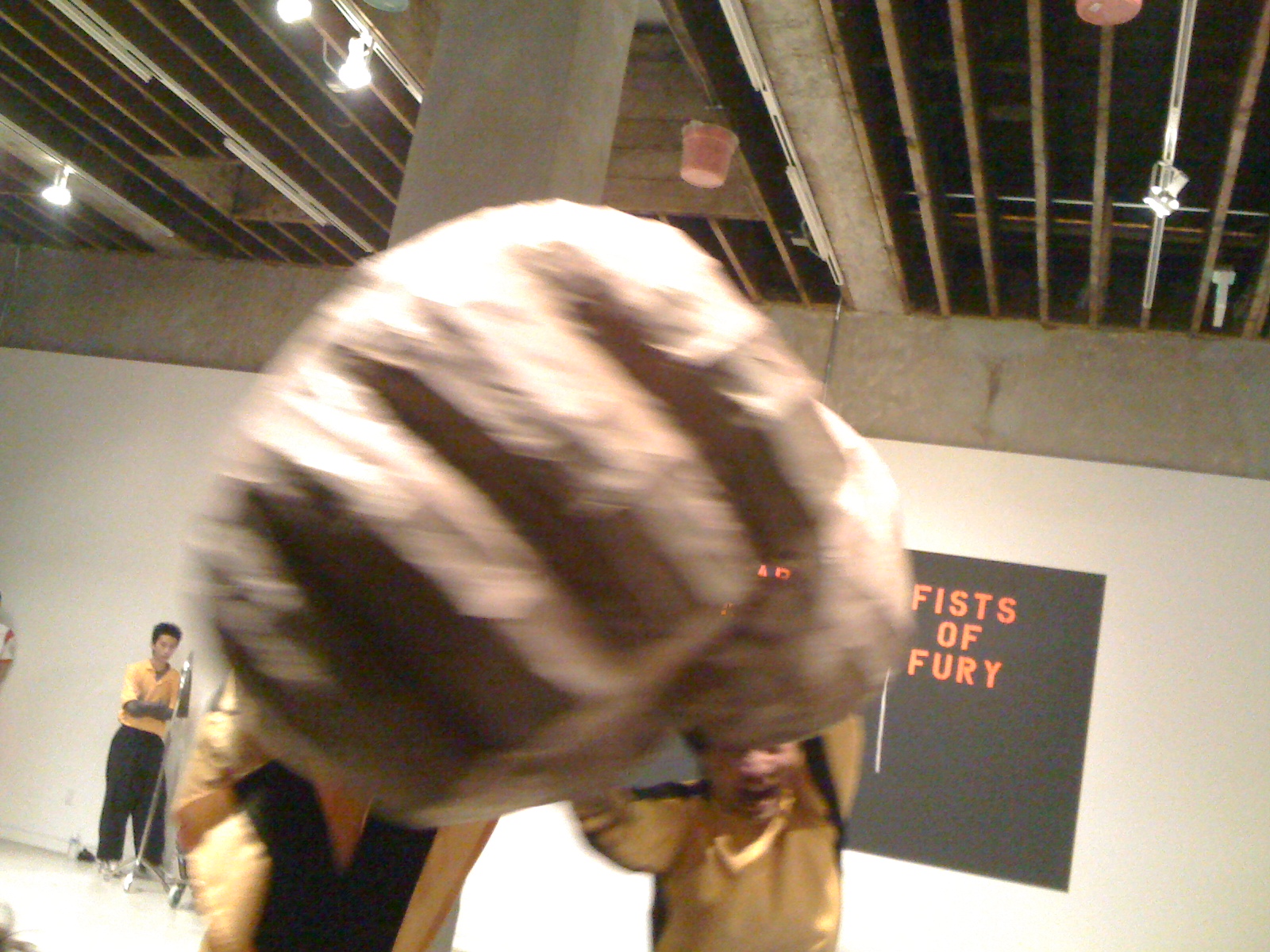
Fist atcha, The Legendary Lions vs. the Fists of Fury, Mike Lai, 2010, Southern Exposure Gallery, San Francisco
Just closed out my Chinese New Year celebration last Friday by attending Mike Lai’s wacky and inspired performance, The Legendary Lions vs. The Fists Of Fury. Staged one night only at Southern Exposure gallery in San Franciso’s Mission District, the performance was a face-off between two traditional Chinese lion dance troupes and the Fists of Fury, Lai’s goofy take on that venerable martial arts/dance/acrobatic form that featured two gigantic paper mache fists trailing yellow-and-black tails.

Nails of fury, Bruce Lee Manicurist/ Golden Dragon Massacre, Mike Lai, Queen’s Nails Annex, 2007
The performance continued Lai’s obsession/fascination with all things Bruce Lee and included yellow-and-black custom-made M & M’s emblazoned with Lai’s face in a Little Dragon bob. Mike Lai is heavy into Bruce and several of his past performances have referenced Siu Lung and his films. He’s especially fond of Bruce’s signature yellow-and-black tracksuit from Game of Death and has used that motif a bunch of times, including at an excellent event at the Queen’s Nails Annex Gallery where he painted tiny yellow-and-black designs on the nails of lucky manicurees.

Leung’s White Crane tears it up, Southern Exposure, 2010
For the first couple rounds last Friday at Southern Exposure the battle was pretty well-balanced between the lion dancers and Lai’s nouveau-dance Fists, but it was all over when the second lion dance troupe took the stage. Leung’s White Crane is one of the top lion dance crews in the world and they’ve performed in oodles of international competitions—the very next night following the SoEx battle they carried the gigantic dragon puppet at San Francisco’s Chinese New Year parade. So though Lai’s Fists put up a valiant fight, they were no match for the mad skillz of Leung’s veteran troupe.

Mike & the Fists, 2010, Southern Exposure Gallery, San Francisco
Although the event was a bit too oppositional for my acculturist tastes (does it really have to be trad vs. modern?) it was a fun and furious, hella loud experience. The night ended with an impromptu confetti fight between myself, my younger daughter (staying up late to watch performance art with her mama), and Chi-Hui Yang, director and curator of the San Francisco International Asian American Film Festival, which is about to start in exactly two weeks. Chi-Hui informed me that Mike and the Fists will reprise their performance at the Film Fest’s big all-day Festival Forum event on Sat. Mar. 13 at 6pm in Japantown’s Peace Plaza. So check it out—it will be brilliant.
Just for kicks, here’s a video of Leung’s White Crane performing atop ten-foot high poles at the 2008 Genting World Lion Dance Championships in Malaysia.
Masculin/Feminin: Shinjuku Incident + Retro Drag Revue at Marlena’s

Jackie Chan & hing dai get their game face on, Shinjuku Incident, 2009
When we arrived at the multiplex, the ticket booth marquee listed Shinjuku Incident merely as “Jackie Chan.” But when is a Jackie Chan movie not a Jackie Chan movie? When it’s directed by Derek Yee, the veteran Hong Kong filmmaker who’s known for both his hard-edged crime thrillers (Protégé; One Nite In Mongkok) as well as his sensitive melodramas (C’est La Vie, Mon Cherie; Lost In Time).
Yee’s one of the best commercial filmmakers currently working in the former Crown Colony and his films are known for an attention to character development, an intensity of emotion, and an affinity for the lives of ordinary, downtrodden people. Shinjuku Incident, which Jackie Chan produced as well as starred in, is no exception, with extreme violence alternating with sympathetic and realistic glimpses into the quotidian existences of its various characters. Although nominally a Jackie Chan vehicle it’s really a Derek Yee movie that happens to star the martial arts superstar, and both Yee and Chan do a good job sublimating Chan’s matinee idol persona in favor of a more serious dramatic characterization.
Jackie Chan plays Steelhead, a Chinese illegal immigrant living in Tokyo’s heavily Chinese Shinjuku district. He’s there to search for an old flame but falls in with other down-on-their luck Chinese, eventually getting involved with petty crimes and tangling with the Tokyo underworld. Shinjuku Incident is definitely not your typical Jackie Chan movie—there are no outrageous stunts or choreographed fight scenes and the film hews pretty closely to a gritty and realistic mis en scene. Steelhead is a real character, not just a variation on the Jackie Chan persona, although occasionally he succumbs to movie star vanity. For instance, although Chan looks every bit his fiftysomething age, both of his love interests (including anime-girl come to life Fan Bing Bing) are women in their late twenties. Probably a perk of executive producing the film, I suppose.

Droogie Daniel, Shinjuku Incident, 2009
But for the most part Chan suppresses his star status and blends seamlessly into the narrative. He’s aided by a strong supporting cast, with veterans such as Chin Kar-Lok (Young and Dangerous; Full Alert), Lam Suet (from the Johnnie To stable), and Jack Gao (Taiwanese heavy extraordinaire) adding gravitas to the proceedings. The East Bay’s own Daniel Wu is also good as Steelhead’s ill-fated buddy Jie, although the poor schmuck gets his third severe beatdown in as many Derek Yee movies. Wu transforms effectively from a timid pretty boy into coke-sniffing clockwork orangey punk who channels Heath Ledger’s Joker, complete with facial scars and smeared lipstick, as well as a crazy silver fright wig.
Unlike most pre-1997 Hong Kong productions, Shinjuku Incident doesn’t focus narrowly on the city of Hong Kong and the provincial interests of its denizens. Instead, like Johnnie To’s Exiled and Fulltime Killer, the film looks beyond Hong Kong’s narrow confines and considers the lives and existence of the Chinese diaspora that Hong Kong residents have only started to realize they belong to.
In a departure from the typical Hong Kong film, the Chinese characters in Shinjaku Incident are not the top dogs but are relegated to second-class status. Although set in Japan and directed and financed by as well as starring mostly Hong Kong natives, the film’s main characters are from the PRC, not Hong Kong, and the dialog is primarily in Mandarin, with smatterings of, Cantonese, Taiwanese and yakuza-style guttural Japanese. Even native HK performers like Jackie Chan and Lam Suet play Mainlanders and speak in putonghua.

Signifier, Shinjuku Incident, 2009
This might be indicative of the general angst that many HK residents have been feeling in the decade or so since 1997’s reunification with China, which is succinctly reflected in not one but two different scenes featuring a severed hand. Talk about castration anxiety—
Postscript: As an interesting contrast to the hypermasculinity on display in Shinjuku Incident, afterwards we stopped by Marlena’s to catch its fabulously retro drag show, The Hayes Valley Follies, hosted by Empress Galilea–the revue included awesome performances by drag queens including Chablis, Chenelle, and Anna Mae Cox. Old-school touches included lip-syncing to disco classics old and new (including Lady Gaga, Whitney Houston and, yes, Gloria Gaynor’s I Will Survive), impossibly arched eyebrows, lots of sequins and fringe, and expert tucking. It was as if the Popstitutes’ smart-ass postmodern punk rock drag never existed and we were time-warped straight back to 1975. Not that I’m complaining, of course—
UPDATE: Shinjuku Incident has just been nominated for Best Picture and Derek Yee for Best Director at this year’s Hong Kong Film Awards, to be announced on April 18.
Bonus beats: Empress Galilea tears it up at Marlena’s
Sweet Dreams Are Made Of This: Top 10 Hong Kong Movies of the Decade
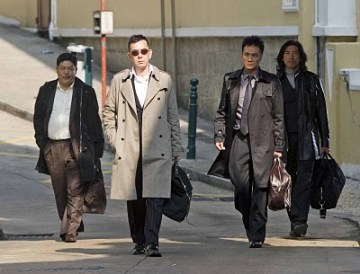
The Hong Kong Spice Boys, Exiled, 2007
This week I’ve been letting my geek flags fly, as I’ve been closely following the countdown of lovehkfilm.com’s Top 50 Hong Kong films of the decade. Webmaster Kozo, Hong Kong film aficionado extraordinaire, has been revealing ten films a day on his blog, Damn You, Kozo, with much commentary from the fanperson peanut gallery. Although Hong Kong films are not the ne plus ultra of film fandom that they were, say, fifteen years ago, more than 150 dedicated otaku responded to lovehkfilm’s poll, which was a completely unscientific open vote of anyone who wanted to send a ranked list of their favorite HK flicks of the past ten years. Being a dutiful HK cinema fangirl I compiled a draft of my top ten and, not surprisingly, the majority of the films on the list starred my personal favorite Francis Ng. Herein follows my list, with reviews of each film. Please note that the list is not a reflection on whether the films are cinematically or historically significant, but based purely on the amount of pleasure that I got while watching them. Which is really how it should be sometimes.
In reverse order:
10. Beauty and the Breast, dir. Raymond Yip, 2003
Wacky comedy starring Francis Ng as an office lothario who bets he can seduce bespectacled smart-girl Michelle Reis. Luckily her dad is an herbalist and kung-fu master who sees through the ruse, setting up Francis and his accomplice, the hapless Daniel Wu, with an appropriate punishment. Unlike most Hollywood actors, Francis Ng sees no need to safeguard his masculine image, which leads to an excellent use of prosthetic mammaries. Favorite scene: A conflicted Francis Ng manifests Good Francis (dressed in white with angel wings) and Bad Francis (in red with a tail and horns), who advise him on his quest to bed Michelle Reis.
9. A Gambler’s Story, dir. Marco Mak, 2000
A weird and loopy, stylized look at a down-on-his-luck gambler, played by Francis Ng, who tries to escape his miserable lot in life. Director Marco Mak mixes slapstick, violence, and pathos as only a Hong Kong director can do in this quirky and bizarre movie. Favorite scene: Francis and Suki Kwan win, then compulsively gamble away a fortune in a Macao casino.

Cecilia Cheung and Lau Ching-Wan show how it's done, Lost In Time, 2003
8. Lost In Time, dir. Derek Yee, 2003
A tearjerker par excellence, by Derek Yee, who also directed the 1993 classic Hong Kong weepy C’est La Vie, Mon Cherie. Lau Ching-Wan and Cecilia Cheung put on an acting clinic as ordinary people coming to grips with personal tragedy. Really one of the best melodramas ever made. Favorite scene: Orphanage scene!
7. PTU: Into The Perilous Night, dir. Johnnie To, 2006
Johnnie To’s dreamlike, surreal travel through nocturnal Hong Kong, with Simon Yam, Lam Suet, and Maggie Siu in search of a lost gun. Possibly the closest To has come to directing an art film, with its poetic use of empty space and expressionistic framing. Favorite scene: Triad musical chairs in a late-night hot pot restaurant.
6. Shaolin Soccer, dir. Stephen Chow, 2001
Though not as brilliant as Stephen Chow’s 1990s mo le tau comedies, Shaolin Soccer still captures Sing Jai’s absurd and wacky persona, with the added bonus of crazy CGI that perfectly meshes with Chow’s insane worldview. Plus it’s a totally fun sports movie. One of the most pleasurable films on the planet, imho. Favorite scene: Stephen Chow demonstrates his kung fu parking skills.

Gigi Leung & Francis Ng a deux, A War Named Desire, 2000
5. A War Named Desire, dir. Alan Mak, 2000
An early film by Alan Mak, one half of the Infernal Affairs team, this intense thriller follows the fate of a pair of estranged brothers who find themselves on the run from triads in Thailand. Francis plays the older brother, a no-nonsense gangster who must choose between duty and honor. Gigi Leung is outstanding as a gun moll whose sharpshooting matches Francis’ shot-for-shot. Favorite scene: Gigi Leung methodically stalks her prey during a chaotic, cacophonous Thai New Year celebration.

Cecilia Cheung and Francis Ng mix it up, The White Dragon, 2003
4. The White Dragon, dir. Wilson Yip, 2003
Fun, frolic, and wuxia, with Francis Ng playing a blind swordsman who falls for bratty and spoiled, vain rich girl Cecilia Cheung. Although the action and comedy scenes are energetic and clever, the best part of the movie lies in the center section of the film, where erstwhile adversaries Francis and Cecilia court and spark. Favorite scene: Cecilia informs the blind, unaware Francis that girls would fall for him since he’s handsome and has straight teeth and a “tall” nose.

Stare-off of the century, Francis Ng and Anthony Wong, Infernal Affairs 2, 2003
3. Infernal Affairs 2, dir. Andrew Lau & Alan Mak, 2003
The prequel to Infernal Affairs, which Martin Scorsese remade as The Departed, Infernal Affairs 2 is a magnificent gangster opus that operatically follows the fate of its many characters. Anthony Wong, Francis Ng, Carina Lau, and Eric Tsang are among the stellar cast. Francis in particular is outstanding as the soft-spoken yet ruthless Triad boss bent on avenging his father’s murder. Favorite scene: Francis mournfully toasts his late father at an outdoor noodle stand, with a cadre of equally somber triads echoing his gesture.
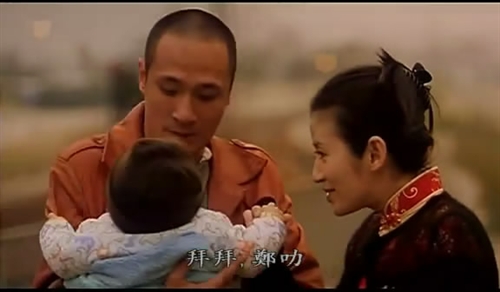
Francis Ng & Sandra Ng try to figure it out, Juliet In Love, 2000
2. Juliet In Love, dir. Wilson Yip, 2000
One of the saddest and most heartfelt genre films ever to reach the screen, with Francis Ng and Sandra Ng as star-crossed lovers who find unexpected solace with each other. Francis plays a low-level triad caught up in a net of fateful events. Sandra is a lonely restaurant hostess who befriends him. Favorite scene: Simon Yam as a mobster boss who indifferently slurps down hot pot while Francis stoically bleeds from a head wound in the corner of the restaurant.

Nick Cheung Ka-Fei shows 'em what for, Exiled, 2007
1. Exiled, dir. Johnnie To, 2007
The ultimate fanperson heroic bloodshed film of the decade, featuring an ensemble cast of hard-guy triad film stars. Anthony Wong, Francis Ng, Lam Suet, Roy Cheung, and Nick Cheung shoot ‘em up on the eve of the 1998 return of Macao to China’s rule. An allegory for the ennui and anomie of Hong Kong and Macao residents during that time, with beautiful cinematography, a haunting soundtrack, and brilliant, tough-as-nails characterizations by the veteran cast, plus five, count ‘em, five amazing shootouts. Favorite scene: the prelude to the awesome opening shootout, in which Anthony Wong and Francis Ng remove ammo from their automatic pistols in order to have the same amount of bullets as Nick Cheung’s six-shooter.
Honorable mentions: Mad Detective; After This Our Exile; Election 1; The Warlords; Sparrow; Turning Point: Laughing Gor; Fantasia; Initial D; Wo Hu; On The Edge
People Get Ready: Iran demonstrations, December 2009
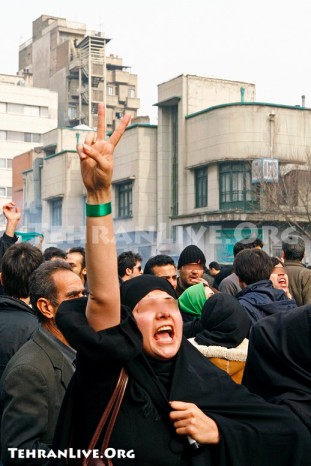
Unidentified protestor, Tehran, December 2009
After several months of bubbling under, turmoil has once again exploded in Iran this weekend, with at least fifteen people killed, including the nephew of Green Movement leader Mir Hossein Mousavi, in demonstrations in support of governmental reform there. I’ll leave it to more diligent and erudite observers to compile and analyze the events as they happen but I did want to note again that the web is the place to be for the most up-to-the minute information about this weekend’s happenings. Andrew Sullivan at The Atlantic has been liveblogging since Saturday night; fletcher christiansen at dailykos.com has a great roundup of news and links: the Daily Nite Owl has also been liveblogging here. And if you’re twittering, #iranelection is the hashmark to follow, with oxfordgirl also livetweeting.
youtube also has much video shot on the streets: I’ve included just one that seems particularly telling.
At 3.49 it apparently shows a member of the Basij, Iran’s paramilitary police force, removing his helmet and holding it aloft, to the cheers and cries of the crowd.
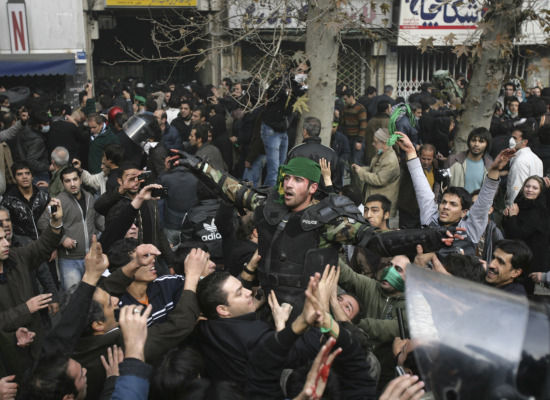
Defecting Basiji carried by the crowd, Tehran, December 27, 2009
Another photo shows a Basiji in a green scarf being carried above a crowd, arms outstretched.
Several observers including Sullivan suggest that the basiji are defecting, taking the side of the demonstrators and renouncing their support for the government. To me this seems like a very significant development. If the regime is beginning to lose the support of the military and no longer has the muscle to back up its repression, it can’t last very long. Or at least that’s what I’d like to believe—no one can tell if the tide has turned in Iran, but at this moment it’s still possible to wish for the Iranian people to free themselves and to gain some measure of self-determination. Here’s hoping the new decade brings them positive and momentous change.
UPDATE: Further discussion here on Sullivan’s blog re: possible Basiji defections. Readers seem to think that nothing conclusive is proven by the images. Great discussion all around.
We Don’t Need This Fascist Groove Thang: One Day: A Collective Narrative Of Tehran

Tehran, Undated, 2009, Merhan Mohajer, C-print, 27.25″H x 27.25″W
Just got back from Intersection for the Arts, where I saw One Day: A Collective Narrative of Tehran, a brilliant group show organized by Iranian American, San Francisco-based Taraneh Hemami, and Ghazaleh Hedayat, an artist living in Iran. Taraneh is a visual artist and curator whose past work includes several projects dealing with her experiences as a diasporic Iranian woman.
Taraneh’s been creating a lot of work that utilizes images downloaded from the web, such as her mixed-media piece Women In Tehran (2007), in which she threaded together small cut-out pictures of downloaded images of women from the Iranian capital city. Her larger 2007 installation, Most Wanted, included a beaded curtain that replicated a poster of fugitive Islamic terrorists that she found on-line, its fuzzy and indistinct images suggesting a culturalist compositing of all Muslims into an overarcing mashup of conflated identity.
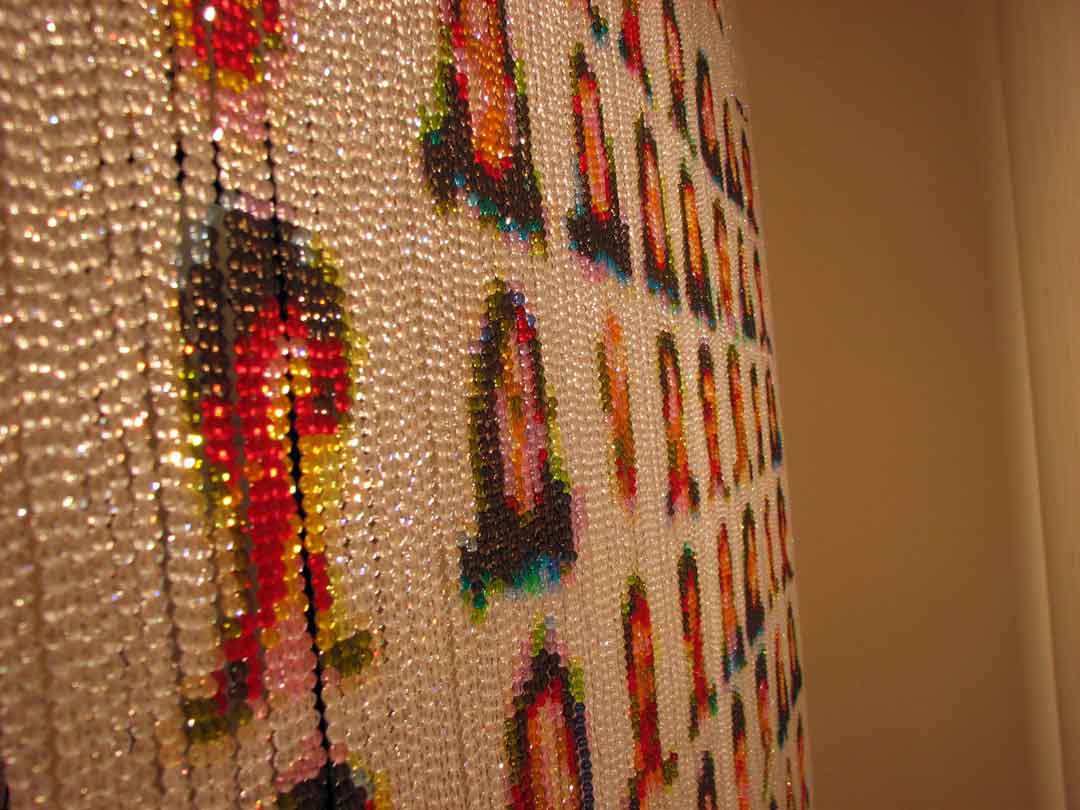
Most Wanted, 2007, Taraneh Hemami, 87,000 6 mm faceted beads, string, pole
Her use of internet-based images reflects her own status as an exile far from her homeland as well as the ways in which diasporic peoples now retain contact with their countries of origin, through websites, social networks and other virtual spaces. By utilizing web-based imagery Tareneh’s work also mirrors the significant role that the internet played in this year’s presidential elections in Iran, during which opposition leaders and activists as well as everyday Iranian citizens communicated their concerns and bypassed the censorship of traditional media outlets through the use of twitter, facebook, youtube, and other net-based media. Without such social-networking sites the Iranian government would likely have been able to completely obfuscate reportage of the protests and demonstrations that took place in the days following the elections.

Find The Lost One, 2007, Neva Razavipour, two-channel video installation
The current show at Intersection builds on some of these concerns in a complex and elegant presentation. The pieces work individually and as a unit, showcasing the mundanities of life in Tehran as well as the heightened tensions now present following the disputed presidential elections. Several of the projects also take on new meaning and significance after the elections and the crackdowns that followed it. Neva Razavipour’s two-channel video installation, Find The Lost One (2007), projects the same image twice, side by side, of passengers exiting a train station in Tehran. With one exception the projections are identical—-Razavipour has digitally erased one of the figures leaving the station. Text running at the bottom of the projection challenges the viewer to “find the lost one” in the right-hand image. As the artist’s statement notes, the piece was created in 2007, but following last summer’s elections the installation has now become a canny commentary on the increased repression of oppositional voices in Tehran.

One Day: A Collective Narrative of Tehran, installation view, Intersection for the Arts, San Francisco
Taxiography, Ghazaleh Heyadat’s processed-based pen-and-ink sketches, also take on additional resonance following the June 2009 elections. Each day Heyadat made a drawing by allowing her pen’s gyrations to trace a line based on the bumping and swaying of the bus or train she was riding through Tehran, with each small sketch reflecting the routes Heyadat followed in her sojourns across the sprawling city. Originally created as a means of passing time on Heyadat’s lengthy commute on Tehran’s public transit system, in the wake of last year’s crackdowns the drawings can also be read as records of the furtive travels of fugitive activists seeking refuge from the Basij and other military personnel.

Yekrooz (One Day), 2009, Taraneh Hemami, neon
Taraneh Hemami also has a couple pieces in the show, including Yekrooz, a green neon sign that spells out “one day” in Persian, and Turning Green, a large laser-cut green wool rug that traces a street map of Tehran. The rug’s central placement on the gallery’s floor unifies the exhibit while referencing Mir Hossein Mousavi’s oppositional Green Movement. It’s also a sly pun on Iran’s more Western-friendly name, Persia, and the ubiquitous carpets of the same name, reflecting the still-fraught relationship between Iran and U.S.
Interestingly enough, of the eight pieces included in the exhibition, only two were physically shipped from Iran. The rest were conceived in Iran, but fabricated in the U.S., from computer files and design plans sent over the web or email. Not only did this strategy save on freight but it also allowed the artists to circumvent censorship of their work by the Iranian government.
Not unlike the role that twitter et al played following the disputed elections, once again the web has aided Iranians in speaking out and voicing their concerns, despite their government’s best efforts to suppress them, and such dauntless determination speaks volumes about the urgent relevancy of this show. The risks that these artists take hopefully will make us here in the U.S. appreciate the casual ease with which we can tweet about our latest DVD purchases, what we had for lunch, or who we support for dogcatcher. With diligence we won’t let net neutrality and other civil rights erode in the U.S., and they’ll remain a given here as they are not in Iran.
One Day: A Collective Narrative of Tehran
Wed, Nov 4 – Sat, Jan 23, 2010 | 12pm – 5pm | FREE
Gallery closed December 20, 2009 – January 4, 2010
Sat. Jan. 16, 7 pm: Artists Talk
Intersection For The Arts
446 Valencia Street
San Francisco, CA 94103-3415
(415) 626-2787



What We All Want: Milestones, Smut, and Shahrukh Khan

SRK forgets to wear a shirt
Holy cow! After less than a year of existence this blog reached 100,000 hits this week. Coincidentally, this week also marked Shahrukh Khan’s 44th birthday, which is only significant because SRK is one of the main reasons for the healthy traffic on this site. Along with fellow semi-naked movie star Edison Chen, SRK’s posts have received fully one-quarter of the total visits to this blog. Nothing like a little celebrity skin to draw an audience–
Interestingly enough, the next-most-popular posts are about the Star Trek reboot and the Tiananmen Square tank man, so it’s not just thrill-seekers stopping by. Other popular search topics are fairly diverse, including Kinatay, Brillante Mendoza’s controversial new flick, asiansartmuseum’s parody website Lord, It’s The Samurai, the late Pinoy poet Al Robles, and President Obama’s brother-in-law Konrad Ng.

Good friends Edison Chen & Bobo Chun, naked, 2007
But the double-barreled combination of a starkers Badshaah of Bollywood and Edison Chen’s sexual escapades are the all-time hit kings here on this site. Considering the popularity of on-line porn, I guess I shouldn’t be surprised that people would be so fascinated with looking at their favorite actors in the altogether. When I started blogging it wasn’t my intention to be a way station for pictures of bare-assed Asian movie stars, and I don’t think I’ve catered to that need too flagrantly, but I’ll take the traffic however it comes.
Probably only a fraction of the flesh-seekers explore the site any further but I’d like to think that I’ve lured a couple unwary readers into my clutches with promises of semi-nude celebrities, then pried open their brains and poured in some radical knowledge. For me one of the great joys of blogging is throwing my random thoughts up on the web, without knowing how they’ll be received or who’s going to come across them, then seeing how they play out. I have to say that I’ve enjoyed every minute of it.
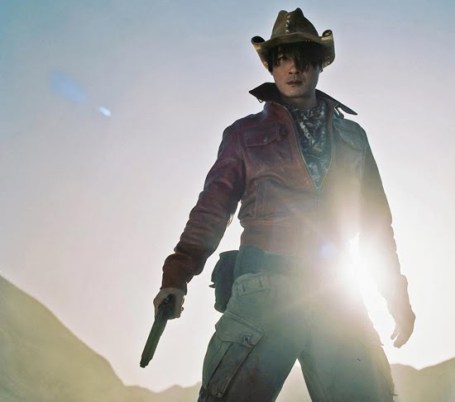
There's a new sheriff in town, Francis Ng, Fierce West Wind, 2010
PS: Just because I can, here’s a nice picture of Francis Ng in his upcoming movie Fierce West Wind. He plays a bounty hunter in what looks like a classic Eastern Western. Cowboy Francis! Be still, my heart–
Why Can’t We Be Friends? Barry Jenkin’s Medicine For Melancholy
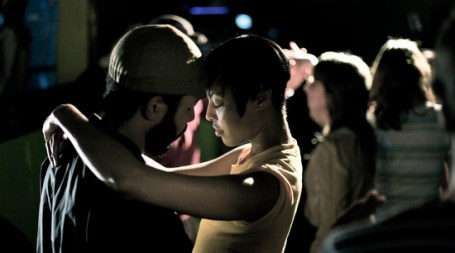
Wyatt Cenac and Tracy Heggens get friendly, Medicine for Melancholy, Barry Jenkins, 2008
I recently caught Barry Jenkin’s debut indie feature, Medicine for Melancholy (2008), and although it’s been a few weeks, this modest little movie has stuck with me. Set in San Francisco, the film begins with a supremely uncomfortable opening sequence as two people wake up together in a bed and a house not their own, although they clearly know each other intimately–at least in the Biblical sense. Apparently the pair had a bit too much to drink at a party the night before and ended up getting busy without first learning each other’s names. They go out to a mostly silent breakfast together and share a taxi to their respective homes, but the female in question is obviously discomfited by their brief encounter and blows off her recent bed partner upon exiting the cab.
This tidy little fifteen minutes sets the tone for the rest of the movie, which is a deft romance that follows a day and a night in the life of these two unlikely partners. They tool around San Francisco, experience some more quality time, and ultimately come to an understanding of each other and their awkward relationship.

Jo & Micah contemplate Afrocentricity, Medicine for Melancholy, Barry Jenkins, 2008
What’s pretty interesting to me about the film is that Micah and Jo, the unlikely couple, are both African American. The movie presents an outstanding alternative to conventional representations of African American life, with no gangstas, mamas, buppies, or thugs. Interwoven with the film’s romantic escapades are some cogent points about African Americans in San Francisco, where the black population has dwindled steadily since the 1960s “urban renewal” (aka “Negro removal”) decimated the Fillmore. San Francisco’s population now has the lowest percentage of African Americans of any major American city.
Although the film frankly discusses racial identity, racism, interraciality and other hot cultural identity topics, it presents these issues in a breezy, lighthearted frame. Both Wyatt Cenac and Tracy Heggens, who play the two leads, are attractive and winsome actors and Jenkins coaxes engaging, low-key performances out of them. Cenac in particular spouts some pretty flagrant identity-politics dialog while managing to remain charming and appealing.
The film also makes excellent use of its San Francisco locations, shooting mainly at night and avoiding the usual touristy exteriors, and the city sparkles like a jewel in the fog. Although they seem almost too groovy and hip to be true (Micah designs aquariums for a living; Jo is an art rep), it’s fun to see them wander from nightclubs (The KnockOut!) to taco trucks to MOAD to Rainbow Grocery on their fixies, smoking pot and sporting Timbuktu bike messenger bags. It seemed very fitting to be watching the film at Craig Baldwin’s Other Cinema, which is housed at Artists Television Access, the longstanding gallery and screening venue in the heart of boholandia in the Mission District. I half-expected Micah and Jo to show up on their bikes and hang out smoking hand-rolled cigarettes with the rest of the audience after the show.
Although some of the plot points are a glossed over or outlandish (why is Jo so quick to step out on her absent boyfriend?) the movie as a whole fulfills its modest expectations. Jenkins stated in the Q&A that, after suffering a failed romance, he wanted to capture the sense of being lonely, African American and male in San Francisco, and the film succeeds in doing so.
The film manages to look at some tough issues of race and culture without becoming didactic, dull, or overwrought. In that way it’s similar to another low-budget indie African American debut film, one that was released more than twenty years before Medicine For Melancholy. Like Spike Lee’s first feature, She’s Gotta Have It, this film uses the romantic lives of its quirky black characters to take on much bigger and broader concerns. Though not quite as brilliant and exhilarating as Spike’s freshman joint, Jenkins’ film does what it sets out to do in an energetic, refreshing way. Here’s hoping Jenkins can maintain his light touch in his future endeavors.

Interraciality, Tall Enough poster, Barry Jenkins, 2009
NOTE: At the same Other Cinema program, Jenkins also screened several of his other projects, including Tall Enough, an intriguing short financed by Bloomingdale’s department store (!) in New York City. The movie looked at an interracial romance between an African American female and an Asian American male. The part where the Chinese American guy speaks in Mandarin to his sleeping lover tilts toward yellow fever, and the film’s title is a little strange (what exactly is tall enough, anyways? are you saying Asian men are, y’know, short somewhere?), but the portrayal is a step towards eradicating Asian male emasculation in media. It’s nice to see an Asian American man as an romantic figure and an object of desire, especially when that idiotic dickwad media ho Jon Gosselin is threatening to set back Asian American male representation 100 years.
For an good discussion by Prometheus Brown, go here.
Medicine For Melancholy is now available on DVD from amazon.com.
Clampdown: Independent Media on G-20 Protests
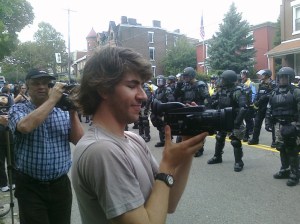
Independent media keeps an eye on riot police, Pittsburgh, PA, Sept. 24, 2009
Once again the web is the place to be for up-to-the-second information about breaking news. This time it’s the G-20 protests taking place in Pittsburgh, PA today. About 500 protestors have been attacked by overzealous policemen in riot gear using tear gas, rubber bullets and other excessive force against the peaceful crowd. On twitter, one poster claims he was told, “No matter your purpose, we will arrest you.” Another tweets, “teargas, rubber bullets, 1 arrest on baum and liberty (Half of march turned one way on baum), beat people with batons, shot with rubber bullets.” Most disturbingly, another reports, “cops using#LRAD less-lethal sound rays on protestors at #g20. Never before used in U.S.” This is confirmed by another poster on the blog of the Pittsburgh Independent Media Center’s website, who states:
Likely sound weapon (LRAD) attacks G20 protesters
On the live G-Infinity Indymedia broadcast, what sounds like the distinct oscillating chirp of the Long Range Acoustic Device (LRAD) military technology was overheard. The Active Denial System has not previously been used by law enforcement or military personnel at major demostrations in the United States until now (An LRAD system was on the streets at the 2004 RNC but not used). LRAD type systems can be used as loudspeakers and also to create extremely high-decibel “chirping” noises — which seemed to be heard on the broadcast. The LRAD was used recently to suppress dissent at large demonstrations in the nation of Georgia.In addition this should raise questions about the role of the US Northern Command (NORTHCOM) which is developing civil dissent repression techniques for implementation around the country. NORTHCOM and the National Geospatial Intelligence Agency (NGA) have major roles in National Security Special Events (NSSE) — the NGA is providing geographic intelligence (GEOINT) to law enforcement under a special confidential agreement that gives them a “loophole” around the Posse Comitatus law restricting domestic military activity.
http://en.wikipedia.org/wiki/Active_Denial_System
posted by Dex Thu 9/24/2009 3:10 pm
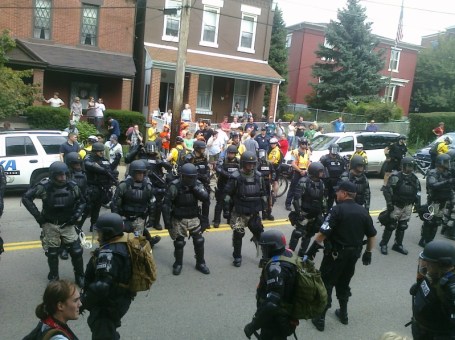
Many police in riot gear, Pittsburgh, PA, Sept. 24, 2009
Traditional media is running the usual nonsense about one protestor throwing a rock and another pushing trash bins into the streets as a way of justifying the extreme force used by the police. But pictures posted from protestors on site show a mostly peaceful and fairly small crowd of about 500 people marching, with a phalanx of 20 police cars and 100 police in riot gear hot on their heels.
msnbc.com and other news outlets have picked up the story, although they refuse to directly acknowledge the riot police’s flagrant civil rights violations. In msnbc’s clip the news reporter cautiously states, “We’re not sure if the gas is coming from authorities,” while showing footage of bleeding protesters pouring water in their eyes. Also audible on the soundtrack is the LRAD’s high-pitched chirping (see above), which indicates that the sound weapon was indeed used on protesters in Pittsburgh.

Violent, anarchistic monks protesting, Pittsburgh, PA, Sept. 24, 2009
Ironically, in order to watch msnbc’s newsclip you have to sit through insipid advertising for teeth whiteners, dog food, and other consumer products. The ad I endured was a commercial for disposable diapers, accompanied by a soundtrack of The Youngbloods’ “Everybody Get Together.” (I somehow doubt that Jesse Colin Young envisioned his tune being used to sell products that take up so much space in our landfills.) Yet another reason to go straight to indie media for your information—so far, there are no ads on twitter, and there’s also no corporate bias. As one tweeter says, “I think I’m going to go back upstairs to my MacBook. The news coverage is just irritating…”
UPDATE: Hot and heavy on twitter tonight. Use #g20 hash for most information. Also follow these tweeters:
@infernoenigma
@robjdlc
@iwasaround
@billpeduto
@resistg20
UPDATE 2: Scary new tweet from @robjdlc: “Just spotted police with shotguns and semi autos behind those with batons”
UPDATE 3: After a peaceful daytime march of several thousand people today, the Pittsburgh police are running wild again tonight on the Pitt campus. Taking advantage of cover of night and scanty mainstream media coverage they’ve gassed students walking home from campus events and set unmuzzled dogs on them. Independent media sources including Oakland CA’s own Davey D are tweeting from the scene, although the intrepid KPFA reporter sounds pretty freaked out, if his last few tweets (Shit I am in the middle of this the entire block is being cordoned off. Trying to be chill I just wanna get the hell out of here) are any indication.
And an on-the-spot post from swwhee on dailykos.com:
Tonight in Schenley Plaza
a large group of Pitt students and G20 protesters gathered to protest the violent tactics of the law enforcement officials. Hundreds of officers descended onto Pitt’s campus, arresting everyone who remained within the vicinity. Countless individuals were arrested merely for standing on their campus, curiously observing the ongoing mele.
Police used tear gas, dogs, a sonic gun, and full riot gear. I myself had an automatic shotgun pointed at my chest and felt as though I was running for my life. I have never been so scared in my own country. We were meant for more than this.
We simply wished to assemble to show our disapproval of the police tactics used from the night before. On Thursday night the police used tear gas and night sticks to disperse students. Many of the students were told to go home when home for many was a dormitory. A dormitory that was locked down for security reasons. Tear gas was released and confused students who were merely trying to go to a home that they were locked out of. The police trapped Pitt’s students and arrested them for not being able to navigate the various blockades and security measures.
Here’s a video of the LRAD sound cannon being used today in Pittsburgh against protestors:
Here’s a video of the Pittsburgh police in riot gear posing with a kneeling, handcuffed student for a snapshot. flickr, anyone? Sorry I can’t get the embed to work—just click to link to the site. Other good videos at the G20 tag, too.
UPDATE 4: Good firsthand accounts from students harassed on Friday night here from the Pittsburgh Post-Gazette.
UPDATE 5: Great eyewitness account from a student who was there on Friday night at dailykos.com

 beyondasiaphilia
Recent Comments