Round & Round: This Is Not A Film film review
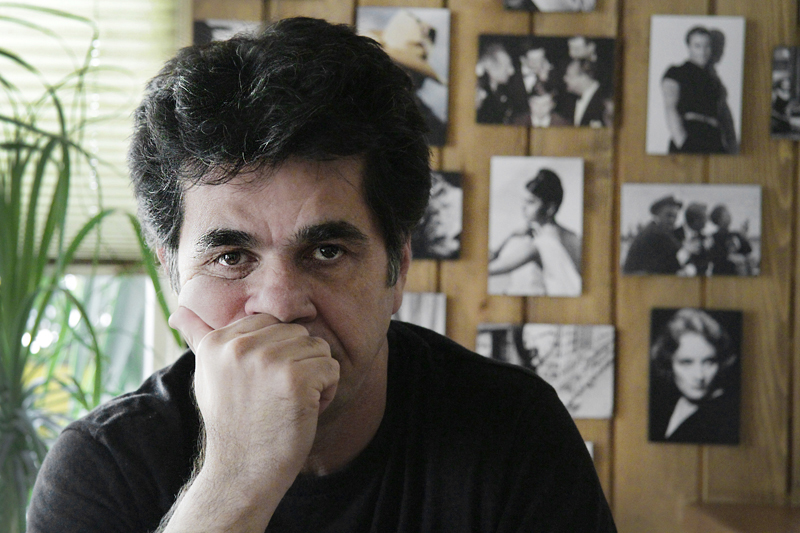
Jafar Panahi, house arrest, This Is Not A Film, 2012
Iranian director Jafar Pahahi has been under house arrest for more than a year now awaiting the outcome of latest appeal of his 2010 conviction of conspiring to overthrow Iran’s Islamic Republic. His latest effort, This Is Not A Film is a documentary of what he describes as “two idle filmmakers,” Panahi and fellow Iranian director Mojtaba Mirtahmasb, attempting to make sense out of a nonsensical situation. Filmed mostly inside Panahi’s Tehran apartment over the course of a day and evening, the movie is an interesting metaphor for the likely state of Panahi’s frustrated creative mind right now.
The movie follows Panahi as he eat breakfast and kibitzes with his lawyer on the phone about the possible results of his legal appeal. It then continues with a visit from Mirtahmasb who films Panahi as he describes the scenario for his most recently script, lately rejected by the Iranian censorship board. Panahi and Mirtahmasb begin to block out the film on Panahi’s living room rug, but the process abruptly ends and the documentary goes on several tangents. Somehow Panahi ends up filming Mirtahmasb on his cell phone camera while Mirtahmasb is filming him, in circumspect defiance of the regime’s ban on Panahi making films. The film ends with Panahi interviewing an art student/garbage collector/deliveryman on his trash-collecting rounds as they discuss the difficulties of creating work under the current regime’s oppressive eye.
Attesting to Panahi’s status as one of Iran’s leading directors, we see him in his comfortable flat casually name-checking various members of the Iranian filmmaking pantheon such as Rakhshān (Bani-E’temād) and Khambozia (Partovi). Yet he also seems quite at ease chatting with the art student/garbageman and doesn’t seem to mind riding in an elevator with a smelly trashcan.

Jafar Pahahi, blocking, This Is Not A Film, 2012
This Is Not A Film has the same watchful intelligence as Panahi’s narrative films (The Circle; Offside; Crimson Gold), and as with those films, this one possesses a sharp critique of the Iranian power structure. Several times Panahi mentions his unwillingness to solicit public support from his fellow Iranian filmmakers due to the risks from the government their aid may cause them and Mirtahmasb at one point asks Panahi to take a picture of him as evidence in case the government retaliates against him for helping out Panahi. Throughout the documentary an uneasy undercurrent of repression flavors the goings-on, adding a furtive guardedness to the proceedings.
Panahi maintains a keen eye for metaphor–he paces fitfully in his apartment, only able to connect to the outside world through remote devices like the cell phone or through TV news, or at a distance, by watching the city’s daily life at a remove on his balcony. The storyline of Panahi’s rejected script involves a young woman attempting to escape the house that her family has locked her in, which of course echoes Panahi’s own real-life house arrest. Tellingly, the recounting of this story and others in the documentary are interrupted and unfinished, adding to the film’s mood of incompleteness and frustration.

Jafar Panahi, frustrated, This Is Not A Film, 2012
Panahi also makes good use of the spectacle of Fireworks Wednesday, the boisterous celebration of Persian New Year. The film ends with Panahi viewing from afar a bonfire just outside the gates of his apartment building as his visitor warns him not to be seen holding a camera or “they will see you.” As he lingers in his doorway he clearly longs to join the celebration, yet his wariness that “they” will censure him constrains him.
This small moment is an excellent representation of the invisible restrictions on Panahi’s freedom and the way in which the Iranian regime holds him captive, as well as the means by which he attempts to subvert that captivity. The doublespeak of This Is Not A Film’s title echoes that subversion, as Panahi tries to find a workaround to his confinement without pushing the regime too far. It’s a delicate, frustrating balance and one Panahi captures pretty effectively in this film. His creative life hangs in the balance and, like the interrupted stories throughout, if the Iranian government prevails, it may never reach its full completeness.
This Is Not a Film (In film nist, Iran 2011), dir. Jafar Panahi
opens April 6
SF Film Society Cinema
1746 Post Street
San Francisco CA
go here for tickets and information
Between Love & Hate: Love In The Buff and Marrying Mr. Perfect film reviews

Cherie & Jimmy living it up, Love In The Buff, 2012
Two romantic comedies that I saw on my trip to Hong Kong radically demonstrate two different aspects of popular Hong Kong movies today, and are possible indicators of the fate of the local film scene. Although once upon a time loyal Hong Kong audiences ardently supported local film productions, in the past ten or fifteen years interlopers first from Hollywood and now mainland China have been chipping away at the once indomitable Hong Kong film industry.
Pang Ho-Cheung’s Love in the Buff, the sequel to his 2010 film Love in a Puff, is a funny, smart flick that picks up shortly after the first film ends. The first film perfectly captured the irreverent lifestyle and language of young adults in Hong Kong and the sequel continues in the same vein. Instead of locating itself smack dab in the middle of Hong Kong’s young urban professional milieu, the film is set both in Hong Kong and Beijing, probably due co-production regulations as well as an attempt to appeal to the massive mainland Chinese audience. Yet despite the change in locale, the movie retains the kicky, profane humor that was so fun in the original. This is due in part to strong performances throughout the film as well as Pang’s clever script and sharp eye for the sleek yet realistic urban landscapes of the two cities.

Luv 'n' hate, with watermelon, Love In The Buff, 2012
In the sequel, protagonists Jimmy and Cherie face more difficulties in their romantic relationship, as they split up at the beginning of the movie (no spoiler here as it happens pretty early on). Both individually end up in Beijing as they follow their jobs to China’s capital city, and both begin new relationships there, but despite their best efforts they can’t seem to keep away from each other. Pang’s script arranges for a few key supporting Hong Kong characters to travel there with them so that the salty vernacular and attitude of the first movie remains intact. Miriam Yeung as Cherie is particularly outstanding as the foul-mouthed city girl stuck on Shawn Yue’s childlike Jimmy. There are also some extremely funny cameos that cannot be revealed without spoiling the fun but suffice to say that they’re cleverly utilized. One in particular resolves the storyline of ugly duckling Brenda (June Lam Siu-Ha) from Love In A Puff in an especially hilarious yet surprisingly heartwarming way.
Pang does a great job capturing the passionate and illogical attraction between Jimmy and Cherie, and places his main characters in a groovy contemporary milieu, surrounding them with fun and interesting supporting characters. It’s no wonder the movie has been going like gangbusters at the local box office, as its portrayal of contemporary Hong Kongers is flattering and appealing. In its opening weekend in Hong Kong Love In The Buff has grossed more than HK$5 million, making it a bona fide hit, and it opened here in the U.S. this weekend to positive reviews across the board.

Awwwww! Ronald Cheng & Gigi Leung, Marrying Mr. Perfect, 2012
On the flipside, while I was in Hong Kong I saw Wong Jing’s latest comic effort, Marrying Mr. Perfect, which stars Ronald Cheng, Gigi Leung, Chapman To, Eric Tsang, and Sandra Ng. With a cast like that it seems like the movie couldn’t help but be pretty funny but alas it was a fairly tepid and formulaic affair, with mistaken identities, catty office politics, and other contrivances making up most of the dumb storyline. All of the above actors have comic chops to spare but here they have to strain for laughs against the idiotic and derivative script. Apparently Wong Jing has lined up some hefty mainland China co-production financing for his next film projects, but if this is the future of Hong Kong filmmaking then things are looking pretty bleak.
I saw Marrying Mr. Perfect at a Sunday afternoon show with a bunch of local Hong Kong movie fans including bloggers and podcasters Paul Fox, Sean Tierney and Glenn Griffith, Ross (Kozo) Chen and Kevin Ma from lovehkfilm.com, and film programmer and writer Tim Youngs, on one of their weekly jaunts to see the latest Hong Kong releases. Afterwards we all spent teatime at the downmarket food court in the otherwise ultra-posh Elements mall and commiserated about the sorry state of Hong Kong films that this picture represented. Besides the seven of us there were about five other people in the small theater and the posters and trailers in the cinema were all for Hollywood movies like The Avengers (except for a trailer for another HK product, Love Lifting, which features Elanne Kong as a heartbroken Olympic weightlifter. Despite its sappy-looking premise the film actually made some money at the HK box office last week).

Chapman To working it, Marrying Mr. Perfect, 2012
This group of HK film aficionados echoed what other friends told me while I was in the SAR; to wit, no one in Hong Kong goes to Hong Kong movies any more. My buddy Jay had never heard of either Love In A Puff or its sequel, although he’s a pretty media-savvy guy, and another friend confessed that he only goes to see Hollywood product. If cheesy goods like Marrying Mr. Perfect are all that the Hong Kong film industry had to offer then it’s not surprising that local films can’t draw a local audience. But Ann Hui’s A Simple Life has been selling out theaters since its release a few weeks ago, and Love In The Buff is also making some bank, so maybe it’s just a case of Hong Kong moviegoers no longer tolerating crappy local products like they used to.

Pretty people, Love In The Buff, 2012
It’s sad that there’s little brand loyalty for the indigenous film scene, but Hong Kong audiences have probably gotten accustomed to the high-gloss commercial fare from around the world that makes its way to local theaters. Last year two of the biggest films in HK were Aamir Khan’s Bollywood hit 3 Idiots and Giddens Ko’s Taiwan youth flick You Are The Apple Of My Eye, and of course most Hollywood blockbusters show up in HK cinemas as well. Interestingly enough, the films with more local flavor, including A Simple Life, Clement Chang’s Gallants, and Alex Law’s Echoes of the Rainbow, have successfully struck a chord with local audiences, so maybe the local film industry isn’t completely dead. With the restrictive requirements of mainland China co-productions threatening to further choke off the Hong Kong movie scene it will be interesting to see in the next few years whether an unadulterated Hong Kong movie aesthetic can survive.
Love In The Buff now playing:
101 Fourth St. San Francisco, CA 94103
10123 North Wolfe Road, Cupertino, California
No Regrets In This Life: Hong Kong travels, 2012

Aaron Kwok decorates the MTR station
Just got back from a week in Hong Kong, where I experienced a full-on immersion in Asian films. Officially I was there to present a paper (A God And A King: Chow Yun-Fat and Shah Ruhk Khan) at the Asian Cinema Studies Conference at Hong Kong University, but I also attended the Hong Kong-Asia Film Financing Forum (HAF) and saw a slew of Asian movies. For seven days I talked about, watched, and pondered the state of Chinese-language films in the 21st century. It was pretty much a perfect vacation for an Asian movie otaku like me.
Prior to this trip I hadn’t been to Hong Kong in particular or Asia in general for at least twenty years, but as soon as I got off the plane I was hit with the familiar smell of equatorial humidity. After seeing countless Hong Kong films over the past couple decades it was quite exciting to set foot back in the motherland. Not literally, of course, since my family comes from Guangzhou and Toisan, but close enough as makes no difference. When I got to my hotel room the movie on the TV was An Autumn’s Tale (1987), director Mabel Cheung’s bittersweet story of two Hong Kong transplants living in New York City. It was curious to watch a movie while in Hong Kong about the Chinese diasporic experience–I felt like I’d reversed that journey in some way, going from the U.S. to Hong Kong.

Weekend, Causeway Bay
Interestingly enough, at the ACS conference I later met Stacilee Ford, the author of a monograph on An Autumn’s Tale. A historian by training, Ford also writes about Hong Kong film and she was kind enough to give a copy of her book along with a DVD of Cheung’s film. She was one of the many stellar Asian film scholars attending the conference–the legendary Gina Marchetti said nice things about my presentation; Stephen Teo politely listened to me fangirlishly blather at him; I chatted with Julia LeSage over tea and sandwiches. It was fun to wade knee-deep in Asian film studies with such an illustrious crew and to parse and analyze the movies that I spend so much of my time watching. I felt invigorated and inspired after attending the conference, as well as slightly starstruck by the company I got to keep.
I stayed in Causeway Bay, which was quite fun in an insanely busy and overcrowded way. The streets were packed until late into the night and the walls of the shopping malls were covered in massive adverts both still and moving. Although there have been tensions between mainlanders and Hongkongers in the past few months, that hasn’t prevented Huang Xiaoming’s gorgeous face from gracing huge billboards all over Causeway Bay. Other movie star faces plastered around town include Angelababy, Nicholas Tse, and Aaron Kwok (in various states of undress).

Random food, Hong Kong 2012
During my stay I ate several outstanding meals, from spicy lamb hot-pot with my buddy Jay (new discovery: fried fish skin), to street food dished into Styrofoam boxes on the corner of Jaffe and Fleming Street, to way too many egg custard tarts from the endless tiny bakeries lining Wan Chai Street. When I wasn’t at the conference or watching movies I walked for hours a day, up and down Hennessy Street and through Causeway Bay, taking the MTR to the insanity that is Mongkok on a weekend night, to Victoria Park on a Sunday morning with the picnicking Indonesian and Filipino domestic workers on their day off. By the fourth day the overwhelming bus fumes and secondhand cigarette smoke started to irritate my lower respiratory tract–now I understand why so many people in Asian cities sport surgical masks when they go outside.

Domestic workers picnicking, Victoria Park
I managed to navigate the city fairly easily, in part because English is still one of Hong Kong’s official languages, although I did spend one tedious hour wending my way through a particularly confusing set of overpasses and bridges near the Hong Kong Convention Center. Hong Kong’s public transit system is excellent and multifarious, with subway, trams, buses, and the Star Ferry all rapidly and efficiently moving its 7.1 million residents to and fro–even the escalators in the MTR stations run at a breakneck pace. While much of the city is pretty urban, its underlying natural beauty still shines through. The view from the top of the double-decker bus careening down the hill from Hong Kong University to Causeway Bay one evening was quite lovely, with the white neon lights amidst gracefully drooping banyan trees providing a enchanting contrast.

Triad Simon on the hotel TV
The last night I was in town, after another tasty meal, I was channel-surfing in my hotel room when I came across a random Simon Yam/Lau Ching-Wan/Roy Cheung triad movie on TV. Yam, Lau, and Cheung have of course starred in many classic Hong Kong crime films but this alas was not one of them. But the best part about watching the movie was that one of the film’s fight scenes takes place outside the President Theater, where I’d just seen Ann Hui’s new movie the day before. Those little pleasurable and surreal moments happened all week, where I came across movie locations in real life, thus heightening my fondness for Hong Kong cinema all the more. Now that I’ve been to Hong Kong after so long, I surely won’t wait another couple decades to go back again.
POSTSCRIPT
While waiting at the Hong Kong airport for my plane home I make a horrible discovery. I’m scamming on the free airport wi-fi and surfing the net when I randomly find out that Francis Ng is scheduled to be at the press conference for Ann Hui’s short film My Way at the Hong Kong Film Festival AND I CAN’T GO! I’m getting on a plane in 20 minutes to go back to San Francisco. I feel like a character in a TV melodrama–I should abandon my flight and run back to Hong Kong in slow motion. The plane has been delayed–maybe if I’m lucky it will be cancelled and I can stay another night. Alas for the inflexibilities of modern air travel. Wonder if there is a later flight–
(I did not take a later flight, in part because immigration wouldn’t have let me back into the airport that same day, and I did not get to see Francis Ng in person. Yet another reason to come back to Hong Kong sooner rather than later, in order to more efficiently plan my stalking of Hong Kong movie stars.)
Next up: the movies I saw, part one
Swagga Like Us: 2012 San Francisco International Asian American Film Festival
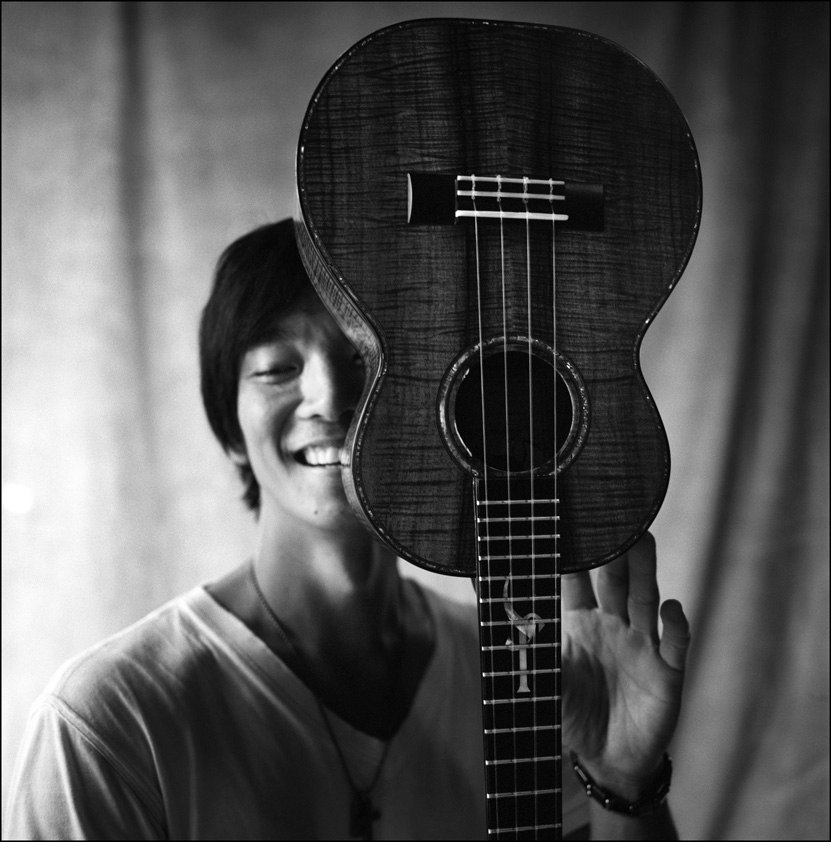
A man and his ukelele, Jake Shimabukuro Documentary, 2012
Now in its thirtieth year, the San Francisco International Asian American film festival offers several treats this year, with some brand new narrative films from Asian American directors. These include features by some familiar names and one remarkable debut by a newcomer that is astoundingly assured and original, demonstrating the continued growth and expansion of Asian American cinema.

The lucky Kimberly-Rose Wolter with foxy Sung Kang, Knots, 2012
Michael Kang’s Knots is a fast-paced rom-com with great comic performances and a decidedly un-cloying script. As in his debut film, the offbeat adolescent comedy The Motel, Kang has an eye for strange yet engaging characters coping with the bizarre dynamics of dysfunctional family life. Lead actress and screenwriter Kimberly-Rose Wolter is a marriage-phobe whose weird mom and sisters are wedding planners in Hawai’i. Sung Kang (Fast & Furious; Better Luck Tomorrow) is the dreamy love interest.
Yes, We’re Open, directed by Richard Wong (Colma: The Musical) is an entirely agreeable, sleek and charming timepass, with a clever and engaging script (by Colma’s star and screenwriter H.P. Mendoza) and winsome performances from its cast. Lynn Chen and Parry Shen play a comfortable yet slightly bored couple whose relationship has lost its groove, until they meet another couple that tantalizes them with the possibility of an open relationship. The film does a good job capturing the feel of non-tourist San Francisco, with locations at Green Apple Books, the Alemany Farmers’ Market, the Roxie Cinema, and other neighborhood locations, as well as gently lampooning foodies, hipsters, and tech geeks. I haven’t seen Parry Shen in a movie since Better Luck Tomorrow and he does a great job as the slightly neurotic male lead who is somewhat lacking in self-awareness. Lynn Chen is funny and endearing as the other half of the conflicted couple. The movie is not unlike Annie Hall or some of Woody Allen’s other earlier romantic comedies in its young urban groovester milieu, its reliance on a specific cityscape (here San Francisco instead of New York) and its lighthearted take on the foibles of contemporary relationships.
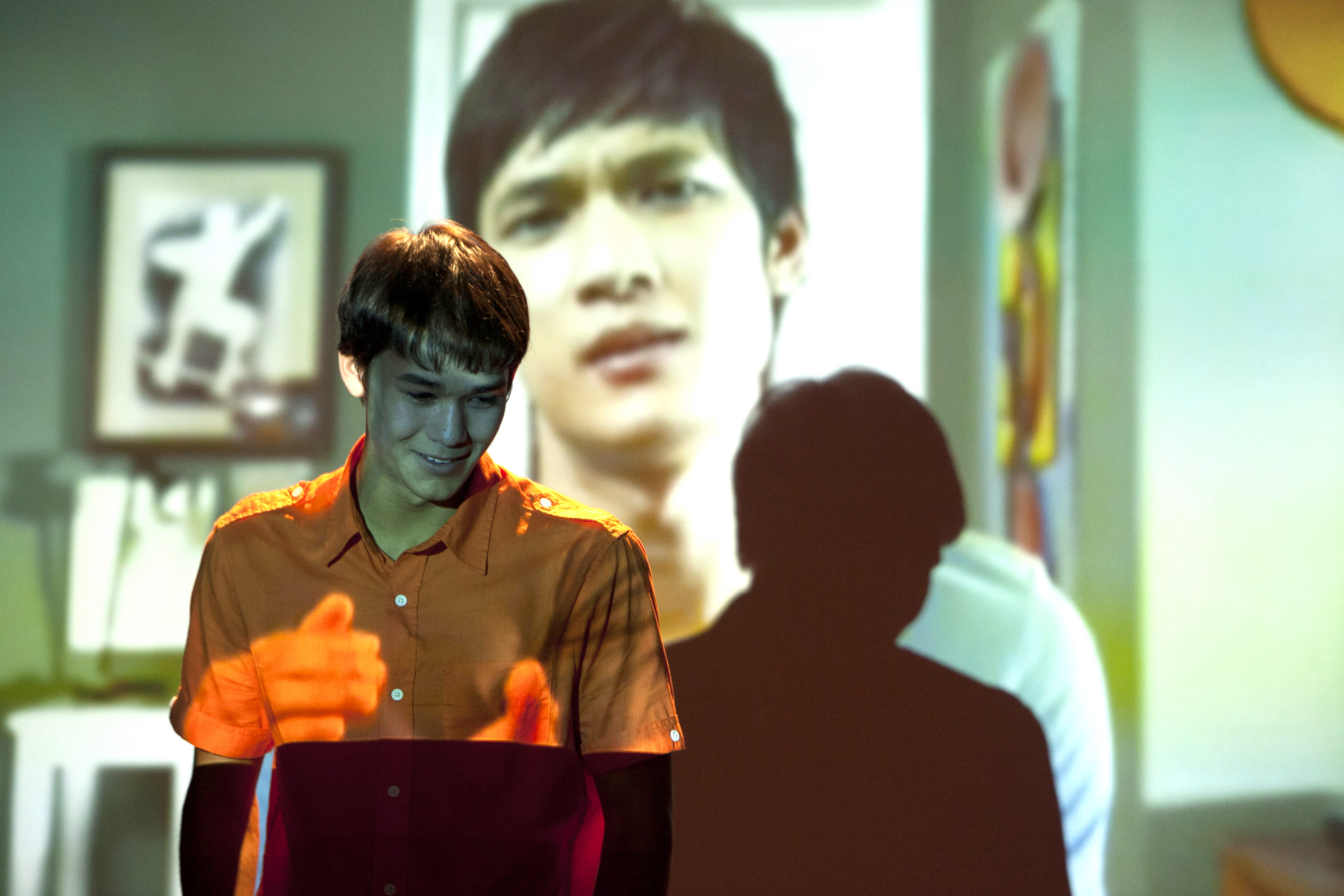
BooBoo on the spectrum, White Frog, 2012
Quentin Lee turns up the melodrama with White Frog, a family tale of a teenager with Asperger’s syndrome dealing with tragic circumstances. Led by a strong performance by BooBoo Stewart (Twilight: Breaking Dawn), the cast also includes some of the best-looking teenagers I’ve seen since Beverly Hills 90210, yet the actors overcome the handicap of their beauty by turning in convincing performances. The story makes a plea for tolerance and understanding of difference, and while it tilts toward maudlin at times, director Lee’s strong direction steers it back toward steady ground. He modulates the somewhat overwrought twists of the narrative by drawing out believable and sympathetic turns from his actors, including BD Wong as the conflicted father and Joan Chen at her dreamy and vulnerable best.
Although it also delves the family dynamics of coping with a tragic loss, Patrick Wang’s In The Family is a horse of a different color. Subtle and smart, the film offers a new way of seeing that diverges radically from the classic Hollywood style of filmmaking–it clocks in at nearly 3 hours, and the majority of the film is shot in long, deep-focus master shots. However, its formal style is in no ways mannered or pretentious. The film begins with a series of long, static scenes that simply explicate the quotidian lives of Joey and Cody, an interracial gay couple living in Martin, Tennessee with their energetic and precocious young son Chip. The long lockdown takes emphasize the normalcy of their everyday life despite a family structure that falls outside of the heteronormative frame. The time that the film takes to establish their deep emotional bonds pays off later in the film as tragic circumstances as well as societal pressure conspire to destroy their idyllic home life. With a reliance on long single takes the acting had better be good and here it’s stellar, anchored by actor-director Wang as the humble yet passionate and devoted father.
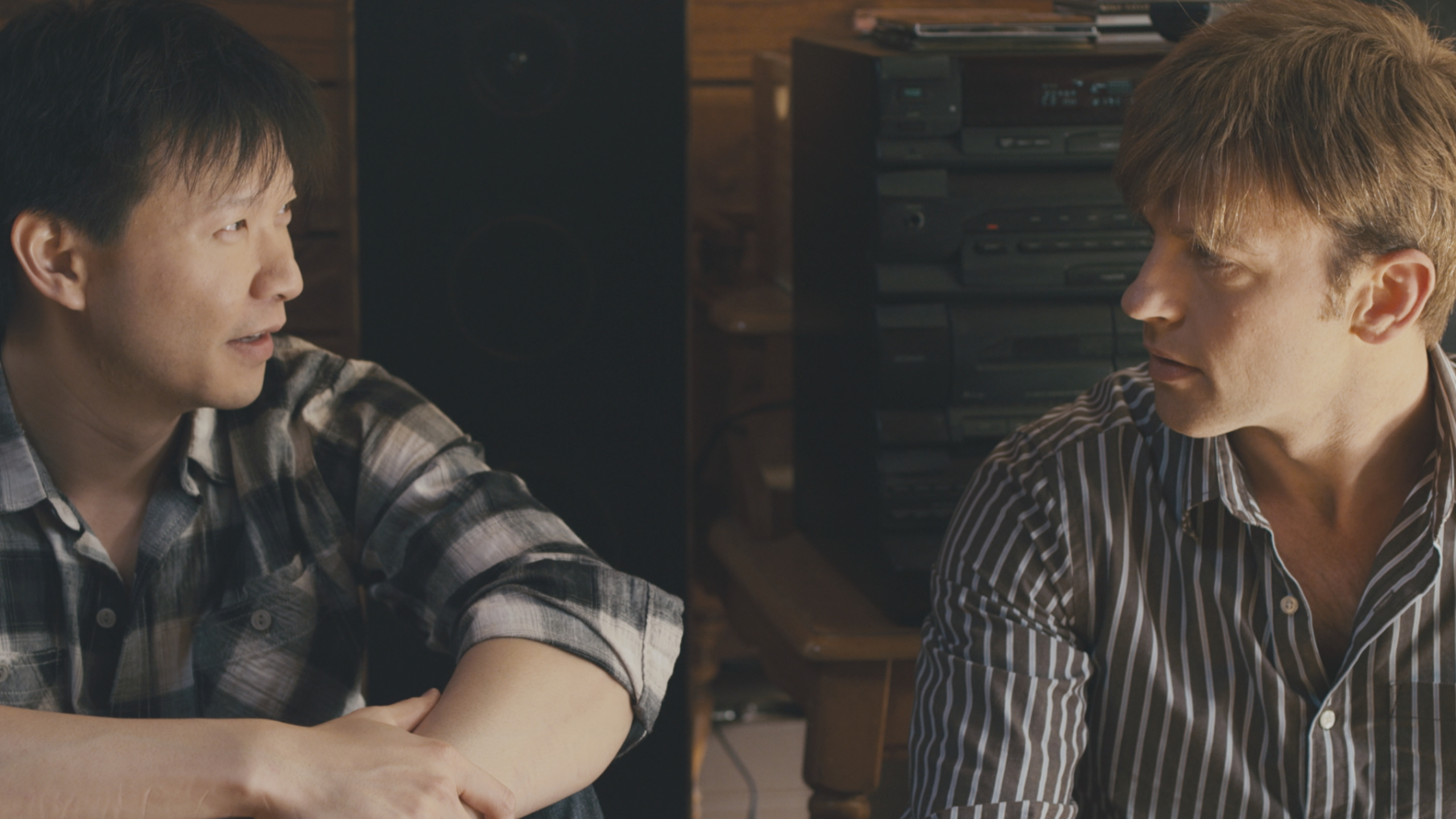
Stillness and movement, In The Family, 2012
In The Family is not only one of the best Asian American films I’ve seen in a long time, it’s one of the best films, period, that I’ve seen in a long time. Not to overstate the point but Wang’s compositions and his confidence in the power of the action within the frame are reminiscent of Taiwanese auteur Hou Hsiao-Hsien or Japanese master Yasujiro Ozu. Although touching on several hot-button issues the film deftly sidesteps polemics and instead presents a subtly shaded, morally complex story.
Also of note: Tad Nakamura’s Jake Shimabukuro Documentary, his first feature-length film that centers on the Okinawan-Hawai’ian ukelele wizard. The film follows up Tad’s short docs Pilgrimage, Yellow Brotherhood, and A Song For Ourselves and, although there were no advance screeners of the film, it promises to be as brilliant and moving as Tad’s earlier work. It’s great to know that not all Asian American filmmakers aspire to making narrative films, and Tad is following in the footsteps of Loni Ding, Steve Okazaki, Renee Tajima-Pena, Christine Choy, and his own parents, Bob Nakamura and Karen Ishizuka, all seminal Asian American filmmakers whose documentaries are the gold standard for Asian American cinema. The film festival will feature a program with Tad and his parents, A Conversation with the Nakamura Family, on Saturday, Mar. 10 at 3.30p, where science will surely be dropped.
Bonus: here’s a clip of Jake Shimabukuro from the upcoming documentary playing Queen’s Bohemian Rhapsody.
For tickets and a full schedule go here.
Better Things: 2012 San Francisco Independent Film Festival

Pissed off, Gandhu, 2012
The San Francisco Independent Film Festival opens tonight at the Roxie Theater and as usual it’s a great chance to see movies that might never again get local theatrical screenings. The festival has gotten more global since its modest inception back in 1998, and this year’s lineup includes three Asian-themed features that demonstrate the SFIFF’s wide range of programming.
From India, director Q’s Gandhu (which roughly translates as “asshole,” “loser,” or “idiot’) is a punk rock, black-and-white opus that follows the daily misadventures of the title character. Gandhu wanders the mean streets of Kolkata with a perpetual scowl, existing in a nihilistic limbo as he fails to connect with most of humanity. Interspersed throughout the movie are short musical rants where Gandhu rails against the injustices in his life and generally blows off steam. Billed as “anti-Bollywood,” the movie is a fun, scruffy alternative to the glitzy, monolithic Hindi-language film industry.
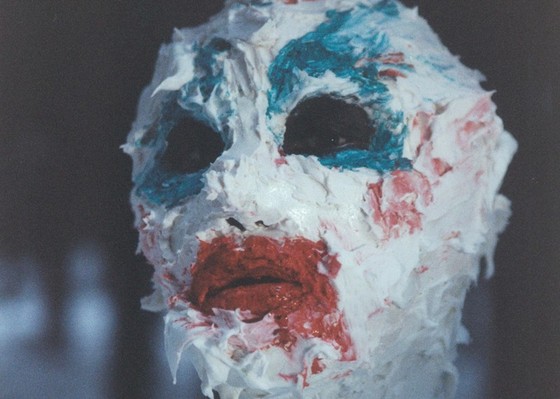
Cake frosting or psychosis? Monsters Club, 2011
Monsters Club deals with a crazed Japanese Unabomber who sees dead people. Bad boy filmmaker Toyoda Toshiaki became interested in Ted Kaczynski’s manifesto and out of that interest grew this dark meditation on life, death, suicide, technology, society and the state. Main character Ryuichi lives in an isolated, snow-covered mountain cabin where he bathes in an icy outdoor shower, cooks spartan meals of cabbage and brown rice, and builds deadly bombs in cigar boxes that he mails to entertainment and journalism CEOs. Yet despite its focus on a mad bomber the film isn’t action-packed—rather, it’s more like a voayge inside the head of the disturbed protagonist. After a visit from his younger sister Ryoichi begins to have visions of his dead brothers, one of whom committed suicide and the other who died in a motorcycle accident. The film’s stark white snowy landscape reflects the vastness of Ryoichi’s psychic anomie as he tries to come to grips with his own violent reaction to what he perceives as the corruption of modern society.

Girljock, No Look Pass, 2011
No Look Pass (dir. Melissa Johnson) follows Emily Tay, Burmese American basketball star for the Harvard women’s team, as she deals with pressures both on and off the court. Included in these are living up to the expectations of her immigrant Burmese parents, who hope she’ll marry rich and settle down after college. Emily’s got other plans, however, including romances with a cheerleader and a female soldier she meets in Germany while playing in the European leagues after graduation. The movie starts strong as Emily deals with the various challenges of her last year in college, but loses steam once she graduates and the narrative moves to Europe. The film also gives short shrift to the Asian American aspects of Emily’s story–at one point she states, “If it were up to me I’d rather be white,” but this startling statement isn’t really followed up. The film also discusses her Burmese parents’ flight from their homeland but doesn’t do much significant investigation into how their refugee experience might impact their aspirations for their children. Instead we see them as stereotypically demanding Asian parents, with (tiger) mom always scowling disapproval despite her daughter’s amazing accomplishments. There are, however, some excellent behind-the-scenes sports moments as we get to witness Emily’s Harvard coach and her coach in Germany both screaming profanities at their respective teams, a tactic that they apparently use to motivate their players.
The San Francisco Independent Film Festival
Feb. 9-23, 2012
Roxie Theater
3117 16th Street, San Francisco, CA 94103-3327
(415) 863-1087
Windows of the World: Once Upon A Time In Anatolia and A Separation film reviews

Big country, Once Upon A Time In Anatolia, 2011
Although I love the overwrought histrionics of commercial cinema (see Agneepath), that’s certainly not the only way to make a movie. Two films that have been on a lot of last year’s top ten lists have recently made their way to San Francisco cinemas. Nuri Bilge Ceylan’s Once Upon A Time In Anatolia and Asghar Farhadi’s A Separation are both riveting pieces of work that deal with the ambiguity and shades of gray found in complex moral situations
Despite a title that harkens back to Sergio Leone’s expressionistic spaghetti Westerns, Ceylan’s Anatolia is an understated, masterfully told story that sidesteps the conventions of most genre films. The film follows a group of local police through a long night on the Anatolian steppes as they search for the grave of a murdered man. The cops are reluctantly assisted by two perps whose memory of the crime wavers in and out of focus throughout the night.

Moral complexity, Once Upon A Time In Anatolia, 2011
As they drive around western Turkey’s vast landscape the police amiably debate the benefits of sheep versus buffalo yogurt, meticulously tot up mileage for reimbursement, and gossip about who among them might have prostate issues, among other mundanities. The narrative unfolds naturalistically, without a soundtrack, with some of the dialogue seemingly improvised or loosely scripted. Themes and plot points emerge slowly and sometimes indirectly—a character’s offhanded comment in one scene takes on great relevance later in the film. Such restraint and respect for the audience’s intelligence is a welcome change from the hamhandedness of most films, where exposition is a blunt instrument used to club the viewer into submission.
The film presents realistic, complex characters, with killers that weep remorsefully, cops that show compassion for criminals, and men who are overawed by the beauty of a young woman simply serving tea by candlelight. Ceylan’s direction brings a deft and subtle touch to the film—the movie concludes with a matter-of-fact autopsy with the unsettling sounds of the procedure, including cracking breastbones and dripping fluids, emphasizing the operation’s dehumanizing effect. Overall Ceylan’s direction is a lovely thing to behold, as he uses the policemen’s wanderings through the Anatolian countryside as a metaphor for the imprecision and ambiguity of humanity’s moral landscape.

While it also looks at the unclarity of human morality, A Separation’s briskly paced and intense storyline takes a different tack than Anatolia’s slower, more naturalistic tale. Farhadi’s political allegory/family drama starts in medias res, with a middle-class Iranian couple arguing their case directly to the camera (standing in for the off-screen judge). Simin, the wife wants a divorce in order to move to the United States against the wishes of Nader, her husband, who feels a duty and an obligation to remain in Iran to care for his Alzheimer’s-afflicted father. Simin pleads the urgency of going abroad in order to improve the life of their adolescent daughter Termeh, although the details of this necessity are not made clear. The judge dismisses her suit, and Simin decides to move to her mother’s house rather than stay with her husband. The film follows the aftermath of her decision, with this seemingly small action leading to unexpected, ever-broadening repercussions.
The film features an outstanding ensemble cast including Leila Hatami and Peyman Moaadi, who won Best Actress and Actor awards at the 2011 Berlin Film Festival for their portrayals of the conflicted couple. However the rest of the performances are also excellent, including Sareh Bayat as the devout woman that Nader hires to care for his father, and Shahab Hosseini as her hotheaded husband.

Divided, A Separation, 2011
Director Farhadi makes great use of his locations’ architecture, confining his characters in small, enclosed spaces that stifle communication and hinder movement. He also effectively utilizes windows and doors, often framing the actors separated or trapped behind panes of glass. Several times his characters slam or pound on a rattling, fragile stained-glass door, yet it resolutely resists shattering. The door thus becomes a symbol for the delicate yet impenetrable separations of class, religion, and gender that divide Iranian society.
Farhadi also successfully conveys the illogic of government bureaucracy in a chaotic trial that takes place in a cramped, crowded judge’s chambers. Witnesses shout at each other without hesitation, various people come and go, and criminal charges quickly escalate from theft to battery to murder based on hearsay, conjecture, and unproven accusations.
The film ultimately hinges on 11-year-old Termeh’s choice—which parent will she stay with? Her indecision becomes the crux of the film, symbolizing the impossibility of neatly resolving most human conflicts.
Like Once Upon A Time In Anatolia, A Separation eschews a Hollywood ending—loose ends dangle, storylines are unresolved, and characters remain in limbo. As in real life, clear and easy resolutions aren’t a part of the picture.
UPDATE: As expected, A Separation won for Best Foreign-language Picture at this year’s Oscars, following a similar award at the Golden Globes and, as expected, with Israel on the verge of bombing its irascible neighbor, (with the tacit approval of the U.S. government), the film’s increased profile is being spun by all sides. Although director Farhadi used his Oscar acceptance speech to make a plea for tolerance and understanding, the Iranian government claimed the award was a blow against “the Zionist lobby,” while Iranian hard-liner Masoud Ferasati called the film “the dirty picture (of Iran that) westerners are wishing for.” No doubt more mud will be slung on both sides of the propaganda war.





Recent Comments