Posts filed under ‘Uncategorized’
Standing In The Way Of Control: Jafar Panahi, David Wojnarowicz, and Cultural Strategy
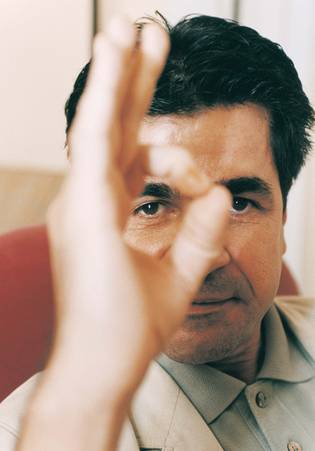
Jafar Panahi, 2010
The Berlinale opened this week and the film festival posted on the front page of its website a powerful and poignant letter from jailed Iranian filmmaker Jafar Panahi, whom the Iranian government recently sentenced to six years in prison and banned for twenty years from making films, for supposedly plotting against the regime. In his letter Panahi states, “The reality is they have deprived me of thinking and writing for twenty years, but they can not keep me from dreaming that in twenty years inquisition and intimidation will be replaced by freedom and free thinking.”
It’s heartbreaking to think that an artist as talented as Panahi and as outspoken in his support of human rights might be muzzled for two decades. I’ve only seen his three most recent films but each of them are both innovative and imaginatively made movies as well as clear, uncompromising critiques of social inequities in Iran and beyond. The Circle (2003) savagely exposes the gender inequities in the lives of Iranian women. Crimson Gold (2003), written by fellow Iranian director Abbas Kiarostami, concerns an everyday pizza delivery man whose daily humiliations by the ruling class eventually push him over the edge. Offside (2006) also takes on gender roles in modern-day Iran, framing its story against the runup to the World Cup.
The international film community, as evidenced by the Berlinale’s decision to leave a symbolically empty chair for Panahi on its jury panel, has been vocal in its opposition to his sentence, but it remains to be seen if the Iranian government will bow to public pressure to release Panahi or reduce his sentence.
Panahi has been eloquent in his own defense, noting in an interview in August, ““When a filmmaker does not make films it is as if he is jailed. Even when he is freed from the small jail, he finds himself wandering in a larger jail. The main question is: why should it be a crime to make a movie? A finished film, well, it can get banned but not the director.”

David Wojnarowicz, still from "A Fire In My Belly," 1987
Though Panahi’s sentence may seem shockingly excessive, we here in the U.S. shouldn’t forget that culture wars are still being fought in this country as well. In October 2010, conservative Reps. John Boehner, R-Ohio (now Speaker of the House) and Eric Cantor (R-Virginia) targeted the inclusion of the late artist and AIDS activist David Wojnarowicz’s short experimental film A Fire in My Belly in the show Hide/Seek: Difference and Desire in American Portraiture at the Smithsonian’s National Portrait Gallery. Citing a brief passage from the film in which ants are seen crawling over a wooden crucifix, Boehner called the exhibit “an outrageous use of taxpayer money and obvious attempt to offend Christians during the Christmas season.” Skittish Smithsonian curators quickly pulled the film from the show, to the outrage of much of the art world (the Warhol Foundation threatened to withdraw its funding from the museum). As with early 1990s attacks on NEA-funded artists by Sen. Jesse Helms, another far-right stalwart, the current assault attempts to silence what the right considers a dangerously subversive perspective, that of a gay man who dared to include religious iconography in his work. It’s one more volley in the ongoing attempt by the right to control the cultural discourse of the U.S.
Perhaps more so that the left, the right wing keenly understands the ability of art and culture to sway public opinion. As Jeff Chang and Brian Komar so astutely note in Vision: How We Can Beat Conservatives With Progressive Culture, their excellent essay on alternet.org about what they term “cultural strategy,” “When artists tell new stories, they can shift the culture and make new politics possible.” There’s a reason why conservatives are once again agitating to de-fund the Corporation for Public Broadcasting, National Public Radio, and the National Endowment for the Arts, and it’s not because they don’t like the tote bag they got with their membership pledge. It’s because the right understands that by controlling arts, culture and media outlets, and by extension controlling the master narrative, it can control the social and political landscape as well. As Mao Zedong famously stated, “[Our purpose is] to ensure that literature and art fit well into the whole revolutionary machine as a component part, that they operate as powerful weapon for uniting and educating the people and for attacking and destroying the enemy.” (Talks at the Yenan Forum on Literature and Art, May 1942) Change “revolutionary” to “conservative” and “enemy” to “Democrats” and this quote could be straight from the latest installment of Fox News.
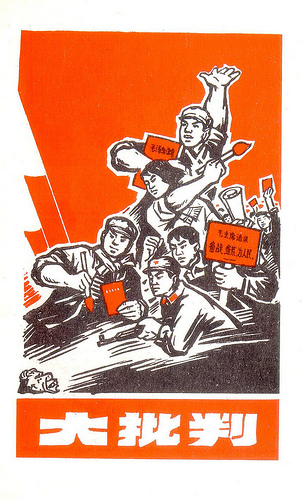
Poster, Cultural Revolution, ca. 1971
Mao had a good reason to fear the millions of artists and intellectuals that he exiled to hard labor in the countryside during the Cultural Revolution. He understood the power of art to shape popular thought and sway political opinion, as does the Republican brain trust that has been fighting for control of the arts and culture of this country for decades, and as does the ruling party in Iran that has chosen to silence Jafar Panahi.
So while we wring our hands over the fate of Panahi, we should keep in mind that we’ve immersed in a culture war here in our own backyard as well. Rush, Sean, and Bill aren’t just harmless kooks mouthing off on cable tv, but are significant bully pulpits of the right-wing thought-control machine. It’s no accident that in the dire hours of the Egyptian revolution this past month, then-President Mubarak immediately moved to shut down Internet access, repress independent media outlets, and harass journalists. The power to define and shape the cultural narrative, whether through art, media, or information exchange, is the new high ground in the battle for ideological and political power.
UPDATE: Jafar Panahi has just been awarded the Carrosse d’Or (Golden Coach) at the 2011 Cannes Film Festival, which is awarded for “innovative qualities, courage and independent-mindedness.” Cannes will screen Offside on May 12 and will keep an symbolically empty chair in the theater for Panahi.
My Ever-Changing Moods: Francis Ng 2010 In Review
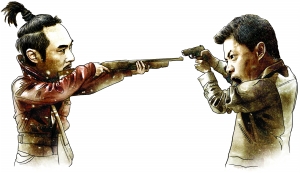
Wind Blast goes graphic
2010 was a busy year for Francis Ng. Just out of the gate on New Year’s Day, Francis made headlines across Asia when he and his Singaporean wife got into a tiff with another customer at a Hong Kong bakery. Apparently Francis’ wife complained when a worker sweeping the floor started getting dust on the baked goods. She and the worker got into it, then another patron jumped into the fray, mouthing off to the missus and possibly pushing her to the floor. Francis, who had been waiting in the car with his 1-year-old kid, heard the commotion, charged into the bakery, and allegedly grabbed the offending customer by the neck and slapped him upside the head. Photos from the scene showed the guy with a bloodied ear and Francis’ wife clutching her damaged hipbone. Francis went to the police station, everyone else went to the hospital, and the Asian press had a field day.
Francis was charged with assault, although he claimed he was only trying to protect his wife. No doubt the best thing about the incident was that it was re-enacted in one of Next Media’s renowned computer animation sequences for Apple Daily News in Taiwan, with Francis joining Tiger Woods, Lindsey Lohan, and other disgraced luminaries in CGI-rendered infamy.
Netizens were fairly divided on the topic, with some giving props to Francis for chivalrously supporting his wife and others chiding him for his straight-up thuggin’. His Hong Kong movie pals also leapt to his defense, with Michael “Laughing Gor” Tse claiming, “It is a man’s duty to protect his girl. I would have stepped up as well.”

Naughty professor
The case dragged on until April when Francis pled guilty to “wounding” and was fined HK $10,000. At his final court appearance Francis looked particularly unhappy, dressed in a brown suit and wearing unflattering black glasses that made him look like a vaguely sinister high school chemistry teacher.
For better or worse, Francis laid low for a while, avoiding appearing in public in Hong Kong. Professionally he kept busy, shooting three films (Wind Blast, Midnight Beating, and The Warring States) in quick succession in mainland China.
But by fall the beatdown incident was mostly forgotten and Francis enjoyed a resurgence of popularity.

Fashion plate
Wind Blast was released at the end of October and was the number one film in China for three weeks running, knocking Tsui Hark’s Detective Dee and the Phantom Flame out of the top spot and earning in excess of RMB 68 million.
The hybridized gangster flick/Western set in the Gobi Desert featured elaborate action sequences including a dusty chase scene involving a Jeep Cherokee, a couple horses, and a gigantic yellow dump truck. Francis in particular was lauded for his portrayal of a world-weary, conflicted bounty hunter and he stole the show from a cast of mainland movie stars including Wu Jing, Duan Yihong, and Ni Dahong. His character’s distinctive red leather jacket briefly became a icon and Francis modeled variations on the theme in a couple high-fashion photo shoots.

Anthony does Francis
Francis also landed on the cover of the Chinese fashion magazine Mr. Mode, sporting a black double-breasted trench coat and a little moue that his good buddy Anthony Wong then ruthlessly parodied for a Chinese newspaper.
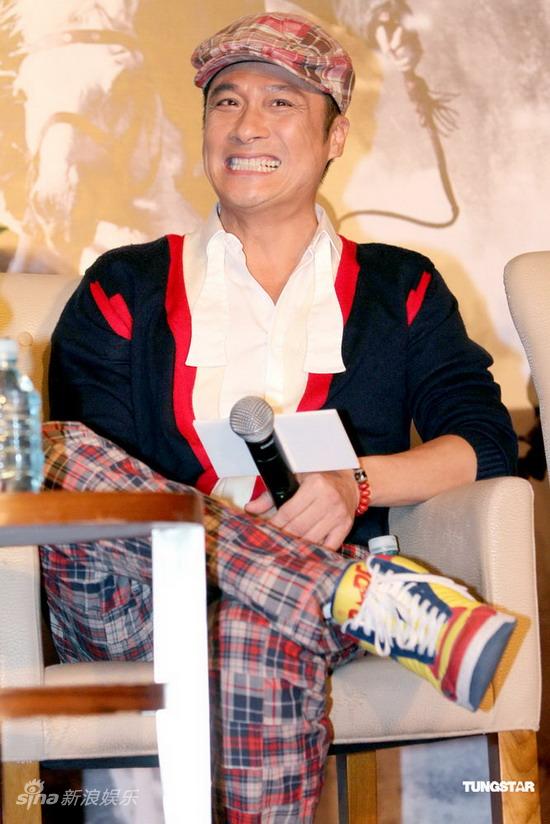
Happy in plaid
Francis later was photographed in Beijing shopping for presents for his kid’s second birthday, which further ingratiated him to the public in China and Hong Kong. He made guest appearances on Chinese television showing off his improving putonghua skills and modeled his natty b-boy wardrobe and continually changing hairstyles in the Chinese press. He also appeared at an event for Jet Li’s One Foundation charity that benefitted autistic children,which further rehabilitated his public rep.
But Francis made the news one more time at the very end of the year. In early December several pictures showed up on the interwebs of what appeared to be Francis getting busy with an unnamed young woman, harkening back to the infamous “sexy photogate” scandal that sank Edison Chen’s career.
News agencies across China gleefully flashed the pix around the ‘net and it seemed like Francis had again been caught with his pants down (see Ellen Chen karaoke oopsie). However, upon closer examination it was apparent that the photos were stills from Midnight Beating, Francis’ upcoming low-budget horror flick (also starring Simon Yam and a quartet of Chinese starlets) and that the woman in question was in fact Francis’ co-star. Cheap publicity stunt or honest mistake?

Faux photogate
At any rate, Midnight Beating was released on Christmas Eve and even up against heavy-hitters like Jiang Wen’s Let The Bullets Fly and Feng Xiaomeng’s If You Are The One 2, the cheapie screamfest made a respectable showing at the box office (before it showed up a couple weeks later on the torrent streams, of course).
Francis has subsequently finished shooting Love Island (also starring Simon Yam, Chang Cheh, and Joan Chen, among many others) and Traffic (with this year’s Golden Horse Best Actress Lu Li-ping, and Wind Blast’s Ni Dahong), and he’s on board for A Land Without Boundaries in 2011. Due out in April is The Warring States, Francis’ first period costume film, and its publicity machine is already revving up. The film promises to be a flashy extravaganza, with Francis and co-star Sun Honglei duking it out for the title of most badass.

Back in the saddle
All in all it’s been an eventful year for our boy Francis, who’s shown an uncanny ability to bounce back from public brawling, internet scorn, bad hair, and myriad other obstacles. Like a cat, Francis just keeps landing on his feet.
Corporate Death Burger: Aasif Mandvi & The Daily Show Fail

Aasif Mandvi shills for McDonald's
I’m a little irked at last week’s Daily Show segment that punk’d San Francisco Supervisor Eric Mar for sponsoring legislation to ban McDonald’s Happy Meals in San Francisco. Aasif Mandvi mugs and pops his eyes at the suggestion that the government should have any role in preventing corporations like McDonalds from marketing toxic, cancer- and obesity-causing poison as food. Mandvi even uses the term “nanny state” to describe regulation, which is a straight-up Fox News talking point. He also suggests that the Board of Supes banning Happy Meals would be like forcing Netflix to send all SF residents free copies of Supersize Me. Sure, it’s a funny gotcha moment, but it’s really a stupid false equivalency–one prevents an action, the other mandates one. I’m no lawyer but even I could see the faulty reasoning behind that one.

Mechanically separated chicken, pre-Nuggets--yum!
I can’t believe I have to even say this but fast food has been repeatedly documented to be total crap, so what’s the point of siding with McDonald’s and its fucked up, evil and bottom-line driven agenda of stuffing people with garbage that kills them? It can’t be that hard to understand that marketing edible poison to little kids with the lure of a cheap and shiny plastic toy is inherently messed up and venal.
And invoking the “nanny state” is straight out of the conservative anti-regulation playbook. Sure, give multinational corporations like McDonald’s free rein to regulate themselves and of course they’ll do what’s socially, morally and ethically responsible. How’s that working out for you, Enron, WaMu, and Halliburton?
Mandvi and the producers at The Daily Show really failed with this one. I guess I’ve been lulled into thinking that The Daily Show has some kind of oppositional cred since in the past Jon Stewart & Co. have successfully satirized other corporate and governmental malfeasance. But the show itself is on Comedy Central, which is owned by Viacom, one of the biggest communications corporations in the world. So I suppose I shouldn’t be surprised to find that The Daily Show is reluctant to bite the pecuniary hand that feeds it.
UPDATE: Just in case you need more evidence, Taco Bell is being sued for false advertising because the “meat” in their tacos is only 36% beef.
UPDATE 2: Public health attorney Michele Simon busts out the legal argument on alternet.org: Why “Happy Meals” Are A Crime. She succinctly notes, “Ample science, along with statements by various professional organizations tells us that marketing to young children is both deceptive and unfair. Why? Because young children simply do not have the cognitive capacity to understand that they are being marketed to; they cannot comprehend “persuasive intent,” the linchpin of advertising.”
This one’s for you, Aasif. MDC live, Corporate Death Burger
Sign O’ The Times: BART police sticker intervention

Hit 'em where it hurts, BART sticker intervention, July 2010
On hemmed-in ground, use subterfuge.
–Sun Tzu
Just a quick shoutout regarding a nice little intervention that’s followed in the wake the Johannes Mehserle verdict a couple weeks ago. Short, sweet, and to the point, these little gems have apparently been popping up on BART trains throughout the Bay Area. I haven’t found images of any of them in situ so if you happen to see one pasted up somewhere on your next BART ride be sure to whip out your cameraphone & document it for me. If you send me a pic I’ll post it for sure.
The Mehserle verdict was frustrating in so many ways, but even more aggravating was the mainstream media’s utterly predictable and fairly irresponsible response to it. The day of the verdict you could almost smell the anticipation on the breath of the cable news networks’ spokesmodels as they hopefully waited on the streets of Oakland for a riot to break out. Oakland residents managed to defy expectations as hundreds of people peacefully rallied for several hours after the verdict was announced, and it was only after most of those folks had gone home that a few goons trashed some storefronts and stole some running shoes. I’m not discounting the idiocy of the vandalism that happened that night but for the most part damage was contained to about 5 blocks in downtown Oakland.

Exercising constitutional rights, Oakland, July 8, 2010
It’s telling that, of the 79 people arrested that night, prosecutors only filed charges against nine of them. Even more significantly, of those arrested 75% were not from Oakland and twelve of them weren’t even from the state of California. This reflects a common pattern of police repression that’s been honed in recent anti-capitalist demonstrations worldwide, most recently at the G-20 summit in Toronto.
As Loius Proyect, aka The Unrepentant Marxist, notes in his blog, what happened in Oakland followed a well-worn scenario:
There’s a mass demonstration. A layer of people do a split from that march and then some engage in expressing their rage against the system by smashing windows and other acts. Given the world we live in, it is surprising that more of this doesn’t happen more often.
In response, the police hold back until the main march disperses. They wait for some damage to be done, and then they go on the offensive. They round-up and brutalize everyone left on the streets, including passers-by, peaceful protesters and those engaged in property damage. In Seattle, Quebec, Genoa, etc. this script has played out over and over again. The police wait until the mass organisations leave, then go after the rest. This strategy suggests that the police and the state are keenly aware of who they want—and don’t want—to provoke.
The events in Oakland suggest that, onced again, we were played both by the police and by the complicity of the mass media. If the powers-that-be have perfected the art of misrepresenting peaceful protests as riots and discouraging the average citizen from any form of dissent, then continuing to utilize creative interventionism as a revolutionary tactic is an absolute must. As 19th-century Prussian military strategist Carl von Clausewitz famously stated, “No battle plan survives first contact with the enemy.” Street protest is a venerable form of dissent, but if properly done, small, sneaky activist artworks like the BART sticker above can also pack a mighty wallop.
For a more detailed analysis of the Mehserle verdict and aftermath, go to Davey D’s blog here.
UPDATE: Nov. 5, 2010. Johannes Mehserle’s sentence has just been announced–he got 2 years, which was the minimum about of jail time he could have received. The gun enhancement charge, which could have added up to 10 years to Mehserle’s sentence, was thrown out by Judge Robert Perry. With time served, Mehserle could be released as early as February 2011, or in about three months. In my opinion there are no words to describe how stunningly wrong this is.
De Paisano A Paisano: An Interview with 9500 Liberty’s Eric Byler and Annabel Park

Proofed in Prince William County, 9500 Liberty, 2010, Eric Byler & Annabel Park
I had the chance last week to sit down with Eric Byler and Annabel Park, the directors of the new documentary 9500 Liberty that’s now playing across the country. 9500 Liberty outlines the 2007 battle in Prince William County, Virginia, over legislation that legalized racial profiling of “illegal immigrants” and the ways in which that battle polarized the tight-knit community.
I know Eric Byler as the director of Charlotte Sometimes and Tre, two seminal Asian American feature narratives dealing with angsty interpersonal relationships among several Asian Americans, but lately Eric’s been devoting his time and creativity to producing activist shorts. He and Annabel are the instigators of the youtube channel 9500 Liberty, of which the feature doc now in theaters is an offshoot. Both Eric and Annabel are articulate, committed, and smart as a whip, and they’re very passionate about changing the ways that political discourse is conducted in this country. Given the aggravating and idiotic screeds that pass for political expression these days it’s great to talk with thoughtful and creative people who are looking for alternative solutions to some of the tough issues facing the U.S. today.
Here are some excerpts from the almost-hourlong talk I had with them—the full interview can be heard below.
on the dangers of election season
Eric Byler: What we observed in Prince William County is that, in an election season, information is not as important as ammunition, and so people decide what they believe, say and repeat based on whether it helps their side win, not whether it’s true.
I think what certain insurgency tacticians have learned is that, because their positions are so radical and so far outside the mainstream, the only way they can assert their will is to use these tactics that alienate the average American from the political process and shrink participation down to a level that’s easier to manipulate.
So that’s what happened in Prince William County–they organized around deeply negative emotions. By combining racial antagonism with political partisanship they created an environment where only people who really thrive on conflict and who are comfortable with racial tension were going to those board meetings and were daring to speak on these issues.

Messaging, 9500 Liberty, 2010, Eric Byler and Annabel Park
I think that’s why Annabel and I were so concerned when we saw that become a national political strategy and instead of a blog amplifying the most negative emotions you find an entire news network to amplify not only the most negative emotions but those people they had assembled.
on button-pushing
EB: If you can make the election about some sort of social issue that really pushes emotional buttons–there are too many Mexicans in Arizona is basically the underlying theme of this election—that’s a really polarizing issue. Extreme candidates introduce extreme laws that get extreme reactions that create the kind of political landscape that favors the extreme candidate. So it’s not a surprise. And it always happens a certain number of months before the election because you’re lighting a fuse that’s gonna blow up.
on the use of intimidation tactics
EB: The week before the election (in Prince William County) was the scariest time for us. The racial tension in the county was more palpable than I ever expected to see in this century and I hope I never see again. People would drive by Liberty Wall and throw things at us—people would drive by and yell racial slurs. Those kind of climates are deliberately created for election season. Whether you’re a Democrat or a Republican you can respond really negatively to this kind of politics—we all can be intimidated, we all can be afraid.

Annabel Park in situ, 9500 Liberty, 2010, Eric Byler and Annabel Park
on film and the internets as a means of empowerment
EB: Given that there are people who are going to use as a political strategy organizing around the most negative emotions known to humankind then what we have to do is to populate our democracy with people who are willing to be responsible and fact-based and solutions-oriented. That’s what the Coffee Party and 9500 Liberty both seek to do is enlist those people who might otherwise be intimidated into silence because of these kinds of tactics and show them two examples of people who are prepared to engage even in a political process that’s been mightily toxified and frightfully polarized, because we have that much at stake, and to convince them that they have something at stake.
on hearing the news of the anti-immigrant laws in Arizona
Annabel Park: I got really emotional—I started crying! It was almost like a flashback to northern Virginia 2007. It was traumatic!
EB: It’s just such an unnecessary tragedy—the economic hardship that this kind of policy caused, the social toxification, the damage to public safety, was all so unnecessary, and really the only ones who benefit are very extreme politicians who cater to a really tiny fraction of out population.
on creating a more civil political discourse
AP: Politics is about us making collective decisions, and democracy is a method for making collective decisions–it’s not meant to be a fight with two sides. It’s supposed to be a situation where we thrive on differences and diversity but we need to be able to talk to one another. We have to create opportunities for people to talk to one another. That’s the first step in a democracy, that open dialogue—it has to be civil, there has to be real information exchanged. In a way it’s a very simple thing—asking people to protect and practice democracy, and by using social media, to create not only a communication network but by having this idea go viral—let’s go viral with this idea that we have to participate in democracy, and to give them portals for doing it.
on making a difference
AP: The (9500 Liberty) youtube channel did have impact on the community. We just showed (the movie) in Phoenix and in parts of Arizona and I think we made some progress there. I think there are people who are now ready to have dialogue at least. Just saying “Illegal Is Illegal” is just not really a starting point for dialog. It doesn’t help us formulate policy, it’s just grandstanding—it shuts down conversation.
on optimism and inevitability
EB: I feel very optimistic. 9500 Liberty is a microcosm of what’s happening in Arizona and Arizona is a microcosm of what’s happening across the country. The reason why we’re seeing these insurgency tactics, these desperation tactics coming from the right is that they’re afraid of the changes that really are inevitable. They feel that they’re actually delaying those changes by using these extreme tactics but I believe they’re actually accelerating these changes.
Every year another crop of kids turn 18 and registers to vote and during that same time unfortunately we have to say goodbye to our grandparents and aunts and uncles who grew up during the pre-civil rights era and who aren’t really as comfortable with the 21st century as those of us who are younger. So these kinds of cultural issues where a group of very extreme politicians are asking us to hate another group more than they love our country, are gonna cease to be effective, and that’s really when this will stop, when it can be shown, and maybe it will be in November, that this kind of fear politics is not effective.
on the relationship between love stories and political activism
EB: Both Tre and Charlotte Sometimes are essentially love stories where I made the choice to cast both mixed race and full-blooded Asian Americans. And I didn’t realize it but, because it’s an identity issue and identity is very much something that informs my artistic choices, for me it became a political choice. As Annabel likes to say, politics and identity are essentially the same thing.
Eventually I had to become comfortable talking about politics because I was talking about race and identity, and so the transition isn’t as unexpected or as dramatic as you might expect. Identity issues are at the core of American politics right now.
The short answer is I think I decided that in this era of American history, when so many important decisions are being made that are going to affect the rest of this century, that just making love stories, albeit love stories that do have social and political commentary, was not enough of a contribution—I wanted to do more.
(Now) I feel like I could make a movie about Weimar Germany. I could do one of those futuristic movies about a war. I now know what it feels like when you have politicians laying the groundwork for war and you have agitators essentially systematically dehumanizing a population so they can directly take action against them

Looking illegal, 9500 Liberty, 2010, Eric Byler and Annabel Park
on “looking illegal”
EB: I think that in some ways Asian Americans were given a pass on this issue in a weird way, even though many Asian Americans are undocumented—it’s a culture war directed at Latinos, let’s face it. And so I’m the one that actually looks Latino (laughs), being the halfer–
During that time, everything was about looking around and trying to figure out who looks illegal–the police are now being directed to try to tell who looks illegal, the government is basing policy on who looks illegal and who citizens say are illegal, because they went to the emergency room and saw a lot of Latinos—so they must’ve been illegal! So everything’s about who looks illegal– And y’know, some days I wake up I look more “ethnic” and my hair’s messy or curly or something. When you live in a climate like that you wake up in the morning and you see yourself in the mirror and you say, “Oh my god—I look illegal today!”
on the role of film and participation politics
AP: Being filmmakers doesn’t give us a special status not any more than being elected gives us a special status. We all have to be part of this democratic process or it’s just gonna fail. To me that one thing that’s a given—if people don’t participate it’s not a democracy.
There are enough people who have been silent who now have an opportunity to say, “Y’know what, I don’t want to be silent any more, I’m sick of this, enough is enough, let’s come together as a community, let’s stop being Democrats and Republicans and start being Americans and figure out what we have in common and have some of these tough conversations about our future. How much money are we spending on the military? How long can we sustain these two wars? What does it mean to be an American at this point? What unites us as a people in a meaningful way beyond the fact that we live in the same land mass?
on the dire need for civility and the role of the Coffee Party
AP: We’ve got to leave our ideology aside in order to come together. Otherwise you’re submitting to these forces that are in every society that want divide people and separate and secede and balkanize—that’s always there. If we don’t step up and counter that with the force of unity and peace and harmony then we’re headed for a very, very bleak future.
With the rise of the Tea Party there was this narrative that the Tea Party represented America, and there’s a lot of frustration with the government, but their point of view is not representative of America. To me it’s a marginalized view of minorities who know how to engage in political theater.
What happened with the Coffee Party is that I started this fanpage on facebook that just exploded. We want to find another way of engaging. We have these problems but I don’t want to be out there denouncing the government or Obama.
I want to be out there trying to figure out how to improve the government and to feel like we’re on the right path so that ordinary people are being represented and we’re on the path to not destroy one another but to work together.
So people are sort of just self-organizing—we have local chapters across the country. In the Bay Area there’s a cluster of them that are very active—in LA, too. There are local chapters–they function largely autonomously. We have national campaigns—like we’re having one right now where we ask people to discuss campaign finance and corporate personhood.
We’re trying to give people ways of connecting to the political process that isn’t alienating, isn’t negative, it isn’t about fighting people but it’s about dialogue and bringing people together–and really insisting on civility.
I don’t know how true this is but I’ve heard people say that people in the Tea Party, it’s had an impact on them. They’ve been much more conscious of their tactics and whether or not they’re going to be judged as being uncivil or not. I think I just like having civility become a viral idea.
Are we gonna being screaming at our politicians and at each other, or are we gonna say, “Okay, we need reform–how do we get there? Let’s work together.”
9500 Liberty (81 minutes)
Co-Directed by Eric Byler and Annabel Park
UPDATE: 9500 Liberty will have its cable television premiere this month on MTV Networks. It will show on Sunday, September 26th at 8pm (ET/PT) on MTV2, mtvU (MTV’s 24-hour college network), and Tr3s: MTV, Música y Más (formerly MTV Tr3s) as part of Hispanic Heritage Month. You go, Eric & Annabel!
Here’s the extended trailer for the film:
Here’s the full interview (trt: 52 min.)
Mad World: Messages to the Future at Galeria de la Raza
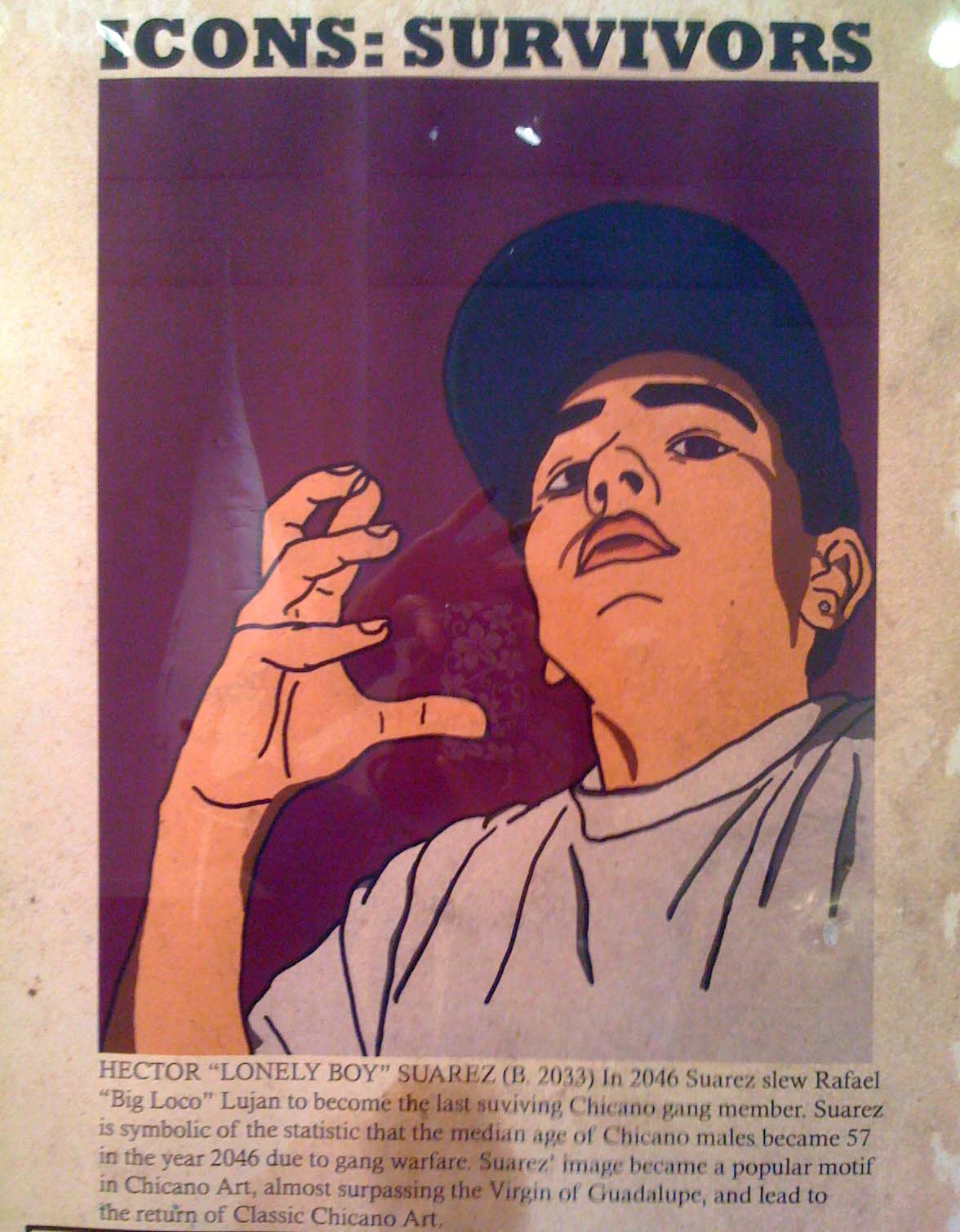
Chicano Visual Almanac, 2050, Rio Yanez, 2010, detail, digital print
So it looks like Arizona has legalized racial profiling, outlawed Ethnic Studies, and forbidden folks who speak accented English from teaching language arts. The Texas Board of Education has set out to rewrite history, by glossing over the imprisonment of Japanese Americans during World War II, renaming the slave trade “the Atlantic triangular trade,” and emphasizing the significance of hard-line segregationists George Wallace and Lester Maddox in the civil rights movement. The Texas BOE also claims that W.E.B. DuBois, Susan B. Anthony, and Ida B. Wells were “obsessed with oppression.” Funny, that–
To me, Texas and Arizona’s boneheaded, mean-spirited, and utterly reactionary actions are the last gasp of a Eurocentric hegemony desperately trying to cling to its rapidly receding cultural dominance, as U.S. demographics inexorably move toward a more diverse and polyphonic society. The top dogs are about to be ousted and they’re not one bit happy about losing their place of privilege, so they’re going down kicking and screaming. As noted by Gregory Rodriguez, “Even though they are still the majority and collectively maintain more access to wealth and political influence than other groups, whites are acting more and more like an aggrieved minority.” Writer and critic Hua Hsu states,
“According to an August 2008 report by the U.S. Census Bureau, those groups currently categorized as racial minorities—blacks and Hispanics, East Asians and South Asians—will account for a majority of the U.S. population by the year 2042. Among Americans under the age of 18, this shift is projected to take place in 2023, which means that every child born in the United States from here on out will belong to the first post-white generation.”
Not to belabor the point, but not only has the horse bolted, it’s three miles down the road. But as evidenced by the nonsense going on in Arizona and Texas, that doesn’t mean that some people aren’t gonna try locking the door anyways.

Chicano Visual Almanac 2050, Rio Yanez, 2010, digital print
Because of the shenanigans going on in the Southwest, the fun new show at the Galeria de la Raza, Mad World: Messages to the Future, is all too relevant in this wacky country where racial difference has suddenly become a crime. The show looks futureward from a Chicano/Latino perspective, envisioning a time forty years hence when California is projected to become a white-minority state.
Rio Yanez’s tongue-in-cheek print series, Chicano Visual Almanac, 2050, takes a smart and sassy look at possible future Chicanocentric events. These include a description of the ascension of Hector “Lonely Boy” Suarez to the title of “last surviving Chicano gang member,” as well as documentation of “notable attempts to resurrect Cesar Chavez,” next to a visual mashup of Chavez and the Virgen de Guadelupe. Yanez also includes a chart outlining the many iterations-to-be of the Chicano art movement, listing, among others, “2010: Post-Chicano Art,” “2017: Post-Xicano Art,” “2036: Chicano Art,” “2039: Post-Pre-Colonial Art,” “2041: Inverse-Hispanic Art,” and “2050: Chicano Art,” making a sly dig at the artworld’s ever-changing fashion trends and its love for absurd and overly descriptive nomenclature.

Breathing, Smoking, and Drinking (BSD) Device, mixed media mask; 2050 Calendar Year, acrylic on non-woven media, Johanna Poethig, 2010
Johanna Poethig’s paired pieces in the show also speculate about possible future scenarios. Breathing, Smoking, and Drinking (BSD) Device, which is essentially a modified gas mask worked up to admit cigarettes, food and beverages, anticipates our poisonous future environment. But all will not be lost–as Poethig notes, “Since we will all have to wear the pesky masks, the BSD will enable us to continue our bad habits as we schmooze and socialize.” Poethig also features the BSD in her other piece, 2050 Calendar Year, a large-scale calendar that features an image of the Hindu elephant god Ganesh decked out in a BSD, clutching a cigar in one hand and coils of tubing from an oxygen tank in the other. The calendar itself commemorates significant dates in the next forty years including “2031: USA declares war on itself,” “2046: Last White Person Day,” and my favorite, “2039: End of Patriarchy.”
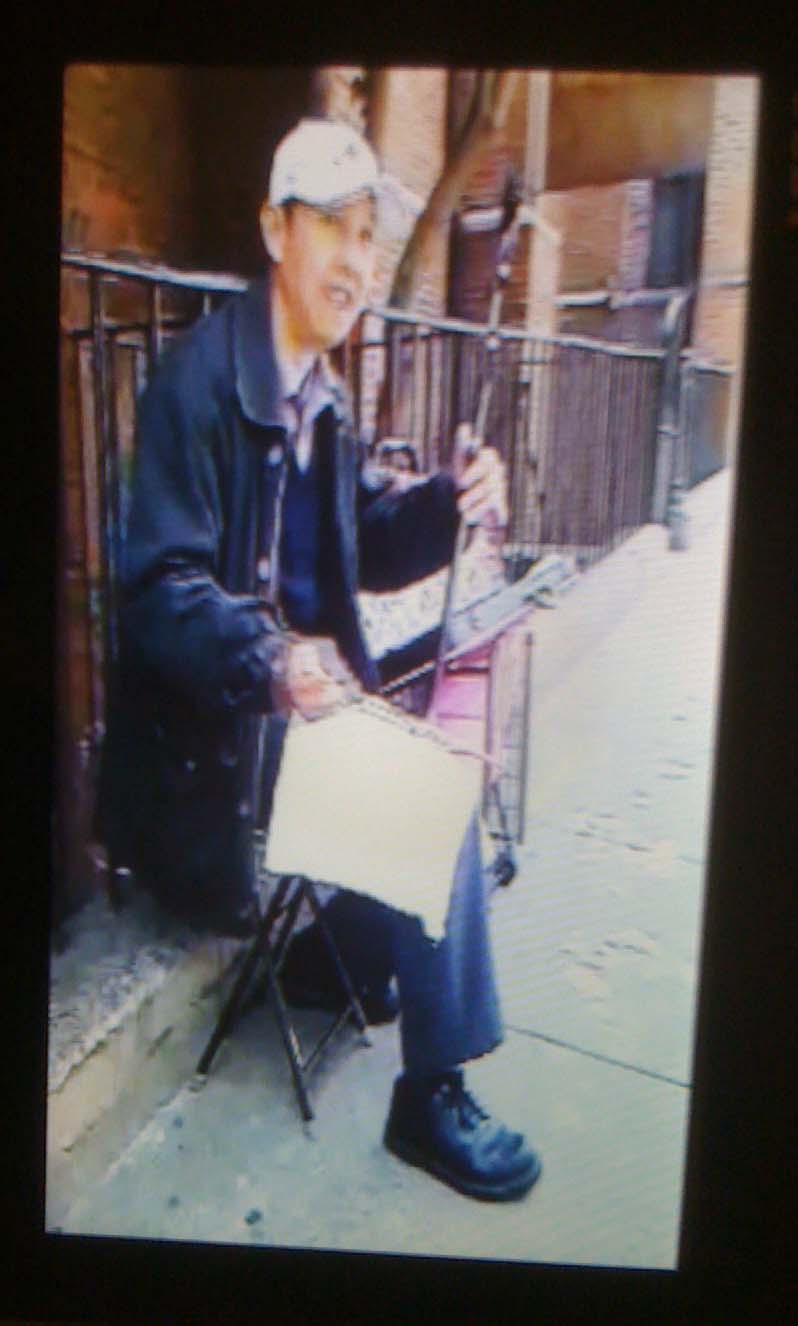
No Home Nowhere, Carlos Castro, 2010, detail, video installation
One of the show’s simplest yet most interesting pieces is Carlos Castro’s three-channel video installation, No Home Nowhere. Castro asked three different U.S. street musicians, originally from Senegal, China, and Latin America, to play the Star-Spangled Banner on their respective instruments. In his installation Castro exhibits video documentation of their performances on three small monitors mounted on the gallery walls. As Castro notes, “Although none of the individuals could play the tune by memory or even understood what the artist was asking, they quickly learned and performed it.” Castro’s piece suggests that the alacrity with which each musician learned the iconic song signifies that, despite language barriers, cultural differences, and diverse countries of origin, we all do belong in this crazy country, and that inevitably, despite our worst instincts, we all can learn to get along. Not a bad future, overall, and one that I wouldn’t mind sending my grandkids to live in. And hopefully by the time that future rolls around, Arizona and Texas’s reactionary haters will only be a brief, spasmodic, forgotten footnote in history.
PS: For a funny take on Chicano Art shows and the people who love them go here.
Mad World: Messages To The Future
Galeria de la Raza
2857 24th Street
San Francisco CA 94110
415-826-8009
http://www.galeriadelaraza.org
Saturday, May 8, 2010 – Saturday, June 26, 2010
Open Tuesday 1-7pm & Wednesday through Saturday from noon till 6pm
Featuring Jose Arenas, Carlos Castro, Emael, Chris Granillo, Erika Hannes, Hector Dio Mendoza, Johanna Poethig, Lady Reni, Joshua Short, Jose Antonio Suarez, Robert Trujillo, Christina Velazquez, Rio Yanez, and Marilyn Yu
A Fool Such As I: 36 More Francis Ng movies

Saluting Francis
Since my Francis Ng movie-watching marathon 18 months ago I’ve been scouring the universe trying to see every possible Francis movie I can find. Herein follows another 33 films and 3 dramas that I was able to locate, with bullet reviews of each flick. Although I’m still less than 50% through his 120 movies, my viewing pace has slowed down quite a bit, since the remainder of his films are either out-of-press or only available unsubbed on Chinese-language streaming sites. Luckily our dear Francis is still actively making new movies and he’s got a couple due out this year, Fierce West Wind and The Warring States, which are both big budget Mainland Chinese productions, so I’ve got something to look forward to. Here’s hoping for 120 more Francis movies in the future.
The best
1. Once Upon A Time In Triad Society 1: Francis shows off his acting chops in this clever and original sendup of triad movies, reprising his career-making role of Ugly Kwan from Young & Dangerous. He won the first of three Best Actor awards in a row from the Hong Kong Film Critics Society for this role.
2. Once Upon A Time In Triad Society 2: The story and characters are unrelated to the first film but it’s also an original and energetic take on gangster life. This time Francis plays a cowardly triad more interested in mahjong than brawling. Smokin’ hot Roy Cheung plays a zealous hing dai.
3. Bakery Amour: Offbeat romantic comedy with Francis as a fish-out-of-water country boy navigating Hong Kong. He falls for his gorgeous neighbor Michelle Reis but plot and circumstance endeavor to keep them apart. Will the two mismatched lovers find one another in the end?
4. A Gambler’s Story: A loopy black comedy about a down & out, hapless gambler, played with mournful determination by Francis. In no way resembles God of Gamblers or any other escapist HK poker movie.
5. Banana Spirit: Francis plays a coroner’s assistant whose job is putting makeup on corpses. He falls for a beautiful ghost living in a banana tree and along the way encounters Taoist exorcists, gangsters, and Tommy Wong as a fire demon. Great stuff–
6. A War Named Desire: Francis as a hard-ass but righteous triad in Thailand who gets tangled up in a gang war. Awesome heroic bloodshed movie with an outstanding turn by Gigi Leung as a sharpshooting gun moll.

Stern Francis, Turning Point: Laughing Gor, 2009
7. Turning Point: Laughing Gor: Gritty actioner based on the popular TVB character played by Michael Tse. Francis & Anthony Wong steal the show as dueling triad bosses who battle it out for the most outlandish hair and costumes. Not bad for a low-budget quickie, this film was the second-highest grossing HK movie of 2009.
8. ‘Til Death Do Us Part: Anita Yuen plays a childlike woman destroyed by her husband’s two-timing. Francis is great in a supporting role as a sympathetic divorce lawyer who tries to save her sanity.
9. Big Bullet: Fast-paced and thrilling cop actioner with Francis as a righteous detective whose best friend is fellow police officer Lau Ching-Wan. Anthony Wong as a very bad guy and, in a change of pace, Jordan Chan as an upstanding cop.
The rest—in rough chronological order
10. In The Lap Of God: a very young yet fully formed Francis in a small supporting role as the boyfriend of big-haired 80s dream girl Irene Wan, who throws him over for hotshot cop Roy Cheung (!). Filmed mostly in the jungles of Thailand.
11. Handsome Siblings: Early Francis wuxia, with A-listers Andy Lau & Brigitte Lin battling Francis’ evil transgendered villain. Francis was nominated for Best Supporting Actor for this one, launching his movie career and freeing him from the clutches of TVB.

Co-joined Francis, The Bride With White Hair, 1993
12. The Bride With White Hair: Leslie Cheung & Brigitte Lin as gorgeous star-crossed lovers in this classic wuxia pian. Francis is a lovelorn Siamese twin demon in glittery eye makeup who is surprising sympathetic and fleshed-out.
13. Sexy & Dangerous: Silly knockoff of the Young & Dangerous movies, with four hot babes instead of Ekin & Jordan. Francis plays a dumb, low-level triad with orange hair who courts one of the chickies. Excellent turn by Karen Mok in the Jordan Chan role.
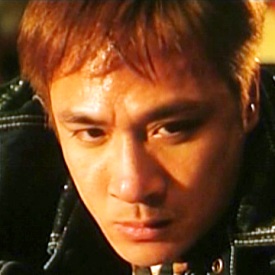
Ginger Francis, Sexy & Dangerous, 1996
14. 24-Hour Ghost Story: Something about a haunted convenience store and the four clueless people who run it. Francis sees ghosts.
15. Wicked Ghost: Don’t remember much about this cheapie horror flick except that Francis wears glasses and plays a professor
16. 9413: Francis directed this quirky tale about an emotionally damaged cop who seeks redemption from his guilt and ennui. Not bad for a freshman directorial attempt, Francis was no doubt much assisted by cinematographer Herman Yau.
17. A Queer Story: Francis turns in a beautiful and subtle supporting role as the younger lover of a man who dies of AIDS. The film fully exploits his astonishing hotness—who wouldn’t fall for him, male or female?

Pretty Francis, A Queer Story, 1997
18. What Makes A Good Teacher? Weird little school drama directed by Francis, who also stars as a former mental patient who ends up teaching a bunch of teenagers in Hong Kong. Amusing cameos by Anthony Wong, Cheung Tat-Ming, Dayo Wong and other friends-of-Francis.
19. The Group: Convoluted action movie about a group of adopted siblings who avenge the death of their priest-father (I think). Francis is the leader of the pack. I think he dances on a table in this one but I can’t remember.
20. Chinese Midnight Express 2: Very cheap prison flick with Francis as a righteous attorney at odds with a corrupt warden. This one has every prison film cliché in the book, done in typical HK low-budget style—not necessarily a bad thing, if you ask me.

Cop Francis, The HK Triad, 1999
21. The HK Triad: Francis & Lau Ching Wan in the 1960s and 70s as lifelong buddies on opposite sides of the law. Tawdry Wong Jing nonsense with senseless torture, gratuitous necking and Athena Chu as a sexy bad girl.
22. 2000 AD: Sleek thriller starring a hapless Aaron Kwok as a computer programmer inadvertently caught up in international espionage. Francis won several Best Actor awards for playing a middle-aged detective who shows Aaron the ropes.
23. Horror Hotline: Big-Headed Baby: Weird Soi Cheang thriller involving an urban legend about a deformed infant. Blair Witchesque ending. Francis smokes a lot in this one.
24. Magnificent Team: Goofy cop adventure comedy that feels like the 80s even though it was made in 1996. Francis leads a bunch of misfit cops through a series of mishandled investigations and gets to court and spark with serious-as-a-heart-attack Amanda Lee from Full Alert.
25. Clean My Name, Mr. Coroner: Francis as a fussy coroner in a bow tie who saves rogue cop Nick Cheung’s bacon. Kinda fun and a good change of pace.
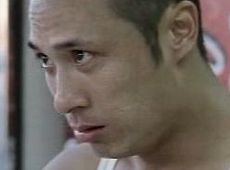
Psycho Francis, Never Compromise, 1999
26. Never Compromise: The ne plus ultra of Evil!Francis, here a heartless mass murderer who casually strangles prostitutes and shoots down entire families. Not really a good movie, but Francis is fascinating as the ultimate sociopathic loser. Great noodle-slurping scene after offing a cop with a hand grenade.
27. Heroic Duo: Francis plays a psychopathic, flashy bad guy and completely overshadows the nominal leads, the bland and boring Ekin Cheng and Leon Lai.
28. Fall For You: Pretty awful rom-com set in Paris, but it’s nice to see Francis as a romantic lead. He charmingly plays a free-spirited artist in the City of Lights who falls for Kristy Yeung, who looks disturbingly like a female Leslie Cheung (although not as charismatic).
29. Women From Mars: did I watch this movie?
30. Hands In The Hair: Francis in a supporting role as the husband of a neurotic and self-centered woman played by Rosamund Kwan. Francis nails it as the mild-mannered cuckolded husband while Rosamund proves again that she really can’t act.
31. McDull, the Alumni: Very cute sequel to My Life As McDull, the surprisingly charming animated kids’ movie. This one mixes live action and animation and has about three dozen cameos by Hong Kong’s biggest stars. Francis very briefly appears as a be-wigged judge in a hot-pot restaurant in a very funny scene with Cheung Tat-Ming and the incomparably entertaining Sandra Ng.

Dissolute Francis, Buttonman, 2009
32. Buttonman: A bloody mess, this extremely violent and nihilistic Taiwanese gangland thriller lacks narrative structure, logical character development, or any kind of directorial guidance. A melancholy Francis sports a James Caan perm and plays a burned-out triad who cleans up after mobster murders.
33. Tracing Shadow: Francis’ latest directorial effort kinda sucks, but some might like it for its excellent swordplay scenes. The dippy comedy falls flat, imho.
34. Triumph In The Skies (drama): Super-popular drama that made Francis a heartthrob in HK, this one focuses on the lives and romances of several airplane pilots. Francis is excellent as the upstanding pilot Sam Tong, whose thwarted love affair with Flora Chan consumes much of the thirty-plus episodes.

Pilot Francis, Triumph In The Skies, 2003
35. The Great Adventurer (drama): Long and languidly paced Mainland Chinese drama about the rise of a business tycoon and his best friend, played by Francis and Dayo Wong. TVB drama queen Flora Chan gets in the way as the scheming woman who comes between them. Surprisingly tepid, although a nattily dressed Francis gets to romance four different women in this one.
36. Healing Souls (drama): Francis as a brain surgeon (!) in a typical hospital soap opera. Much blood, bedside drama, and infectious diseases. Francis unfortunately has orange hair in this one.
Little Dragon Redux: Mike Lai at Southern Exposure Gallery
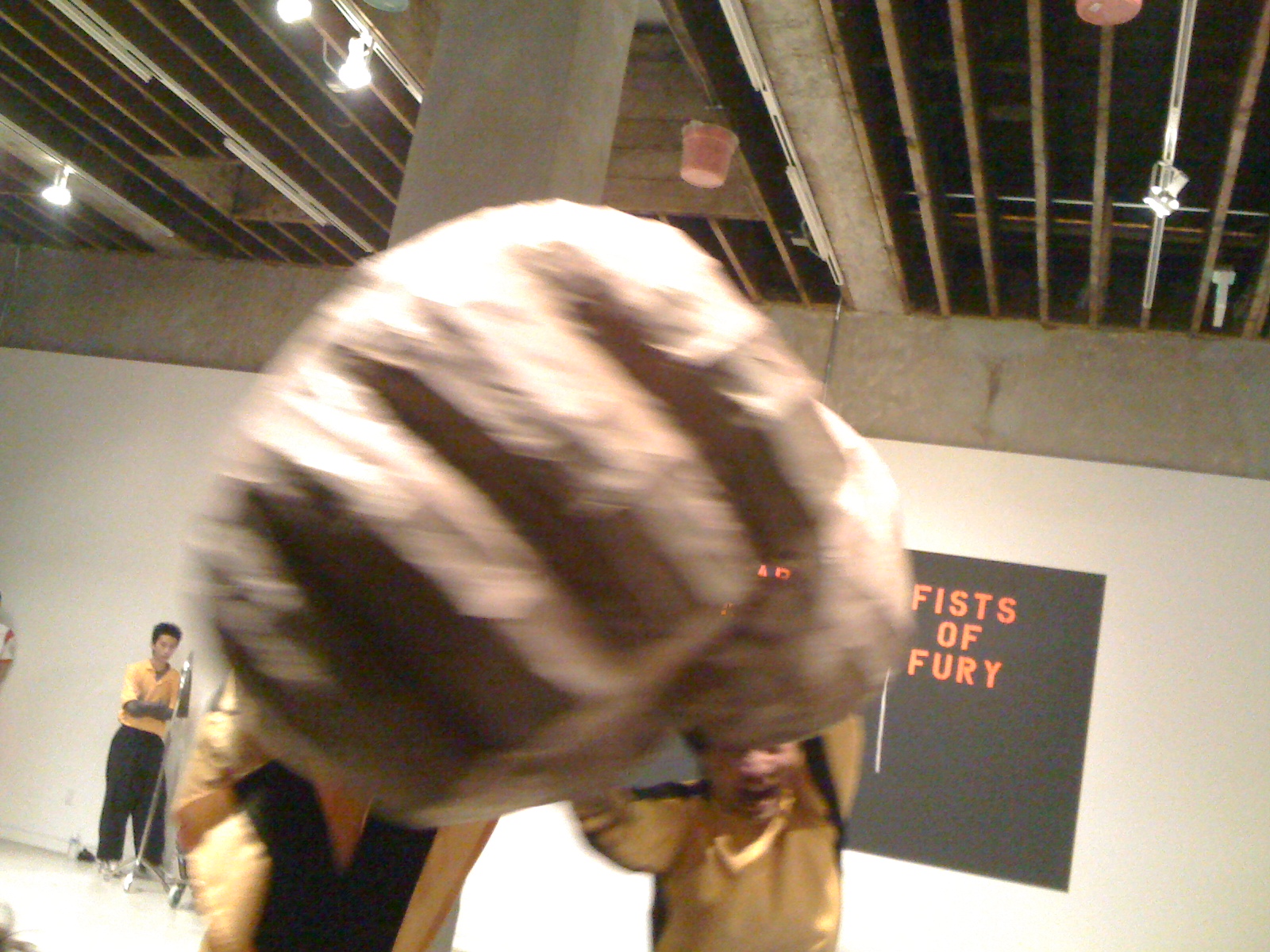
Fist atcha, The Legendary Lions vs. the Fists of Fury, Mike Lai, 2010, Southern Exposure Gallery, San Francisco
Just closed out my Chinese New Year celebration last Friday by attending Mike Lai’s wacky and inspired performance, The Legendary Lions vs. The Fists Of Fury. Staged one night only at Southern Exposure gallery in San Franciso’s Mission District, the performance was a face-off between two traditional Chinese lion dance troupes and the Fists of Fury, Lai’s goofy take on that venerable martial arts/dance/acrobatic form that featured two gigantic paper mache fists trailing yellow-and-black tails.

Nails of fury, Bruce Lee Manicurist/ Golden Dragon Massacre, Mike Lai, Queen’s Nails Annex, 2007
The performance continued Lai’s obsession/fascination with all things Bruce Lee and included yellow-and-black custom-made M & M’s emblazoned with Lai’s face in a Little Dragon bob. Mike Lai is heavy into Bruce and several of his past performances have referenced Siu Lung and his films. He’s especially fond of Bruce’s signature yellow-and-black tracksuit from Game of Death and has used that motif a bunch of times, including at an excellent event at the Queen’s Nails Annex Gallery where he painted tiny yellow-and-black designs on the nails of lucky manicurees.

Leung’s White Crane tears it up, Southern Exposure, 2010
For the first couple rounds last Friday at Southern Exposure the battle was pretty well-balanced between the lion dancers and Lai’s nouveau-dance Fists, but it was all over when the second lion dance troupe took the stage. Leung’s White Crane is one of the top lion dance crews in the world and they’ve performed in oodles of international competitions—the very next night following the SoEx battle they carried the gigantic dragon puppet at San Francisco’s Chinese New Year parade. So though Lai’s Fists put up a valiant fight, they were no match for the mad skillz of Leung’s veteran troupe.

Mike & the Fists, 2010, Southern Exposure Gallery, San Francisco
Although the event was a bit too oppositional for my acculturist tastes (does it really have to be trad vs. modern?) it was a fun and furious, hella loud experience. The night ended with an impromptu confetti fight between myself, my younger daughter (staying up late to watch performance art with her mama), and Chi-Hui Yang, director and curator of the San Francisco International Asian American Film Festival, which is about to start in exactly two weeks. Chi-Hui informed me that Mike and the Fists will reprise their performance at the Film Fest’s big all-day Festival Forum event on Sat. Mar. 13 at 6pm in Japantown’s Peace Plaza. So check it out—it will be brilliant.
Just for kicks, here’s a video of Leung’s White Crane performing atop ten-foot high poles at the 2008 Genting World Lion Dance Championships in Malaysia.
Sweet Dreams Are Made Of This: Top 10 Hong Kong Movies of the Decade
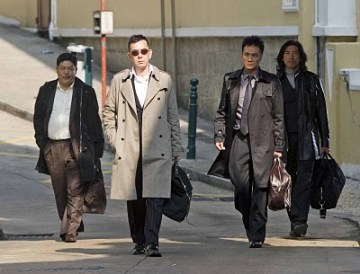
The Hong Kong Spice Boys, Exiled, 2007
This week I’ve been letting my geek flags fly, as I’ve been closely following the countdown of lovehkfilm.com’s Top 50 Hong Kong films of the decade. Webmaster Kozo, Hong Kong film aficionado extraordinaire, has been revealing ten films a day on his blog, Damn You, Kozo, with much commentary from the fanperson peanut gallery. Although Hong Kong films are not the ne plus ultra of film fandom that they were, say, fifteen years ago, more than 150 dedicated otaku responded to lovehkfilm’s poll, which was a completely unscientific open vote of anyone who wanted to send a ranked list of their favorite HK flicks of the past ten years. Being a dutiful HK cinema fangirl I compiled a draft of my top ten and, not surprisingly, the majority of the films on the list starred my personal favorite Francis Ng. Herein follows my list, with reviews of each film. Please note that the list is not a reflection on whether the films are cinematically or historically significant, but based purely on the amount of pleasure that I got while watching them. Which is really how it should be sometimes.
In reverse order:
10. Beauty and the Breast, dir. Raymond Yip, 2003
Wacky comedy starring Francis Ng as an office lothario who bets he can seduce bespectacled smart-girl Michelle Reis. Luckily her dad is an herbalist and kung-fu master who sees through the ruse, setting up Francis and his accomplice, the hapless Daniel Wu, with an appropriate punishment. Unlike most Hollywood actors, Francis Ng sees no need to safeguard his masculine image, which leads to an excellent use of prosthetic mammaries. Favorite scene: A conflicted Francis Ng manifests Good Francis (dressed in white with angel wings) and Bad Francis (in red with a tail and horns), who advise him on his quest to bed Michelle Reis.
9. A Gambler’s Story, dir. Marco Mak, 2000
A weird and loopy, stylized look at a down-on-his-luck gambler, played by Francis Ng, who tries to escape his miserable lot in life. Director Marco Mak mixes slapstick, violence, and pathos as only a Hong Kong director can do in this quirky and bizarre movie. Favorite scene: Francis and Suki Kwan win, then compulsively gamble away a fortune in a Macao casino.

Cecilia Cheung and Lau Ching-Wan show how it's done, Lost In Time, 2003
8. Lost In Time, dir. Derek Yee, 2003
A tearjerker par excellence, by Derek Yee, who also directed the 1993 classic Hong Kong weepy C’est La Vie, Mon Cherie. Lau Ching-Wan and Cecilia Cheung put on an acting clinic as ordinary people coming to grips with personal tragedy. Really one of the best melodramas ever made. Favorite scene: Orphanage scene!
7. PTU: Into The Perilous Night, dir. Johnnie To, 2006
Johnnie To’s dreamlike, surreal travel through nocturnal Hong Kong, with Simon Yam, Lam Suet, and Maggie Siu in search of a lost gun. Possibly the closest To has come to directing an art film, with its poetic use of empty space and expressionistic framing. Favorite scene: Triad musical chairs in a late-night hot pot restaurant.
6. Shaolin Soccer, dir. Stephen Chow, 2001
Though not as brilliant as Stephen Chow’s 1990s mo le tau comedies, Shaolin Soccer still captures Sing Jai’s absurd and wacky persona, with the added bonus of crazy CGI that perfectly meshes with Chow’s insane worldview. Plus it’s a totally fun sports movie. One of the most pleasurable films on the planet, imho. Favorite scene: Stephen Chow demonstrates his kung fu parking skills.

Gigi Leung & Francis Ng a deux, A War Named Desire, 2000
5. A War Named Desire, dir. Alan Mak, 2000
An early film by Alan Mak, one half of the Infernal Affairs team, this intense thriller follows the fate of a pair of estranged brothers who find themselves on the run from triads in Thailand. Francis plays the older brother, a no-nonsense gangster who must choose between duty and honor. Gigi Leung is outstanding as a gun moll whose sharpshooting matches Francis’ shot-for-shot. Favorite scene: Gigi Leung methodically stalks her prey during a chaotic, cacophonous Thai New Year celebration.

Cecilia Cheung and Francis Ng mix it up, The White Dragon, 2003
4. The White Dragon, dir. Wilson Yip, 2003
Fun, frolic, and wuxia, with Francis Ng playing a blind swordsman who falls for bratty and spoiled, vain rich girl Cecilia Cheung. Although the action and comedy scenes are energetic and clever, the best part of the movie lies in the center section of the film, where erstwhile adversaries Francis and Cecilia court and spark. Favorite scene: Cecilia informs the blind, unaware Francis that girls would fall for him since he’s handsome and has straight teeth and a “tall” nose.

Stare-off of the century, Francis Ng and Anthony Wong, Infernal Affairs 2, 2003
3. Infernal Affairs 2, dir. Andrew Lau & Alan Mak, 2003
The prequel to Infernal Affairs, which Martin Scorsese remade as The Departed, Infernal Affairs 2 is a magnificent gangster opus that operatically follows the fate of its many characters. Anthony Wong, Francis Ng, Carina Lau, and Eric Tsang are among the stellar cast. Francis in particular is outstanding as the soft-spoken yet ruthless Triad boss bent on avenging his father’s murder. Favorite scene: Francis mournfully toasts his late father at an outdoor noodle stand, with a cadre of equally somber triads echoing his gesture.
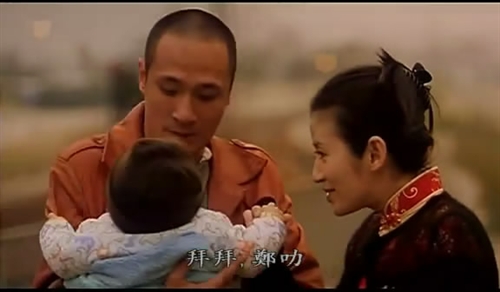
Francis Ng & Sandra Ng try to figure it out, Juliet In Love, 2000
2. Juliet In Love, dir. Wilson Yip, 2000
One of the saddest and most heartfelt genre films ever to reach the screen, with Francis Ng and Sandra Ng as star-crossed lovers who find unexpected solace with each other. Francis plays a low-level triad caught up in a net of fateful events. Sandra is a lonely restaurant hostess who befriends him. Favorite scene: Simon Yam as a mobster boss who indifferently slurps down hot pot while Francis stoically bleeds from a head wound in the corner of the restaurant.

Nick Cheung Ka-Fei shows 'em what for, Exiled, 2007
1. Exiled, dir. Johnnie To, 2007
The ultimate fanperson heroic bloodshed film of the decade, featuring an ensemble cast of hard-guy triad film stars. Anthony Wong, Francis Ng, Lam Suet, Roy Cheung, and Nick Cheung shoot ‘em up on the eve of the 1998 return of Macao to China’s rule. An allegory for the ennui and anomie of Hong Kong and Macao residents during that time, with beautiful cinematography, a haunting soundtrack, and brilliant, tough-as-nails characterizations by the veteran cast, plus five, count ‘em, five amazing shootouts. Favorite scene: the prelude to the awesome opening shootout, in which Anthony Wong and Francis Ng remove ammo from their automatic pistols in order to have the same amount of bullets as Nick Cheung’s six-shooter.
Honorable mentions: Mad Detective; After This Our Exile; Election 1; The Warlords; Sparrow; Turning Point: Laughing Gor; Fantasia; Initial D; Wo Hu; On The Edge
People Get Ready: Iran demonstrations, December 2009
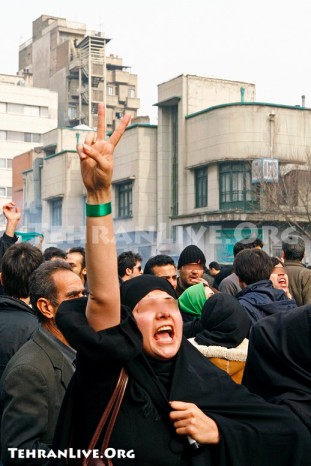
Unidentified protestor, Tehran, December 2009
After several months of bubbling under, turmoil has once again exploded in Iran this weekend, with at least fifteen people killed, including the nephew of Green Movement leader Mir Hossein Mousavi, in demonstrations in support of governmental reform there. I’ll leave it to more diligent and erudite observers to compile and analyze the events as they happen but I did want to note again that the web is the place to be for the most up-to-the minute information about this weekend’s happenings. Andrew Sullivan at The Atlantic has been liveblogging since Saturday night; fletcher christiansen at dailykos.com has a great roundup of news and links: the Daily Nite Owl has also been liveblogging here. And if you’re twittering, #iranelection is the hashmark to follow, with oxfordgirl also livetweeting.
youtube also has much video shot on the streets: I’ve included just one that seems particularly telling.
At 3.49 it apparently shows a member of the Basij, Iran’s paramilitary police force, removing his helmet and holding it aloft, to the cheers and cries of the crowd.
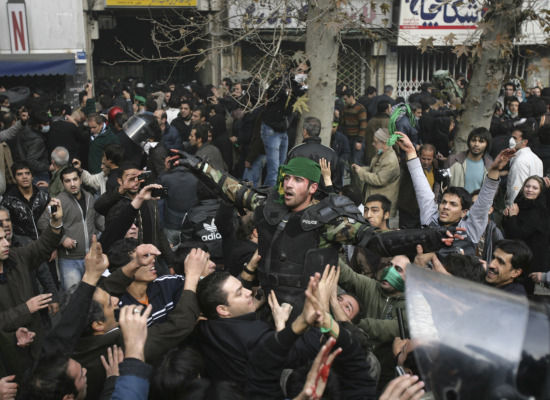
Defecting Basiji carried by the crowd, Tehran, December 27, 2009
Another photo shows a Basiji in a green scarf being carried above a crowd, arms outstretched.
Several observers including Sullivan suggest that the basiji are defecting, taking the side of the demonstrators and renouncing their support for the government. To me this seems like a very significant development. If the regime is beginning to lose the support of the military and no longer has the muscle to back up its repression, it can’t last very long. Or at least that’s what I’d like to believe—no one can tell if the tide has turned in Iran, but at this moment it’s still possible to wish for the Iranian people to free themselves and to gain some measure of self-determination. Here’s hoping the new decade brings them positive and momentous change.
UPDATE: Further discussion here on Sullivan’s blog re: possible Basiji defections. Readers seem to think that nothing conclusive is proven by the images. Great discussion all around.

 beyondasiaphilia
Recent Comments