Posts filed under ‘movies’
What We All Want: Milestones, Smut, and Shahrukh Khan

SRK forgets to wear a shirt
Holy cow! After less than a year of existence this blog reached 100,000 hits this week. Coincidentally, this week also marked Shahrukh Khan’s 44th birthday, which is only significant because SRK is one of the main reasons for the healthy traffic on this site. Along with fellow semi-naked movie star Edison Chen, SRK’s posts have received fully one-quarter of the total visits to this blog. Nothing like a little celebrity skin to draw an audience–
Interestingly enough, the next-most-popular posts are about the Star Trek reboot and the Tiananmen Square tank man, so it’s not just thrill-seekers stopping by. Other popular search topics are fairly diverse, including Kinatay, Brillante Mendoza’s controversial new flick, asiansartmuseum’s parody website Lord, It’s The Samurai, the late Pinoy poet Al Robles, and President Obama’s brother-in-law Konrad Ng.

Good friends Edison Chen & Bobo Chun, naked, 2007
But the double-barreled combination of a starkers Badshaah of Bollywood and Edison Chen’s sexual escapades are the all-time hit kings here on this site. Considering the popularity of on-line porn, I guess I shouldn’t be surprised that people would be so fascinated with looking at their favorite actors in the altogether. When I started blogging it wasn’t my intention to be a way station for pictures of bare-assed Asian movie stars, and I don’t think I’ve catered to that need too flagrantly, but I’ll take the traffic however it comes.
Probably only a fraction of the flesh-seekers explore the site any further but I’d like to think that I’ve lured a couple unwary readers into my clutches with promises of semi-nude celebrities, then pried open their brains and poured in some radical knowledge. For me one of the great joys of blogging is throwing my random thoughts up on the web, without knowing how they’ll be received or who’s going to come across them, then seeing how they play out. I have to say that I’ve enjoyed every minute of it.
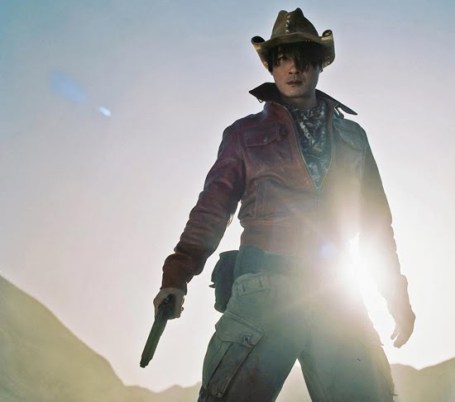
There's a new sheriff in town, Francis Ng, Fierce West Wind, 2010
PS: Just because I can, here’s a nice picture of Francis Ng in his upcoming movie Fierce West Wind. He plays a bounty hunter in what looks like a classic Eastern Western. Cowboy Francis! Be still, my heart–
Why Can’t We Be Friends? Barry Jenkin’s Medicine For Melancholy
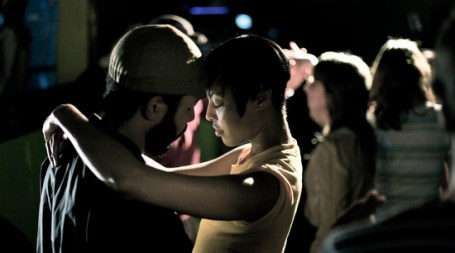
Wyatt Cenac and Tracy Heggens get friendly, Medicine for Melancholy, Barry Jenkins, 2008
I recently caught Barry Jenkin’s debut indie feature, Medicine for Melancholy (2008), and although it’s been a few weeks, this modest little movie has stuck with me. Set in San Francisco, the film begins with a supremely uncomfortable opening sequence as two people wake up together in a bed and a house not their own, although they clearly know each other intimately–at least in the Biblical sense. Apparently the pair had a bit too much to drink at a party the night before and ended up getting busy without first learning each other’s names. They go out to a mostly silent breakfast together and share a taxi to their respective homes, but the female in question is obviously discomfited by their brief encounter and blows off her recent bed partner upon exiting the cab.
This tidy little fifteen minutes sets the tone for the rest of the movie, which is a deft romance that follows a day and a night in the life of these two unlikely partners. They tool around San Francisco, experience some more quality time, and ultimately come to an understanding of each other and their awkward relationship.

Jo & Micah contemplate Afrocentricity, Medicine for Melancholy, Barry Jenkins, 2008
What’s pretty interesting to me about the film is that Micah and Jo, the unlikely couple, are both African American. The movie presents an outstanding alternative to conventional representations of African American life, with no gangstas, mamas, buppies, or thugs. Interwoven with the film’s romantic escapades are some cogent points about African Americans in San Francisco, where the black population has dwindled steadily since the 1960s “urban renewal” (aka “Negro removal”) decimated the Fillmore. San Francisco’s population now has the lowest percentage of African Americans of any major American city.
Although the film frankly discusses racial identity, racism, interraciality and other hot cultural identity topics, it presents these issues in a breezy, lighthearted frame. Both Wyatt Cenac and Tracy Heggens, who play the two leads, are attractive and winsome actors and Jenkins coaxes engaging, low-key performances out of them. Cenac in particular spouts some pretty flagrant identity-politics dialog while managing to remain charming and appealing.
The film also makes excellent use of its San Francisco locations, shooting mainly at night and avoiding the usual touristy exteriors, and the city sparkles like a jewel in the fog. Although they seem almost too groovy and hip to be true (Micah designs aquariums for a living; Jo is an art rep), it’s fun to see them wander from nightclubs (The KnockOut!) to taco trucks to MOAD to Rainbow Grocery on their fixies, smoking pot and sporting Timbuktu bike messenger bags. It seemed very fitting to be watching the film at Craig Baldwin’s Other Cinema, which is housed at Artists Television Access, the longstanding gallery and screening venue in the heart of boholandia in the Mission District. I half-expected Micah and Jo to show up on their bikes and hang out smoking hand-rolled cigarettes with the rest of the audience after the show.
Although some of the plot points are a glossed over or outlandish (why is Jo so quick to step out on her absent boyfriend?) the movie as a whole fulfills its modest expectations. Jenkins stated in the Q&A that, after suffering a failed romance, he wanted to capture the sense of being lonely, African American and male in San Francisco, and the film succeeds in doing so.
The film manages to look at some tough issues of race and culture without becoming didactic, dull, or overwrought. In that way it’s similar to another low-budget indie African American debut film, one that was released more than twenty years before Medicine For Melancholy. Like Spike Lee’s first feature, She’s Gotta Have It, this film uses the romantic lives of its quirky black characters to take on much bigger and broader concerns. Though not quite as brilliant and exhilarating as Spike’s freshman joint, Jenkins’ film does what it sets out to do in an energetic, refreshing way. Here’s hoping Jenkins can maintain his light touch in his future endeavors.

Interraciality, Tall Enough poster, Barry Jenkins, 2009
NOTE: At the same Other Cinema program, Jenkins also screened several of his other projects, including Tall Enough, an intriguing short financed by Bloomingdale’s department store (!) in New York City. The movie looked at an interracial romance between an African American female and an Asian American male. The part where the Chinese American guy speaks in Mandarin to his sleeping lover tilts toward yellow fever, and the film’s title is a little strange (what exactly is tall enough, anyways? are you saying Asian men are, y’know, short somewhere?), but the portrayal is a step towards eradicating Asian male emasculation in media. It’s nice to see an Asian American man as an romantic figure and an object of desire, especially when that idiotic dickwad media ho Jon Gosselin is threatening to set back Asian American male representation 100 years.
For an good discussion by Prometheus Brown, go here.
Medicine For Melancholy is now available on DVD from amazon.com.
Constant Sorrow: Tracing Shadow film review
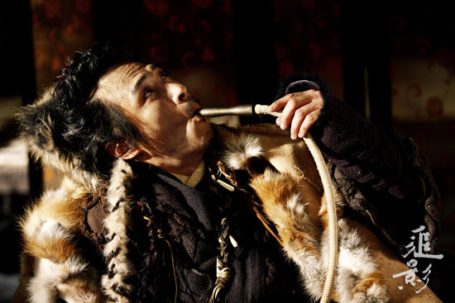
Francis Ng contemplates filmmaking, Tracing Shadow, 2009
Dear Francis,
Just wanted to let you know that I saw your new movie, Tracing Shadow, and I’m sorry to say that I didn’t really like it very much. Although it had some killer martial arts sequences, the art direction was divine, and you yourself looked quite lovely in your braided hair extensions and little mustache, the movie as a whole really stank. Unfortunately, since you’re the director as well as the star of the film, there’s no one else to blame for the slipshod pacing, unimaginative blocking and framing, egregious mugging and overacting (Xie Na being the absolute worst offender on that account), and aggravating, abrupt shifts in tone and mood throughout the movie. You yourself put in a less-than-thrilling performance, which I didn’t think you were capable of doing. And both you and your love interest, Pace Wu, have really nice cheekbones, but there isn’t a whole lot of chemistry between the two of you otherwise.

Pace Wu and bone structure, Tracing Shadow, 2009
Ever since it was announced several months ago I’ve been looking forward to this film, since you’re my favorite actor and your last wuxia movie, The White Dragon, is a great little flick. But somewhere along the way something went terribly wrong. It’s a shame, since the movie has the bones of a much better film. The storyline is classically drawn, with martial-arts masters converging on a village in search of a lost treasure map. But the film’s execution is so off-kilter and confused that it feels bad regional theater. At times it seemed like two or three different pictures competing for screen time—the slapstick comedy, the martial-arts action film, the dramatic mystery—with none given enough time or attention to cohere successfully. I felt myself wishing that you’d stuck to a straight-ahead dramatic treatment of the material, ala the film’s supposed inspiration, King Hu’s classic Dragon Inn, instead of using the story for laughs.
Your past directorial efforts, although flawed, showed flashes of brilliance and promise. But all three of your other movies were small-scale affairs rather than big-budget extravaganzas like Tracing Shadow. 9413 was an intense crime drama that showed a feel for mood and intensity as well as some cinematic chops. What Is A Good Teacher brought out some good, quirky moments from its youthful cast. Dancing Lion had some great improvisational set pieces. But all of those also had top-drawer actors, yourself included, to move things along, whereas the cast of Tracing Shadow–a TV show hostess, a model, and the son of a famous man–is, to put it delicately, pretty weak.

Xie Na and Jaycee Chan mug for the camera, Tracing Shadow, 2009
I’m truly sorry that the film turned out so badly. I really wanted you to achieve your dream of directing a successful movie. I don’t know exactly why things went so wrong–I’m not sure if it was the strain of holding together a big-budget costume picture, the complexity of mixing so many genres, or the pressure of living up to the hype of a high-profile project. I wonder if there was pressure from your financial backers (Huayi Brothers) to make the film as accessible, i.e., lowbrow, as possible, too, or if that decision was yours. At any rate, I hope that you get another chance to direct a film and that you’re more successful next time. This time I’m afraid you lost your way.
Sincerely,
your biggest fan
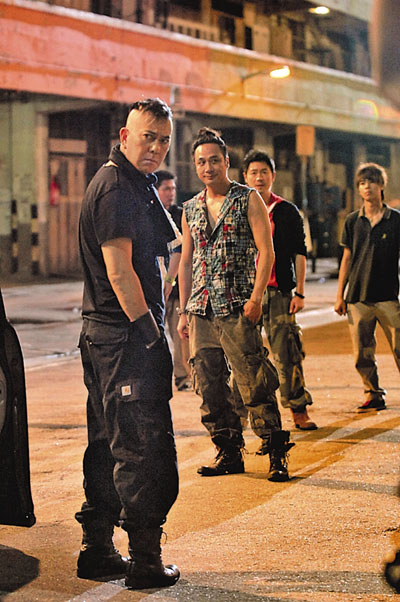
Anthony Wong with Francis Ng in happier times, Laughing Gor: Turning Point, 2009
PS: Congratulations on Laughing Gor: Turning Point—I’ve heard that it’s really good and that it’s doing great box office, too, which hopefully takes some of the sting out of Tracing Shadow’s disappointing ticket sales.
UPDATE: Go here for a much nicer, more positive review of the movie.
Working Day & Night: Run-up to The Oak Park Story WIP screenings
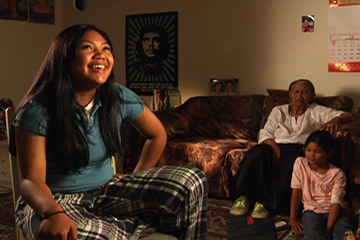
Veasina Thang & Khlot Ry break it down, The Oak Park Story, 2009
I’ve been on a little blogging hiatus for a few weeks because I’ve been furiously working on my latest movie, a documentary called The Oak Park Story. Filmmaking is my primary creative outlet, and in the past I’ve produced a bunch of experimental videos and short documentaries, although I’ve been less prolific since having kids. I’ve managed to put together a few micro-shorts since entering parenthood, but this new flick is the longest and most involved project I’ve worked on in many a year. The film just had two work-in-progress screenings almost back-to-back, so I’ve been cranking on the Final Cut Pro full time for more than a month.
I was lucky enough to get a residency this year from the San Francisco Film Society’s Filmhouse program, which provides free office space for selected film projects. They gave me a nice sunny little room down on the Embarcadero near Pier 39 where I’ve parked my iMac, my scanner, and my collection of hard drives for the past five months or so. It’s great to have a room of my own, away from my messy house, with a free parking space and ready access via streetcar to the Ferry Plaza building. I’m afraid I’ve spent way too much money on Taylor’s Automatic Refresher’s divine hamburgers and sweet potato fries, Out The Door’s excellent wonton noodle soup, and Blue Bottle’s outstanding drip coffee. But I’ve also managed to be pretty productive as far as my movie is concerned and I was able to knock out a reasonable facsimile of a film in time for both screenings.

Khlot Ry, Oak Park tenant, The Oak Park Story, 2009
The documentary is all about an amazing coalition of tenant-activists at the Oak Park Apartments in Oakland’s San Antonio district who rose up against their exploitative landlord. Undocumented immigrants from Mexico, refugees from Cambodia, and faith-based activists who lived at Oak Park for more than a decade all came together to fight back against the negligent landlord and the crummy living conditions he foisted on them. After a three-year battle the tenants won a landmark settlement of nearly a million bucks. My collaborator, Russell Jeung, was one of the live-in activists at Oak Park and was in residence there for ten years. He and I interviewed nearly twenty people, and collected hours of archival footage and reams of documents, photographs and other ephemera from Oak Park and since April we’ve been stitching it all together in the editing studio.
In the two or three weeks leading up to the screenings I was in the studio non-stop from morning to night. I made myself stand up and do triangle pose every so often to battle the muscular damage I was causing by endlessly sitting hunched over my computer screen. I blew out the speakers in my 20-year-old Sony NTSC monitor, no doubt hastening its demise by running it continuously for too many hours on end. Sometime around the end of last week, just before the second of our W-I-P screenings, my neck got a permanent crick in it and I had to take Advil to get to sleep at night. My massage therapist told me that I’d twisted my vertebrae out of alignment from cranking my head in one direction too long (note: she fixed it).
But the movie is shaping up pretty well, and the feedback from both of the screenings was invaluable. After working on the film for so long and so intensively I had very little perspective left, so hearing responses from an impartial audience was great. I got rid of some of the confusing parts, added some more backstory, and otherwise was able to tighten up the movie considerably after hearing what people had to say at the screenings.

Camilo Landau & Carne Cruda sing it
I also got a big boost from Camilo Landau’s awesome advice and help with the soundtrack. Camilo is a former student of mine (when he was in high school!) who’s now a grown-up and a professional musician and producer. He’s based in Oakland and, along with his uncle Greg Landau, runs Round Whirled Records, which puts out music by a bunch of great local bands including Fuga, Quetzal, Omar Sosa, and Carne Cruda, Camilo’s own combo. Camilo’s been a brilliant resource and I was able to use lots of the music he sent my way on the film’s soundtrack.
We’re in the home stretch with the film, and we have a couple of grant applications out there that will cover some of our postproduction, if we get them (which is always iffy, considering the perennially tough competition for indie movie funding). So we’re also soliciting our social networks and asking family, friends, associates and anyone who wants to support a good cause to contribute to the completion of the movie. We’ve even got fiscal sponsorship, so any donation is tax-deductible. So if anyone wants to help out a worthy project, please think about giving us some support. We’ve got some nifty premiums (t-shirts, dvds, tickets to the premiere) just like public television, though no coffee mugs or tote bags.
Okay, shameless pitch and self-promotion over. Back to regularly scheduled programming soonest.
For donations, here’s the link to the paypal information. You can also send a check—in either case be sure to note that the money is for The Oak Park Story.
UPDATE: Here’s a brief clip from the film:
One Time, One Night: Fangirl Extra and Shah Rukh Khan, My Name Is Khan
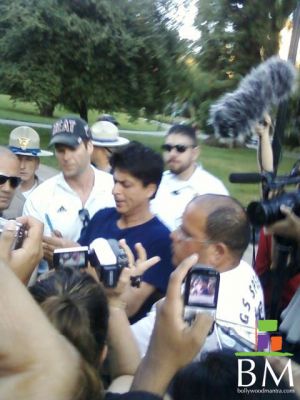
Shah Rukh Khan and friends, My Name Is Khan location, San Francisco, 2009
I’ve known for a while that Shah Rukh Khan’s newest movie, My Name Is Khan (MNIK), would be filming in California this summer and I was amused to think that the King of Bollywood, as well as his equally fabulous co-star, Kajol, would possibly be within a few hundred miles of me sometime this month.
When the movie shoot finally arrived here I realized that, according to various Bollywood fansites, MNIK was not only filming in California but in San Francisco, within miles of my house. Like the good otaku that I am, I tried to track down the production in hopes of possibly seeing SRK up close and in person.
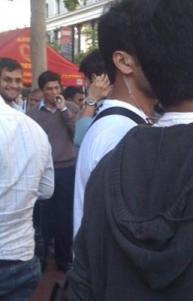
Shah Rukh Khan smoking, Market Street, My Name Is Khan location, San Francisco, 2009
At first I tried to trace SRK’s whereabouts via twitter, but the news was always a little too late—I found out he was at the Palace of Fine Arts a day after the shoot there; he was at Dolores Park on a Friday but I read about it the following Sunday; the movie crew was in the South Bay for a couple days but it was impossible and insane for me to drive two hours in the hopes of crashing a closed set to catch a glimpse of him. Then by chance I ran into an Indian couple at my excellent local video store, Four-Star Video, and chatted with them in front of the store’s newly inaugurated Bollywood section (full disclosure: I helped Ken Shelf, the store’s awesome proprietor, pick out several of the movies therein and wrote the blurbs for him, too). The Indian couple mentioned that they’d just been extras on MNIK and that the production was probably still seeking people for the last couple days of filming. So I raced home and looked up the information about becoming an extra, emailed the casting agency, and within a couple hours had received a call back to work on the very last day of the shoot.
It sounded great at first, but then I found out that the location was in Healdsburg, which is about 1.5 hours north of where I live, and the call time was 6 pm, with shooting to possibly go up to 4 am. Would I be able to keep my eyes open? (I hadn’t pulled an all-nighter in many a year, especially without extreme chemical assistance). Would my kids freak out if I was gone that long? Where the hell would I sleep once the shoot was over?
In a panic I posted on facebook—what to do? As expected nearly everyone who responded urged me to do it, but I was still undecidedly fretting about it the next day. Finally I figured out the logistics (take a nap earlier that day, don’t let the kids know I’d be gone all night, sleep at a friend’s place), but when I called the casting agency back, they’d already filled their quota for extras! Ah, the irony! but they put me on the backup list in case there was a cancellation. I sulked for a few hours, then the casting folks called back and told me I was in.
So at 6 pm the next day, after fighting holiday rush hour traffic up Highway 101, I signed in at the location with 300 other extras and settled down with a book (The Golden Compass) and my iPhone (to live-tweet the whole event) and waited the extra wait. As anyone knows who’s worked as talent on a movie, there’s a whole lot of sitting around interspersed by brief bursts of shooting activity, then more sitting around, repeated ad infinitum. True to form, the extras weren’t bussed to the set until three hours after we’d arrived—by then filming had started and things were jumping.
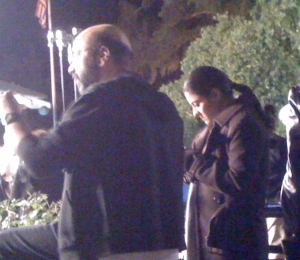
Kajol texting, My Name Is Khan location, Healdsburg, 2009
Myself and a few other eagle-eyed fans quickly spotted Kajol, MNIK’s beautiful, violet-eyed lead actress, near the edge of the shoot as she hung out shooting the breeze with the natty, baby-faced Karan Johar, the film’s director. I was disappointed to see that Kajol had tweezed her famous unibrow but she looked great nonetheless. Since this was one of the last days of filming there was much back-slapping and souvenir picture-taking amongst the cast and crew. I managed to fire off a couple of surreptitious, fuzzy pictures on my iPhone and post them on twitter before one of Kajol’s handlers asked me to stop.
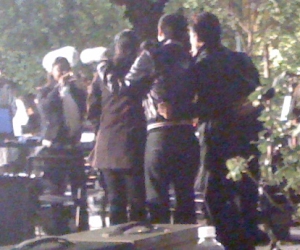
Back of Kajol, Karan Johar & friend, My Name Is Khan location, Healdsburg, 2009
More waiting around, then we extras, or “background,” in Bollywood parlance, were pressed into action. I was envious of the fancy lighting rig, including a huge, helium-filled china-ball lantern that floated many feet above the crowd, and two twenty-by-thirty foot scrims to diffuse the giant lights that lit the scene. This was a top-notch, high-end production, with a crew of about 200, and as complex and professionally run as any Hollywood set I’ve been on (which, admittedly, have been very few).
After a while filming without any of the principle actors, I was standing near the edge of the set when a ripple went through the crowd. And there he was, cigarette in hand, strolling up the path with an entourage of about 15 people, five feet from where I stood. He was wearing a white caftan and looked quite kingly, in a casual sort of way. Needless to say I was overcome by fangirl recklessness and, with a tiny shriek, called out, “Shah Rukh!” SRK waved lazily in our general direction and continued on his way. As he passed by us another, much louder series of screams and calls came from the other side of the plaza where we were shooting and I realized that a good-sized crowd had formed at the perimeter of the location, held back by several wary-looking security guards and a ring of caution tape. Apparently every Indian in Sonoma County had gotten wind of the filming and had trekked to Healdsburg in hopes of spying Shah Rukh Khan, and now that the man himself had arrived they were very vocal in expressing their delight.
The crowd, seemingly consisting of entire families, stayed on until well past midnight. At one point SRK waved directly at the eager onlookers and they shrieked in admiration, but whenever the AD called “Silence!” (Bollywood-speak for “quiet on the set”), they quickly fell into rapt quiescence. Amongst the extras, however, the majority were unfamiliar with SRK—a few people asked me who he was and which of his films they should watch (all of them!). There were some clued-in folks, though, including one (non-Indian) couple who had driven down from Washington State to be near their idol, and many others who kept up a constant low chatter in Hindi and boldly snapped photos of King Khan and Kajol despite the ADs stern admonitions not to do so.

Back of Shah Rukh Khan's head, very far away, My Name Is Khan location, Healdsburg, 2009
At one point SRK stood about ten feet from me in the crowd, but I was too cowed by the constantly prowling ADs to try to take a picture, for fear of being thrown off the set. But I did live-tweet most of the night and early on, before I lost my nerve, I shot and posted some blurry photos. This was quite fun and helped me to stave off boredom, especially when several people began following and tweeting back for more information.
In person SRK looked exactly like he does onscreen, though perhaps a bit more slender and compact. He’s also very focused when he’s performing, though between takes he was pretty chill, taking lots of ciggie breaks and chatting with assorted paparazzi. Likewise, Kajol didn’t have any diva moments and hung out on set most of the time with the rest of us peons instead of hiding in her trailer. Altogether it was a pretty tightly run ship, without any star-drama or untoward extra-abuse. We were allowed to watch the filming, sit down, or wander about between takes, we got decently fed at the appropriate hour, and no one on the crew yelled at us just to vent their emotions.

Blurry but close Shah Rukh Khan, My Name Is Khan location, Healdsburg, 2009
When we finally wrapped at about 2.30 am, the extras were instructed to head toward the bus that would take us back to our staging area a few blocks away. But about fifty people bolted in the opposite direction, swarming after the departing Shah Rukh Khan as he left the set. Security tried in vain to divert us but the extras, many of whom were South Asian, weren’t about to miss their chance after standing in the cold for six-and-a-half hours. Luckily SRK was really cool and allowed several people to take pictures with him, as well as signing many autographs. I got a couple of blurry but reasonable photos of him, though I was hampered by the lack of a zoom lens or a flash on my iPhone. And so my fangirl night was complete—
UPDATE: Ironically, Shah Rukh Khan was just detained by while trying to enter the U.S. at the Newark (New Jersey) airport for almost two hours for unclear reasons. Speculation is that his last name (which is common among Muslim Indians) set off alarm bells at the airport.
According to the New York Daily News, after the incident SRK texted to reporters, “I was really being hassled, perhaps because of my name being Khan. These guys wouldn’t let me through.”
I can just imagine the exchange in the Customs interrogation room:
SRK: I’m the biggest movie star in India!”
Customs: Mmmmhmmm.
SRK: I’m here as to lead a parade celebrating Indian independence!
Customs: Sure you are.
SRK: A billion people recognize me by sight!
Customs: But we don’t. So tell us the real reason you’re coming to America, MISTER Khan.
Although his travel papers were in order, at first Shah Rukh Khan wasn’t permitted to use his cell phone and, despite being recognized by several fellow travelers, he was only released after he was allowed to call the Indian embassy and an official vouched for him.
There’s a huge discussion on twitter about it and some wags speculate that it’s all a publicity stunt to promote MNIK. Whatever the truth may be, you can be sure that the shrewd and canny SRK will be milking for all it’s worth.
Thanks to dleedlee and Sunny for tipping me to this while I’m on vacation, otherwise I might have missed it.
Violence Grows: Kinatay and the Abduction of Melissa Roxas

Kinatay, still from movie, 2009, Brillante Mendoza
When I first read the description of Pilipino director Brillante Mendoza’s new film Kinatay (Butchered) I thought, “That sounds kind of wack.” Shot on HD video with a budget of $100,000, it’s a down-and-dirty, graphic representation of the rape, murder and dismemberment of a prostitute in the Philippines through the eyes of an idealistic, greenhorn cop. The controversial film just won the Best Director award at the 2009 Cannes Film Festival, where the announcement of the award was greeted by boos and gasps of shock. Roger Ebert calls it “the worst film in the history of the Cannes Film Festival,” and extensively details his disdain for the picture in his blog.
But after I read a few interviews with Mendoza about the film, I started to change my opinion of it (though still sight-unseen; the film will probably receive pretty limited distribution in the U.S., if at all). Mendoza claims that the movie is based on a true-life event and that it reflects the rampant police corruption and unchecked military violence in the Philippines. “This is not just entertainment, these kinds of stories are real,” Mendoza said after winning his award at Cannes.

Surface Melissa Roxas, online poster, 2009
This was borne out by an email blast I received on the same day that Kinatay won at Cannes. On May 19 Pilipino American Melissa Roxas, a poet and human rights activist from BAYAN-USA, a non-government organization (NGO), was kidnapped along with two co-workers while doing volunteer health work in the Tarlac Province in the Philippines. The email I received stated that BAYAN-USA was mounting a campaign to demand the Pilipino government aid in searching for and surfacing her. Thankfully, Roxas surfaced after a week of captivity, although her compatriots are still missing. What’s interesting in light of the accolades that Kinatay received is that Roxas and BAYAN-USA have claimed that she was abducted and tortured by the Pilipino police and military and that this event is the latest in a series of abuses against political activists by government agencies in the Philippines. The New York Times notes:
“According to the human rights group Karapatan, more than 200 Filipino activists have been kidnapped and never heard from since 2001, the year President Gloria Macapagal Arroyo came to power. Others have turned up dead or showing signs of torture.”
If the claims by Roxas, Karapatan, and BAYAN-USA are true, then Mendoza’s film takes on an added significance. Most of the film’s detractors criticized it for its graphic, unvarnished depiction of violence and brutality, with Ebert in particular scorning its rough-hewn soundtrack and cinematography. What Ebert might not understand is that Mendoza is making a conscious decision not to sanitize the film’s violent events. Movie violence is nothing new, but it’s usually presented with a patina of glamour and unreality, an aestheticization that distances the viewer and sanctions the viewing of the violence, making it an acceptable form of entertainment.
By denying his film the glossy sheen of conventional filmic violence, Mendoza forces viewers out of their complacent moviewatching habits, taking them out of their comfort zone and making them realize that, as in the case of Melissa Roxas and many others around the globe, violence is not a form of entertainment but a dire part of everyday life. In this case, Mendoza is working toward the same goal as Roxas—to expose and eradicate the corruption and human-rights abuses of the power structure in the Philippines.
UPDATE: Here’s the transcript of Melissa Roxas’ June 28 press conference in which she describes her ordeal.
Geek Love: Star Trek and Hybridity Revisited
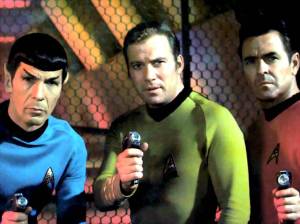
OGs, Star Trek, 1968
Here’s the kind of Star Trek geek that I am—I went to Star Trek conventions back at the dawn of time before the movies were made. In the lean years between the cancellation of the original series (TOS) in 1969 and the release of Star Trek: The Motion Picture in 1979, only the most hardcore dorks attended Star Trek conventions and I was right there with them. I was in junior high back then and had discovered TOS in syndication, on some UHF channel in San Francisco. In typical obsessive fashion I watched every episode religiously, so when the annual Star Trek conventions came to the Bay Area I was totally there.

Star Trek convention habitues
At that time the conventions were shaggy, grassroots affairs, with socially inept misanthropes attending in their homespun costumes clutching hand-rigged tricorders. The TV show’s stars were also pretty desperate then, since they’d been typecast in the original series and couldn’t get work once it went off the air. The show was probably the biggest sci-fi cult item at the time, though that still only put it a few notches above Dark Shadows, but its glory days as a billion-dollar franchise were yet to come. So I was able to witness William Shatner recite “Rocket Man” in person at the Oakland Convention Center and I also got Walter Koenig’s autograph (I think I asked him what sign he was).
When Paramount revived the franchise in 1979 and the movies and the new TV series started to take off again, I dutifully followed along, but as the sequels and spinoffs multiplied, my interest gradually waned. It’s not that I didn’t like and enjoy some of the new shows and characters but there were eventually so many of them that I couldn’t properly keep track. Plus by the time Star Trek 6 rolled around in 1991, the original cast was getting mighty long in the tooth and it felt a bit unseemly for them to be running around all over creation in their unsightly hairweaves.
So the new Star Trek reboot is a rare treat for this geekster, as it features actors who are actually young and vigorous enough to be convincingly roaming all over the galaxy in high-powered starships. I saw the movie in its opening weekend and was pleased with its faithful yet innovative reworking of the original series’ mythology.
I was also keenly interested in seeing how John Cho fared as Lt. Sulu, since as previously noted in earlier posts, good roles for Asian American males are few and far between in Hollywoodland. Cho as Sulu acquitted himself just fine, but surprisingly enough, it was the new young Spock that really grabbed my attention.
Spock’s always been coded as “other” in Star Trek lore—Leonard “Bones” McCoy shamelessly let fly with many a culturalist epithet such as, “You green-blooded (mumble mumble),” or “you pointy-eared . . . .” In TOS, Spock’s mixed heritage provided plenty of dramatic tension as he played out a toned-down version of the tragic mulatto trope.
The new old Spock, Star Trek, 2009
In the current film, Spock seems to have been given a new dimension, as a sexy young thing who snags the hottest woman on the starship (no spoilers here but it’s a mighty fine, unexpected and yet completely feasible pairing). The filmmakers seem to realize that Spock’s constant need to suppress his hereditary Vulcan rage as well as his human emotions makes the character into a smoldering mass of brooding antihero. Compared to this angsty creature, Kirk’s breezy rebel seems juvenile and shallow.
I’m hoping Spock’s latest incarnation in the new Trek alternaverse further develops the character’s intriguing cultural possibilities. Instead of a conflicted half-breed, maybe Spock can become a new and improved representative of the joys of hybrid vigor, embracing and celebrating his dual heritage rather than constantly lamenting it. It would be so 21st-century to go beyond the last couple hundred years of beating ourselves up over race-mixing, miscegenation and other supposedly unnatural acts. I for one am wholeheartedly rooting for it.
Thanks to Barbara Jane Reyes and Wei Ming Dariotis for helping me to incubate the ideas herein.
Kinda Like A Big Deal: The Beast Stalker, Full Alert and Greatness in Hong Kong Movies

Nick Cheung and wonky eye, The Beast Stalker, 2008
Just saw The Beast Stalker (Dante Lam, 2008) at the San Francisco International Film Festival and, although it held up pretty well and wasn’t an embarrassment, it wasn’t quite all that. Introduced by the Film Festival as “perhaps the best Hong Kong action film since Johnnie To’s Election,” this gritty thriller demonstrates that the former Crown Colony can still crank out hard-ass crime dramas. But the field has been mighty thin in Hong Kong of late and in other, more fruitful years, The Beast Stalker might’ve been just one of the crowd.
Former teen heartthrob Nicolas Tse plays a tough cop (!) haunted by the death of a child hostage he accidentally kills in a chaotic shootout/car crash involving malevolent gangsters, innocent bystanders and much shattered glass. Nick Cheung plays a kidnapper-for-hire in charge of snatching the dead girl’s twin sister whose lawyer mother is involved in prosecuting the crime. Their meshing stories play out in a dizzying spiral of guilt, honor, fate and obligation.
The Beast Stalker has several full-on child-in-extreme-danger moments and the cast realistically sports facial scars and other mementos of mortal peril, but somehow the film falls short of greatness. Nic Tse, further distancing himself from his youthful idol years, shrieks angrily at his subordinates, but he still can’t nail the crying scenes. Likewise, Nick Cheung, who won Best Actor statues from both the Hong Kong Film Critics’ Association and the Hong Kong Film Awards for this role, glowers menacingly but doesn’t quite bring the extra layer of pathos and complexity that might have deepened his portrayal. As my pal Laura, aka redbean, aka longtime Hong Kong movie fanatic, noted, “Anthony Wong would’ve eaten this role alive.” Unfortunately Anthony wasn’t cast and in this case Nick Cheung only makes a so-so substitute.
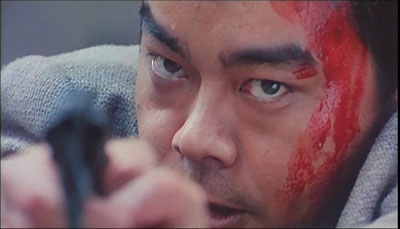
Lau Ching-Wan shoots straight, Full Alert, 1997
I recently purchased a copy of Ringo Lam’s brilliant crime thriller Full Alert (1997), which bears some similarities to The Beast Stalker in its depiction of the complex relationship between a cop and a criminal. But Full Alert has the inestimable actors Lau Ching-Wan and Francis Ng in the lead roles and their sublime skills breathe life into their stock characters and make the film’s cat-and-mouse story vibrant and believable. Francis brilliantly creates a strangely sympathetic yet reprehensible character and Lau Ching-Wan’s finely tuned fits of anger and frustration show a cop dangerously on the edge of sanity. The final confrontation between these two driven characters beautifully brings their fraught relationship to a stunning conclusion. On the other hand, The Beast Stalker’s antagonistic pair never fully reach the heights suggested by their intertwined destinies and their anticipated showdown is merely a tease.

Nick & Nic mix it up, The Beast Stalker, 2008
Full Alert and The Beast Stalker both have magnificent car chases as their centerpieces, the work of car-choreography specialist Bruce Law. The action direction in The Beast Stalker, however, unfortunately succumbs to the closeups and nausea-inducing jerky camerawork now in fashion, whereas Ringo Lam understood the need for distance and framing in an action sequence. Attesting to its greatness, Full Alert more than stands the test of repeated viewings, even more than a decade after its release. The Beast Stalker is a exciting, smartly-made movie but if, as several critics have suggested, this is one of the best of recent Hong Kong films, then the bar has been seriously lowered.
Dante Lam will soon have another chance to make a great Hong Kong movie. His next project, Most Wanted Terrorist, has just announced its cast, which includes the dream team of Lau Ching-Wan, Anthony Wong and Francis Ng, along with Nick Cheung. Hopefully Nick Cheung can keep pace with his illustrious co-stars, as they’re widely held to be among the best actors of their generation. He did just fine opposite Anthony and Francis in Exiled, and even in The Beast Stalker he showed glimmers of potential. but if he’s not careful the rest of the cast is going to blow him out of the water.
Interestingly, Dante Lam has indicated that he will forgo any Mainland Chinese financing for Most Wanted Terrorist in order to preserve a Hong Kong sensibility in the film. Several recent HK/China co-productions, including Sammi Cheng’s recent Lady Cop and Papa Crook, have suffered from the restrictions of Mainland film censors, so Lam’s decision to avoid PRC money is an interesting one. With Hong Kong film financing languishing due to the economic recession it’s a bold and risky move, but Lam is determined to retain his artistic freedom without having to answer to the Mainland government.
Let’s hope Most Wanted Terrorist gives everyone involved the chance to strut their stuff to their fullest capabilities. With its killer cast and seasoned director, if all goes well, we could once again see greatness in Hong Kong films next year.
The Beast Stalker opens Friday, May 15 at one of the last places in the Bay Area to see Hong Kong movies on the big screen, the 4-Star Theater, 23rd Avenue and Clement Street, San Francisco.
All For The Winner: 28th Hong Kong Film Awards

Crocodile tears? Xu Jiao wins Best New Performer for CJ7
Just a quick note about this year’s Hong Kong Film Awards, which took place this Saturday. Wilson Yip’s biopic Ip Man, about the martial arts legend, took Best Picture, with Ann Hui winning Best Director for The Way We Are, her docudrama about the New Territories town of Tin Shui Wai. The Way We Are, with its mostly non-professional cast, also won three other awards including Best Actress, Best Supporting Actress, and Best Screenplay. Nick Cheung (The Beast Stalker) nabbed his first Best Actor statue, adding it to his award from the Hong Kong Film Critics’ Society. Cute little girl Xu Jiao won Best New Performer for her crossdressing turn as Stephen Chow Sing-Chi’s son in Chow’s sci-fi blockbuster CJ7. Unfortunately, according to the Golden Rock’s liveblog she gave a horribly fake acceptance speech that included fake crying. I guess child stars are the same all over the world.

Carina Lau & Tony Leung burn up the red carpet, HKFA 2009
Interestingly, in a repeat of the Golden Horse Awards last year, John Woo’s lavish epic Red Cliff was shut out of the major acting and directing awards (including Tony Leung Chi-Wai’s failure to win his sixth Best Actor award). Red Cliff did clean up in several creative categories such as Best Art Direction and Best Visual Effects, winning five awards. Apparently this year’s nominations were only for Red Cliff 1—Red Cliff 2 will be eligible again next year so maybe then it will make out a little better in the major awards. Ironically, Red Cliff is probably the only film among the award winners that will receive international distribution.

Simon Yam in brown satin, Hong Kong Film Awards, 2009
Poor Simon Yam, nominated for Best Actor for Johnnie To’s Sparrow, went home empty-handed again. But he got to wear a natty two-toned sharkskin suit, white spats, and a spider-motif tie, and looked way too dashing for a man in his fifties. Sadly, Sparrow also lost (to Red Cliff) for Best Film Score, which just goes to show that not everyone appreciated its awesome Martin Denny/Michel Legrand/Henry Mancini homage.
For a full listing of the awards go here.
For lots more pix of celebrity finery go here.
For a great liveblog of the event go here.
And here’s the trailer for Sparrow, for a sample of its excellent soundtrack:
Get It While It’s Hot: The 2009 San Francisco International Asian American Film Festival

Hee Yeon Kim and Song Hee, Treeless Mountain, 2009
The 2009 version of the San Francisco International Asian American Film Festival starts next week (March 12) and runs until March 22 in San Francisco, Berkeley, and San Jose. Herein follows some of the movies I previewed from the festival, which is in its 27th year and will include 108 films in its ten-day run. The SFIAAFF is the biggest and one of the oldest of its type and kicks off the season for Asian American festivals around the country. Even if you don’t see something you like described below there are plenty of other treats to be had—go to the SFIAAFF website for more details. And buy your tickets early—shows sell out fast and some of these movies will never have another theatrical screening in the Bay Area again.

Ha Jung-Woo and Jeon Do-Yeon duke it out, My Dear Enemy, 200
My Dear Enemy, Lee Yoon-Ki
Powered by a charming, engaging performance by the talented Ha Jung-Woo, who may be becoming one of my favorite actors, this romantic drama follows two former lovers as they travel the streets of Seoul trying to settle a debt. Ha plays a ne’er-do-well ladies man and unemployed gambler whose fed-up ex-girlfriend (Jeon Do-Yeon, recent Best Actress winner at the 2007 Cannes Film Festival) finds him at the racetrack and demands repayment of a loan she’d made him before their breakup. The film skips lightly from one situation to the next, along the way commenting on life, relationships, intimacy, and dreams. One memorable scene features a newlywed couple whose husband is obsessed with his wife’s past lovers; another takes place at a barbeque party with a Korean motorcycle club. Throughout the film Ha and Jeon maintain a wary relationship with each other, trying to resist falling into old patterns while keeping from strangling each other.

Kim Yoon-Suk has a rough night, The Chaser, 2008The Chaser, Na Hong-Jin
A Korean movie of a completely different sort than My Dear Enemy, The Chaser also starts the versatile and charismatic Ha Jung-Woo, this time as a psychotic serial killer on the loose in Seoul. Brutally violent, with a touch of horror film layered on its crime-drama scenario, the film is a cat-and-mouse game between Ha’s nasty murderer and Kim Yoon-Suk’s world-weary pimp. The film features some gorgeous night-photography and good performances from its two lead actors but with a bit too much fetishized violence even for me, as well as too much psychosexual posturing, The Chaser doesn’t manage to transcend its genre into greatness.
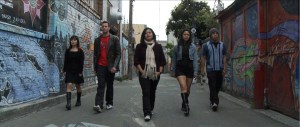
Balmy Alley, Fruit Fly, 2009
Fruit Fly, HP Mendoza
Mendoza’s follow-up to the divine Colma: The Musical, and his directorial debut, Fruit Fly follows the story of Bethesda, a nice Filipina performance artist from Maryland (duh) who’s looking for her biological parents. Set amongst San Francisco’s queer boho crowd, the film lacks Colma’s poignancy and sympathetic characters, as well as Colma director Richard Wong’s cinematic flair. Fruit Fly makes good use of its San Francisco setting, including scenes in Balmy Alley, Dolores Park and various other real-life, non-touristy locations, and it has a great title sequence and nice graphics throughout, but it doesn’t quite have the urgency of Colma’s coming-of-age story, with Bethesda’s search for her birth mother shunted to the side in favor of backstage antics involving a vain magician and a few too many musical numbers with the quirky patrons of a gay bar.
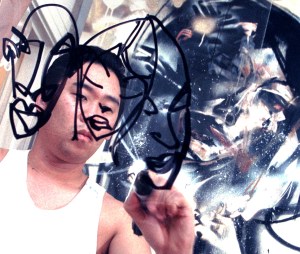
David Choe, insane, Dirty Hands, 2009
Dirty Hands: The Art and Crimes of David Choe, Harry Kim
A lively and comprehensive portrait of batshit-crazy bad-boy Korean American artist David Choe, Dirty Hands follows Choe from his beginnings as a grafitti artist and tagger in Los Angeles to his current status as a blue-chip gallery artist. Choe is an insane mo-fo, but in a productive, creative way, channeling his self-described kleptomaniac, sex-addict, bipolar, OCD personality into a highly successful career as an illustrator and painter. Choe energetically narrates his own story, describing his experiences as an illustrator for porn magazines, his stint in a Japanese jail (for punching a plain-clothes cop), his discovery of and subsequent disillusionment with God, and his various trips to the Congo and other non-industrialized parts of the world. The doc goes easy on its wacky subject, skimming over the misogyny and messed-up violence in Choe’s art in favor of portraying him as a happy lunatic, but it’s a compelling portrait nonetheless. We also meet his long-suffering girlfriend, his family, and his friends, all of whom think Choe is the best thing since sliced bread. The focus is a bit too Giant Robot-hipster-Asiaphile-friendly to be a truly great film but it does a good job of capturing Choe’s insane outlook on life. As he succinctly notes, “If I’m normal in real life it fucks up my art.”

Que paso? Nuevo Dragon City, 2008
The Secret Lives Of Urban Space
This program of short films includes a couple intriguing selections. Sergio de la Torre’s Nuevo Dragon City focuses on a group of Mexican Chinese teens who gradually barricade themselves in an appliance store. Shot without dialog with beautiful cinematography, their mysterious actions lead to serenity. No answers are given for their inexplicable acts but the imagery is lovely and the mood is profound.
Chris Chong’s Block B is a single static long shot of a high-rise housing project in Malaysia, moving from darkness to daylight and back through to night. The film’s bare-bones structure forces the viewer to focus on small mundanities during its twenty-minute running time—a woman drops a piece of laundry from a balcony and it flutters down the side of the building. Children run from one side of the frame to the other. Conversations in Malay emerge and retreat. At some point fireworks go off. Though some might find it incomprehesible, the film is beautiful and intriguing and truly challenges the way that we are accustomed to watching the moving image.

Two good kid actors, Children of Invention, 2008
Children of Invention, Tse Chun; Treeless Mountain, So Yong Kim
One of two “recession dramas” that I previewed, this engaging film looks at the tribulations of a Chinese American family in Boston falling through the cracks of the economic crisis. A single mom with two young kids gets caught up in “multi-level marketing,” a fancy name for a pyramid scheme that preys on immigrants and poor people. After mom gets thrown in jail as a material witness, the two kids are forced to fend for themselves. As the Top Ramen runs out and no adults are in sight, what will happen to our young protagonists? The movie has good, non-cloying performances by its two kid actors, following their fate in a realistic, unsentimental way.
A similar fate faces the two kids in the second recession drama, Treeless Mountain, So Yong Kim’s follow-up to her subtle and intriguing debut film In Between Days. Set in South Korea, the film follows two young sisters whose mother leaves them with an alcoholic auntie when she can no longer support them. Said auntie turns out to be an indifferent caretaker and the girls eventually end up catching, roasting and selling grasshoppers to local schoolkids to assuage their hunger and to make ends meet. Then things really start to go downhill. The movie is grim and beautiful, with an observational style that never veers into melodrama or histrionics, and its conclusion demonstrates the redemption of small kindnesses in the face of hardship.

The late, great Chris Iijima, A Song For Ourselves, 2009
A Song For Ourselves, Tad Nakamura
This short documentary centers on Chris Iijima, the seminal sansei musician who, along with Charlie Chin and Nobu Miyamoto, recorded A Grain of Sand, one of the most significant albums from the 1970s Asian American movement. Layered and emotional, the film looks at Iijima’s community activism, his music, and his later career as a lawyer and professor in Hawaii until his untimely death in 2005. Nakamura follows up on the promise of his earlier docs, Yellow Brotherhood and Pilgrimage, investigating the ties of family, friends, community, and creativity in a moving, resounding portrait of a singular personality.

Lam Yiu-Sing, future idol? High Noon, 2008
High Noon, Heiward Mak
24-year-old Heiward Mak brings it in her debut feature that follows a group of teenage Hong Kong schoolboys as they do drugs, chase girls, fight, eat and get into trouble. Shot on video, with frenetic computer graphics, the movie nicely captures the disposable lifestyle of post-millennial youth. The movie gets bonus points for featuring a sex scandal spread virally via cellphones (the internet is so five years ago). As the characters’ mischief escalates into more serious business, Mak’s strong visual sense and her sure direction of her peers makes the film a quintessential look at teenagers slamming up against their own mortality. Interestingly, Mak almost won the Hong Kong Film Critics Society’s 2008 Best Director award for this flick, nearly upsetting 30-year-veteran Ann Hui for the distinction. Side note: As I watched the movie I couldn’t help wondering which of the cute boys would be picked for this year’s idol status by the relentless Hong Kong media machine. Probably the dreamy one with the orange hair, though lead actor Lam Yiu-Sing has a quiet charm as well.

 beyondasiaphilia
Recent Comments