Posts tagged ‘asian american film’
Nothing Compares 2 U: 2015 CAAMfest

Traces, Dot 2 Dot, 2014
CAAMfest, everyone’s favorite San Francisco-based Asian American arts festival, starts up this week and as usual it’s stuffed with films from Asian and Asian American directors, musical happenings, and food events. The festival spotlights veteran documentary filmmaker Arthur Dong, including a premiere of his new feature-length documentary The Killing Fields of Dr. Haing S. Ngor, which is about the Cambodian doctor perhaps best known for his Oscar-winning turn in The Killing Fields in 1984 and whose mysterious murder tragically ended his life some years later. Former CAAMfest/San Francisco International Asian American Film Festival director Chi-Hui Yang curates a program of shorts, Playtime, that includes Trails, Cyrus Tabar’s hallucinogenic microportrait of Tokyo, as well as a revival of the rarity Snipers In The Trees (1985), an early experimental short by Curtis Choy (The Fall of the I-Hotel). Below are a few other highlights of the upcoming cinematic onslaught.
Dot 2 Dot
Amos Why’s debut feature is the real deal, an intriguing look at Hong Kong’s past and present that uses the city’s unique history and geography as a backdrop for a thoughtful commentary on the transience of culture, place, and identity. The film follows Chung, a Chinese Canadian expat returning to HK who leaves dot-to-dot puzzles inscribed on the walls of the stations of the MTR, Hong Kong’s ubiquitous subway system. A recent mainland China emigre (Meng Ting-yi) begins to decipher Chung’s cryptograms and the two begin a virtual courtship, linked by Chung’s mysterious symbology. Director Why captures a street-level view of contemporary Hong Kong that’s filled with ordinary people who represent the multifaceted denizens of the city in the 21st century. The movie includes lots of non-touristy Hong Kong locations and has a great feel for the everyday sights and rhythms of the city. Hong Kong movie fans can also spot Susan Shaw as a language-school headmistress, and Tze-chung Lam, aka the chubby guy from Stephen Chow’s Shaolin Soccer, as a teacher, as well as TVB star Moses Chan (hiding his celebrity good-looks behind black-framed eyeglasses) as Chung. Though it fondly recalls the Hong Kong of the past, the movie isn’t overly sentimental or nostalgic. It’s a nice look at what’s vanished in Hong Kong over the past few decades and the rapidly accelerating changes in the city.

Possessed, Hollow, 2014
Hollow
This US/Vietnam co-production is a slick and creepy horror movie by Ham Tran, the director of Journey From the Fall (2006), which looked at the experiences of Vietnamese immigrants in the US, as well as last year’s glam-slam How To Fight in Six-Inch Heels. Hollow is a quite a departure from Tran’s debut film and demonstrates both the uptick in genre films directed by Asian Americans in the past few years as well as the trend toward US/Asia co-productions. The story centers on Chi, whose younger half-sister Ai apparently drowns in a nearby river, causing Chi much guilt and anguish. But when Ai later turns up a few kilometers down the river seemingly alive and well, things take a turn for the supernatural as the young girl develops a greenish pallor, scratches at mysterious wounds, and otherwise exhibits signs of demonic possession. The movie does an good job blending Viet ghost stories with modern-day horror film tropes and for the most part keeps the source of the mysterious child-possession hidden until the end. I would like to have seen a bit more agency on the part of Chi’s character but the film draws interesting parallels between sex traffickers and malevolent spirits, trying together past and present evils in Viet society. The movie is nicely shot, although the soundtrack relies a bit too heavily on sudden loud and jarring violin sounds to emphasize the scary bits in the story, but there are some nice visceral touches—it’s always rewarding to see pimps and child abductors vomiting gallons of river water.

Water country, Nuoc 2030, 2014
Nuoc 2030
Nuoc 2030 is another US/Viet genre film coproduction, this one a science-fictional look at Vietnam in 2030, which is by then mostly flooded by global warming. The film’s title plays on the dual translation of “nuoc,” which means both “water” and “country” in Vietnamese. Despite a modest budget, director Nghiem-Minh Nguyen-Vo does an excellent job of world-building with his imaginative use of existing locations and evocative imagery to suggest a drowned world. The poetic narrative centers on Sao, a fisherman’s widow searching for clues to her husband’s murder in a watery Vietnam of the not-too-distant mid-21st century. For the most part the film delicately renders its futuristic storyline with imagination and vision, mixing in environmentalism, genetic engineering, and a fatalistic romance.
Flowing Stories
Jessey Tsang Tsui-Shan’s outstanding documentary looks Ho Chung village, a small settlement in Hong Kong’s New Territories, an area which is currently undergoing a construction boom due to its location near the Hong Kong/China border. Due to the harshness of farming in the region many NT residents immigrate to Europe to find work, including the two generations of the Lau Family featured in Tsang’s film. Tsuan shot much of the film during the village’s ten-year festival that occurs every decade, using that event as a means of examining the ongoing village diaspora and its effects on the residents. The Laus dispersed primarily to France and the UK and the film also includes footage of their lives overseas, with the resulting French/English-speaking children, intermarriages, and mixed-heritage offspring. Only the family’s world-weary matriarch remains in the village, where she bitterly reminisces about the poverty and hardship of farm life and her still-raging anger at her late husband, who emigrated to the UK decades before and who was only able to return a handful of times to visit his wife and children. The film is an excellent testament to the effects of globalization and the costs of modernization on ordinary people but it’s by no means downbeat or depressing, as it also celebrates the endurance of and connections to the villagers’ cultural roots as they return every decade to celebrate the festival.

I’m gonna live forever, My Voice, My Life, 2014
My Voice, My Life
Oscar-winner (and former San Franciscan) Ruby Lam’s latest film follows several at-risk Hong Kong high school students as they prepare for a large-scale musical production. This verite-style doc celebrates the struggles and accomplishments of those who have been left out of Hong Kong’s fast-lane, including students from a school for the blind, recent mainland China immigrants, and those whose academics keep them from top-ranked educations. Part Fame, part Frederick Wiseman’s High School, the movie subtly reveals a lot about the social strata of contemporary Hong Kong and its constantly changing cultural milieu.
March 12-22, 2015
San Francisco, Oakland, Berkeley
The Dark of the Matinee: CAAMfest 2014

Looking, A Picture of You, 2014
Everyone’s favorite local festival starts this week with a slew of film screenings, food parties, and musical events. The fest includes treats such as the world premiere of the legendary Rea Tajiri’s newest experimental doc, Lordville, as well as Golden Gate Girls, Louisa Wei’s feature length study of Chinese American film director Esther Eng, who worked in the Hong Kong film industry in the 1930s, and The Missing Picture, Rithy Panh’s Oscar-nominated personal doc that’s a harrowing look at the Khmer Rouge’s reign of terror, told with intricately designed miniature tableaux populated by rough-hewn clay dolls.
Though by no means exhaustive, herewith is a small selection of some of the festival’s other highlights.
Ilo Ilo
This family drama out of Singapore has been racking up a bunch of awards including the Camera d’Or at the Cannes Film Festival and Best Film at the Golden Horse awards. The plot concerns a middle-class Singaporean couple with a rambunctious 11-year-old son who hire a live-in Filipino housekeeper. Shot in Ann Hui-styled realism, the film shows the struggle of ordinary people caught in the global economic crisis. None of the characters in the film are exempt from the human cost of corporatization, as the OWF maid has a young son back in the Philippines and must moonlight as a hairdresser to make ends meet, while her Singaporean employers hold a series of oppressive, soul-crushing office jobs. Everyone is ground up by the relentless gears of global capitalism—will their humanity remain intact?
A Picture of You
JP Chan’s debut feature (he’s directed a bunch of short films) is a sharply drawn slice of life about a brother and sister, Kyle and Jen, who return to their late mom’s house in the Pennsylvania countryside to pack it up after her passing. Despite the potentially maudlin subject matter, director Chan infuses the film with levity—the tense and familiar bickering between the siblings rings pretty true as once in their mom’s house the two revert to old patterns of behavior. As they’re packing up they find out a bit more about their mom than they might want to know, which leads to more tension and bickering. Chan draws out amusing performances from his cast, lead by Andrew Pang as the sardonic brother and Jo Mei as the discombobulated sister. Also good are Lucas Dixon as Jen’s dorky white guy boyfriend, and Teyonah Parris from Mad Men who plays Jen’s BFF with endearing geekiness. The movie is a bit like a Wes Anderson film (without the twee and annoying stylistic tics) in the way that it delves into the quirkiness of interpersonal familial relationships without sentiment or melodrama.

Rote, Innocents, 2013
Innocents
In yet another Singaporean narrative, two lonely kids befriend each other at their strict middle school. Syafiqah’s absent parents have left her with her indifferent grandmother. Huat lives with his strict father and his mentally handicapped younger sister. The two become friends despite Syafiqah being the good girl and Huat the outcast who’s bullied by the other kids. The scenes where the two kids play joyfully in an aquaduct on the edge of the town contrast beautifully with the rigid, doctrinaire atmosphere of the schoolroom, where corporal punishment is routine and the students dutifully recite facts and numbers without analysis or critical thinking. Huat is imaginative and creative and so doomed to fail in this educational and social system. The adults are either cruel,abusive, or absent and the only affection and tenderness the two children find are with each other. Writer-director Wong Chen Hsi, who grew up in Singapore but who went to USC film school, draws out quite wonderful performances from her two young leads who effectively convey the stubbornness, rebellion, and confusion of their pre-adolescent characters. The film sports some impressive wide-screen cinematography and has a subtle and effective sound design, with the sound of Singapore’s relentless equatorial rain becoming a metaphor for the muffling of dissent in the school and in society. The film is a poignant and moving indictment of the stifling of difference within the modern Singaporean social system.
The Haumana
Lisette Marie Flanary’s documentary Na Kamalei: Men of Hula was a huge hit on the Asian American film festival circuit a few years back, so it’s no wonder someone else has decided to further mine the trials and tribulations of male hula dancers. The Haumana follows Johnny Kealoha (competently played by Tui Asau), a cheesy, alcoholic Waikiki lounge singer who’s bastardized his native Hawai’ian heritage for the aim of fleecing tourists. Yet despite Johnny’s apparent lack of hula street cred, on her deathbed Johnny’s mentor recruits him to tutor a group of high school male hula dancers for the big show. The movie follows Johnny as he strives to whip his motley crew of hula dancers into dancing trim while rediscovering his cultural roots. A feel-good, let’s-put-on-a-show hula movie with lots of pretty boys and nice scenery, The Haumana touches briefly on some of the social issues facing Hawaii but it’s not a particularly dark or gritty movie and it never really strays far from afterschool-special territory. Of note is Kelly Hu in a small role as a barkeep–for some reason she looks absolutely dreadful. She’s badly lit and sports unflattering chola eyebrows and a frizzy frightwig blow-out. But Tui Asau in the lead role is cute and dimply, and the young dude hula dancers, each with their own representative backstory, are about as sexy and cut as you can get. What more could you ask for?
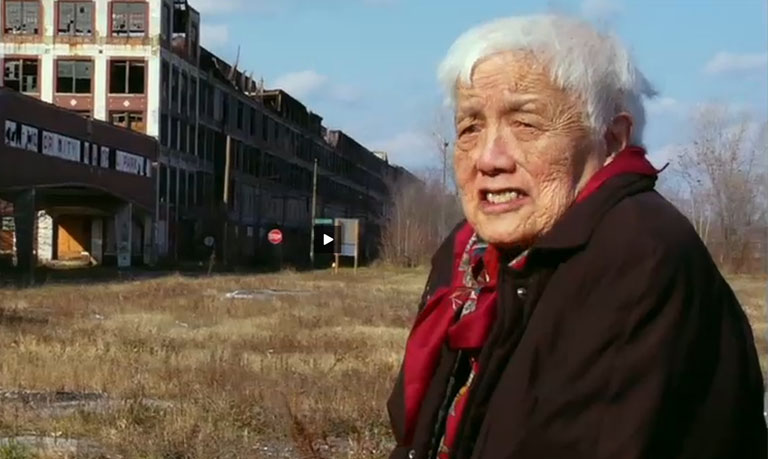
Grace & Detroit, American Revolutionary: The Evolution of Grace Lee Boggs, 2013
American Revolutionary: The Evolution of Grace Lee Boggs
A good, solid portrait of long-time Detroit civil rights activist Grace Lee Boggs, this documentary traces Boggs’ journey from a middle-class daughter of a Chinese American restaurateur to her 1960s activism in the Black Power movement and through the present day. Now in her late nineties, Boggs is as cogent and cognizant as ever and speaks eloquently about her involvement with the struggle for self-determination in Detroit’s African American community and beyond. Although the pace of the film lags a bit after a dynamite first half, the film captures the thoughtful intellectualism that has driven Boggs’ work for nearly seventy years, and director Grace Lee (no relation, ha) effectively blends personal narrative, historical documentation, and Boggs’ own thoughtful ruminations in an engrossing and informative package.
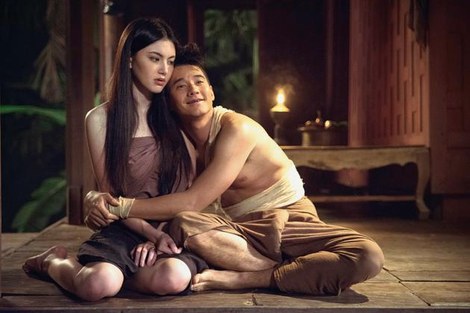
Slapstick, Pee Mak, 2013
Pee Mak
The highest grossing Thai film of all time and a big hit across several Asian territories, Pee Mak is a comedic remaking of a classic Thai ghost story in which a beautiful apparition romances her besotted, living husband. Here the fable is played for laughs, and the film owes a lot to Stephen Chow movies, 90s Hong Kong ghost story films, and the Three Stooges as it utilizes physical shtick and nonsense situations for its laffs. The movie follows four hapless idiots who determine that their friend’s beautiful wife may be a more than she seems. Hilarity ensues, but the broad slapstick lacks Chow’s ingenious blend of crude physical shtick, perfect comedic timing, rapid-fire wordplay, and cinematic finesse. While classic Hong Kong ghost stories certainly were often full of idiotic slapstick and mo lei tau nonsense they also had imaginative cinematography, creative art direction, and the divine action choreography of masters like Ching Siu Tung, not to mention the well-honed comedic chops of actors like the late great Wu Ma to support their pratfalls. Pee Mak’s cast mostly mugs and screeches its way through the exposition, supported by wacky haircuts and toothblack. I wanted to love this movie but after about 30 minutes I wearied of the clueless, somewhat repetitious antics of the various characters.
March 13-23, 2014
San Francisco, Berkeley, Oakland
U Got The Look: CAAMfest 2013
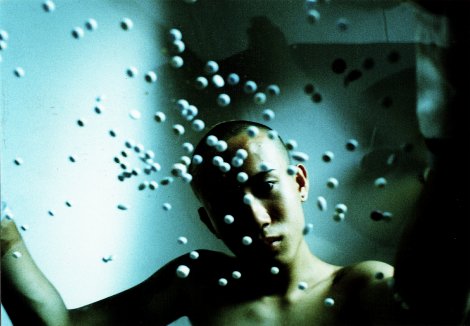
Teen dream, 15, dir. Royston Tan, 2003
Another year, another San Francisco Asian American International Film Festival, except now it’s been rebranded as CAAMfest, which certainly rolls off the tongue more easily than the previous moniker. The festival has added a tagline (film, music, food) that’s a nod to the increased presence of the audio and gustatory arts, but it doesn’t mean that movies are taking a backseat. As per usual there are more than a hundred new Asian and Asian American flicks in this year’s festival—below are a few preview picks.

Jeremy being Jeremy, Linsanity, dir. Evan Jackson Leong, 2013
Linsanity
I don’t need to tell you that this is a great Cinderella story, but filmmaker Evan Jackson Leong has taken the familiar material and shaped a charming and inspiring documentary about everyone’s favorite Asian American underdog. Jeremy Lin turns out to be funny, self-aware, and loquacious and Leong uses his longstanding access to his subject (he started shooting the film when Lin was at Harvard) to great effect. Interviews with Lin’s friends and family members, home videos of the budding basketball prodigy, and great coverage of the actual Linsanity phenomenon makes this a super-fun, captivating movie. The movie also touches on the racism and discrimination faced by Lin, the NBA’s first Asian American superstar, as well as Lin’s devout Christianity, but Lin is such a self-effacing guy and Leong so skillfully handles these elements that they work seamlessly into the whole picture.
Graceland
A solid film noir set in Manila and directed by Filipino American Ron Morales (Santa Mesa, 2008), Graceland looks at the repercussions of the kidnapping of a pair of young girls. Dark and moody, the film questions the morality of its various characters and, like the best noirs, no one is above scrutiny, everyone is guilty, and everyone has something to hide. The cast is lead by a nervous, sweaty performance by Arnold Reyes as the desperate father trying to save his daughter and who has many hard choices to make. The film also indicts the sex trade, corrupt policemen, and shady politicians—this is classic hardboiled stuff and well worth a look.
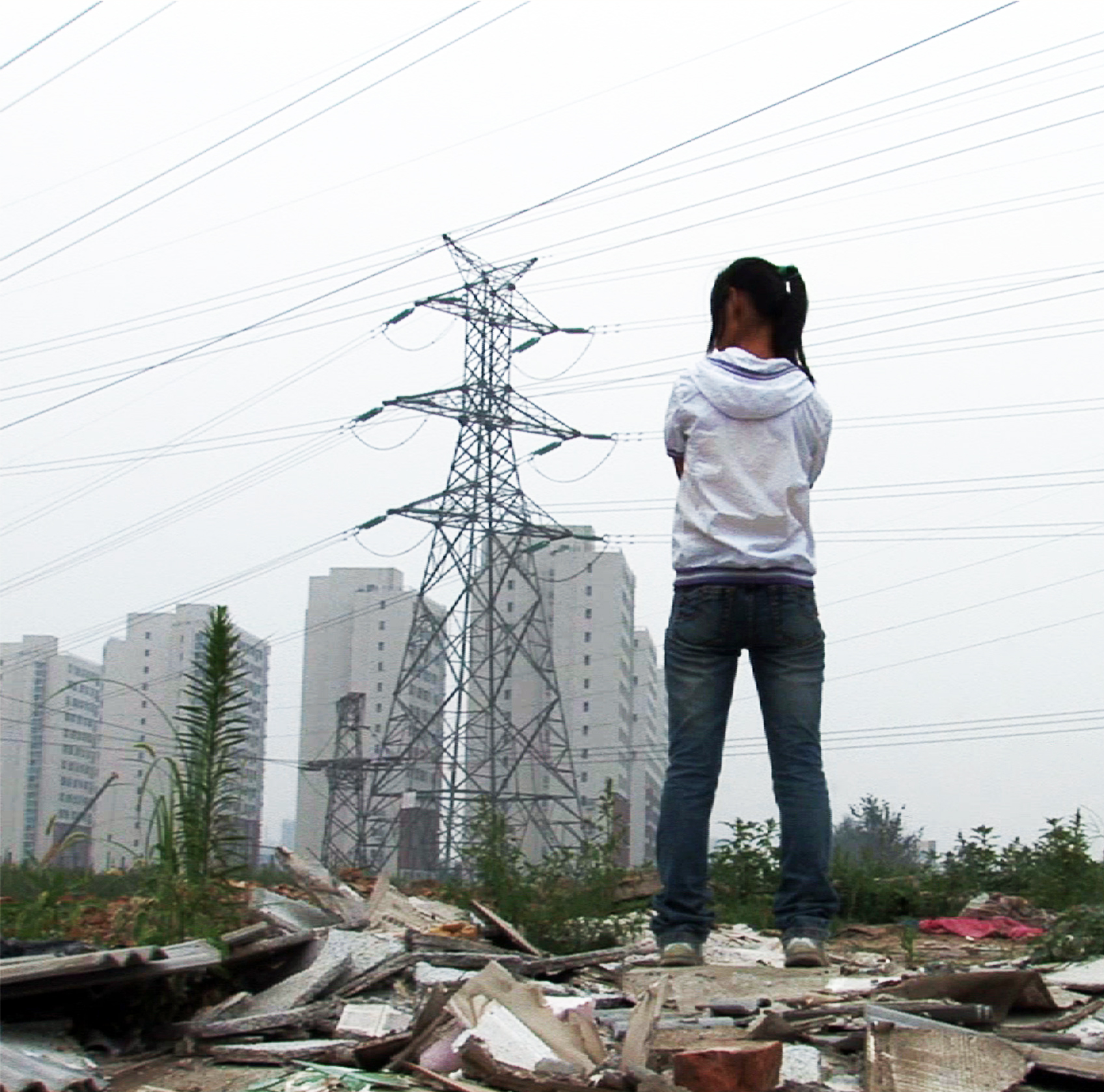
Hard times, When The Bough Breaks, dir. Ji Dan, 2012
When The Bough Breaks
Ji Dan’s verite documentary about a poor Chinese family living in a hovel on the outskirts of Beijing examines the effects of China’s rapidly expanding economy, which has ironically left many in dire economic and social straits. The father is a laborer, the daughters are adolescents trying to find money for themselves and/or their preteen brother to go to a decent school (one “sponsor,” a sick elderly man, offers to fund their education if they’ll sleep with him), and upward mobility is nowhere to be found. As if that wasn’t enough, Dad is a tyrannical drunk who verbally abuses his family at any opportunity, Mom is angry and fed up, and the teenagers are already learning to psychologically torment each other. Plus, the family’s eldest daughter has gone missing for some years after being lured into prostitution by the false promise of a factory job folding cardboard boxes. Overlong, somewhat shapeless, and leaning toward poverty porn, the film is interesting nonetheless due to the tenacity of the two younger daughters who grimly soldier on in the face of a bleak existence.
When Night Falls
Another film set in China, this narrative examines the notorious case of a young man who is driven to commit murder by that country’s oppressive police force. Ai Wei Wei made a documentary about the same case, but this film focuses on travails of the man’s mother as she tries to unravel her son’s unfortunate fate. The movie is composed primarily of long, stationary shots that emphasize the delicate action within the frame, lending a sense of oppression, immediacy, and intimacy to the film.
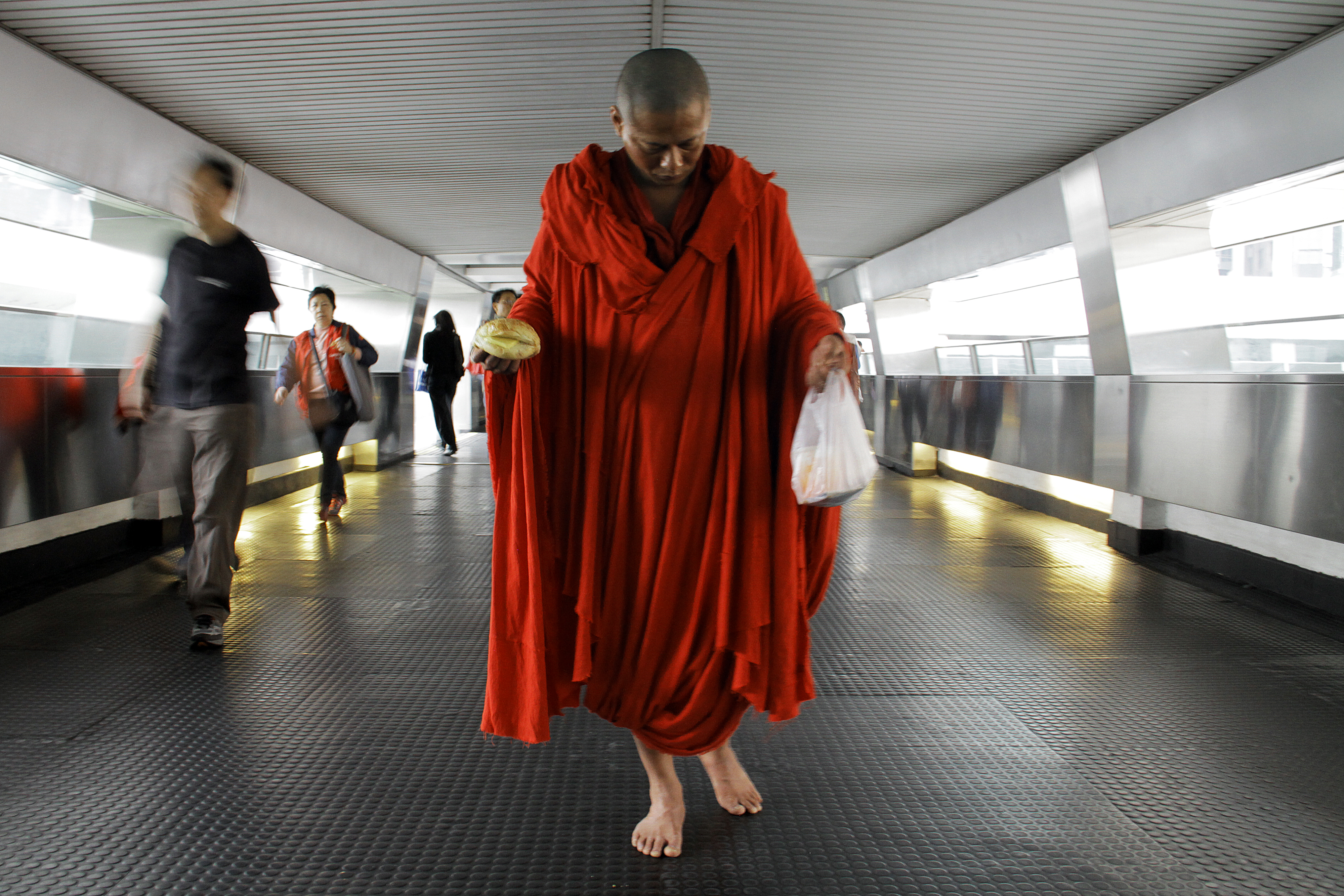
Walker, Beautiful 2012, dir. Tsai Ming-Liang, 2012
Also of note in the fest: Debbie Lum’s sharp and observant documentary, Seeking Asian Female, which is all about white dudes with yellow fever (full review here); The Land of Hope, Sion Sono’s second feature set in the Fukashima tsunami zone (full review here); the omnibus film Beautiful 2012, which includes Hong Kong director Ann Hui’s short narrative My Way, starring Francis Ng as a transgendered woman (!) (full review here), and Apichatpong Weerasethakul’s latest dreamwork, The Mekong Hotel. The festival is also presenting a brief retrospective of director Royston Tan, including Old Romances, his documentary elegy to old-time Singapore, the maniacal musical 881, and his debut feature 15, which looks at teenage angst, Singaporean-style. I’ll be interviewing the director onstage live at the Pacific Film Archive following the screening of 15, so be there!
CAAMfest
March 14-24, 2013
San Francisco and Berkeley, CA
full schedule and ticket information here.
Everyday People: An interview with In The Family director Patrick Wang
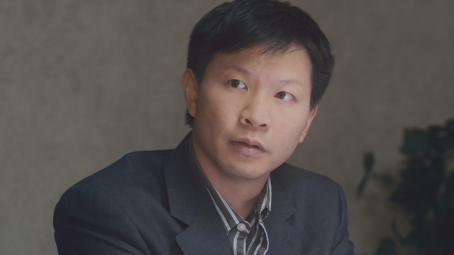
Director Patrick Wang, In The Family
I recently had the chance to sit down with Patrick Wang, the director, writer, and star of the amazing indie narrative film In The Family, which just opened its second theatrical run in San Francisco. In The Family is possibly the most surprising film of the year (longer review here), a family drama that steers clear of melodrama even when dealing with tragedy, a movie about a gay interracial family living in the South that’s not about identity, and a film by a first-time director that displays a singular vision and directorial style that recalls work by filmmakers like Ozu, Bergman and Hou Hsiao-hsien. Patrick proved to be as thoughtful in person as his filmmaking suggests, discussing the movie’s unusual distribution trajectory, his love for seeing the film in a theater with a live audience, and how being an outsider to the film world can be an artistic advantage.
beyond asiaphilia: How are you liking it back in SF?
Patrick Wang: I’m really excited because I was here for the (San Francisco International Asian American Film Festival) and I wasn’t able to be here for the opening. This week I get to spend a whole week here—-these days I don’t get to spend a whole week anywhere (laughs).
BA: I was kind of wondering about that—-what’s up with this distribution pattern, it’s kind of random—or is this intentional?
PW: Y’know, it keeps changing. I am the distributor and part of it is that I’m learning as I go along. I think you have to do some of that with every film, so I’ve just been figuring it out. Every few weeks a new opportunity comes up or something doesn’t work out quite the way we hoped so we have to readjust. There are other Bay Area theaters watching what happens this week so if we do well they’ll pick us up pretty quickly. And I’m kind of learning that pattern as well.
BA: But you were here in San Francisco already—-right after the Festival? It’s okay if you come back?
PW: It’s one of those things that—-it’s what’s normal and then, um (laughs). And all I see is there’s this huge gulf between the number of people who have seen it and those who would like it and would get something out of the experience, and I’m going to keep trying to bridge that gulf.
We do a lot of things we’re not supposed to. First of all, we’re not supposed to keep playing this long. People told me at the beginning, “You gotta get your DVD going,” and I said, “No, I’m not ready for that, I still haven’t finished—”
BA: The touring around?
PW: Well, its life in theaters, that’s not done, and I’m barely starting to understand it, there’s still work to be done there. So, yeah, we’ll leave a city, we’ll come back to some cities many times.
BA: Which ones have you come back to?
PW: Miami, Chicago, we just reopened in New York
BA: And people come in?
PW: And people come in, and actually more people. It’s funny, word of mouth is just—-y’know, there’s manufactured word of mouth, which behaves a certain way, and there’s real word of mouth—-for it to organically happen takes time. And it’s a question mark, y’know—if the time we’re giving it and the opportunities we’re creating for people to see it in the theaters will ever align.
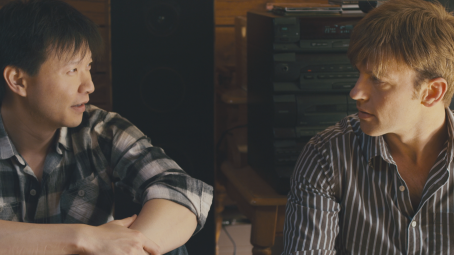
Word of mouth, In The Family, 2011
BA: That’s interesting because it kind of reflects the aesthetic of the movie itself, right? I mean you have these long takes—-I wonder where that comes from. You’re from theater, I know, but you’re also an economist, and you do other stuff. You weren’t even in film at all—
PW: I didn’t do much, y’know, I acted in a couple (films) and that’s pretty much it. But you know, it’s funny that you sometimes hit these points in life where different strands of your life that seem completely unrelated and completely in different camps kind of come together. And I think everything from the work I did as an economist managing a team—people think, oh, it’s in the business side, but no, it’s the managing the team and realizing how to balance the use of hard and soft powers, and how to help people do what they’re good at, and help them realize that, that’s directing.
And there was a time when I taught kindergarten, and that came back to be useful, too, because I know how five- and six-year-olds talk and I know how to work with that.
BA: As well as the grown-up five- and six-year-olds, I guess.
PW: Uh huh.
BA: That’s pretty cool that you were able draw on different parts of your life together to work on this project. I think a lot of people don’t realize that a lot of the filmmaking is the marketing and getting it out there, people watching it.
PW: Yeah, and I hope this doesn’t happen to too many other films, but y’know, a good film—-you’re sometimes left with no one else willing to do something for it and so you have to decide if you’re going to do it for yourself. And some filmmakers, very understandably, don’t know or aren’t interested or can’t do that.
BA: So you’re outside life experience has helped with that—
PW: It’s helped but I think the really big thing is just I saw what happened in the first few audiences when we screened it in New York and I just—-it made me angry that people were not getting the opportunity to see this. It’s this opportunity and I did not want it to be lost. It’s this film that can do a lot of good and now it needed a way to do that and I was willing to learn what that took.
BA: And you’re sort of learning on the job, I guess.
PW: I am learning on the job, but you know, it’s not unlike the filmmaking—-you have certain experiences you bring in. A lot is new and you figure it out, and actually it is very similar to filmmaking—-you put together this team to make the movie, and I kind of put together this team to help get the movie out. And the way we broke rules in the making of the movie, we’re breaking rules in the distribution, too!
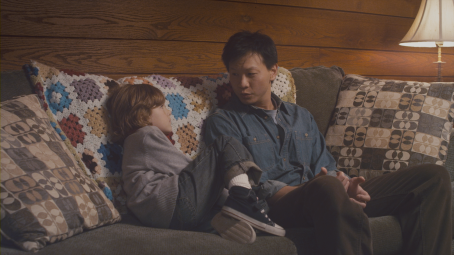
Learning on the job, In The Family, 2011
BA: So, you’re fairly self-taught so you don’t have expectations about what you need to do—-I don’t want to use the word “outsider” because that seems sort of hierarchical, but you’re not trained from film school, which is a really particular way of thinking of how you have to make a movie or how you have to deal with the movie business.
PW: Yeah, and I really like that word “outsider” because I think it’s very useful. Like every field of endeavor, whether it’s in the arts or something else, I feel like the outsider is very valuable, someone not engrained in the conventions or the general thinking about a kind of long-term path. I think what weighs down a lot of young filmmakers is their head is already in their career and their next two movies. So I feel like there’s quite a bit of freedom being from the outside, of having no expectations for how the thing is received or what’s the next step in your career.
BA: But you must be thinking a little bit about that?
PW: I think a little bit about that but not so much that it changes what I do. I guess that’s the key thing, you want to think enough that you create some opportunities but not so much it changes the important decisions you’re making about your project now, the one that’s right in front of you.
BA: Is that something that’s inherent in your personality, is that something you’ve learned? I mean, it does kind of reflect the filmmaking itself—-
PW: I don’t know, but there is this funny parallel, and I hope I have that very satisfying third act (laughs) that the film has.
BA: Well, I think there’s a certain tenacity the way you’ve approached the film itself. I’ve read about the directing experience—-it’s not that people openly fought you but I know that the way you made the movie is not like a conventional way to shoot a movie and the way you’re distributing it is kind of interesting too—-someone I know said, “It’s coming back to San Francisco?”
PW: (laughs) I think it’s definitely unpredictable, and that’s what keeps me interested in filmmaking and that’s what keeps me interested in the distribution.
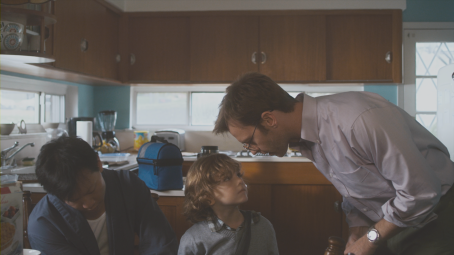
Unpredictable, In The Family, 2011
BA: So do you prefer people seeing it the theater?
PW: I absolutely do.
BA: Why is that?
PW: I think that there’s this focus that the theater allows. You can’t push “pause” in the theater. And other people, you feel them. Even if it’s a small crowd you to feel them and you feel some sort of responsibility that’s different—-the manners type of responsibility, as in we’re sharing a space and this is how we behave, but there’s also some sort of social responsibility that kind of jumps to life as people interact with this movie amongst other people. And there’s also the sharing of the emotion—-you hear and you feel it in the audience and it forms this type of comfort that you can’t get at home.
BA: That’s an interesting way to describe it. It’s like you’re very bonded to people you don’t know.
PW: There’s this one part in the film that I never expected would be a high point. There’s sort of a series of events and actions that Chip does when they come back from the funeral and when he clinks glasses—-people remember that detail when they’ve seen it at home, they remember that scene, but there’s this release in the theater, people laugh—-there’s like this communal exhale. And it’s across all cultures, it happens here in the U.S., Canada, Brazil, it happened in Taiwan. It’s so unpredictable to me—-I never expected that to be such a vocal moment. But somebody made the point that that will only happen in the theater.
BA: Someone said that you’ve seen the movie a lot of times—-
PW: I’ve seen the movie a lot of times—-I think we’re getting close to 200.
BA: That’s a lot of times.
PW: Yeah—-
BA: But you enjoy it every time, it sound like—-you get something out of it.
PW: I still get a lot out of it, and I think it’s mostly because it’s people—-it’s kinda like, y’know, it’s 200 people, (laughs). Y’know, you don’t say, I’ve had enough of people, I don’t need to meet anyone else (laughs).
BA: That could come from being in the theater and performing arts, too, right?
PW: Exactly, and someone had a very interesting way of putting it. A part of the performance is on screen, and then part of it is that the audience performs, and that performance is gonna change.
BA: And so that’s still really interesting to you—-
PA: Yeah, and especially some cities, I mean, obviously San Francisco’s huge, there’s lots of voices, local voices opining and talking about the film, but you get to a smaller town and there’s nobody in town that’s reviewing the movie or that’s talking about the movie and so you kind of have to go in there to see what it’s doing.
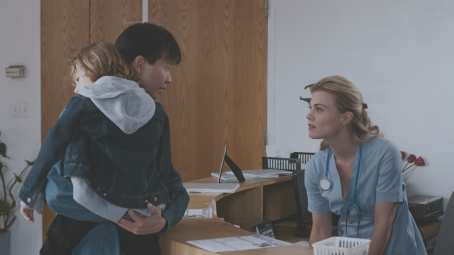
Comfort, In The Family, 2011
BA: So what about these small towns, what’s the response been? What’s the smallest city you’ve played?
PW: Y’know, there’s a town, fairly small—-I mean it’s not tiny, I mean it used to be the largest or the second-largest in Maryland—-Cumberland, Maryland. And it was such a feeling of community—-it was at a community college. And it’s people who have had some challenges in life. It’s definitely not an arthouse crowd! The arthouse crowds are wonderful but these are people who have probably never seen an art film. That’s the thing, you get a range, like anywhere.
BA: And how did they like the movie?
PW: They loved it, and some of the smartest commentary and questions—
BA: They could relate to it.
PW: Yeah. And I think that there’s some sort of pride, actually, in smaller towns that we screen in—-the same way there’s a pride in Tennessee, in that “we’re proud this movie takes place there and it reflects the range of what we’re capable of there.”
BA: It’s a very nuanced view of that part of the world that you don’t usually get. I know you deliberately chose to set the movie in the South, and that was interesting-—you’re from Texas.
PW: I’m from Texas!
BA: Do you consider that the South?
PW: Y’know, it’s up for debate (laughs). Different people consider it different things-—I do. But I didn’t set it in Texas because I didn’t want it to be too familiar. I wanted someplace for me to go, because if there’s a place for me to go, I feel like the discovery is a little more honest for the audience, too. Same thing for the story, too—-I didn’t know quite where it was going, and I think that translates to the audience’s experience. It’s not quite predictable.
But everyone I’ve met from Tennessee the few times I’ve been there—-there’s something I see in a middle-class life in Tennessee that is, in my view, dramatic, but I think in most films is not particularly interesting, is not particularly dramatic, these type of characters are not necessarily the stuff of drama, but I see a lot in their lives.
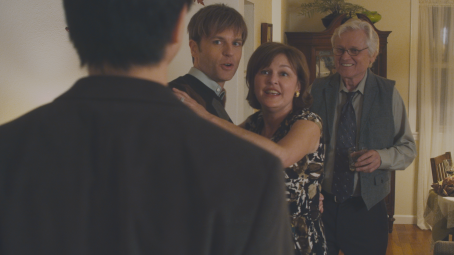
Dramatic, In The Family, 2011
BA: I think you’ve probably heard people tossing around names like Ozu and Bergman, which is pretty flattering for a first-time filmmaker.
PW: It’s wonderful, yeah.
BA: Those filmmakers really do look at middle-class people, everyday people, they’re not looking at extraordinary people at all, and there’s a similarity in that as well as the stylistic similarities.
PW: You know, I’d never seen an Ozu film before, and when the reviews started coming out, I decided to start with a comedy—-I saw “Good Morning,” and I loved it, and I loved how funny it was, how great the actors are. Making a movie is wonderful because you get this great viewing list-—and not even a viewing list, someone compared it to Alice Munro’s short story and I started reading those and they are tremendous. I think she’s pretty much rocketed to the top of my favorite author list.
BA: I wanted to ask you a little bit about the characters and yourself. It’s obviously really important that the characters are a gay couple, but what about being an Asian man, a Chinese American man who is adopted, or fostered, and has a really interesting background. There’s never any overt discussion of his ethnicity.
PW: There isn’t, and one of the very interesting things is when you leave out certain terms, it’s interesting to see how people fill in whatever they want. It’s nice to have that flexibility to fill in. For example, when I wrote it, he’s not Chinese, and yet a lot of people assume he’s Chinese, and so that’s interesting.
BA: His name is not Chinese, obviously, but I guess that’s part of the backstory.
PW: Yeah, but it’s a really interesting combination. I think one of the nice things that happens is that all these things combined kind of jam a lot of signals. For example, though some people may be used to two-dad families, they’ll look up there and they cannot process that face with that voice. So I think when you have that combination of things it helps you start from scratch because it’s so unfamiliar.
I think a lot of times people view places and people as averages, whereas I feel what’s much more realistic are these anomalies from time to time. You know, you’ll be in that town where there’s that one person, and somehow they got there, and they have a story and everybody knows them and they’re okay. I feel like it also helps to provide these situations where you’re not quite sure which aspect of Joey people are responding to, because there’s also a class issue at play, and I think that’s also very realistic, because in life you’re like, “What exactly is this person responding to? Is it how I’m dressed, is it my gender, is it my race?” You just don’t know.
BA: And sexuality.
PW: Yeah.
BA: I think that’s another thing that’s interesting is the way you elide a lot of the obvious things that could have made the film much more dramatic in a conventional way but by avoiding them you don’t ever touch on them—
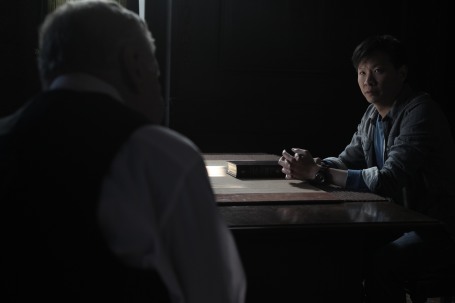
Eliding, In The Family, 2011
PW: Well, even things like coming out—-somebody wrote something very interesting about the film. It’s almost like there’s this continual process of coming out that Joey does but it’s not the way we’re used to seeing it or thinking about it—-it’s so small and unspoken. There’s this film called Nighthawks, a British film, that was one of the first to depict a gay life and it’s tremendous. There’s this moment where the character comes out to his friend but it’s in this way where he just uses the correct pronoun to describe a relationship, and they don’t speak about anything and you see her shocked, adjusting, and then deciding to continue the conversation, and it’s so beautiful. I think a lot of scenes in life are like that.
BA: Yeah, and I think that’s why your film is so real because it’s not melodramatic in a conventional sense. The things that happen are melodramatic but the reactions are very real. The audience appreciates that you’re not forcing them to think the way that you want them to think. You talked a little bit about how the audience is the participant in the making of the story.
PW: It really is, and they’re a participant in the emotional flavor. I do the work to set up the situation and, especially early in the film, I’ll pull back at the height of the emotion, and it’s to let the audience complete it, and I think when they do that it becomes a much more personal emotion.
BA: And this was a conscious decision?
PW: Yeah, it makes sense as the shape of things, and I think most movies do the opposite, right, they give you no context, and this emotional burst comes out of nowhere and you can’t understand it.
BA: Right, it’s like you’re observing more than participating. So when you’re making the movie you’re thinking about how this is going to play as people were watching it?
PW: Thinking about it, but mostly just thinking about how it plays with me, how I feel as I’m going through this, and it’s a basic approach that I know a lot of people talk about but if you don’t assume the audience is any better or worse than you—-both are dangerous—-you get really far. Somebody said, “It’s shocking for a movie to assume that I’m a human being, that I’ve actually had some human experiences,” (laughs) “that I’m not a bear, that you don’t have to explain the basics of being human.”
BA: Which I think is nice-—you leave a lot of space for people to fill in the blanks.
PW: And they can, and they like doing it. We do it in life, too.
BA: It’s like a respect for people’s intelligence.
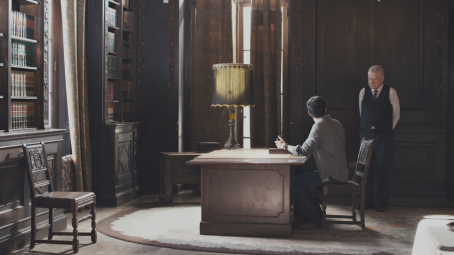
Fill in the blanks, In The Family, 2011
BA: So I guess the standard question is, what’s next? Are you going to keep touring it around for as long as it will play?
PW: This week will tell us a lot and then we’ll have to readjust, if we get to play longer, if more people want to play us, because a lot of other cities, not just theaters in the Bay Area, but theaters in other cities are watching.
BA: How many prints do you have?
PW: Of the 35mm we have twelve prints, and we have DCP now.
BA: That’s a fair amount.
PW: It’s not a constraint, and that’s the thing I wanted. I never wanted the number of prints to be a constraint and it hasn’t been so far. We had a philosophy at the beginning—every time we screen it, we do it a favor, even if two people come, even if it’s in a place you’re not expecting.
BA: So have you had that experience where only two people come?
PW: We’ve had experiences where two people come.
BA: And have they liked it?
PW: Yeah, I think one of the best screenings I was at there were nine people, including myself, and the two owners of the theater. But it felt like I made the movie for those nine people, it was such an active screening, so much laughter, so much warmth in the room. Because you get disappointed, you see empty seats in the room and a part of you is disappointed, but I’m like, “What kind of person have you become when two people don’t matter, or these nine people don’t matter?”
BA: So they all count?
PW: Exactly. If it has an impact on them, and I think it does, you see people coming out of the theater and you see them just cracked open a little bit, you see something in their eyes, you see them just cracked open to something. They’re feeling something a little more fully, they’re processing a lot of things in their own lives and rethinking, revisiting maybe some of the conflicts and family issues in their own life—so it matters. It matters.
UPDATE: In The Family will open Fri. Dec. 14 at the Roxie Theater in San Francisco. Go see it!
In The Family, dir. Patrick Wang
opens Fri. Dec. 7, 2012
Opera Plaza Cinema
601 Van Ness Avenue, San Francisco, CA, 94102
(415) 267-4893
San Francisco CA 94102
Swagga Like Us: 2012 San Francisco International Asian American Film Festival
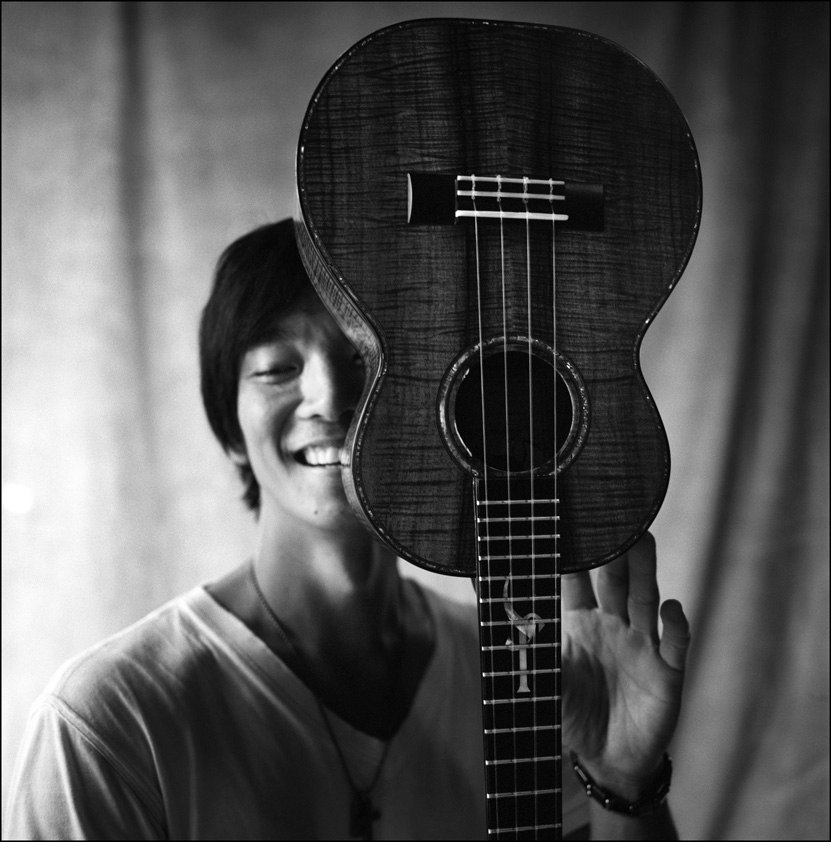
A man and his ukelele, Jake Shimabukuro Documentary, 2012
Now in its thirtieth year, the San Francisco International Asian American film festival offers several treats this year, with some brand new narrative films from Asian American directors. These include features by some familiar names and one remarkable debut by a newcomer that is astoundingly assured and original, demonstrating the continued growth and expansion of Asian American cinema.

The lucky Kimberly-Rose Wolter with foxy Sung Kang, Knots, 2012
Michael Kang’s Knots is a fast-paced rom-com with great comic performances and a decidedly un-cloying script. As in his debut film, the offbeat adolescent comedy The Motel, Kang has an eye for strange yet engaging characters coping with the bizarre dynamics of dysfunctional family life. Lead actress and screenwriter Kimberly-Rose Wolter is a marriage-phobe whose weird mom and sisters are wedding planners in Hawai’i. Sung Kang (Fast & Furious; Better Luck Tomorrow) is the dreamy love interest.
Yes, We’re Open, directed by Richard Wong (Colma: The Musical) is an entirely agreeable, sleek and charming timepass, with a clever and engaging script (by Colma’s star and screenwriter H.P. Mendoza) and winsome performances from its cast. Lynn Chen and Parry Shen play a comfortable yet slightly bored couple whose relationship has lost its groove, until they meet another couple that tantalizes them with the possibility of an open relationship. The film does a good job capturing the feel of non-tourist San Francisco, with locations at Green Apple Books, the Alemany Farmers’ Market, the Roxie Cinema, and other neighborhood locations, as well as gently lampooning foodies, hipsters, and tech geeks. I haven’t seen Parry Shen in a movie since Better Luck Tomorrow and he does a great job as the slightly neurotic male lead who is somewhat lacking in self-awareness. Lynn Chen is funny and endearing as the other half of the conflicted couple. The movie is not unlike Annie Hall or some of Woody Allen’s other earlier romantic comedies in its young urban groovester milieu, its reliance on a specific cityscape (here San Francisco instead of New York) and its lighthearted take on the foibles of contemporary relationships.
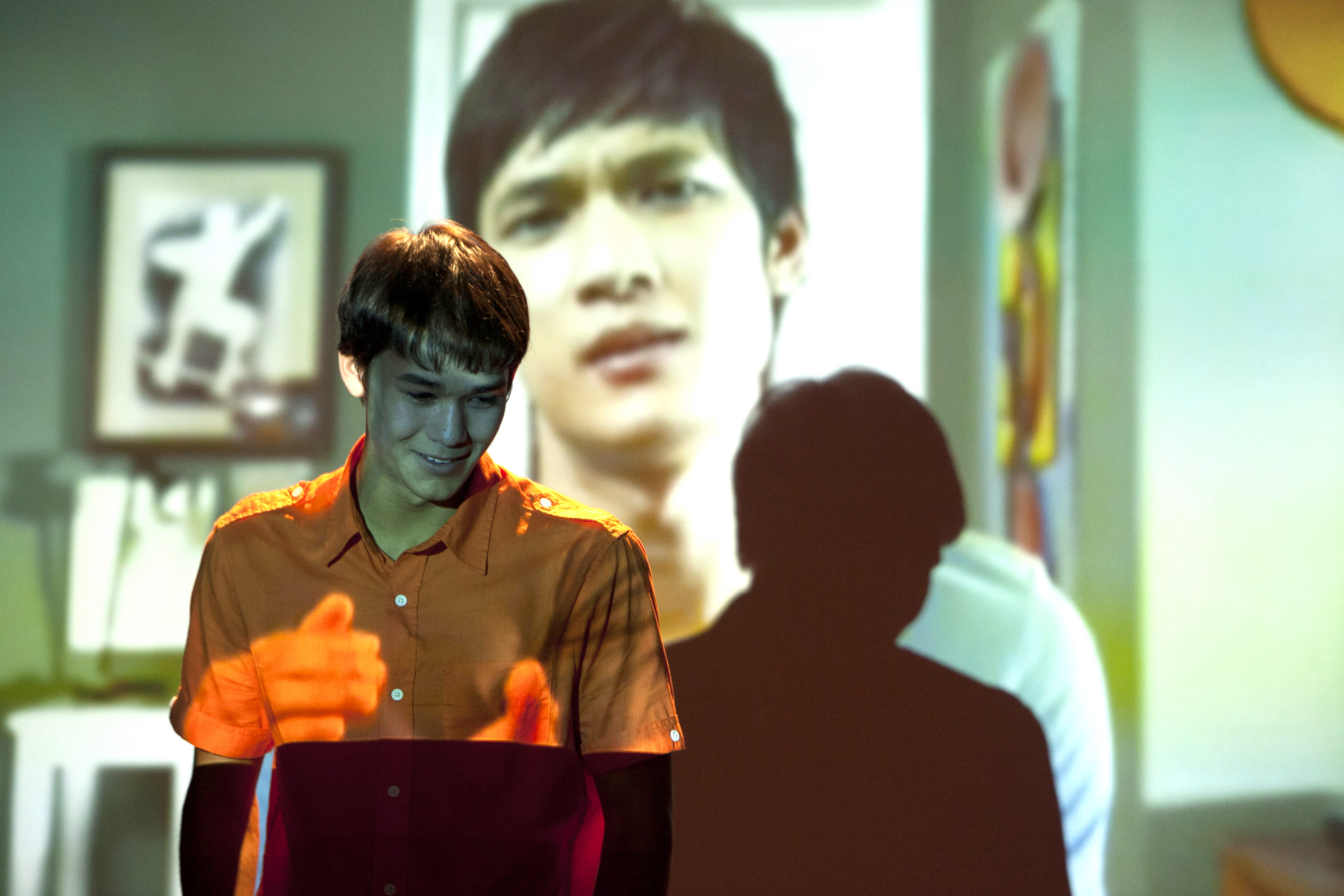
BooBoo on the spectrum, White Frog, 2012
Quentin Lee turns up the melodrama with White Frog, a family tale of a teenager with Asperger’s syndrome dealing with tragic circumstances. Led by a strong performance by BooBoo Stewart (Twilight: Breaking Dawn), the cast also includes some of the best-looking teenagers I’ve seen since Beverly Hills 90210, yet the actors overcome the handicap of their beauty by turning in convincing performances. The story makes a plea for tolerance and understanding of difference, and while it tilts toward maudlin at times, director Lee’s strong direction steers it back toward steady ground. He modulates the somewhat overwrought twists of the narrative by drawing out believable and sympathetic turns from his actors, including BD Wong as the conflicted father and Joan Chen at her dreamy and vulnerable best.
Although it also delves the family dynamics of coping with a tragic loss, Patrick Wang’s In The Family is a horse of a different color. Subtle and smart, the film offers a new way of seeing that diverges radically from the classic Hollywood style of filmmaking–it clocks in at nearly 3 hours, and the majority of the film is shot in long, deep-focus master shots. However, its formal style is in no ways mannered or pretentious. The film begins with a series of long, static scenes that simply explicate the quotidian lives of Joey and Cody, an interracial gay couple living in Martin, Tennessee with their energetic and precocious young son Chip. The long lockdown takes emphasize the normalcy of their everyday life despite a family structure that falls outside of the heteronormative frame. The time that the film takes to establish their deep emotional bonds pays off later in the film as tragic circumstances as well as societal pressure conspire to destroy their idyllic home life. With a reliance on long single takes the acting had better be good and here it’s stellar, anchored by actor-director Wang as the humble yet passionate and devoted father.
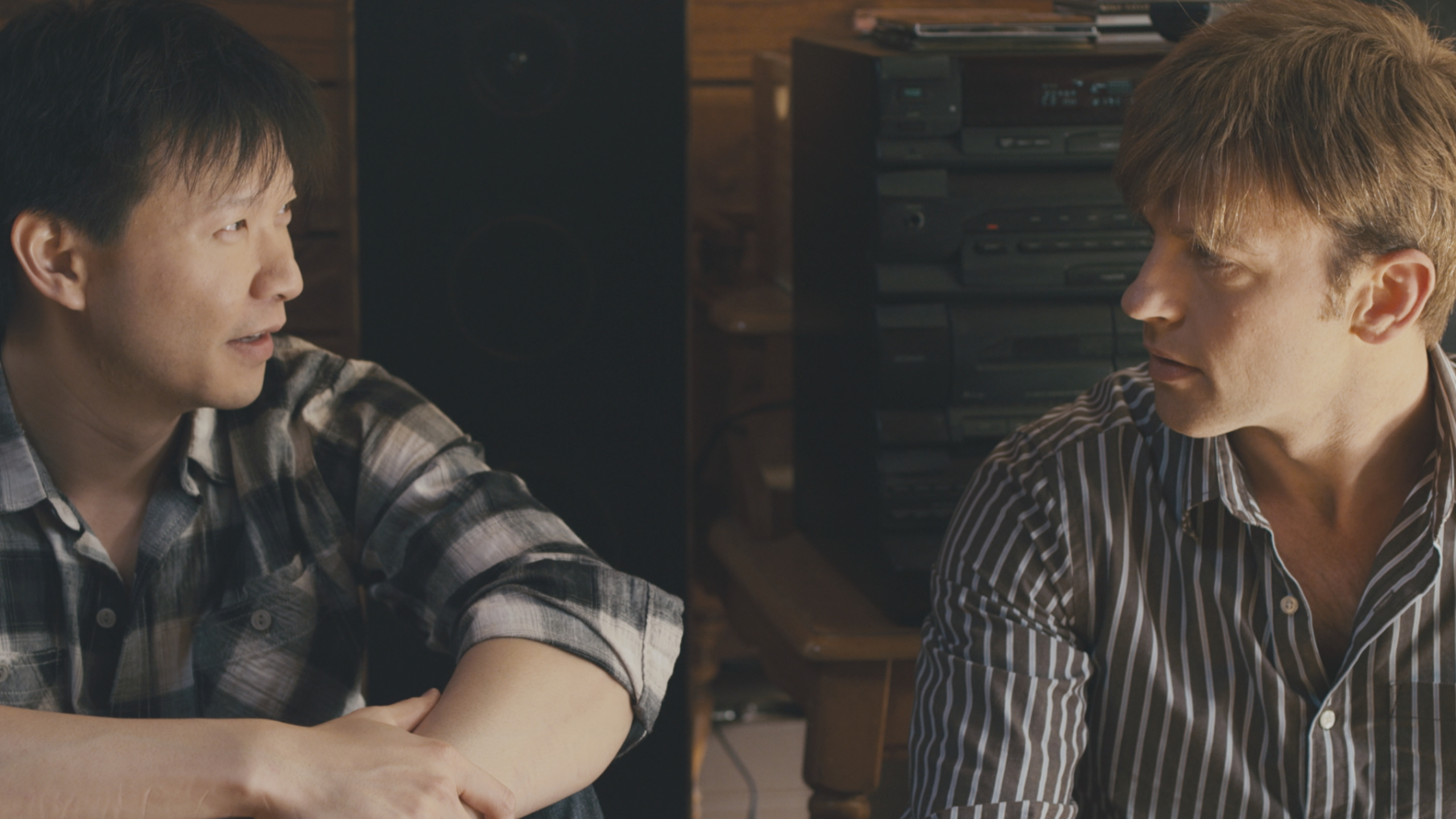
Stillness and movement, In The Family, 2012
In The Family is not only one of the best Asian American films I’ve seen in a long time, it’s one of the best films, period, that I’ve seen in a long time. Not to overstate the point but Wang’s compositions and his confidence in the power of the action within the frame are reminiscent of Taiwanese auteur Hou Hsiao-Hsien or Japanese master Yasujiro Ozu. Although touching on several hot-button issues the film deftly sidesteps polemics and instead presents a subtly shaded, morally complex story.
Also of note: Tad Nakamura’s Jake Shimabukuro Documentary, his first feature-length film that centers on the Okinawan-Hawai’ian ukelele wizard. The film follows up Tad’s short docs Pilgrimage, Yellow Brotherhood, and A Song For Ourselves and, although there were no advance screeners of the film, it promises to be as brilliant and moving as Tad’s earlier work. It’s great to know that not all Asian American filmmakers aspire to making narrative films, and Tad is following in the footsteps of Loni Ding, Steve Okazaki, Renee Tajima-Pena, Christine Choy, and his own parents, Bob Nakamura and Karen Ishizuka, all seminal Asian American filmmakers whose documentaries are the gold standard for Asian American cinema. The film festival will feature a program with Tad and his parents, A Conversation with the Nakamura Family, on Saturday, Mar. 10 at 3.30p, where science will surely be dropped.
Bonus: here’s a clip of Jake Shimabukuro from the upcoming documentary playing Queen’s Bohemian Rhapsody.
For tickets and a full schedule go here.
The American In Me: DC APA Film Festival and the Vietnam Veterans’ Memorial
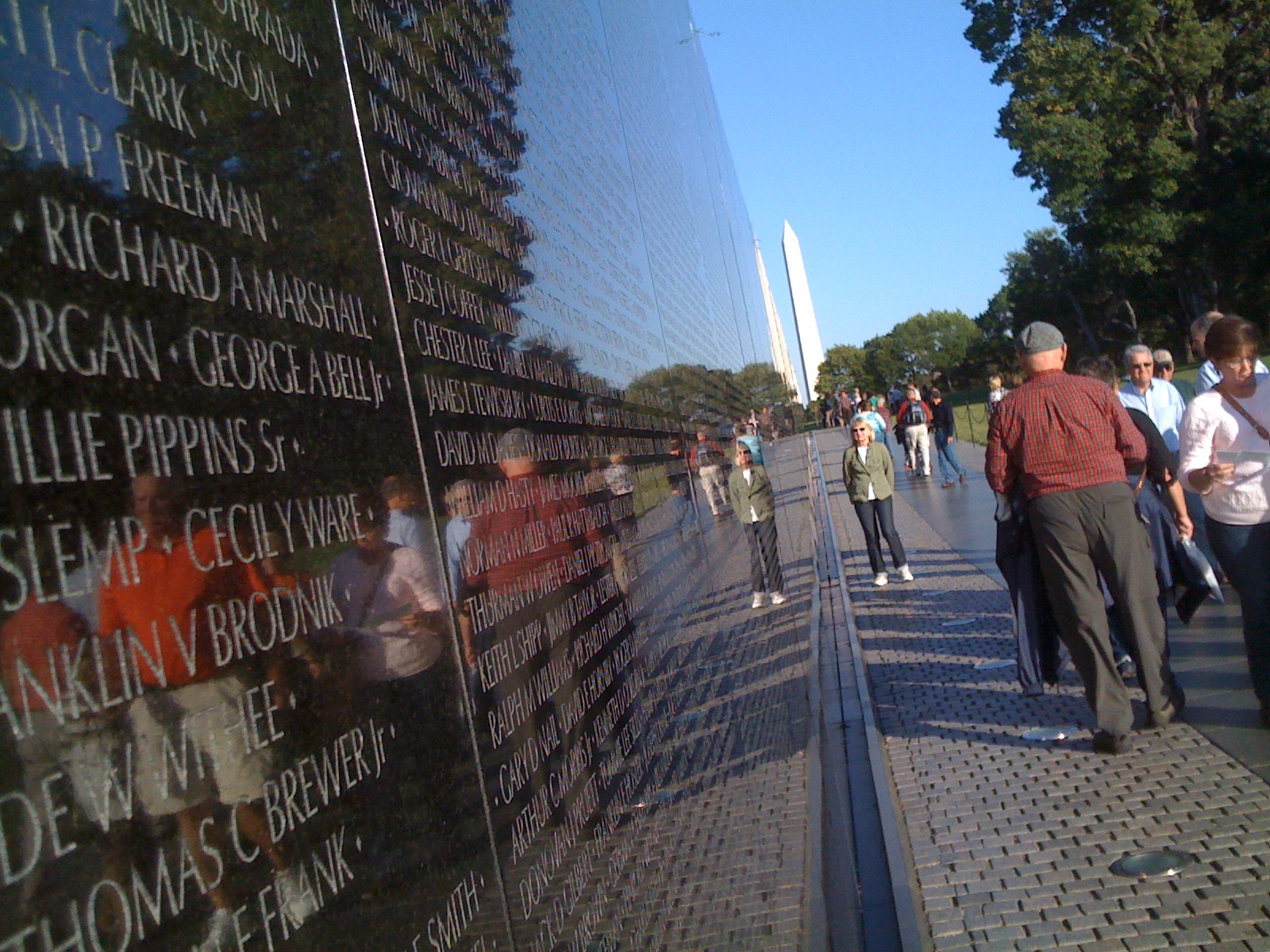
Reflecting, Vietnam Veterans' Memorial, 2010
Just got back from a weekend at the DC Asian Pacific American Film Festival in Washington DC. This is the second time I’ve attended the festival (the first time being in 2007 when the fest screened Snapshot: Six Months of the Korean American Male) and, as with my last visit, it was totally great. Although I had to take the red-eye from SFO and could only attend one day, I saw all three of Saturday’s programs, which pretty much satisfied my Asian American film jones.

Grace & food, DCAPA Film Festival closing night party, 2010
The DCAPA staff are an especially fun and friendly bunch and they always put on a great festival with lots of bang for your buck, with this year being no exception. Staff member Grace even cooked up a bunch of delicious snacks for the closing night reception, including ginger oatmeal cookies, edamame hummous, and K-food mini-tostadas with kimchee salsa.
The closing night film, The Things We Carry, was a gritty and heartfelt little drama about a pair of Korean American sisters coping with their fucked-up crackhead mom. The movie did an especially good job of capturing the rundown, seedy side of LA, with lonely and forlorn drug addicts puking their guts out in mini-mall parking lots. Though the film occassionally flirted with melodrama, the hard-ass lead performance by Alyssa Lobit kept the film from veering into pathos. Lobit also wrote the semi-autobiographical screenplay and the film was produced by her sister Athena and executive-produced by their dad, so it was a family affair all the way.

Tat Marina, before and after, Finding Face, 2009
My short film, The Oak Park Story, screened with Finding Face, an intense agit-prop documentary feature about acid burn attacks on women in Cambodia. Though it wandered a bit in its focus, it still managed to convey a gripping urgency about these crimes, which are growing in number since the high-profile attack on 17-year-old karaoke starlet Tat Marina in 1999. Marina and her family are the focus of the film as both she and her brother, the swoonfully intense Tat Sequndo, attempt to bring the perpetrators (including Cambodia’s Undersecretary of State Svay Sitha) to justice.

Image capturing, Lincoln Memorial, 2010
The day after the festival closed I got to play tourist in DC, visiting the National Gallery to see the amazing Chester Dale collection, which included a huge number of paintings by brand-name Impressionists such as Manet, Degas, Cezanne, Cassat, and Monet. I also hiked over to see the Washington Monument in all of its erect glory, then trekked to the far end of the reflecting pool to cool my heels on the steps of the Lincoln Memorial, where Americans of all shapes and colors snapped photos and posed with Honest Abe.
I ended up at Maya Lin’s Vietnam Veterans’ Memorial, which I’d never seen in person before. The Memorial is arguably the most famous artwork by an Asian American in this country so it’s been on my list of places to visit. Arriving there near the end of a balmy early autumn day, I was impressed by the simple, poignant power and beauty of the piece. Several people there were clearly there to find the names of lost loved ones, somberly pausing in front of the polished black granite. Seeing it in person, I was struck not only by how long and tall the memorial is, but by how small names are rendered and how very many of them there are. It’s amazing exactly how much space more than 58,000 names can take up, even when engraved in pretty small text. It’s a testament to the brilliance of Lin’s design that the piece conveys at once the enormity of the loss of life as well as each individual behind that monstrous sacrifice.
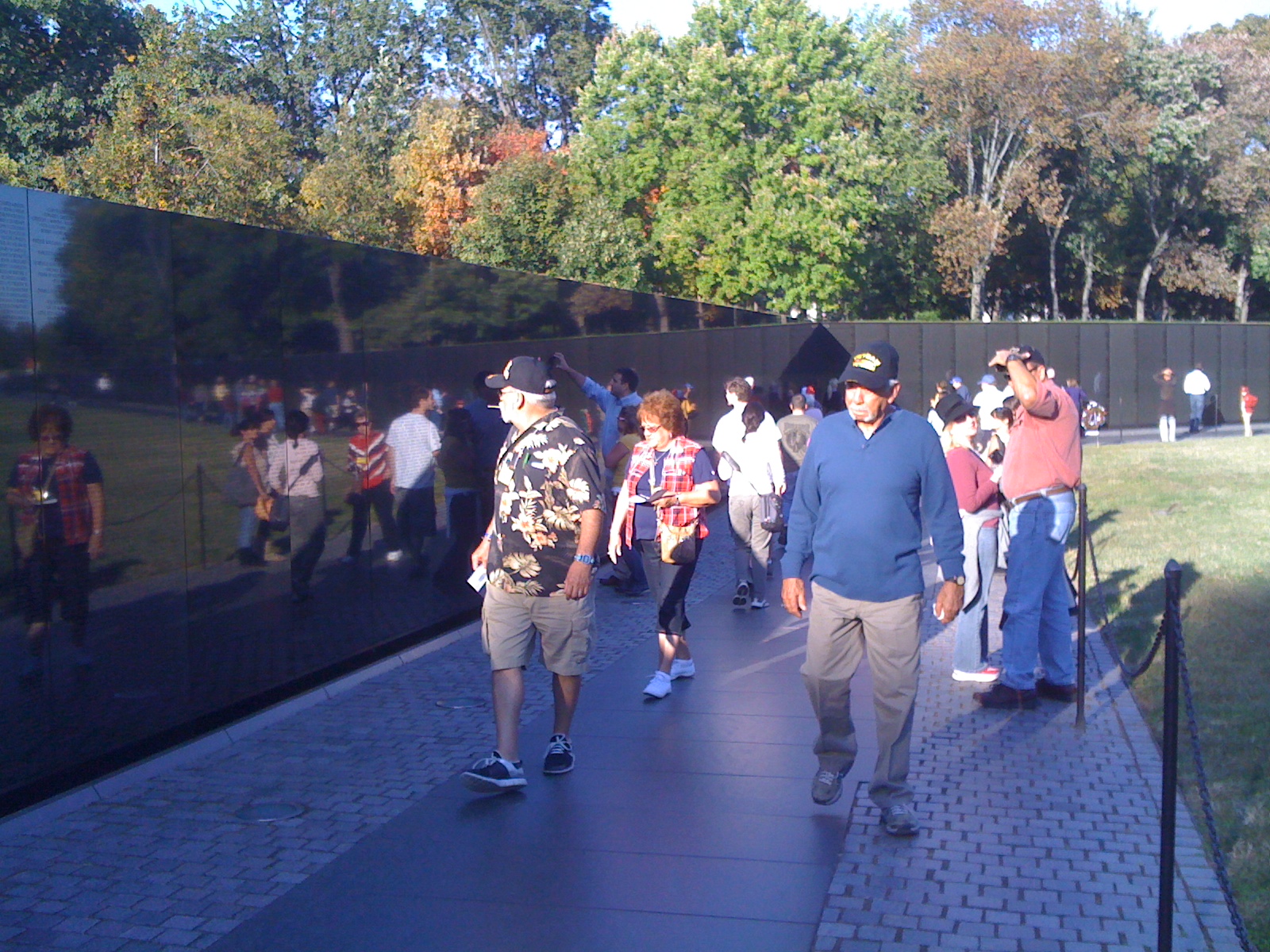
Vets, Vietnam Veterans' Memorial, 2010
It’s significant to remember that back in the early 80s when her design was first selected, Lin was vilified by conservatives as an inappropriate choice for the memorial due to her Chinese background (Ross Perot called her an “egg roll”), since, of course, that was pretty close to being a gook, right? Doubters also wanted to install a more traditionally representative memorial instead of Lin’s minimalist design and because of that sentiment, Frederick Hart’s abysmally banal bronze statue of three noble soldiers mars the entrance to the memorial. But despite the naysayers, Lin put up an epic fight to preserve the integrity of her original design and, nearly 30 years down the line, Lin is a renowned artist, the memorial is a landmark, and the haters have been proven dead wrong. Glad I was able to finally see the results of Lin’s persistant vision, and glad it still resonates today.
Bonus beats: The Avengers, legendary San Francisco punk band, performs “The American In Me,” Winterland, 1978
De Paisano A Paisano: An Interview with 9500 Liberty’s Eric Byler and Annabel Park

Proofed in Prince William County, 9500 Liberty, 2010, Eric Byler & Annabel Park
I had the chance last week to sit down with Eric Byler and Annabel Park, the directors of the new documentary 9500 Liberty that’s now playing across the country. 9500 Liberty outlines the 2007 battle in Prince William County, Virginia, over legislation that legalized racial profiling of “illegal immigrants” and the ways in which that battle polarized the tight-knit community.
I know Eric Byler as the director of Charlotte Sometimes and Tre, two seminal Asian American feature narratives dealing with angsty interpersonal relationships among several Asian Americans, but lately Eric’s been devoting his time and creativity to producing activist shorts. He and Annabel are the instigators of the youtube channel 9500 Liberty, of which the feature doc now in theaters is an offshoot. Both Eric and Annabel are articulate, committed, and smart as a whip, and they’re very passionate about changing the ways that political discourse is conducted in this country. Given the aggravating and idiotic screeds that pass for political expression these days it’s great to talk with thoughtful and creative people who are looking for alternative solutions to some of the tough issues facing the U.S. today.
Here are some excerpts from the almost-hourlong talk I had with them—the full interview can be heard below.
on the dangers of election season
Eric Byler: What we observed in Prince William County is that, in an election season, information is not as important as ammunition, and so people decide what they believe, say and repeat based on whether it helps their side win, not whether it’s true.
I think what certain insurgency tacticians have learned is that, because their positions are so radical and so far outside the mainstream, the only way they can assert their will is to use these tactics that alienate the average American from the political process and shrink participation down to a level that’s easier to manipulate.
So that’s what happened in Prince William County–they organized around deeply negative emotions. By combining racial antagonism with political partisanship they created an environment where only people who really thrive on conflict and who are comfortable with racial tension were going to those board meetings and were daring to speak on these issues.

Messaging, 9500 Liberty, 2010, Eric Byler and Annabel Park
I think that’s why Annabel and I were so concerned when we saw that become a national political strategy and instead of a blog amplifying the most negative emotions you find an entire news network to amplify not only the most negative emotions but those people they had assembled.
on button-pushing
EB: If you can make the election about some sort of social issue that really pushes emotional buttons–there are too many Mexicans in Arizona is basically the underlying theme of this election—that’s a really polarizing issue. Extreme candidates introduce extreme laws that get extreme reactions that create the kind of political landscape that favors the extreme candidate. So it’s not a surprise. And it always happens a certain number of months before the election because you’re lighting a fuse that’s gonna blow up.
on the use of intimidation tactics
EB: The week before the election (in Prince William County) was the scariest time for us. The racial tension in the county was more palpable than I ever expected to see in this century and I hope I never see again. People would drive by Liberty Wall and throw things at us—people would drive by and yell racial slurs. Those kind of climates are deliberately created for election season. Whether you’re a Democrat or a Republican you can respond really negatively to this kind of politics—we all can be intimidated, we all can be afraid.

Annabel Park in situ, 9500 Liberty, 2010, Eric Byler and Annabel Park
on film and the internets as a means of empowerment
EB: Given that there are people who are going to use as a political strategy organizing around the most negative emotions known to humankind then what we have to do is to populate our democracy with people who are willing to be responsible and fact-based and solutions-oriented. That’s what the Coffee Party and 9500 Liberty both seek to do is enlist those people who might otherwise be intimidated into silence because of these kinds of tactics and show them two examples of people who are prepared to engage even in a political process that’s been mightily toxified and frightfully polarized, because we have that much at stake, and to convince them that they have something at stake.
on hearing the news of the anti-immigrant laws in Arizona
Annabel Park: I got really emotional—I started crying! It was almost like a flashback to northern Virginia 2007. It was traumatic!
EB: It’s just such an unnecessary tragedy—the economic hardship that this kind of policy caused, the social toxification, the damage to public safety, was all so unnecessary, and really the only ones who benefit are very extreme politicians who cater to a really tiny fraction of out population.
on creating a more civil political discourse
AP: Politics is about us making collective decisions, and democracy is a method for making collective decisions–it’s not meant to be a fight with two sides. It’s supposed to be a situation where we thrive on differences and diversity but we need to be able to talk to one another. We have to create opportunities for people to talk to one another. That’s the first step in a democracy, that open dialogue—it has to be civil, there has to be real information exchanged. In a way it’s a very simple thing—asking people to protect and practice democracy, and by using social media, to create not only a communication network but by having this idea go viral—let’s go viral with this idea that we have to participate in democracy, and to give them portals for doing it.
on making a difference
AP: The (9500 Liberty) youtube channel did have impact on the community. We just showed (the movie) in Phoenix and in parts of Arizona and I think we made some progress there. I think there are people who are now ready to have dialogue at least. Just saying “Illegal Is Illegal” is just not really a starting point for dialog. It doesn’t help us formulate policy, it’s just grandstanding—it shuts down conversation.
on optimism and inevitability
EB: I feel very optimistic. 9500 Liberty is a microcosm of what’s happening in Arizona and Arizona is a microcosm of what’s happening across the country. The reason why we’re seeing these insurgency tactics, these desperation tactics coming from the right is that they’re afraid of the changes that really are inevitable. They feel that they’re actually delaying those changes by using these extreme tactics but I believe they’re actually accelerating these changes.
Every year another crop of kids turn 18 and registers to vote and during that same time unfortunately we have to say goodbye to our grandparents and aunts and uncles who grew up during the pre-civil rights era and who aren’t really as comfortable with the 21st century as those of us who are younger. So these kinds of cultural issues where a group of very extreme politicians are asking us to hate another group more than they love our country, are gonna cease to be effective, and that’s really when this will stop, when it can be shown, and maybe it will be in November, that this kind of fear politics is not effective.
on the relationship between love stories and political activism
EB: Both Tre and Charlotte Sometimes are essentially love stories where I made the choice to cast both mixed race and full-blooded Asian Americans. And I didn’t realize it but, because it’s an identity issue and identity is very much something that informs my artistic choices, for me it became a political choice. As Annabel likes to say, politics and identity are essentially the same thing.
Eventually I had to become comfortable talking about politics because I was talking about race and identity, and so the transition isn’t as unexpected or as dramatic as you might expect. Identity issues are at the core of American politics right now.
The short answer is I think I decided that in this era of American history, when so many important decisions are being made that are going to affect the rest of this century, that just making love stories, albeit love stories that do have social and political commentary, was not enough of a contribution—I wanted to do more.
(Now) I feel like I could make a movie about Weimar Germany. I could do one of those futuristic movies about a war. I now know what it feels like when you have politicians laying the groundwork for war and you have agitators essentially systematically dehumanizing a population so they can directly take action against them

Looking illegal, 9500 Liberty, 2010, Eric Byler and Annabel Park
on “looking illegal”
EB: I think that in some ways Asian Americans were given a pass on this issue in a weird way, even though many Asian Americans are undocumented—it’s a culture war directed at Latinos, let’s face it. And so I’m the one that actually looks Latino (laughs), being the halfer–
During that time, everything was about looking around and trying to figure out who looks illegal–the police are now being directed to try to tell who looks illegal, the government is basing policy on who looks illegal and who citizens say are illegal, because they went to the emergency room and saw a lot of Latinos—so they must’ve been illegal! So everything’s about who looks illegal– And y’know, some days I wake up I look more “ethnic” and my hair’s messy or curly or something. When you live in a climate like that you wake up in the morning and you see yourself in the mirror and you say, “Oh my god—I look illegal today!”
on the role of film and participation politics
AP: Being filmmakers doesn’t give us a special status not any more than being elected gives us a special status. We all have to be part of this democratic process or it’s just gonna fail. To me that one thing that’s a given—if people don’t participate it’s not a democracy.
There are enough people who have been silent who now have an opportunity to say, “Y’know what, I don’t want to be silent any more, I’m sick of this, enough is enough, let’s come together as a community, let’s stop being Democrats and Republicans and start being Americans and figure out what we have in common and have some of these tough conversations about our future. How much money are we spending on the military? How long can we sustain these two wars? What does it mean to be an American at this point? What unites us as a people in a meaningful way beyond the fact that we live in the same land mass?
on the dire need for civility and the role of the Coffee Party
AP: We’ve got to leave our ideology aside in order to come together. Otherwise you’re submitting to these forces that are in every society that want divide people and separate and secede and balkanize—that’s always there. If we don’t step up and counter that with the force of unity and peace and harmony then we’re headed for a very, very bleak future.
With the rise of the Tea Party there was this narrative that the Tea Party represented America, and there’s a lot of frustration with the government, but their point of view is not representative of America. To me it’s a marginalized view of minorities who know how to engage in political theater.
What happened with the Coffee Party is that I started this fanpage on facebook that just exploded. We want to find another way of engaging. We have these problems but I don’t want to be out there denouncing the government or Obama.
I want to be out there trying to figure out how to improve the government and to feel like we’re on the right path so that ordinary people are being represented and we’re on the path to not destroy one another but to work together.
So people are sort of just self-organizing—we have local chapters across the country. In the Bay Area there’s a cluster of them that are very active—in LA, too. There are local chapters–they function largely autonomously. We have national campaigns—like we’re having one right now where we ask people to discuss campaign finance and corporate personhood.
We’re trying to give people ways of connecting to the political process that isn’t alienating, isn’t negative, it isn’t about fighting people but it’s about dialogue and bringing people together–and really insisting on civility.
I don’t know how true this is but I’ve heard people say that people in the Tea Party, it’s had an impact on them. They’ve been much more conscious of their tactics and whether or not they’re going to be judged as being uncivil or not. I think I just like having civility become a viral idea.
Are we gonna being screaming at our politicians and at each other, or are we gonna say, “Okay, we need reform–how do we get there? Let’s work together.”
9500 Liberty (81 minutes)
Co-Directed by Eric Byler and Annabel Park
UPDATE: 9500 Liberty will have its cable television premiere this month on MTV Networks. It will show on Sunday, September 26th at 8pm (ET/PT) on MTV2, mtvU (MTV’s 24-hour college network), and Tr3s: MTV, Música y Más (formerly MTV Tr3s) as part of Hispanic Heritage Month. You go, Eric & Annabel!
Here’s the extended trailer for the film:
Here’s the full interview (trt: 52 min.)

 beyondasiaphilia
Recent Comments