Posts tagged ‘asian american artists’
Sound and Vision: Yuan Goang-Ming, Isaac Julian, Ruth Asawa exhibit reviews
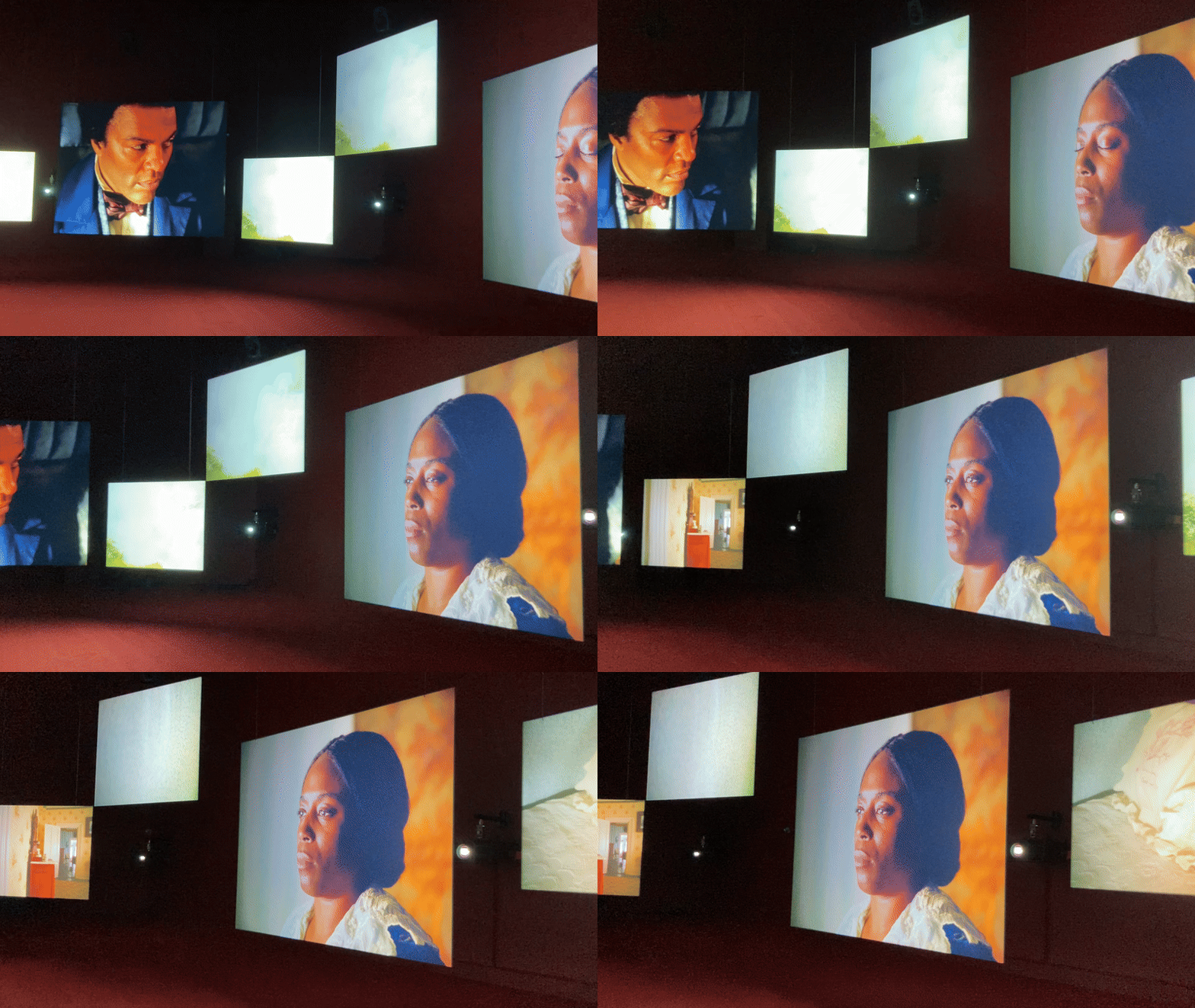
This year three of the major art museums in San Francisco had toplining shows of contemporary artists of color. While this might seem unremarkable in the 21st century it has in fact been a long time coming, especially here in the Bay. Despite the diverse demographics of the city, SF museums have a bit of a history of not exhibiting contemporary BIPOC artists.
It was so egregious that way back in 2004 and 2009 my pal Scott Tsuchitani staged two interventions at San Francisco’s Asian Art Museum pointing out the museum’s lack of support for living contemporary Asian American artists. Both Memoirs of a Sansei Geisha: Snapshots of Cultural Resistance (2004) and Lord, It’s The Samurai (2009) satirically critiqued the AAM’s orientalist tendencies. Since then the AAM has tried to clean up its act, engaging Abby Chen in 2018 as the museum’s head of the department for contemporary art, where she’s booked shows on iconic Asian American artists including Carlos Villa and Bernice Bing. Most recently Chen has curated the first international show of Taiwanese video artist Yuan Goang-Ming, Everyday War.
Yuan’s show includes several single-channel pieces that feature everyday tableaux suddenly exploding or bursting into flames, but the piece that riveted my attention was “The 561st Hour of Occupation” (2014). The piece includes a long drone shot of an empty Taipei cityscape, shot during the country’s annual Wan’an air raid drill (萬安演習) where all residents are required to remain indoors for thirty minutes in preparation for any potential attack from China, Taiwan’s bellicose neighbor to the west. Combined with footage from the 2014 Sunflower Movement, where students peacefully occupied Taiwan’s legislative yuan for twenty-four days to protest a controversial Taiwan-China trade agreement. Yuan’s video piece is a reminder of the constant underlying threat of invasion in Taiwan, whether military or economic, from China.
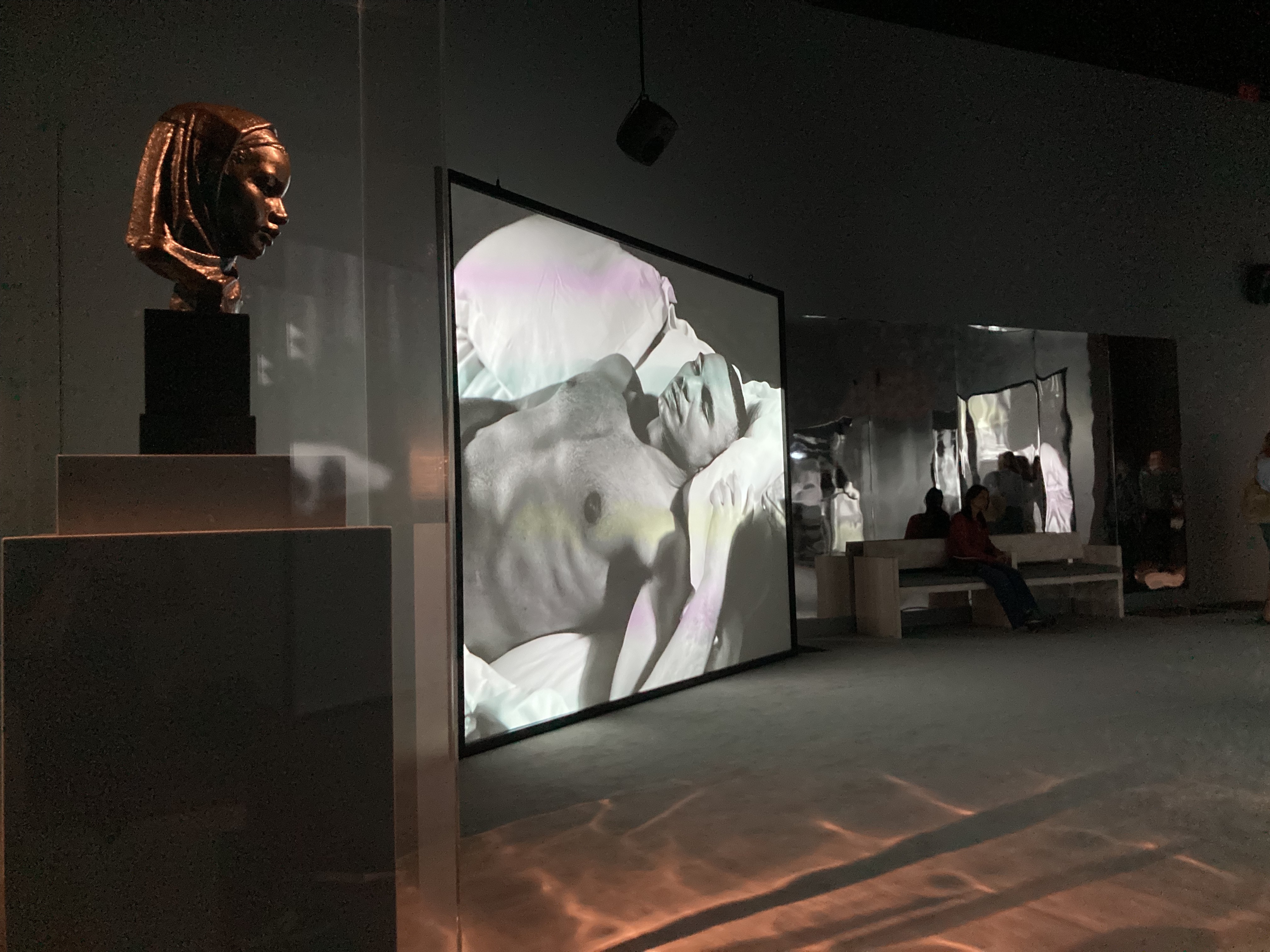
The de Young Museum in Golden Gate Park also recently featured the work of filmmaker and artist Isaac Julian, including several installations of his single and multichannel work. I enjoyed the lush, beautifully lit and photographed images from his more recent works that include fictional re-imaginings of historical events. Once Again . . . (Statues Never Die) (2022) (31 min) mixes in a bit of Africaphilia, gorgeous black and white cinematography, and a healthy dose of queer looks to critique the complicity of the museum system in colonization and exploitation.

Lessons of the Hour (2019) (28 min), a ten-channel installation starring Frederick Douglass (or rather, a reasonable facsimile), combines Douglass’s oratory, including his famous 4th of July speech, lovely landscapes, and images of ships, sailing and coastlines. As a self-identified sewist I also appreciated the images of Douglass’s wife Anna on her hand-cranked sewing machine industriously stitching away.
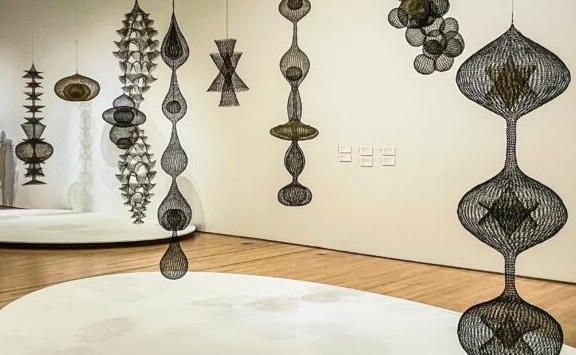
SFMOMA was the third of the major-museum triumvirate to topline BIPOC artists this year, with its blockbuster show Ruth Asawa: Retrospective, the first major exhibition of the influential Japanese American sculptor and arts educator. The show features a huge selection of Asawa’s iconic large-scale hanging woven wire sculptures, with the lighting design emphasizing the cast shadows of the pieces. I also appreciated the asymmetrical lozenge shapes of the platforms below the sculptures, underscoring Asawa’s midcentury aesthetic.
I had the privilege of collaborating with Ruth in 2002 on Each One Teach One: The Alvarado School Arts Program, a documentary about her arts education programs in the San Francisco public schools and seeing her show was very pleasurable for me. In addition to her famous wire sculptures the exhibit also includes several of her paintings and drawings as well as information about her many public art pieces throughout San Francisco and the Bay Area. I grew up seeing these public art pieces, including the nursing mermaid at Ghiradhelli Square, the origami fountains in Japantown, the bread-dough cast bronze round fountain at Union Square, and the woven wire medallion at the entrance to the Oakland Museum of California, so it was great to see documentation of those all collected together in one show.
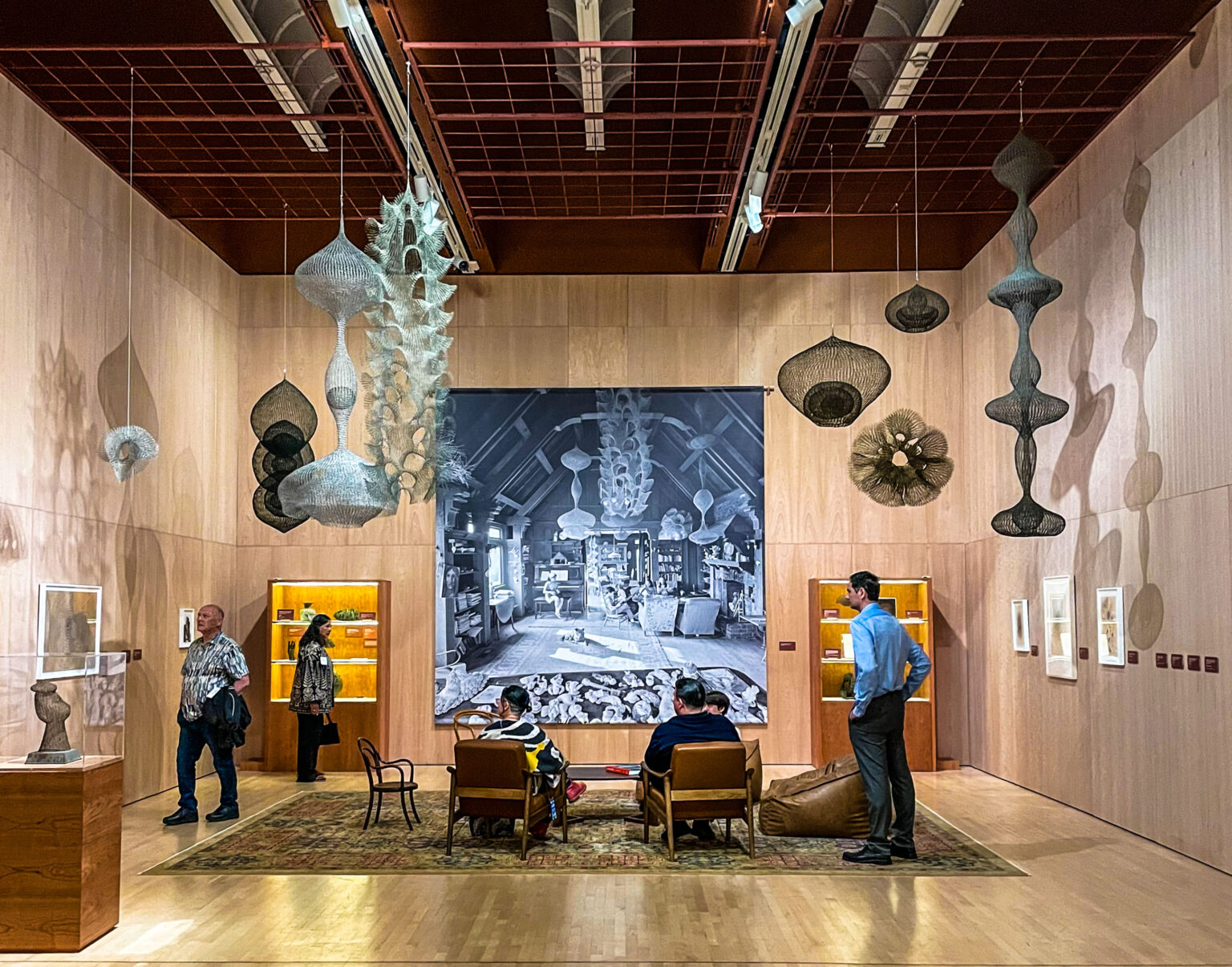
I had visited Ruth’s house a lot when we worked on the movie together and remember many of her sculptures hanging from the high wooden beams of her living room. The SFMOMA includes a reconstruction of her living room, including the carpet and a facsimile of the chairs, which was a fun thing to see in a museum setting and which underscored the primacy of her family and community in her work. Several of Ruth’s children and grandchildren are working artists and uncounted numbers of children who worked with her and her fellow Alvarado School parents have felt the positive effects of her arts education programs. Along with her iconic woven sire sculptures and her ubiquitous and legendary public arts projects Asawa is truly one of San Francisco’s most important artists and culture workers and it’s great to see her legacy honored with a full-scale retrospective.
Along with the 2020 Dawoud Bey show, last year’s Amy Sherald show, the 2023-24 Pacita Abad retrospective and the current Kara Walker installation at SFMOMA, as well as the 2022 Faith Ringgold show at the de Young, it seems like major institutions in the Bay are finally catching up to the important and groundbreaking work that BIPOC artists have been creating for decades. It’s been a long time coming but hopefully it means that more people of color are entering the art world canon, or perhaps more cynically, that more of their work is becoming commodified. Whatever the reason, it’s good to see San Francisco museums showcasing work from artists that reflect the of city’s population.
Pictures of You: Portraiture Now at the National Portrait Gallery
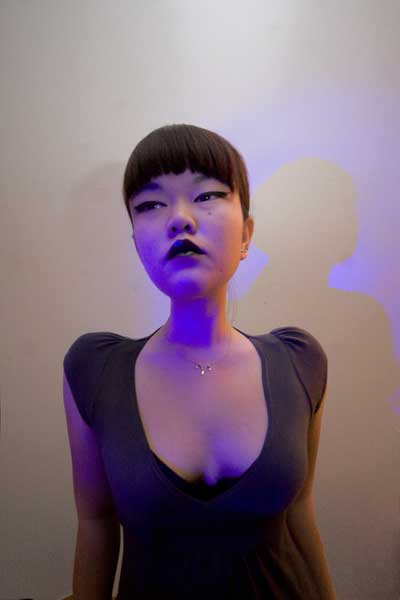
Youniverse, Tam Tran, digital print, 2010
I recently made a trip to our nation’s capital and caught Portraiture Now: Asian American Portraits of Encounter at the Smithsonian’s National Portrait Gallery. Although there have been a few significant Asian American arts shows in the past few years at major institutions (including One Way Or Another at the Asia Society in 2006 and Asian/American/Modern Art: Shifting Currents at the deYoung Museum in 2008) and Asian American community arts organizations like Kearny Street Workshop have been going strong for more than forty years, Portraiture Now is a coming-out of sorts for Asian American artists since it was organized by the Smithsonian aka this country’s big-time cultural gatekeeper.
Just downstairs from the Annie Leibowitz show and up the hall from Leutze’s Washington Crossing the Delaware, the show had a nice primetime location on on the NPG’s first floor, and it included some good stuff by mostly younger artists that moved beyond classic ideas of representation.
Self-portraiture figures into several of the artists’ work featured in the show. Tam Tran’s funky and intriguing photos of herself make good use of her unusual physicality and a fish-eye lens. Despite their prettiness, Zhang Chun Hong’s meticulous charcoal drawings of hers and her sisters’ hair become observations about the fetishization and objectification of the female Asian body. Hye Yeon Nam’s four-part video self-portrait, Walking, Drinking, Eating, and Sitting, something of a throwback to early lo-fi 1970s video art by Joan Jonas and Vito Acconci, uses absurd and repetitious actions to convey everyday life’s ongoing anxiety.

Cat and Carm, Shizu Saldamando, Gold leaf and oil on wood, 2008
With their sleek surfaces and liberal use of gold leaf, Shizu Saldamando’s paintings of LA baby-dyke scenesters recall both medieval illuminated manuscripts and Japanese folding screens. By treating these images of her friends as semi-sacred iconography Salamando’s portraits combine the earthly and the sublime, capturing and elevating the everyday camaraderie of her crew.
CYJO’s KYOPO Project, a series of full-length, full-color photographs of more than 200 Korean Americans, features text in their own words detailing the subject’s relationship to their Korean American-ness. At the NPG the photos were mounted one after another down the length of two walls and seen this way the entire series makes for an impressive collective portrait, with the personal stories adding humor, complexity and nuance to the project.
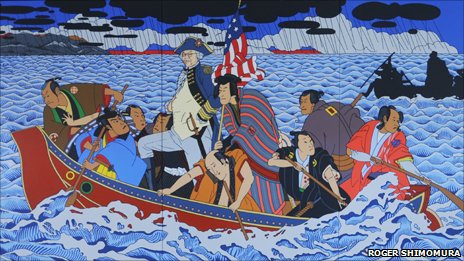
Shimomura Crossing The Delaware, Roger Shimomura, 2011
The venerable Roger Shimomura represented the older set, with his reworkings of Pikachu and Hello Kitty demonstrating his continued awareness of the ironies of U.S. cultural representations. Americans vs. Japs, is a clever rendering that locates Shimomura’s (Japanese) American visage amidst a hoard of invading Japanese stereotypes borrowed from World War II propaganda. The painting shrewdly interrogates assumptions about Asian American identity in Shimomura’s signature style, blending classical Japanese brush paintings with U.S. pop culture iconography. The show also features his epic painting Shimomura Crossing The Delaware, which is at once a display of Shimomura’s technical mastery, a cogent critique of American pop history, and a brilliant goof on its source material located just down the hall in the NPG.
While I was on the Mall I also stopped in at Colorful Realm: Japanese Bird-and-Flower Paintings by 18th-century painter Itō Jakuchū. On loan for only four weeks from Japan, the show includes some truly legendary paintings that in Japan are the equivalent of the Mona Lisa or The Last Supper. The show was packed four-deep with people on a Saturday afternoon, with a line to get in and a brisk sale of related prints, books, and postcards in the museum gift shop. In contrast, the Asian American NPG show was much more lightly attended, with plenty of room to sit and ponder the intricacies of meaning of each piece in the exhibit, but despite losing the popularity contest to the Jakuchū show’s more conventional appeal, its mere presence in the NPG, the first pan-Asian American show at the Smithsonian, surely recognizes the artistic and cultural relevance of Asians in the U.S.
The spiffy National Museum of the American Indian on the Mall opened across from the National Gallery in 2004 and the National Museum of African American History and Culture just broke ground in February 2012. The Asian American population is currently more than 5% in the U.S. and former UH Manoa professor Konrad Ng (aka Barack Obama’s brother-in-law) now heads up the Asian Pacific American Arts division of the Smithsonian. So this begs the questions: when will we Asian Americans get a national museum of our own? If the existence of high-profile Asian American art shows like Portraiture Now and the growing Asian American demographic are any indication, it seems to me that the time is now.
Portraiture Now: Asian American Portraits of Encounter
National Portrait Gallery, Smithsonian Institution
August 12, 2011 through October 14, 2012
The Myth of Chinese Restaurants, Part Three: Indigo Som’s Chinese Restaurant Project

Wonderful House, Rock Springs, Wyoming, 2002, iris print, 34"x34", Indigo Som
Regarding Chinese restaurants of a different sort, Indigo Som has an installation from her Chinese Restaurant Project in Present Tense Bienniel: Chinese Character, at the Chinese Cultural Center in San Francisco. Indigo’s project is manifold and ongoing, but its three main parts basically attempt to document and capture the gestalt of Chinese eateries in the U.S. and look at the ways in which these omnipresent establishments reflect and represent Chinese American culture, both real and imagined.
My brother and his wife once went on a driving trip that took them through a sparsely populated part of Idaho. On the way they stopped at a roadside restaurant and when they walked in, the Chinese proprietor spotted them immediately. As soon as he saw that my brother was Chinese, a huge grin broke out on his face. My brother must’ve been the first Chinese person outside of his own family that the owner had seen in a mighty long time. Indigo’s project reminds me of this incident in that it demonstrates both the pervasiveness and the isolation of these solitary outposts. Living in the Bay Area, which is clogged with Asians of every make and model, it’s pretty easy to forget that Asian Americans still only make up about 4% of the total U.S. population. The Chinese Restaurant Project captures some of the melancholy of life outside of urban centers for many Asians in this country.
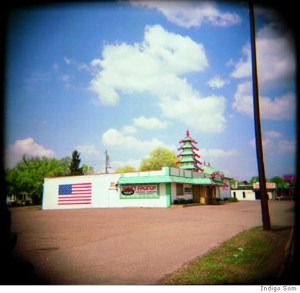
Woo's Pagoda, Eau Claire, Wisconsin, 2003, inkjet print, 34x34", Indigo Som
Some of you might be familiar with the large-scale color prints of Chinese restaurant facades that Indigo’s exhibited extensively in the past few years—she’s been selectively documenting Chinese restaurants across the U.S. for a while now, shooting hordes of images of this multifarious architectural phenomenon with a plastic, fixed-focus Holga camera. Many of the pictures were taken in locations far from sizable Chinese American communities and are plaintive reflections on the sometimes funky, in-between state of being Chinese in America.
The other two parts of the Chinese Restaurant Project are Indigo’s blog documentation of her travels across the country in search of Chinese restaurants and her quixotic attempt to collect a menu from every one of the thousands of Chinese restaurants in the U.S.
Indigo’s project captures the absurdity of attempting to define “Chinese American culture” in this modern world. Signage from most of the restaurants uses “ching-chong” script, or what Indigo calls the “Evil Chinky Font,” the one that poorly emulates classical Chinese calligraphy; names for the restaurants usually involve pagodas, jade, bamboo and other tiresome “Chinese” signifiers. Her menu collection also demonstrates the ways in which these restaurants have adapted Chinese cuisine to suit the tastes of the mainstream American palate, such as the weird pervasiveness of Crab Rangoon, those nasty little deep-fried cream cheese and surimi wontons that in all likelihood were invented in the 1950s at Trader Vic’s, that tiki torch lounge heaven in San Francisco.

Chinese Menus, Present Tense Bienniel, 2009, Indigo Som
On display as part of Present Tense Bienniel is a floor-to-ceiling installation of all of Indigo’s current collection of Chinese menus, which number in the hundreds. Covering a pretty big corner of the gallery, it’s still only a tease of what the piece will be when Indigo has, say, a thousand Chinese restaurant menus papering an entire gallery. Knowing her capacity for obsessive activity and her dedication to her goal, I have no doubt that one day we’ll see an entire floor of the deYoung Museum covered over with menus sporting the Evil Chinky Font from all over the country. But until then, this little snippet will more than suffice.
Present Tense Biennial: Chinese Character – an exhibition of
contemporary artwork by 31 artists that reflect and reinterpret China
Curated by Kevin Chen
May 1 – August 23, 2009
Tuesdays-Saturdays, 10am to 4pm; Sundays, 12 to 4pm
Chinese Culture Center, 750 Kearny Street, 3rd Floor (inside the Hilton Hotel), between Clay & Washington Streets in San Francisco CA
Admission is free.

 beyondasiaphilia
Recent Comments