Posts tagged ‘activism’
We Don’t Need This Fascist Groove Thang: One Day: A Collective Narrative Of Tehran

Tehran, Undated, 2009, Merhan Mohajer, C-print, 27.25″H x 27.25″W
Just got back from Intersection for the Arts, where I saw One Day: A Collective Narrative of Tehran, a brilliant group show organized by Iranian American, San Francisco-based Taraneh Hemami, and Ghazaleh Hedayat, an artist living in Iran. Taraneh is a visual artist and curator whose past work includes several projects dealing with her experiences as a diasporic Iranian woman.
Taraneh’s been creating a lot of work that utilizes images downloaded from the web, such as her mixed-media piece Women In Tehran (2007), in which she threaded together small cut-out pictures of downloaded images of women from the Iranian capital city. Her larger 2007 installation, Most Wanted, included a beaded curtain that replicated a poster of fugitive Islamic terrorists that she found on-line, its fuzzy and indistinct images suggesting a culturalist compositing of all Muslims into an overarcing mashup of conflated identity.
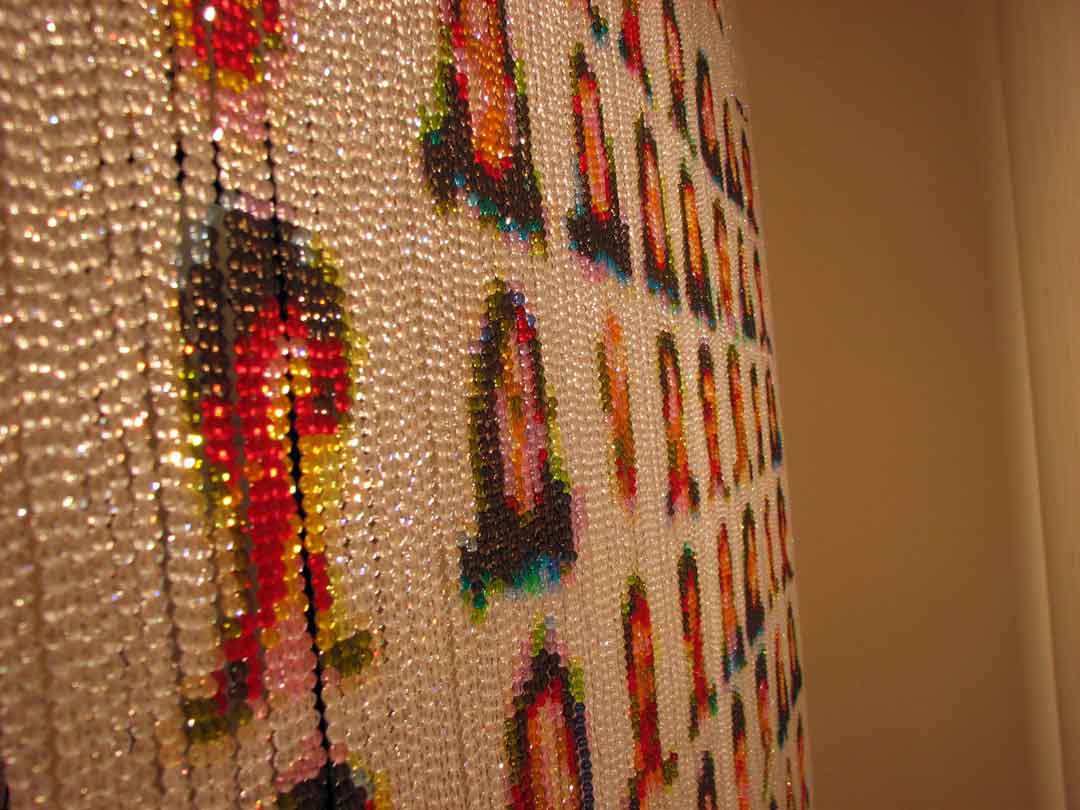
Most Wanted, 2007, Taraneh Hemami, 87,000 6 mm faceted beads, string, pole
Her use of internet-based images reflects her own status as an exile far from her homeland as well as the ways in which diasporic peoples now retain contact with their countries of origin, through websites, social networks and other virtual spaces. By utilizing web-based imagery Tareneh’s work also mirrors the significant role that the internet played in this year’s presidential elections in Iran, during which opposition leaders and activists as well as everyday Iranian citizens communicated their concerns and bypassed the censorship of traditional media outlets through the use of twitter, facebook, youtube, and other net-based media. Without such social-networking sites the Iranian government would likely have been able to completely obfuscate reportage of the protests and demonstrations that took place in the days following the elections.

Find The Lost One, 2007, Neva Razavipour, two-channel video installation
The current show at Intersection builds on some of these concerns in a complex and elegant presentation. The pieces work individually and as a unit, showcasing the mundanities of life in Tehran as well as the heightened tensions now present following the disputed presidential elections. Several of the projects also take on new meaning and significance after the elections and the crackdowns that followed it. Neva Razavipour’s two-channel video installation, Find The Lost One (2007), projects the same image twice, side by side, of passengers exiting a train station in Tehran. With one exception the projections are identical—-Razavipour has digitally erased one of the figures leaving the station. Text running at the bottom of the projection challenges the viewer to “find the lost one” in the right-hand image. As the artist’s statement notes, the piece was created in 2007, but following last summer’s elections the installation has now become a canny commentary on the increased repression of oppositional voices in Tehran.

One Day: A Collective Narrative of Tehran, installation view, Intersection for the Arts, San Francisco
Taxiography, Ghazaleh Heyadat’s processed-based pen-and-ink sketches, also take on additional resonance following the June 2009 elections. Each day Heyadat made a drawing by allowing her pen’s gyrations to trace a line based on the bumping and swaying of the bus or train she was riding through Tehran, with each small sketch reflecting the routes Heyadat followed in her sojourns across the sprawling city. Originally created as a means of passing time on Heyadat’s lengthy commute on Tehran’s public transit system, in the wake of last year’s crackdowns the drawings can also be read as records of the furtive travels of fugitive activists seeking refuge from the Basij and other military personnel.

Yekrooz (One Day), 2009, Taraneh Hemami, neon
Taraneh Hemami also has a couple pieces in the show, including Yekrooz, a green neon sign that spells out “one day” in Persian, and Turning Green, a large laser-cut green wool rug that traces a street map of Tehran. The rug’s central placement on the gallery’s floor unifies the exhibit while referencing Mir Hossein Mousavi’s oppositional Green Movement. It’s also a sly pun on Iran’s more Western-friendly name, Persia, and the ubiquitous carpets of the same name, reflecting the still-fraught relationship between Iran and U.S.
Interestingly enough, of the eight pieces included in the exhibition, only two were physically shipped from Iran. The rest were conceived in Iran, but fabricated in the U.S., from computer files and design plans sent over the web or email. Not only did this strategy save on freight but it also allowed the artists to circumvent censorship of their work by the Iranian government.
Not unlike the role that twitter et al played following the disputed elections, once again the web has aided Iranians in speaking out and voicing their concerns, despite their government’s best efforts to suppress them, and such dauntless determination speaks volumes about the urgent relevancy of this show. The risks that these artists take hopefully will make us here in the U.S. appreciate the casual ease with which we can tweet about our latest DVD purchases, what we had for lunch, or who we support for dogcatcher. With diligence we won’t let net neutrality and other civil rights erode in the U.S., and they’ll remain a given here as they are not in Iran.
One Day: A Collective Narrative of Tehran
Wed, Nov 4 – Sat, Jan 23, 2010 | 12pm – 5pm | FREE
Gallery closed December 20, 2009 – January 4, 2010
Sat. Jan. 16, 7 pm: Artists Talk
Intersection For The Arts
446 Valencia Street
San Francisco, CA 94103-3415
(415) 626-2787




Clampdown: Independent Media on G-20 Protests
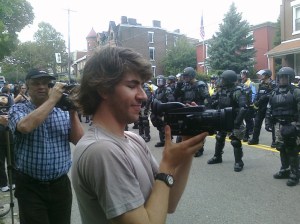
Independent media keeps an eye on riot police, Pittsburgh, PA, Sept. 24, 2009
Once again the web is the place to be for up-to-the-second information about breaking news. This time it’s the G-20 protests taking place in Pittsburgh, PA today. About 500 protestors have been attacked by overzealous policemen in riot gear using tear gas, rubber bullets and other excessive force against the peaceful crowd. On twitter, one poster claims he was told, “No matter your purpose, we will arrest you.” Another tweets, “teargas, rubber bullets, 1 arrest on baum and liberty (Half of march turned one way on baum), beat people with batons, shot with rubber bullets.” Most disturbingly, another reports, “cops using#LRAD less-lethal sound rays on protestors at #g20. Never before used in U.S.” This is confirmed by another poster on the blog of the Pittsburgh Independent Media Center’s website, who states:
Likely sound weapon (LRAD) attacks G20 protesters
On the live G-Infinity Indymedia broadcast, what sounds like the distinct oscillating chirp of the Long Range Acoustic Device (LRAD) military technology was overheard. The Active Denial System has not previously been used by law enforcement or military personnel at major demostrations in the United States until now (An LRAD system was on the streets at the 2004 RNC but not used). LRAD type systems can be used as loudspeakers and also to create extremely high-decibel “chirping” noises — which seemed to be heard on the broadcast. The LRAD was used recently to suppress dissent at large demonstrations in the nation of Georgia.In addition this should raise questions about the role of the US Northern Command (NORTHCOM) which is developing civil dissent repression techniques for implementation around the country. NORTHCOM and the National Geospatial Intelligence Agency (NGA) have major roles in National Security Special Events (NSSE) — the NGA is providing geographic intelligence (GEOINT) to law enforcement under a special confidential agreement that gives them a “loophole” around the Posse Comitatus law restricting domestic military activity.
http://en.wikipedia.org/wiki/Active_Denial_System
posted by Dex Thu 9/24/2009 3:10 pm

Many police in riot gear, Pittsburgh, PA, Sept. 24, 2009
Traditional media is running the usual nonsense about one protestor throwing a rock and another pushing trash bins into the streets as a way of justifying the extreme force used by the police. But pictures posted from protestors on site show a mostly peaceful and fairly small crowd of about 500 people marching, with a phalanx of 20 police cars and 100 police in riot gear hot on their heels.
msnbc.com and other news outlets have picked up the story, although they refuse to directly acknowledge the riot police’s flagrant civil rights violations. In msnbc’s clip the news reporter cautiously states, “We’re not sure if the gas is coming from authorities,” while showing footage of bleeding protesters pouring water in their eyes. Also audible on the soundtrack is the LRAD’s high-pitched chirping (see above), which indicates that the sound weapon was indeed used on protesters in Pittsburgh.

Violent, anarchistic monks protesting, Pittsburgh, PA, Sept. 24, 2009
Ironically, in order to watch msnbc’s newsclip you have to sit through insipid advertising for teeth whiteners, dog food, and other consumer products. The ad I endured was a commercial for disposable diapers, accompanied by a soundtrack of The Youngbloods’ “Everybody Get Together.” (I somehow doubt that Jesse Colin Young envisioned his tune being used to sell products that take up so much space in our landfills.) Yet another reason to go straight to indie media for your information—so far, there are no ads on twitter, and there’s also no corporate bias. As one tweeter says, “I think I’m going to go back upstairs to my MacBook. The news coverage is just irritating…”
UPDATE: Hot and heavy on twitter tonight. Use #g20 hash for most information. Also follow these tweeters:
@infernoenigma
@robjdlc
@iwasaround
@billpeduto
@resistg20
UPDATE 2: Scary new tweet from @robjdlc: “Just spotted police with shotguns and semi autos behind those with batons”
UPDATE 3: After a peaceful daytime march of several thousand people today, the Pittsburgh police are running wild again tonight on the Pitt campus. Taking advantage of cover of night and scanty mainstream media coverage they’ve gassed students walking home from campus events and set unmuzzled dogs on them. Independent media sources including Oakland CA’s own Davey D are tweeting from the scene, although the intrepid KPFA reporter sounds pretty freaked out, if his last few tweets (Shit I am in the middle of this the entire block is being cordoned off. Trying to be chill I just wanna get the hell out of here) are any indication.
And an on-the-spot post from swwhee on dailykos.com:
Tonight in Schenley Plaza
a large group of Pitt students and G20 protesters gathered to protest the violent tactics of the law enforcement officials. Hundreds of officers descended onto Pitt’s campus, arresting everyone who remained within the vicinity. Countless individuals were arrested merely for standing on their campus, curiously observing the ongoing mele.
Police used tear gas, dogs, a sonic gun, and full riot gear. I myself had an automatic shotgun pointed at my chest and felt as though I was running for my life. I have never been so scared in my own country. We were meant for more than this.
We simply wished to assemble to show our disapproval of the police tactics used from the night before. On Thursday night the police used tear gas and night sticks to disperse students. Many of the students were told to go home when home for many was a dormitory. A dormitory that was locked down for security reasons. Tear gas was released and confused students who were merely trying to go to a home that they were locked out of. The police trapped Pitt’s students and arrested them for not being able to navigate the various blockades and security measures.
Here’s a video of the LRAD sound cannon being used today in Pittsburgh against protestors:
Here’s a video of the Pittsburgh police in riot gear posing with a kneeling, handcuffed student for a snapshot. flickr, anyone? Sorry I can’t get the embed to work—just click to link to the site. Other good videos at the G20 tag, too.
UPDATE 4: Good firsthand accounts from students harassed on Friday night here from the Pittsburgh Post-Gazette.
UPDATE 5: Great eyewitness account from a student who was there on Friday night at dailykos.com
That’s Not My Name: Lord, It’s The Samurai! intervention

Altered poster, Lord, It's the Samurai!, 2009
Just got tipped to an excellent new intervention critiquing the San Francisco Asian Art Museum’s latest orientalist extravaganza, Lords of the Samurai. My anonymous source sent me the link to Lord, it’s the Samurai!, a brilliant goof on this year’s summer blockbuster which replicates the show’s official website with a twist—it offers a detailed, pointed, and well-researched deconstruction of the problematic exhibition. The faux-site points out the less-than-savory aspects of samurai culture that the AAM conveniently glosses over, including the militarism, slavery, pederasty and misogyny inherent in the “code of the warrior.”
The ersatz site also recognizes the dangers of the exhibit’s glamorization of violence, noting,
No myth here, and it hasn’t changed since the times of the samurai: it’s universal and real, how war dehumanizes everyone.
Aestheticizing violence, normalizing war.
The museum may not want you to see it, but there is blood on those swords.
The faux-site also calls out the AAM’s ongoing Asian fetish with its hilarious tagline (Where Asian Still Means Oriental) and a fun little word-scramble that mixes up past titles from AAM exhibits to form an amalgamation of exotic Asiaphilic fantasies.
The imitation site also makes a cogent connection between the Museum’s soft-peddling of Japanese nationalism and the U.S. government’s interest in remilitarizing Japan, which would aid the U.S. in maintaining the upper hand in Asia. The faux-site also notes that it’s not the first time the AAM has backed up a superpower’s questionable point of view, as seen in Tibet: Treasures from the Roof of the World, the 2005 show that gave credence to the PRC’s claim that Tibet is really just the back door of China.

Hard-copy flyers, Lord, It's the Samurai!, 2009
All told, this little fakey website is a fine, funny, and extremely effective critique that packs in a copious number of links and information. It’s a companion piece to hard-copy flyers that have been distributed in public brochure racks in San Francisco’s Japantown. Someone upstairs at the AAM must have twigged to the switch since, as noted in the site, the counterfeit flyers have been systematically removed and replaced with the AAM’s own brochures almost as soon as they’ve been distributed. The fake site’s gmail address was also disabled shortly after sending out its first email blast. If the museum’s functionaries are so freaked out that they’re furiously trying to eradicate it, then I’d have to say that the intervention is working.
UPDATE: After just a couple days it appears that Lord, It’s The Samurai! has gone viral. This very blog entry has outstripped the site’s previous champion Shah Rukh Khan (and his six-pack) as the top post of the week and news of the faux-site has travelled far and wide around the blogosphere. Here are a few links:
mrpoopypants’ post (scroll down to the comments where an AAM employee defends the museum)
8asians post (wherein the bloggers confess to being pwned by the faux-site)
Interview with the anonymous creators of the site here.
UPDATE 2: The Asian Art Museum itself has posted an entry on its blog about the intervention. I’m de-linking it, though, since they’ve selectively refused trackbacks (including mine) from sites critical of their position. Another example of systematic exclusion on their part.
And Japanese history scholars weigh in with their approval of the site, calling it “an instant classic.” There are also some great observations on the significance of museum shows as well as a shout-out to the scholarly rigor of Lord, It’s The Samurai!
UPDATE 3: Found this nice manifesto about social art intervention on John Jota Leanos’ site and thought I’d toss it out there, since it’s relevant to the conversation at hand. You can check out his art and other relevant information there, too. Plus his significant other was my kid’s kindergarten teacher.
UPDATE 3: Myself and a representative from asiansart.org, the folks who put together the parody website, were on Hard Knock Radio on KPFA-FM this week talking about the intervention. Go here for the stream, or download the interview here.
UPDATE 4: Ken Baker, art critic for the San Francisco Chronicle, weighs in here. Mostly positive, with some great dialogue in the user comments (aside from some obvious cluelessness). Viraling!
UPDATE 5: Continued fallout some nine months later as Asian Art Museum director Jay Xu talks in the LA Times about how “painful” it was to be pwned by asiansart.org’s intervention. Maybe getting a clue would ease some of the pain, Jay. asianarts.org talks back here.
Working Day & Night: Run-up to The Oak Park Story WIP screenings
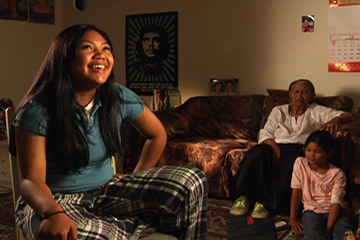
Veasina Thang & Khlot Ry break it down, The Oak Park Story, 2009
I’ve been on a little blogging hiatus for a few weeks because I’ve been furiously working on my latest movie, a documentary called The Oak Park Story. Filmmaking is my primary creative outlet, and in the past I’ve produced a bunch of experimental videos and short documentaries, although I’ve been less prolific since having kids. I’ve managed to put together a few micro-shorts since entering parenthood, but this new flick is the longest and most involved project I’ve worked on in many a year. The film just had two work-in-progress screenings almost back-to-back, so I’ve been cranking on the Final Cut Pro full time for more than a month.
I was lucky enough to get a residency this year from the San Francisco Film Society’s Filmhouse program, which provides free office space for selected film projects. They gave me a nice sunny little room down on the Embarcadero near Pier 39 where I’ve parked my iMac, my scanner, and my collection of hard drives for the past five months or so. It’s great to have a room of my own, away from my messy house, with a free parking space and ready access via streetcar to the Ferry Plaza building. I’m afraid I’ve spent way too much money on Taylor’s Automatic Refresher’s divine hamburgers and sweet potato fries, Out The Door’s excellent wonton noodle soup, and Blue Bottle’s outstanding drip coffee. But I’ve also managed to be pretty productive as far as my movie is concerned and I was able to knock out a reasonable facsimile of a film in time for both screenings.

Khlot Ry, Oak Park tenant, The Oak Park Story, 2009
The documentary is all about an amazing coalition of tenant-activists at the Oak Park Apartments in Oakland’s San Antonio district who rose up against their exploitative landlord. Undocumented immigrants from Mexico, refugees from Cambodia, and faith-based activists who lived at Oak Park for more than a decade all came together to fight back against the negligent landlord and the crummy living conditions he foisted on them. After a three-year battle the tenants won a landmark settlement of nearly a million bucks. My collaborator, Russell Jeung, was one of the live-in activists at Oak Park and was in residence there for ten years. He and I interviewed nearly twenty people, and collected hours of archival footage and reams of documents, photographs and other ephemera from Oak Park and since April we’ve been stitching it all together in the editing studio.
In the two or three weeks leading up to the screenings I was in the studio non-stop from morning to night. I made myself stand up and do triangle pose every so often to battle the muscular damage I was causing by endlessly sitting hunched over my computer screen. I blew out the speakers in my 20-year-old Sony NTSC monitor, no doubt hastening its demise by running it continuously for too many hours on end. Sometime around the end of last week, just before the second of our W-I-P screenings, my neck got a permanent crick in it and I had to take Advil to get to sleep at night. My massage therapist told me that I’d twisted my vertebrae out of alignment from cranking my head in one direction too long (note: she fixed it).
But the movie is shaping up pretty well, and the feedback from both of the screenings was invaluable. After working on the film for so long and so intensively I had very little perspective left, so hearing responses from an impartial audience was great. I got rid of some of the confusing parts, added some more backstory, and otherwise was able to tighten up the movie considerably after hearing what people had to say at the screenings.

Camilo Landau & Carne Cruda sing it
I also got a big boost from Camilo Landau’s awesome advice and help with the soundtrack. Camilo is a former student of mine (when he was in high school!) who’s now a grown-up and a professional musician and producer. He’s based in Oakland and, along with his uncle Greg Landau, runs Round Whirled Records, which puts out music by a bunch of great local bands including Fuga, Quetzal, Omar Sosa, and Carne Cruda, Camilo’s own combo. Camilo’s been a brilliant resource and I was able to use lots of the music he sent my way on the film’s soundtrack.
We’re in the home stretch with the film, and we have a couple of grant applications out there that will cover some of our postproduction, if we get them (which is always iffy, considering the perennially tough competition for indie movie funding). So we’re also soliciting our social networks and asking family, friends, associates and anyone who wants to support a good cause to contribute to the completion of the movie. We’ve even got fiscal sponsorship, so any donation is tax-deductible. So if anyone wants to help out a worthy project, please think about giving us some support. We’ve got some nifty premiums (t-shirts, dvds, tickets to the premiere) just like public television, though no coffee mugs or tote bags.
Okay, shameless pitch and self-promotion over. Back to regularly scheduled programming soonest.
For donations, here’s the link to the paypal information. You can also send a check—in either case be sure to note that the money is for The Oak Park Story.
UPDATE: Here’s a brief clip from the film:
Which Side Are You On? 2009 APALA Convention
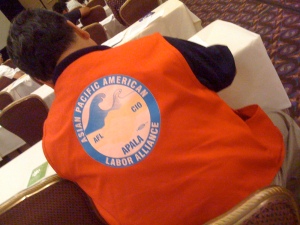 Sergeant-at-arms, 2009 APALA convention, Las Vegas
Just got back from a long weekend in Vegas, but I didn’t do any gambling, see any shows or go to the Liberace Museum (though I did eat at a couple buffets). Instead I spent most of my time consorting with a crowd of fired-up labor union activists at the Asian Pacific American Labor Alliance (APALA) convention. Equal parts awards ceremony, strategy session, and revival meeting, the APALA convention rocked the old-school trade unionist rhetoric with more than 300 delegates from across the country. I got a crash course in union acronyms—represented at the convention were IBEW (International Brotherhood of Electrical Workers), SEIU (Service Employees International Union), AFSCME (American Federation of State, County, and Municipal Employees), IFPTE (International Federation of Professional and Technical Employees), and CWU (Culinary Workers Union), to name just a few. I met homecare workers, teachers, electricians, lab techs, hotel and restaurant workers, longshoremen, nurses, ironworkers (not to be confused with steelworkers, who were also in the house), and straight-up union organizers, all of whom were dedicated to the cause of uplifting and honoring the worker and making sure we all get paid a living wage.
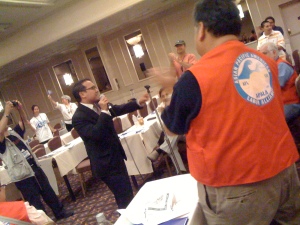
John Delloro brings 'em to their feet, 2009 APALA convention, Las Vegas
Some of the convention’s most interesting aspects were the various forms of creative expression, both subtle and overt, that repeatedly surfaced during the weekend. Songs and poetry by labor unionists go way back, and one of the convention’s speakers, Johanna Puno Hestor, referenced this long history by quoting from a poem by famed Pinoy farmworker and organizer Philip Vera Cruz. Chants and unions also go together hand in glove and one of my favorite moments was when John Delloro of the Dolores Huerta Labor Institute let rip with a full-throated rendition of the old picket-line chant, “We Are The Union,” getting the whole convention to swing it with him. Several other times during the proceedings a speaker would spontaneously bust out with a rousing chant in various languages including Spanish, Tagalog, and Mandarin as well as English.
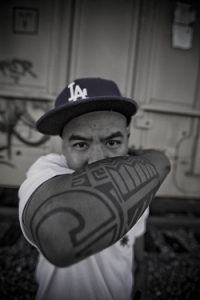
APALA convention presenter Kiwi and tats
The connections between art and activism were further explicated throughout the convention. Rapper Kiwi, formerly of Native Guns, and Geo Quibuyen, aka Geologic, aka Prometheus Brown, blogger and a member of Seattle’s isangmahal arts kollective and one-half of the rap duo Blues Scholars, led a standing-room-only workshop entitled “Cultural Activism and The Fight For Workers’ Rights,” which looked at the work of sansei singer/songwriter Chris Iijima, Pilipino filmmaker Lino Brocka, Tupac Shakur, and writer Carlos Bulosan, linking their creative work to issues of human rights and social justice. Rick Rocamora gave a slide show of his luminous and evocative black-and-white photographs from “Filipino World War II Soldiers: America’s Second-Class Veterans,” his book about the Pinoy soldiers’ struggle to receive benefits from the U.S. government. On the filmmaking tip, Tam Tran screened “Lost And Found,” her poignant short documentary (see below) about Stephanie Solis, a UCLA undergraduate and undocumented immigrant who entered the U.S. as a child. Both Tran and Solis spoke in support of the DREAM (Development, Relief and Education for Alien Minors) Act, which would facilitate legal status for many young people who are, due to the peculiarities of U.S. immigration law, in permanent non-citizen limbo.
All in all the convention was pretty informative and enlightening, with much more lively speeches than the dry-as-dust presentations I’m used hearing at, say, your standard academic conference. I enjoyed the convocation being referred to as “sisters and brothers” and it was fun to hear the boos and gasps of shock when particularly nefarious employers were called on the carpet for their various transgressions (ten-hour work day! no lunch break! no overtime!). The topics discussed were particularly relevant to me since my own union, the California Faculty Association, just voted on whether or not to accept work furloughs equaling a 10% pay cut. Trade unions may seem outdated and retro but with the Republican policies of the last presidential administration resulting in the current economic meltdown, maybe there’s something to be said for fairer labor practices and a return to honoring workers instead of exploiting them. In the end, it’s all about doing right by as many people as possible instead of only looking out for yourself, which really isn’t a bad thing at all.
A few fun facts:
Only 12% of U.S. workers are union members, with only 9% of the private sector unionized.
All of the hotels on the Vegas strip save one (The Venetian, boooo!) are union shops.
It took more than six years to unionize the MGM Grand Hotel.
Here’s Tam Tran’s short about Stephanie Solis and the DREAM Act.
UPDATE: May 16, 2010: Terrible news–Tam Tran was just killed in a car accident in Maine today when a pickup truck crossed the meridian and crashed head on into a car she was riding in. I’d only met Tam once, after she showed the above video, and she was a promising young filmmaker and activist. All thoughts to her family and friends.
UPDATE 2: June 6, 2010. More incredibly bad news–just found out today that John Delloro died of a heart attack yesterday. This is quite shocking to me since John was an incredibly vibrant person who was literally bursting with life. I’d only met him once, at the APALA convention last year, but I was more than impressed with his incredible energy, dedication, and optimism. The Asian American community has lost a a potentially great leader who has passed long before his time. We can only hope that in his memory we will all continue his work toward peace, justice, and the betterment of the world for all.
———————-
And for good measure, the lyrics to Which Side Are You On?, written by Florence Reece in 1931 during a strike by the United Mine Workers of America in which her husband, Sam Reece, was an organizer.
Which Side Are You On?
Come all you good workers,
Good news to you I’ll tell
Of how the good old union
Has come in here to dwell.
CHORUS:
Which side are you on?
Which side are you on?
Which side are you on?
Which side are you on?
My daddy was a miner,
And I’m a miner’s son,
And I’ll stick with the union
‘Til every battle’s won.
They say in Harlan County
There are no neutrals there.
You’ll either be a union man
Or a thug for J. H. Blair.
Oh workers can you stand it?
Oh tell me how you can?
Will you be a lousy scab
Or will you be a man?
Don’t scab for the bosses,
Don’t listen to their lies.
Us poor folks haven’t got a chance
Unless we organize.
Body and Soul: Pahole Sookkasikon’s Art and Activism

Only For Pretend, ink on paper, 18″x24″, Pahole Sookkasikon, 2009
As of last Saturday night, I’m the proud owner of a t-shirt emblazoned with artwork by artist/activist Pahole Sookkasikon. Pahole’s solo show, Only For Pretend, opened at My Trick Pony in San Francisco last weekend, a smart little gallery space that also is a purveyor of custom t-shirts based on designs by the artists featured at the shop.
Pahole’s show is made up of several of his beautiful, impressionistic pen-and-ink drawings on paper. Delicate and dreamlike, the images flow gracefully across the page, with faces and shapes emerging amidst the swirling lines.
In addition to exhibiting the original artwork, My Trick Pony has also made up graphics of Pahole’s drawings for transfer onto nice, non-sweatshop t-shirts from American Apparel in a variety of colors and styles.
The shop’s adaptations of Pahole’s black-and-white drawings are available in several colors, including many metallic options.
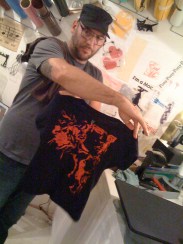
Matteo in action, My Trick Pony
Pahole’s pictures take beautifully to the to the t-shirt medium, with their lacy imagery gaining an added layer of feathery abstraction when rendered in metallic glitter.
Gallery proprietor Matteo is masterful on the hot-press, with a keen eye for the proper placement of the picture on each individual shirt.
At the show’s reception he whipped through the creation of several dozen shirts in the space of a couple hours, expertly applying Pahole’s ethereal drawings onto each garment.
Pahole’s exhibit continues through June. Stop by for your own custom t-shirt; visit My Trick Pony’s website for more information.
Pahole has also been tirelessly advocating for the Wat Mongkolratanaram Thai Buddhist Temple in Berkeley in its struggle for religious and cultural self-determination. For more than a year the Temple has been in conflict with some of its immediate neighbors who object to the smell, congestion, and lack of parking during the Wat’s Sunday food sharing, which has been taking place since 1994.
Part of the Buddhist tradition of merit-making, the food sharing raises operating funds for the Temple and supports the monks in residence. The Temple has made numerous concessions to the neighbors’ demands, including reducing by half the hours of the food offerings, providing alternate parking spaces for visitors, and increasing trash pickup on Sundays.

Save The Thai Temple poster, 2009
Neighbors claim that the Temple is running an unlicensed restaurant on its grounds, but the Temple maintains that the food offerings are an important part of its religious traditions. As outlined in a recent Wall Street Journal article:
Abbot Tahn Manas, who has lived at the temple for 22 years, says the event is critical to the Buddhist religious practice of “earning merit.” Monks are forbidden by their religion from earning money or accumulating earthly goods on their own. Providing for monks and temples is the religious duty of Buddhists of the Theravada school; it helps them build goodwill for later in life or for the next life. In Thailand, they earn merit by giving money to monks in the street. Berkeley Buddhists earn merit by volunteering at brunch, thereby serving the temple.
“Our Sunday activity is pretty much like Christians going to church every Sunday,” says Abbot Manas. “Without it, it would be very difficult for us to continue merit making.”
There’s also more than a bit of cultural insensitivity in the neighbors’ complaints, including the accusation that the glorious scent of Thai food is intrusive and offensive. As Veena Dubal notes in Asian Week,
“It smells like coconut milk!” Dubal said. “When I heard those remarks, I felt a tinge of pain. That kind of … xenophobic rhetoric has no space in this diverse community.”
About 20 neighbors continue to pursue their actions against the Temple; in contrast, more than 2000 people have signed a petition in support of the Temple and its facebook group has more than 1400 members.
The Temple hopes to build a new sanctuary on its site, for which it recently has received approval from the Berkeley Zoning Adjustments Board (ZAB). However, the Temple faces an appeals hearing before the Berkeley City Council meeting in July 2009, during which the Council can approve or deny the ZAB ruling. The exact time and date for the hearing will be posted on the Save The Thai Temple website as soon as that information is known.
Violence Grows: Kinatay and the Abduction of Melissa Roxas

Kinatay, still from movie, 2009, Brillante Mendoza
When I first read the description of Pilipino director Brillante Mendoza’s new film Kinatay (Butchered) I thought, “That sounds kind of wack.” Shot on HD video with a budget of $100,000, it’s a down-and-dirty, graphic representation of the rape, murder and dismemberment of a prostitute in the Philippines through the eyes of an idealistic, greenhorn cop. The controversial film just won the Best Director award at the 2009 Cannes Film Festival, where the announcement of the award was greeted by boos and gasps of shock. Roger Ebert calls it “the worst film in the history of the Cannes Film Festival,” and extensively details his disdain for the picture in his blog.
But after I read a few interviews with Mendoza about the film, I started to change my opinion of it (though still sight-unseen; the film will probably receive pretty limited distribution in the U.S., if at all). Mendoza claims that the movie is based on a true-life event and that it reflects the rampant police corruption and unchecked military violence in the Philippines. “This is not just entertainment, these kinds of stories are real,” Mendoza said after winning his award at Cannes.

Surface Melissa Roxas, online poster, 2009
This was borne out by an email blast I received on the same day that Kinatay won at Cannes. On May 19 Pilipino American Melissa Roxas, a poet and human rights activist from BAYAN-USA, a non-government organization (NGO), was kidnapped along with two co-workers while doing volunteer health work in the Tarlac Province in the Philippines. The email I received stated that BAYAN-USA was mounting a campaign to demand the Pilipino government aid in searching for and surfacing her. Thankfully, Roxas surfaced after a week of captivity, although her compatriots are still missing. What’s interesting in light of the accolades that Kinatay received is that Roxas and BAYAN-USA have claimed that she was abducted and tortured by the Pilipino police and military and that this event is the latest in a series of abuses against political activists by government agencies in the Philippines. The New York Times notes:
“According to the human rights group Karapatan, more than 200 Filipino activists have been kidnapped and never heard from since 2001, the year President Gloria Macapagal Arroyo came to power. Others have turned up dead or showing signs of torture.”
If the claims by Roxas, Karapatan, and BAYAN-USA are true, then Mendoza’s film takes on an added significance. Most of the film’s detractors criticized it for its graphic, unvarnished depiction of violence and brutality, with Ebert in particular scorning its rough-hewn soundtrack and cinematography. What Ebert might not understand is that Mendoza is making a conscious decision not to sanitize the film’s violent events. Movie violence is nothing new, but it’s usually presented with a patina of glamour and unreality, an aestheticization that distances the viewer and sanctions the viewing of the violence, making it an acceptable form of entertainment.
By denying his film the glossy sheen of conventional filmic violence, Mendoza forces viewers out of their complacent moviewatching habits, taking them out of their comfort zone and making them realize that, as in the case of Melissa Roxas and many others around the globe, violence is not a form of entertainment but a dire part of everyday life. In this case, Mendoza is working toward the same goal as Roxas—to expose and eradicate the corruption and human-rights abuses of the power structure in the Philippines.
UPDATE: Here’s the transcript of Melissa Roxas’ June 28 press conference in which she describes her ordeal.
Da Hil Sa’Yo: The Passing of Al Robles
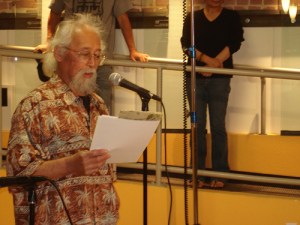
Al Robles brings it, Manilatown Heritage Foundation
I’d only met Al Robles once or twice, but his voice was one that I’d known and carried with me for years. He was prominently featured in The Fall of the I-Hotel, Curtis Choy’s seminal documentary about the long fight to preserve low-income housing in San Francisco’s Manilatown against the onslaught of business interests and developers. The film showed Al alongside his fellow manongs as an organizer and activist in the struggle, and one of the movie’s highlights is his reading of his sublime and evocative poem International Hotel Night Watch, just before all hell breaks loose in the midnight eviction of the I-Hotel tenants. At one point Al’s mellow, emotional voice sings a line from Da Hil Sa’Yo (Because of You), which Choy uses as an ironic refrain throughout the film. I’ve shown The Fall of the I-Hotel every semester for more than a dozen years in my Asian American Film History class and even now I can hear Al’s voice singing that song in my head. Because I’ve seen the film so many times I’ve learned the song by heart, though I speak no Tagalog, and it moves me every time I hear it.
As we all know, after the 1977 eviction the original I-Hotel was demolished in 1981, but through their tireless vigilance community activists, including Al Robles, managed to block the construction of a commercial building and a parking lot on the site. Due to these ceaseless efforts, in 2005 a new International Hotel finally opened, with the Manilatown Heritage Foundation (MHF) on the ground floor and 105 units of low-income housing above. Though nearly three decades had passed since the eviction, two former tenants of the original I-Hotel moved into the new building, along with other low-income senior citizens.
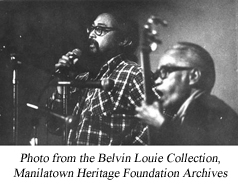
Poet Al, ca. 1975
Last year I took one of my classes to the MHF and there was Al, big as life, chatting with the art gallery staff. I immediately recognized his bushy ponytail and beard, but it was his distinctive voice that confirmed to me his identity. My students and I were a bit starstruck and no one wanted to approach him and say hello, but after a while some of them got up the nerve to introduce themselves and ask him what event he was there for. “Nothing special, I’m just hanging out,” Al genially replied, smiling broadly and shaking everyone’s hands. He went on to explain that he stopped by pretty often just to visit and check in with what was going on at the MHF. After so many years of struggle, maybe he was still savoring the fact that in this case the good guys had won, and that we could chalk up one on the side of justice. Al was an integral part of that victory, through his poetry, his advocacy, and his activism. I’m glad I’ll always have his voice with me.
Update: Here are some nice tributes to Al at various blogs.
RJ talked to Al about being a writer.
Barbara has several poems she wrote for Al.
Mark documented Al’s memorial at MHF.
Theo’s podcast for Al
Alana Robles has a central site for remembrances of Al.
UPDATE 2: Just because it’s divine, here’s Nat “King” Cole’s version of Da Hil Sa’Yo, live in Manila c. 1961. Listening to King Cole’s silken voice tickle this song is heavenly.
UPDATE 3: Briefly stopped in at the massive Al Robles memorial on Sunday at the SOMARTS Gallery and I’m happy to report that Phil Chavez performend “Da Hil Sa’Yo” on his ukelele. Phil noted that this song and “Over The Rainbow,” which Phil also sang, were two of Al’s favorites. It was nice to see folks out in force at the memorial despite the 90 degree heat in San Francisco.
Da Hil Sa’Yo (English translation)
Because of you, there’s a joy in living
Because of you, ‘till death (you) must realize
In my heart I know there is only you
And ask my heart, you’ll know that this is true
Long have I endured in my life
The pain and sorrows from love arise
Then you came and redeemed me, my dear,
My only hope in my darkest fears
Because of you, I found happiness
That to you I offer this love that is so blessed
Though indeed I may be a slave for loving you so true
It matters not to me, ‘cause everything’s because of you
Da Hil Sa’Yo (original tagalog)
Dahil Sa’yo
Sa buhay ko’y labis
Ang hirap at pasakit, ng pusong umiibig
Mandin wala ng langit
At ng lumigaya, hinango mo sa dusa
Tanging ikaw sinta, ang aking pag-asa.
Dahil sa iyo, nais kong mabuhay
Dahil sa iyo, hanggang mamatay
Dapat mong tantuin, wala ng ibang giliw
Puso ko’y tanungin, ikaw at ikaw rin
Dahil sa iyo, ako’y lumigaya
Pagmamahal, ay alayan ka
Kung tunay man ako, ay alipinin mo
Ang lahat ng ito, dahil sa iyo

 beyondasiaphilia
Recent Comments