Posts filed under ‘visual art’
Blood Red and Going Down: Tank Man In Tiananmen Square, part 2

Tank Man - lone citizen vs. PLA tanks, Tiananmen Square, 1989, Jeff Widener
I confess to being taken by melancholy this week as I recalled the events on June 4, 1989 in Tiananmen Square in Beijing. But it’s a good opportunity to think back on those fateful days from a perspective of twenty years later.
In the six weeks prior to when things all went to hell on June 4 two decades ago, students and workers were peacefully occupying the Square and sympathy was growing across China for their demands for reforms to China’s political and economic systems. Sometime during those six weeks I remember talking on the phone with my friend Rebecca. We thought we were witnessing a revolution in the works and that the Chinese people’s voices would surely be heeded.
Terribly, things turned out differently than we’d hoped and the insurrection was violently crushed by the tanks and guns of the People’s Liberation Army. More horribly, the numbers of the dead were never confirmed, as many bodies were burned in mass cremations, and many other demonstrators were taken elsewhere for execution. China’s official tally of those killed was a ridiculously lowball count of 241 people, most of whom were deemed by the government to be “ruffians” and “armed thugs” who weren’t actually students. The government also claimed that no one was killed in the Square itself. Other estimates by NGOs on site range from 500 to 7,000 people killed that day.
This morning Rebecca forwarded me a link to a project by artist Michael Mandiberg that utilizes the famous image of the Tank Man, the anonymous protestor who blocked a column of tanks the day after the PLA cleared Tiananmen Square of demonstrators. Four years ago Mandiberg conducted an experiment in which he sent copies of the Tank Man image to a dozen commercial artists in China and asked them to paint a replica of the picture. The responses from the artists suggest that some if not all of them were unaware of the image and its historical context, and few knew its source.

Tiananmen Square: You can add the person to painting when you get it, 2005, Michael Mandiberg
Mandiberg notes:
“Of the dozen requests I sent, most were returned with a price and the universal salutation “it is a pleasure to do business with you.” A few painters suggested I just leave the man and the lamp post out, often for unclear reasons: political or aesthetic? One person outright declared that he could not paint the image.”
In the West the image of the Tank Man is well-known, as photographs and video footage of his actions that day were widely disseminated throughout the media at the time. However, in China the image is largely unrecognized, due to the government’s attempts to erase the June 4 events from public memory.
The government has achieved this in part through its severe restrictions on Internet access. In recent days, in an attempt to prevent the Chinese citizenry from getting to online discussions of the Tiananmen Square killings, the Chinese government blocked access to twitter, facebook, and other social networking sites, as well as blogging sites such as wordpress, xanga and blogspot.
But before we go too far in excoriating the Chinese government for its erasure of June 4, let’s remember that historical amnesia is not unique to China. Many World War II Nazi concentration camps sites in Europe have been razed or otherwise obliterated. The Japanese government still hasn’t acknowledged the Rape of Nanking. And lest we start to feel too pleased with ourselves here in the U.S. let’s not forget the Bush Administration’s multiple attempts to rewrite reality, from un-defining waterboarding as torture to linking Iraq to the destruction of the World Trade Center.
So on this grim anniversary it’s vitally important to remember the untold numbers of demonstrators who were silenced twenty years ago on Tiananmen Square. But it’s also significant to note that the Chinese government doesn’t stand alone in its disregard for facts and that our constant vigilance is required to keep ignorance and the obliteration of history at bay.
UPDATE: Thanks to dleedlee for sending along the following information, which fills in some of the backstory of the Tank Man photos and video.
FYI, Frontline is rebroadcasting its The Tank Man program this week.
Also, a New York Times blog posted this interesting piece on the various versions of the ‘tank man’ photo(s).
http://lens.blogs.nytimes.com/2009/06/03/behind-the-scenes-tank-man-of-tiananmen/
And artist Michael Mandiberg sent me a further link to his flickr site, which contains all of the images from his series:
http://www.flickr.com/photos/theredproject/sets/72157619172370116/
Hawai’ian Eye: Asian American Studies conference

AAAS conference back porch, 2009
Just got back from the Association of Asian American Studies annual conference, which this year was held in Honolulu, HI. Needless to say it was a very well-attended event, taking place a block from the beach in Waikiki. I myself confess that the percentage of time I spent swimming in the ocean vs. attending panels and roundtables was pretty much skewed toward boogie boards and sandcastles, but I’d brought my kids along so I had an excuse.
I did manage to tear myself away from skimming stones and walking in the sea foam to attend a few presentations, however, and participated in a couple as well. UC Berkeley’s Elaine Kim organized a great panel, Bollywood, Believing Women, and the Female Bin-Laden, which included Huma Dar’s pointed critique of Hindi-language films that demonize Muslim men and exoticize Muslim women. Filmmaker and scholar Irum Sheikh displayed several images of “disappeared” individuals who have been detained by the U.S. government, many held for years on flimsy or nonexistent charges in the “war on terror” perpetuated by the Bush regime. Her straightforward and unvarnished presentation made an unimpeachable case against a foreign policy gone horribly awry.

Dawn Mabalon & Allyson Tintiangco-Cubales, fedora'ing
I also ran into several former students, now all grown up, including Sudarat Musikawong, who’s a prof at Willamette University, Mitch Wu, now teaching at SUNY Hunter, Carolyn Tran, about to enter grad school at the New School for Social Research, Margaret Rhee, poet & PhD candidate at UC Berkeley, and Celine Parrenas-Shimizu, who’s a superstar professor at UC Santa Barbara and whose latest tome, The Hypersexuality of Race, won one of conference’s book awards this year. Plus, as at any good Asian American gathering, I spotted several people in felted hats, further supporting my contention that Asian Americans love stylish headwear.
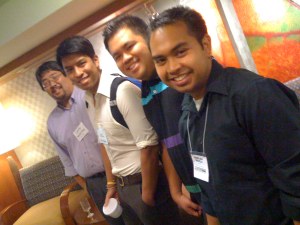
Lawrence Hashima, Pahole Sookkasikon, Kevin Lim & RJ Quiambao rock the house, AAAS 2009
I also took along a couple grad students from SFSU to present their research on a panel called Assimilation, Rice Queens, Porn, and the Mainstream: Constructing Media Images, which, in keeping with scholarly tradition, wordily includes a term from all of the panelists’ papers in its title. Pahole and RJ from SFSU and Kevin from UH Manoa rocked their presentations and made me feel like a proud mother fawning over her young. It ain’t easy covering topics ranging from “The King and I,” Asian & Hawai’ian women in online porn, and a new framework for Asian American cinema, but the guys pulled it off with flair. Larry Hashima provided excellent feedback and tied together the panel in style.
I also organized a panel called Art and the Academy: Working Artists In Asian American Studies wherein I talked about the legacy of creative work in SFSU’s Asian American Studies Department and outlined the production of POP! Producing Our Power: Presenting Asian American Culture, a student-run show at SFSU that asks the age-old question, “What is Asian American culture and how can we express it on stage?” Also presenting their awesome social practice projects were brilliant artist-scholars Ming-Yuen S. Ma, who talked about his amazing video art bus tours through Los Angeles, and Gaye Chan, chair of the Art Dept. at UH Manoa, who described her guerilla gardening project, Eating In Public. Both projects are unapologetic blows against the empire that conclusively prove that artists are indispensible in the battle against tyranny and injustice.
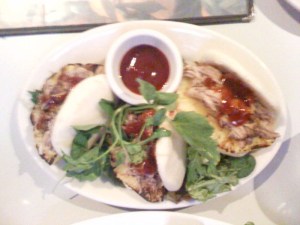
Sliders, Hawai'ian style, Sidestreet Inn, Honolulu
On the recreational tip, I managed to have shave ice nearly every day, though the Waikiki version is pretty tepid. The killer stuff is found on the North Shore in Haleiwa, at Matsumoto’s, where the sour lemon, lilekoi, and coconut combo I tried was stunning. Back in Honolulu, good eats were to be had at Sidestreet Inn, a formica-table sports/karaoke bar that serves up some of the best Hawai’ian food around, including excellent ahi poke, kahlua pig sliders, and fried chicken wings.
So despite my struggle to resist the lure of the beach and do my academic duty, the trip was pretty fun. I’m glad to be back in my cool grey city of love, but I sure do miss swimming in the tropical sea every day.
The Tyranny of Beauty: transPOP! Korea Vietnam remix

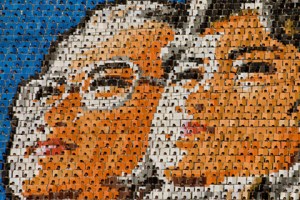
Area Park, Three second-frozen defectors from North Korea, 2006, transPOP! Korea Vietnam Remix
Just got back from the symposium attached to the awesome art exhibition, transPOP! Korea Vietnam remix, which is at the Yerba Buena Center for the Arts in San Francisco through March 15. The show looks at the intersections between Korean and Vietnamese pop culture through the eyes of several visual artists from Korea, Vietnam & the U.S. It’s definitely worth a visit for any fans of Korean dramas, Vietnamese movies and Asian pop stars.
Anyways, the symposium today was held at UC Berkeley’s Institute of East Asian Studies and featured heavy hitters like deconstructionist film queen and scholar Trinh T. Minh Ha (who I missed because I had to make pancakes for my kids) and Korean American artist and transPOP co-curator Yong Soon Min. I attended the roundtable discussion about the links between Korean and Vietnamese pop culture, which was pretty great and featured an excellent mashup of Korean and Viet films and dramas that concluded with a music video by The Wonder Girls.
transPOP! Korea Vietnam remix
What I loved most, though, was the same moment occurred that almost always happens when I talk with my fellow academics and scholars about Hong Kong films, or Korean soap operas, or any other form of Asian pop culture. At some point the academic/scholar/intellectual will start to talk about his or her favorite drama/film/idol and will get that same dreamy-eyed look as an adolescent girl when she’s discussing Jay Chou or Takeshi Kaneshiro. It’s usually very brief and it’s followed by a fleeting, giddy smile, then the conversation will quickly return to emotional transnationalism or the crisis of modernity or gender politics. But it always proves to me that we academics are people too, and we’re just as vulnerable to the allure of a beautiful face as anyone else.

 beyondasiaphilia
Recent Comments