Posts filed under ‘movies’
How Can I Miss You When You Won’t Go Away? Edison Chen Sex Scandal

Edison and Ah Gil, cropped, 2008
After several months of quiescence, the Edison Chen sex photo scandal has reared its salacious head again. I’ve resisted writing about it because God knows you can get plenty of information about it elsewhere, but recently this blog has been slammed with hits from people searching “edison chen sex photos” and related terms, even though a previous post only briefly mentioned our boy Edison. It’s probably not significant traffic but it shows that the the subject is still one of the hottest ones on the internets even a year after the whole scandal broke in January 2008. Last year in China Edison Chen was most-searched subject on google and yahoo, ahead of the Beijing Olympics, facebook and iphone. Suffice to say that the Hong Kong public and the media were pretty overexcited by the whole event since it involved pop stars, nudity, adultery, and sex.
Now that Edison’s in a Vancouver court starting to spill the beans about the incident, his fellow erstwhile naked Hong Kong celebrities Gillian Chung and Cecilia Cheung have also started to surface and blab about the whole thing again. Full details as well as hundreds of images from the scandal can be easily found elsewhere but needless to say that last winter the Hong Kong media had a field day when naked sex pictures of several of their beloved idols flooded the internet, all from the misappropriated laptop of rising pretty-boy actor Edison Chen. After about a monthlong firestorm during which a seemingly endless number of the amateur-porny pictures popped up on the web, the whole incident climaxed (sorry) with a grim-faced Chen announcing his retirement from Hong Kong entertainment in order to devote time to “charity work” in Canada. Not to mention fleeing the pissed-off Hong Kong triad members who wanted to chop off one of his hands for killing the careers of several of golden-egg layers like Gillian and Cecilia.
Gillian, aka Ah Gil, aka one half of the phenomenally popular Cantopop girl group The Twins, is now testing the waters for a comeback after last year’s sleazy & unflattering pictures of her and little Edison in flagrante delicto annihilated her image as a squeaky clean Jade Girl. At a recent fashion shoot several smart-ass Hong Kong truck drivers heckled her as she left the photo studio, calling her “naïve Gil.” Maybe she needs to wait a bit longer until things die down some more.

Cecilia talks Edison, February 2009
Meanwhile, Cecilia Cheung, aka 2003 Hong Kong Film Awards Best Actress, aka wife of fellow superstar Nic Tse, has come out of hiding with a high-profile interview on Hong Kong television in which she calls Edison a fake, a hypocrite and a liar. Hey, Cece, what do you really think about him?
For his part, Edison has claimed that he would do “anything” to protect “the ladies” involved, though exactly what that might entail is sketchy. In the meantime he’s publically named five of his partners in the pictures for the first time and claimed that several of the photos were actually taken by the women in question. Way to blame the victim, dude.

Edison cleans up his image, Singapore, February 2009
He’s also been quietly trying to revive his acting career–his 2008 movie The Sniper, which was delayed after last year’s naughty pictures surfaced, is playing at the Hong Kong International Film Festival next month and he recently made an appearance at a Singapore Carl’s Jr., though of course he’ll be donating all proceeds “to charity.” Edison’s mom has also spoken up in support of her boy, saying that Edison would rather go to jail to protect “the girls.” Huh, no kidding.
Anyways, I doubt that a media ho like Edison will be able to resist the spotlight for long. We’ll see how the Hong Kong public responds and if fans forgive and forget, or if they continue to excoriate poor Edison and his compatriots. Either way I guarantee the Hong Kong media will be all over this story until we’re all heartily sick of it.
More on this as it develops, or not, depending on how intense and tedious the media hype becomes.
UPDATE: A quick shout-out to the venerable Hong Kong Movie Database Daily News forum, which provided most of the links and images in this posting. Thanks for being you.

Anthony Wong says, "Keep clear of Hong Kong, Edison"
UPDATE 2: Okay, a quick update after a flurry of useless overreporting. Some killjoy has sent Edison Chen a bullet via the US Mail accompanied by a death threat stating, “We hope Edison Chen will take this warning seriously, otherwise his personal safety will be threatened,” and goes on to make more unfriendly remarks about Edison and his well-being. The ever-sensible Anthony Wong Chau-Sang, who is Edison’s godfather, commented, “This time they send a bullet, next time they send a bomb?… When I meet Edison for a meal he will have to wear a bullet-proof vest and helmet!” Anthony had previously warned Edison to stay out of Hong Kong or he’d kick his ass. Tough love from the Bunman.
81st Academy Awards: Slumdog Takes It

Azharuddin Mohammed Ismail, Slumdog Millionaire, 2008
Crazy as this may seem, tonight I was rooting for a movie I have yet to see. And when Slumdog Millionaire won Best Picture I was jumping-out-of-my-seat happy. Identity politics at its worst? Maybe—but for me it was the joy of seeing Bollywood invade Hollywood, and Asians in the inner circle at last. (My heart was broken a couple years ago when Brokeback Mountain lost to Crash, not only because Brokeback was a much superior film but because I feared that homophobia as well as racism might’ve contributed to its defeat.)
The night started with a series of small wins for The Curious Case Of Benjamin Button and I fretted that it might be business as usual on Oscar night again, with the bland, big-budget, eurocentric Hollywood product taking the evening’s prizes. But at some point in the evening Slumdog started to pick up some awards and I started to feel a bit more hopeful. Then when composer A.R. Rahman won for Best Score and gave his acceptance speech in English and Tamil, followed shortly by Slumdog’s Danny Boyle taking Best Director (plus the film’s five other subsequent awards), I sensed the tide was turning. And, though it had nothing to do directly with Slumdog, when Sean Penn won an upset Best Actor victory against favorite Mickey Rourke, and gave a shout-out to our “elegant’ new President as well as calling shame on those who supported Prop. 8, I knew there was a paradigm shift in the making. Slumdog won the big prize immediately afterwards and the evening was complete.
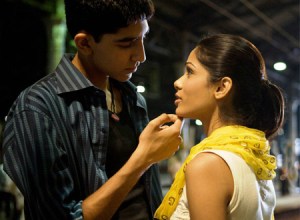
Dev Patel & Freida Pinto looking pretty, Slumdog Millionaire, 2008
So tonight was a great win for Asian cinema, even though Slumdog is directed by an Englishman and strictly speaking, isn’t a Bollywood product. But its subject matter, stars, themes, and aesthetic are decidedly South Asian and the fact that the Academy chose to honor it over Brad Pitt’s conventionally Hollywood star vehicle seems somehow significant to me. Dare I say that it reminds me of Barack Obama and the barriers he’s shattered with his election? Some might argue that equating the Best Picture Oscar with the election of the U.S. President is a bit of stretch, but I’m in the business of cultural criticism and I think Slumdog’s victory is pretty relevant. It was thrilling to see the huge Slumdog contingent, British, Indian, and everything in between, up on the stage at the Academy Awards, which is the primary symbol and celebration of Hollywood’s cultural hegemony. So, yeah, I need to watch Slumdog soon, but because of its big win tonight, I feel like I’ve already seen what I need to see. In some small way, tonight the margins have moved a bit closer to the center.

The Slumdog crew at the Oscars, 2009
UPDATE: Breaking it down, via The Inspired Economist–a good, measured discussion of Slumdog, including a mention of the the film’s “poverty porn.”
Triumph In The Skies: A Different Kind of Tension

Francis Ng gazes soulfully, Triumph In The Skies, 2003
Gotta say that, despite myself, I really liked this series. It’s one of the most popular dramas ever made in Hong Kong and it made stars out of several of its younger cast members (notably the Solar 4 or S4—Bosco Wong, Sammul Chan, Ron Ng and Kenneth Ma) when it was first aired back in 2003. But it also made Francis Ng into a major idol, which, although he’d won acting awards and starred in many HK movies, he’d never been before in his home territory. His role as Sam Tong, the principled and upstanding pilot of the fictional Solar Airways, was a killer star vehicle for him and allowed him to showcase his great dramatic range to a hometown audience who had been mostly “meh” to the idea of him as a heroic figure.
The show is pretty expensive by TVB standards, with location shoots in Italy, Japan, and Australia, and has a huge and fairly decent cast including TVB queen Flora Chan as well as Francis as star-crossed lovers. Cinematography, art direction, lighting, and direction are all solid and the storyline isn’t too cringeful, although of course there are classic melodramatic moments including several hospital and near-death scenes, many love triangles, and various other common soapy contrivances. But a lot of the show concentrates on the professional training of airline pilots, which is presented in a surprisingly gripping manner and is deftly interwoven with the crisscrossing romantic storylines.

Fly me, Triumph In The Skies, 2003
The plot revolves around the lives of various people working for Solar Airways in Hong Kong’s International Airport, including pilots, flight attendants, and ground crews. Sam (Francis Ng) and Belle (Flora Chan), the main characters, meet by chance in Rome and, after chasing through the city in a series of coincidental meetings, hook up and have hot (off-screen) sex. But a plot contrivance drives them apart and the next time they see each other Belle is dating Sam’s best friend and fellow pilot Vincent (Joe Ma). The rest of the series pretty much follows Sam and Belle’s attempts to resolve the mess of their relationship and their unrequited desire for each other.

Flora & Francis get friendly, Triumph In The Skies, 2003
Francis Ng puts in an amazingly disciplined performance—he sustains his character over the course of 40 one-hour episodes and actually shows a believable growth and change, while remaining true to the character’s organic persona. He also proves that he can convincingly play a romantic lead and it’s difficult to imagine that this is the same performer who tore up the scenery playing hard-ass killers in movies like The Mission, Exiled, and Young And Dangerous. The character of Sam could have been an insufferable, controlling bore but Francis makes him intriguing, sympathetic and ultimately loveable despite his restrained personality. This is most evident in Sam’s relationship with Zoe, the younger woman who chases after him and eventually wins his affections. In the hands of a less skillful actor this May-December relationship could have gone horribly wrong but Francis convincingly moves from a reluctant target of Zoe’s affection to gradually becoming a willing partner in the relationship. The show also directly addresses the fifteen-year age difference between the two characters, with running commentary throughout the series on the difficulties of this seemingly mismatched pair finding harmony.
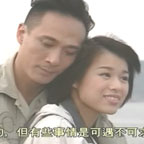
Francis makes Myolie into a decent actor, Triumph In The Skies, 2003
At some point the series basically becomes The Francis Ng Show, with long stretches of the plot devoted to his character’s activities. But it’s a credit to the screenwriters that when the focus shifts to other characters and their storylines the show remains engaging. Francis is clearly the best actor in the program but for the most part the rest of the cast holds up pretty well to his star-power and acting chops. He has an uncanny knack for intently listening to and playing off of his fellow actors, elevating and enhancing their performances by his subtle and effective responses. This almost seems to make the other actors get better as the show progresses, as they rise to the occasion of working with a truly talented performer. Ron Ng, one of the young turks who became a star after appearing in this show, starts out the series as a stilted and wooden performer. By the end of the series he’s learned some skills and exudes a decent amount of on-screen presence. Likewise, Myolie Wu as Zoe, one of Francis Ng’s love interests, begins the show by ceaselessly mugging and overacting her ingénue role–by the series’ end she’s become a much more nuanced and affecting performer. Her concluding scenes with Francis are fairly moving and I can’t help but think that she learned something by working with him. Francis gets to cry a few times, too, which he does with absolute conviction.
There is also an absolutely fabulous cameo by veteran HK actress Helen Law Lan, who was so great in Bullets Over Summer, as a complaining customer of Solar Airways. She and Francis have a couple divine scenes together which showcase their sublime comic timing and acting skills. Young and Dangerous fans will also spot Jerry Lamb, aka Piggy, who is very good in a supporting role.

Little Francis happy at last, Triumph In The Skies, 2003
SPOILER: Francis also gets the opportunity to be happy at the end of this show, and his joyous smiles at the program’s climax made me realize a couple things: a.) he’s got a really nice smile, and b.) I really can’t think of any movies I’ve seen him in where he gets to be genuinely joyful. I’ve seen at least fifty Francis Ng flicks by now and most of them are dark, violent crime dramas where he comes to a bad end. Even the ones where he doesn’t die don’t necessarily end happily (see The Mission; A War Named Desire; A Gambler’s Story). His comedies are a different story, but even so, being in a funny movie doesn’t necessarily mean that you get to be happy. I’m actually getting a little tired of seeing Francis die or be tormented at the end of movies and I definitely don’t want to watch any more movies where he’s the bad guy. Thankfully, he seems to be through with playing villains, though I suspect he’ll die in a few more of his films in the future. So it was great in TITS when he not only survives but lives happily ever after, and he gets to flash his beautiful, happy smile. END OF SPOILER
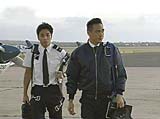
Follow your destiny, Triumph In The Skies, 2003
Strangely enough, the show also addresses, in a soap-opera fashion, the tensions between destiny and free will, delivering a surprisingly cogent and deeply felt commentary on the subject. It was interesting to find thoughtful observations on fatalism versus self-determination in a pop culture production but this was one of the strongest themes running through the show. One of the show’s characters, Belle, believes that life and love are preordained, but it is only through her attempts to take control of her life that she can save herself from despair. Another character, Zoe, feels that she can wrest control of her destiny through the sheer force of her will, but she has to give up control and surrender to her fate before her ultimate triumph. Sam, the character caught between them, is agnostic and rational but he too learns to balance between steering his own life’s path and giving in to forces beyond his control. Not only that but the show also has no real villain to speak of. Instead the characters struggle against their own inner demons and conflicts, and in the end most of them make choices that show honor and growth. This is a refreshing change of pace and, along with the show’s examination of fate and destiny, adds another level of pleasure to the viewing of the program that elevates it beyond the typical television drama.
Apparently audiences throughout Asia felt similarly enthusiastic about Triumph In The Skies. In its first broadcast in Hong Kong in 2003 it had more than a 35% share throughout the run of the series, meaning that more than one-third of all households watching television at the time were tuned in to it when it aired. During its rebroadcast last year in a late-night slot it gained almost a 10% share, nearly unheard of for such a time slot. In most polls it’s consistently rated as the favorite show of Hong Kong television audiences and rumors of a sequel (nixed by most of the cast, including Francis Ng) continue to swirl six years after its debut. It also finally made Francis Ng into a romantic leading man.

Francis and curry puff hairdo, Triumph In The Skies, 2003
NOTE: Francis Ng has a hella weird hairstyle in this show, kind of an asymmetrical pompadour that looks like a throwback to the 1950s crossed with a poodle. It gets a little less absurd and more toned-down as the show progresses but it’s definitely funny to see, especially in contrast to the ultrahip shaggy and dyed-out coifs of the rest of the cast. Of course Francis makes the retro hairdo work, and ultimately it becomes an unspoken commentary on the character’s somewhat anachronistic sense of honor and the way that he’s out of step with many of the other characters in the show. Not surprisingly, Francis purportedly designed the hairstyle himself–
UPDATE: Apparently back in December 2008 TVB put both Ron Ng & Myolie Wu on what they call the “retrenchment” list, which means they’ve moved back from lead to supporting roles. I’m not sure about the specifics but it looks like their fifteen minutes are over. Hasta la vista, baby–
UPDATE 2: For my comments and review of Triumph In The Skies 2 go here.
Salty Pork Hand
Learned a new phrase today that I love—salty pork hand. It’s the literal translation of the term for pervert in Cantonese and it’s been featured in the latest television idol kerfuffle in Hong Kong, wherein a blind gossip item has implicated a mysterious male TVB “artiste” in groping a couple female starlets. It’s got the internets abuzz over there, with top male stars like Joe Ma and Moses Chan avidly denying that they are the salty pork hand in question.
So who else is a salty pork hand?

Edison, Bobo Chun, and little edison, 2007
Edison Chen? For being a raging exhibitionist and non-consensually exposing his many girlfriends’ ungroomed pudenda to international scrutiny?
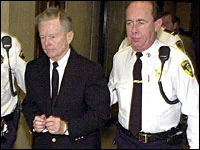
Father Geoghan busted, 1991
Father John Geoghan and too many of his fellow priests, for serially molesting little boys?
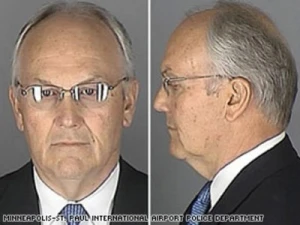
Sen. Larry Craig mugs for the camera
Sen. Larry Craig, for denying he likes sex in public toilets?

R. Kelly, prisonwear
R. Kelly, for liking it like that with underaged girls?
Who’s your nominee for salty pork hand?
UPDATE: Looks like whistleblower Kingdom Yuen (gotta love those English names the HK stars pick) has backed down from her original accusations and that TVB is trying to sweep the whole salty pork hand incident under the rug. Which means the speculation can continue unabated, of course, since Hong Kong pop culture loves a sex scandal. But it seems like without solid incriminating evidence this one may not get as much mileage as last year’s Edison Chen sex picture incident, which was the best scandal to come along in decades.
UPDATE 2: If anyone knows the Cantonese etymology for the term “salty pork hand,” please let me know. We are all dying to find out.
UPDATE 3: Looks like TVB’s Salty Pork Hand is Ellesmere Choi.
And my friend Jay Chan in Hong Kong translates the term as “salty wet hands.” Eeeewww.
UPDATE 4: Another “salty pork hand” has emerged on the Hong Kong scene, through another mysterious blind item. The start of a trend?
UPDATE 5: Wongsaurus over at LoveHKFilm breaks it down like this:
Not familiar with “salty pork” only “salty wet” but this sexual harassmen thing is obviously about non-consensual touching and groping.
Salty = Hom
Wet = Sup
Sow/Sou = Hand
Hom + Sup = Compound word (slangy) for Horny, Dirty (as in sexually dirty), pornographic, lewd and lascivious. [There are other more proper terminology for tawdry and sexual nasties and one example is uttered in the movie Crazy “N The City during the double-decker bus scene with Eason Chan, Chloe Chiu, and the masturbating pervert passenger.]
Please note that my romanization of Cantonese may not be accurate Yale or Wade-Giles.
Thus Hom + Sup + Sou suggests that someone did some nasty fondling. We’re all adults here so we leave it to your imagination.
Film review: Scott Walker: 30 Century Man
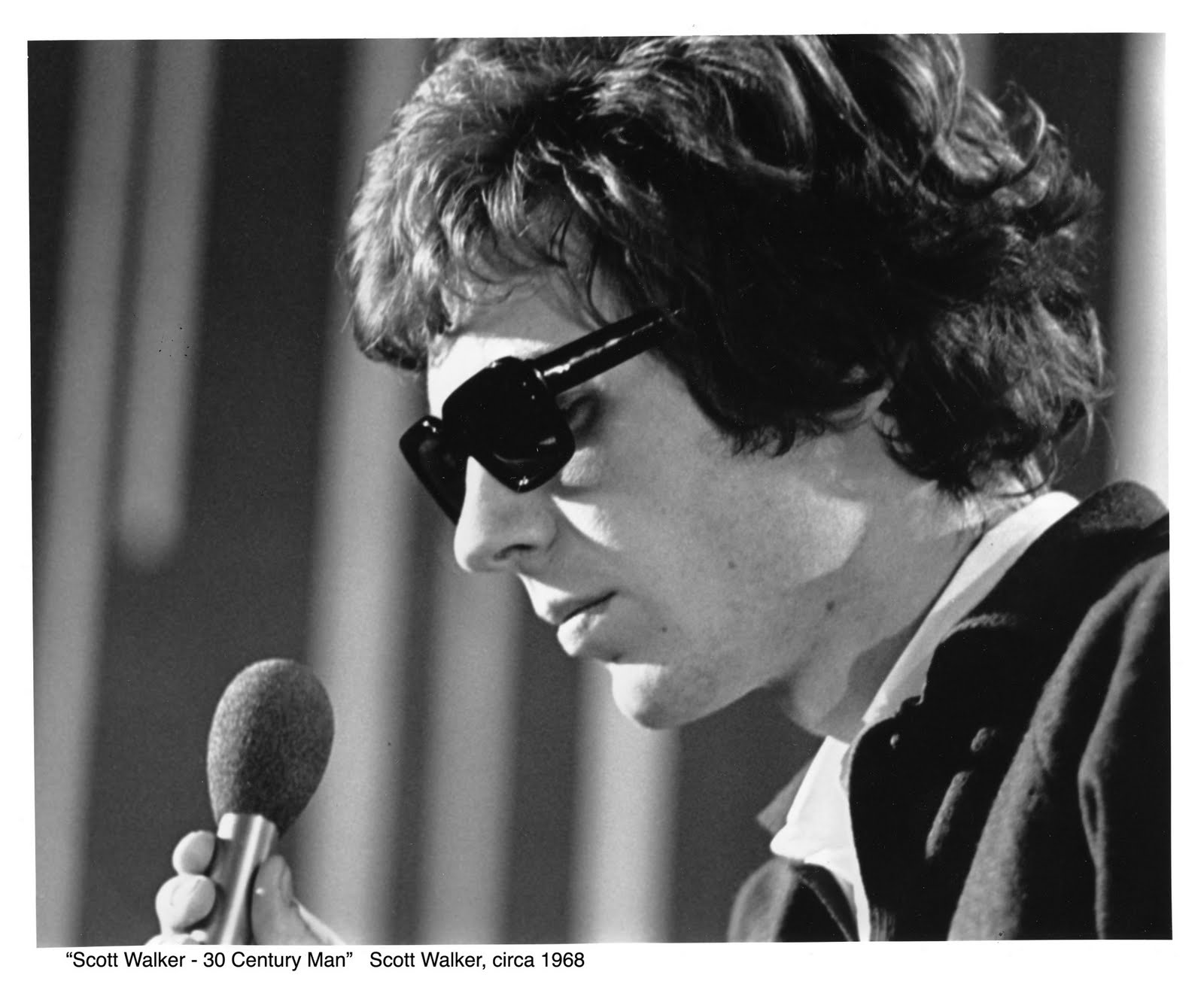
Scott in shades
Just saw the documentary Scott Walker: 30 Century Man last night with my pal Danny P. I’ve been waiting for the film to get Stateside distribution for a while (it was completed a few years ago and has been cruising the festival circuit since) so needless to say I was pretty excited to finally see it. At one point a few months ago I almost broke down and bought the movie on dvd but, being a big-screen kind of person, I’m glad I waited. (I think a film-watching experience is almost always enhanced by seeing a movie in a room full of people–for instance, seeing the excellent Arlene Dahl flick Wicked As They Come last Saturday at the sold-out Castro Theater with 1,400 other noir-crazed people was infinitely more thrilling than watching it alone in my house on Turner Movie Classics—but I digress).
Anyways, 30 Century Man traces the career ot Scott Walker, one of the greatest pop singers you’ve probably never heard of. With his 1960s trio The Walker Brothers (not really brothers, and not really named Walker), Scott busted open the British pop charts with a string of top ten hits including the soaring Burt Bacharach ballad Make It Easy On Yourself and the peppy gloom-pop classic The Sun Ain’t Gonna Shine Any More, both number one singles in Britain in the mid-sixties. Both Scott and his nominal brother John were pretty young things and they quickly became the subject of much teenybopper love in the two years that they were topping the UK charts. Scott in particular was an object of desire, not only for his blond Beatle bob but for his sweetly melancholic baritone voice and his talent for imbuing banal pop tunes with a suffusion of emotion and depth. Through interviews and archival footage the film does a good job depicting the substantial Walkermania in the UK at the time.

The Walkers with birds, 1967
After the Walker Brothers broke up in 1967, Scott reached a creative peak in four solo albums that contained a mix of orchestral pop songs ala Dusty Springfield (he shared the same producer, Johnny Franz, with the equally brilliant, mercurial Springfield), Scott’s own self-penned, poetic musings, and several covers of the songs of Belgian music-hall singer/composer Jacques Brel. The first three of these esoteric collections climbed high on the British charts, but the fourth, consisting only of Scott’s own compositions, failed miserably. Scott’s career went into eclipse until 1981, when The Teardrop Explodes’ frontman Julian Cope (amusingly described in the film as “a foremost expert on Britain’s stone circles”) packaged several of Scott’s songs in a none-too-subtly titled compilation, The Fire Escape In The Sky: The Godlike Genius of Scott Walker. Suddenly, after nearly 15 years, Scott Walker was cool again.
30 Century Man includes interviews with a veritable who’s who of edgy British pop singers—Jarvis Cocker, David Bowie (who also executive-produced the movie), Brian Eno, Marc Almond, Ute Lemper and a host of others—who speak admiringly of Scott’s singing and songwriting. The film utilizes the interesting technique of shooting each person listening intently to a Scott Walker song, their faces transformed by pleasure or emotion. As one who has been repeatedly captivated by Walker’s recordings, particularly Scott’s rich, lavish mid-sixties solo albums, I found these passages to be particularly effective in capturing his music’s ineffable allure.
The latter portion of the film focuses on Scott’s last three solo albums, starting from 1984 and released over a span of 22 years (!). During that period Walker’s music took a severe left turn and these collections are dark, haunting, and decisively anti-pop and anti-commercial. In the film Walker states that once he’s finished a recording he never listens to it again, and certainly some people feel the same way about this part of his oeuvre (a quick peek at Metacritic’s user comments of his last album, The Drift (2006) reveals only two ratings, 10 or 0, with almost no middle ground).
Scott Walker wails, 2005
30 Century Man features an extensive interview with Walker who, for a renowned recluse, is very affable and articulate. Now in his sixties, Walker retains his Midwestern twang (he was born in Hamilton, OH) and resembles a grown-up Opie from The Andy Griffith Show. The film nicely intercuts Walker’s intelligent and straightforward commentary with footage documenting the wacky process of recording The Drift, which included a percussionist pummeling a slab of ribs, a metal garbage can being slammed on a large wooden box, and an orchestral string section being asked to replicate the sound of tanks approaching from fifty meters away. Subject matter ranges from the collapse of the World Trade Center to Elvis Presley’s dead twin to Mussolini’s mistress, who insisted on being shot with her lover.
Like Scott himself, 30 Century Man is coy about revealing the personal details of Walker’s life, instead focusing on his creative output. While some might find this a flawed strategy, in a mediaworld littered with Behind The Music and The Osbornes, I though it was a refreshing change of pace. In the end, it’s all about the music, and that’s fine with me.
Three phases of Scott Walker’s career:
Early
Middle
Late
Quickie fangirl post: teaser trailer for new Francis Ng 吳鎮宇wuxia movie Tracing Shadow 追影

Francis Ng & deadly chopsticks, Tracing Shadow 追影, 2009
Just wanted to fire off a fast post about the appearance of a new, very brief teaser trailer (see below) for the upcoming Francis Ng wuxia pic Chasing Shadows. Looks like the movie will be full of the old-school 1990s style wire-fu & special effects that I cut my teeth on back in the day.
The very first Hong Kong movie that I saw long ago at the Roxie Theater in San Francisco was A Chinese Ghost Story, with its amazing action choreography by the great Ching Siu-Tung. His trademark style includes lots of beautiful night photography, swirling fog, gravity-defying synchronized stunt performers, flowing robes, and flying people bounding over rooftops and through forests. He’s the action director for classics including Swordsman 2, New Dragon Inn, and House of Flying Daggers, among many more.
Chasing Shadows, in which Francis Ng not only stars but codirects, with Marco Mak, looks like a throwback to those glorious movies. According to news sources,
“As a form of tribute to past wuxia films, not only does the film contain various well-worn wuxia elements, but it also has the protagonist, his nemesis, and the four exponents named directly, onomatopoeically, metaphorically, in part or combination after the famed wuxia directors: Chang Cheh, Li Han Hsiang, Tsui Hark, Chor Yuen, Sammo Hung, Liu Chia Liang, Tong Gai and King Hu, possibly with some of them doing cameos.”
The movie also stars Jackie Chan’s son Jaycee Chan and Pace Wu. Ching Siu-Tung’s protege, Ma Yuk Sing, is the action choreographer for Chasing Shadows and Ching’s influence is pretty clear in the trailer.

The lady in red, Tracing Shadow 追影, 2009
Needless to say, my anticipation meter is off the charts with this one.
UPDATE: According to Twitch, as of late March the film’s title has been altered to “Tracing Shadow 追影,” which I’m not sure I like more than the original. “Chasing” seems a bit more active and dynamic than “tracing,” but I’m not the marketing expert so who am I to say? Looking forward to it at any rate & hoping it rocks.
Here’s the teaser trailer for your viewing pleasure. There’s a very short subliminal of Francis at the very end of the clip fyi.
UPDATE 2: New trailer for Tracing Shadow 追影 below, which lists a July 2009 release date. It’s mostly in Mandarin, except for one cryptic English intertitle that states “kung fu all star,” and seems to be living up to previous reports that the film will be a martial arts comedy. Francis Ng appears briefly about halfway through, getting water thrown in his face, striding across the screen, and later comically twitching his eyebrow. The rest of the trailer heavily features clips of Jaycee Chan, backed by a raucous electric guitar riff, no doubt aiming straight for the lucrative youth market. I’m sure I’m missing lots of other significant information due to my lack of Chinese-language skills–if anyone else wants to fill in the blanks it would be much appreciated.

Director Ng & cast at Tracing Shadow 追影 press conference, June 16, 2009
There’s also a lot of information in the Chinese press this week about the launching of the film’s website but the translation I got through google translate gives me a headache so I can offer little insight. But here’s a picture from the press conference. Francis has his hair in the little topknot he seems to have adopted for his role in Laughing Gor, which he’s shooting at the moment.
UPDATE 3: English translation about the press conference here, plus another view of Francis’ topknot.

Happy Francis with topknot, Tracing Shadow 追影 press conference, June 2009
UPDATE 4: Go here for The Making Of Tracing Shadow 追影. Caveat: it’s on youku.com, the Chinese streaming site, which sometimes loads awfully slow, and the video is all in Mandarin. But it’s got nice behind-the-scenes footage of the movie shoot, with interviews with all of the stars including Francis, Jaycee Chan, and Pace Wu. With the movie being released in just a couple weeks the hype is becoming deafening. Huayi Brothers are obviously banking on this to be a big summer hit and every other day there are more movie stills, interviews, and other fluff about the movie all over the Chinese press. It will be interesting to see the actual box office once the movie’s out.

Tracing Shadow 追影 movie poster, July 2009
UPDATE 5: Here’s the latest Tracing Shadow 追影 poster, and here’s the official website. Navigation is in English, though the movie clips, synopsis and other info are in Chinese. The gallery has tons of stills that showcase the movie’s fancy costumes and art direction, featuring lots of animal furs, elaborate upswept hairdos, and saturated blacks and reds.
twitchfilm.net also has the first English-language review of the film and it’s pretty favorable.
And here’s the cool little music video from the movie—it takes several scenes from the film and incorporates them into a comic-book style layout. The song is Zhui Ying 追影 and the singer is Cong Haonan 丛浩楠.

Francis Ng drowns his sorrows at Laughing Gor: Turning Point premiere
UPDATE 6: Alas, despite the massive hype, it looks like Tracing Shadow has tanked at the box office in mainland China. Apparently it went head-to-head with Wong Jing’s latest inane comedy, On His Majesty’s Secret Service, and lost big time–according to NetEase Enterntainment, OHMSS earned over $100 million yuan at the box office, while Tracing Shadow took in a measly $13 million. Not only that, but Wong Jing apparently claimed in an interview that he wasn’t afraid of duking it out with Tracing Shadow because Francis Ng’s earlier directorial efforts (9413; What Is A Good Teacher; and Dancing Lion) also tanked at the box office. Way to rub salt in the wound, dude! It’s especially painful because earlier Francis had predicted that Tracing Shadow would easily take in at least $100 million. No wonder Francis Ng looked so tweaky at the Laughing Gor: Turning Point premiere. He had probably just heard the bad news about ticket sales for Tracing Shadow.
The film opened today (Sept. 2) in Hong Kong to much less fanfare. Wonder if HK audiences will give their homeboy some support or if the movie will die a slow death in the Special Administrative Region as well.
UPDATE 7: Tracing Shadow just hit the torrent streams so that probably spells an end to any theatrical box office. Some commentators on twitter were less than charitable about the film.
tracing shadow is a very indiscriminate mess
tracing shadow is a lousy movie. i’m sad that I spent more than half an hour to get to this conclusion.
watched the film tracing shadow online, download a waste of time, a waste of computer hard-disk space
You know it’s bad when people who watch the movie for free are dissing it.
But Francis might take some comfort in the fact that On His Majesty’s Secret Service also got reamed by the tweeters:
this is really a rare year of lousy movies—tracing shadow and OHMSS are tied.
Strangely enough, Huayi Brothers might not be too fussed about Tracing Shadows less-than-stellar performance. The film presold to several Asian territories, so chances are that HB got its investment back even before it was released.
Where is the love? The Asian guy in Milk
Kelvin Yu as Michael Wong is not in this picture, Milk, 2008
Don’t get me wrong—I really liked Milk, the new Sean Penn biopic about San Francisco’s own gay martyr and political icon. As someone who was (just barely) old enough to remember the actual events portrayed as they happened (or do I just remember watching The Times of Harvey Milk?), I thought the movie did a great job depicting the sexy, exhilarating place that was the 1970s Castro district as well as the political intrigue of San Francisco’s City Hall. Gus Van Sant’s not afraid of lots of gratuitous boy-kissing and as far as I’m concerned there can never be enough shots of James Franco’s bare ass. As a Bay Area native, the real-life San Francisco locations resonated for me and the final scene of the candlelight procession brought this heartless beyotch to tears.
But a little fly in the ointment, as usual, was the depiction of the film’s Asian American character, Michael Wong, who was one of Harvey’s inner circle. Apparently the real-life Wong’s extensive diaries from the time were an invaluable resource for the filmmakers, but those expecting a breakthrough Asian American male role in this film will be disappointed. Kelvin Yu as Wong is little more than a flower vase, pretty much relegated to window dressing despite the fact that he’s supposed to be one of Harvey Milk’s closest advisors. Throughout the film Milk affectionately calls Wong “Lotus Blossom,” which is cute but a little too close to the usual emasculated Asian male epithets for my liking. Kelvin Yu claims that the character is “biting, caustic, acidically comedic and intelligent,” but too few of those characteristics come through in the final cut. Instead we see Wong on the sidelines supporting Milk, with precious few actual interactions between the two. There are also makeout scenes galore for most of the characters major and minor, but Wong doesn’t seem to rate a kiss from anyone, male or female.
Some of this may stem from lingering issues resulting from the infamous casting call for the character, which described Wong as “asexual” and “the ultimate dork. Very, very nerdy.” Kelvin Yu states that Gus Van Sant eventually decided against portraying Wong as sexless and dorky, and apparently the real-life Wong has given the depiction his stamp of approval, but in the finished product Wong is still bland and mostly invisible.
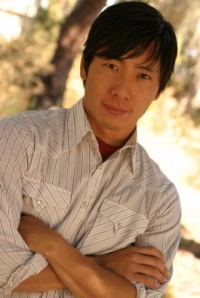
Dork or not? Kelvin Yu
It doesn’t help that the good-looking Yu was made homely, with Ugly Betty glasses and an unflattering haircut (although this is apparently is true to the real Wong’s actual appearance at the time).
I’m trying to overcome the tendency to nit-pick any Asian American portrayals I see in Hollywood movies but it’s a hard habit to break, especially when those images are still few and far between. Here’s hoping John Cho fares better in Star Trek—
UPDATE: For a longer take on the film in general, see Sunny Vergara’ s nice little dissection.
Takeshi then and now: The Warlords, Red Cliff and the aesthetics of dirt
His role in The House of Flying Daggers (2004, dir. Zhang Yimou) notwithstanding, Takeshi Kaneshiro has almost always appeared in modern-day movies. But in 2007 he was cast in two prominent historical dramas, The Warlords (dir. Peter Chan) and Red Cliff (dir. John Woo). How did Takeshi’s decidedly modern visage affect these two Hong Kong costume dramas? The results in each film are somewhat different and are a telling indication of perceptions of Chinese films in Asia and in the West.

Movie kings dress down, The Warlords, 2007
In The Warlords, Peter Chan’s gritty, realistic flick about a 19th century Qing Dynasty power struggle, Takeshi and his equally famous and glamorous co-stars Jet Li and Andy Lau are called upon to play their parts clad in animal skins and splattered with blood, sweat and mud. Jet Li reportedly gained weight and dirtied up to play his part (and was rewarded with his very first Best Actor statue at the 2008 Hong Kong Film Awards); he and the usually dapper Andy Lau also shaved their heads and grew scruffy beards for the film. At the start of the film Li vomits convincingly and Andy Lau has sex still dressed in his war togs.
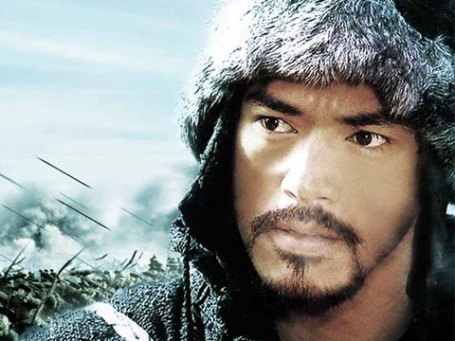
Takeshi in furs, The Warlords, 2007
Takeshi, however, did not shave his head, though he did sport a tidy beard. Still, it was hard to spot Takeshi-the-movie-star in this flick, due to the strength of the film’s mise-en-scene. The film’s blood-caked impalings, stabbings and general fisticuffs, and its evocative smoky-toned cinematography overcame Takeshi’s good looks and he managed to fit into the overall rough-hewn look of the movie despite being one of the most beautiful people on the planet.
In Red Cliff, however, the film’s art direction is much less down-and-dirty and much more stylized and this somehow makes Takeshi’s perfect nose and expensive haircut more anachronistic than in Peter Chan’s film. John Woo’s film aims for the heroic, not the realistic, and here Takeshi’s Prada-model gorgeousness shines a bit too brightly for a period piece. Although co-star Tony Leung Chi-Wai cuts no less a handsome figure, he’s a bit stronger actor and is a little more convincing as a third-century Chinese warrior. Tony also gets to wear armour and swing a sword in a big fighting scene, whereas Takeshi watches on the sidelines in pristine, flowing white robes without a hair out of place.

Pristine Takeshi, Red Cliff, 2008
Somehow Takeshi’s overt modernity works against him much more in Red Cliff than in The Warlords and this is underscored by each films’ respective directorial vision. Peter Chan’s film feels much more in step with current Chinese cinematic trends, moving away from superficial heroic images towards a deeper, more serious critique (in the same way that Johnnie To’s Election 1 & 2 completely deglamorized the Triad film, in contrast to the gauzy romantic fantasies of gangster brotherhood from Andrew Lau’s Young & Dangerous series). In comparison, John Woo’s film seems like a nostalgic, old-fashioned look backwards at classic Shaw Brothers and 1990s wuxia productions. Interestingly, a truncated version of Red Cliff is slated to open in the U.S. and Europe in 2009 while The Warlords has not received distribution outside of Asia. This perhaps reflects outdated perceptions of Hong Kong films in the West, where the most recognizable HK actor is the long-dead Bruce Lee and most viewers relate Chinese films to out-of-sync dubbing and chop-socky action pieces. Since precious few Western viewers keep abreast of current trends in Chinese cinema it stands to reason that John Woo’s conventionally retro, faintly Orientalist vision of history is more marketable outside of Asia than Peter Chan’s more contemporary presentation.
The Warlords was a big box office hit in Asia and, Red Cliff, Part 1 similarly broke box office records across Asia. Release of Red Cliff, Part 2 was moved up to capitalize on the success of Part 1 and it premiered in Beijing on Jan. 4. The Warlords cleaned up at both the 2007 Hong Kong Film Awards (eight awards including Best Picture, Best Director, and Best Actor) and the 2008 Golden Horse Awards (Best Picture, Best Director). Red Cliff, however, was shut out of the major awards at this year’s Golden Horse presentation, with only four nominations and no wins. Perhaps as with the Academy Awards and the last installment of the Lord of the Rings trilogy, Red Cliff, Part 2 will fare better at awards time than its predecessor. For now it remains to be seen whether it will duplicate the The Warlords’ hometown awards success.
One Last Dance revisted
Just rewatched One Last Dance (2005, dir. Max Makowski) last night and liked it much more upon another viewing. It starts a bit slowly but once Francis Ng shows up, playing a world-weary contract killer in nocturnal Singapore, the film’s focus snaps into place and he carries the movie after that. The film’s non-linear narrative is much easier to follow the second time around and, although there are some rough patches in the movie, there are also several pretty interesting moments. Notable among these are a scene in which Francis’s hitman character evades several security cameras at a Singapore train station and an amusing exchange with a prepubescent girl in which she and Francis discuss the meaning of life. Francis also gets into a staring contest (guess who wins?) and, as mentioned in a previous post, has a classic scene in which he extracts information with the help of plastic wrap, scotch tape and a fork.
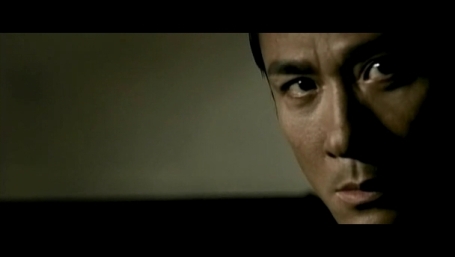
Francis as a hitman, One Last Dance, 2005
The film wraps up its unconventional structure fairly well by the end of the movie and Francis delivers another subtle and nuanced performance that occasionally explodes into swift and efficient violence. There are a few moments of slapstick humor that some Western viewers might find jarring but anyone familiar with the rapid-fire genre-switching found in many Asian films should be able to deal with it. Definitely worth a look.
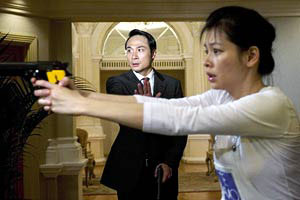
Francis helps Vivian Hsu with her aim, One Last Dance, 2005
Interestingly enough, Brazilian-born director Makowski has been attached to direct a couple Hollywood films on the strength of this picture, though it never received stateside distribution. Makowski’s slated to direct the live-action version of Voltron as well as a big-screen version of the lamentable 1970s television series Kung Fu. Also attached, though his role is yet to be clarified, is none other than Francis Ng. Surely he’s too old play Caine–hopefully they’ll find him a better part than the old blind guy with the pebbles in his hand.
three more francis ng movies
Best to worst
The White Dragon, dir. Wilson Yip, 2004
Francis plays a blind swordsman opposite spoiled and vain rich girl Cecilia Cheung in this 21st century martial arts redux. Full of jokey anachronisms and mo le tau humor, the film is nonetheless affecting due to the charisma and chemistry of the two leads. Francis channels Zatoichi with a twist–he’s a sensitive and noble, lovelorn guy.

Francis with bangs, The White Dragon, 2005
He also battles a very bad haircut but miraculously manages to become more and more attractive, even though he spends half the film with his eyes rolled up in his head. The scene where he discovers that Cecilia thinks he’s handsome is classic–charming, funny and convincing. Kudos to Cecilia Cheung (who won Best Actress at the HK Film Awards) for keeping her bratty character light and appealing. Wilson Yip continues his schizophrenic directing career, combining wuxia, comedy, romance and satire in classic HK style.
Dancing Lion, dir. Marco Mak & Francis Ng, 2007
Kinda dumb, unfortunately. Sitcom-style humor about a dysfunctional family that starts a lion dancing business and becomes a HK phenomenom. Francis co-directs and stars as a forty-year-old hip hop wannabe dope.

Francis and bling, Dancing Lion, 2007
Anthony Wong is amazing as a 72-year-old lion dance master–he’s very fun to watch in an otherwise dippy film.
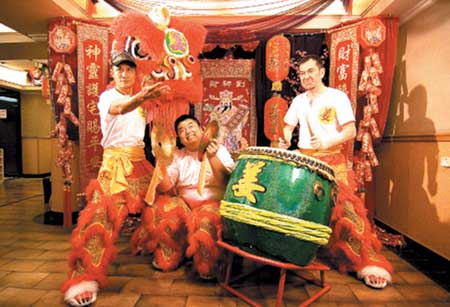
Francis & Anthony in furry pants, Dancing Lion, 2007
Himalaya Singh, dir. Wai Kar-Fei, 2005
“Hey, you ever been to India?” “No, why?” “Wanna make a movie there?” “Well, what’s there?” “I dunno, elephants, cobras, yoga.” “Okay, sounds great. Think Francis & Lau Ching Wan will want to go?” “Yeah, and maybe Cecilia.” “Okay, let’s do it.” “And we need to find some Indian guys who can speak Cantonese.”

Cultural insensitivity, HK style, Himalaya Singh, 2005

 beyondasiaphilia
Recent Comments