Posts filed under ‘movies’
My Ever-Changing Moods: Francis Ng 2010 In Review
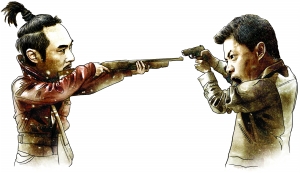
Wind Blast goes graphic
2010 was a busy year for Francis Ng. Just out of the gate on New Year’s Day, Francis made headlines across Asia when he and his Singaporean wife got into a tiff with another customer at a Hong Kong bakery. Apparently Francis’ wife complained when a worker sweeping the floor started getting dust on the baked goods. She and the worker got into it, then another patron jumped into the fray, mouthing off to the missus and possibly pushing her to the floor. Francis, who had been waiting in the car with his 1-year-old kid, heard the commotion, charged into the bakery, and allegedly grabbed the offending customer by the neck and slapped him upside the head. Photos from the scene showed the guy with a bloodied ear and Francis’ wife clutching her damaged hipbone. Francis went to the police station, everyone else went to the hospital, and the Asian press had a field day.
Francis was charged with assault, although he claimed he was only trying to protect his wife. No doubt the best thing about the incident was that it was re-enacted in one of Next Media’s renowned computer animation sequences for Apple Daily News in Taiwan, with Francis joining Tiger Woods, Lindsey Lohan, and other disgraced luminaries in CGI-rendered infamy.
Netizens were fairly divided on the topic, with some giving props to Francis for chivalrously supporting his wife and others chiding him for his straight-up thuggin’. His Hong Kong movie pals also leapt to his defense, with Michael “Laughing Gor” Tse claiming, “It is a man’s duty to protect his girl. I would have stepped up as well.”

Naughty professor
The case dragged on until April when Francis pled guilty to “wounding” and was fined HK $10,000. At his final court appearance Francis looked particularly unhappy, dressed in a brown suit and wearing unflattering black glasses that made him look like a vaguely sinister high school chemistry teacher.
For better or worse, Francis laid low for a while, avoiding appearing in public in Hong Kong. Professionally he kept busy, shooting three films (Wind Blast, Midnight Beating, and The Warring States) in quick succession in mainland China.
But by fall the beatdown incident was mostly forgotten and Francis enjoyed a resurgence of popularity.

Fashion plate
Wind Blast was released at the end of October and was the number one film in China for three weeks running, knocking Tsui Hark’s Detective Dee and the Phantom Flame out of the top spot and earning in excess of RMB 68 million.
The hybridized gangster flick/Western set in the Gobi Desert featured elaborate action sequences including a dusty chase scene involving a Jeep Cherokee, a couple horses, and a gigantic yellow dump truck. Francis in particular was lauded for his portrayal of a world-weary, conflicted bounty hunter and he stole the show from a cast of mainland movie stars including Wu Jing, Duan Yihong, and Ni Dahong. His character’s distinctive red leather jacket briefly became a icon and Francis modeled variations on the theme in a couple high-fashion photo shoots.

Anthony does Francis
Francis also landed on the cover of the Chinese fashion magazine Mr. Mode, sporting a black double-breasted trench coat and a little moue that his good buddy Anthony Wong then ruthlessly parodied for a Chinese newspaper.
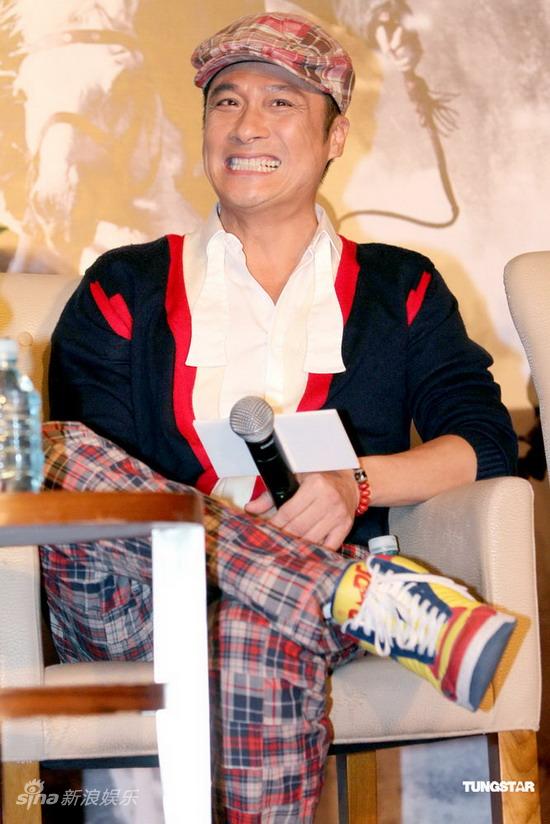
Happy in plaid
Francis later was photographed in Beijing shopping for presents for his kid’s second birthday, which further ingratiated him to the public in China and Hong Kong. He made guest appearances on Chinese television showing off his improving putonghua skills and modeled his natty b-boy wardrobe and continually changing hairstyles in the Chinese press. He also appeared at an event for Jet Li’s One Foundation charity that benefitted autistic children,which further rehabilitated his public rep.
But Francis made the news one more time at the very end of the year. In early December several pictures showed up on the interwebs of what appeared to be Francis getting busy with an unnamed young woman, harkening back to the infamous “sexy photogate” scandal that sank Edison Chen’s career.
News agencies across China gleefully flashed the pix around the ‘net and it seemed like Francis had again been caught with his pants down (see Ellen Chen karaoke oopsie). However, upon closer examination it was apparent that the photos were stills from Midnight Beating, Francis’ upcoming low-budget horror flick (also starring Simon Yam and a quartet of Chinese starlets) and that the woman in question was in fact Francis’ co-star. Cheap publicity stunt or honest mistake?
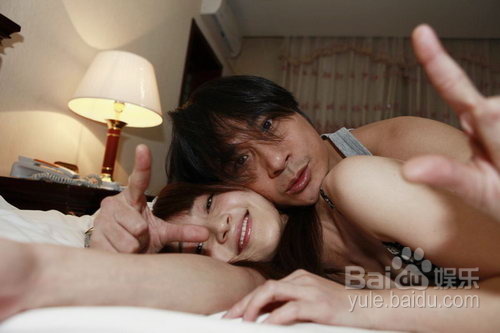
Faux photogate
At any rate, Midnight Beating was released on Christmas Eve and even up against heavy-hitters like Jiang Wen’s Let The Bullets Fly and Feng Xiaomeng’s If You Are The One 2, the cheapie screamfest made a respectable showing at the box office (before it showed up a couple weeks later on the torrent streams, of course).
Francis has subsequently finished shooting Love Island (also starring Simon Yam, Chang Cheh, and Joan Chen, among many others) and Traffic (with this year’s Golden Horse Best Actress Lu Li-ping, and Wind Blast’s Ni Dahong), and he’s on board for A Land Without Boundaries in 2011. Due out in April is The Warring States, Francis’ first period costume film, and its publicity machine is already revving up. The film promises to be a flashy extravaganza, with Francis and co-star Sun Honglei duking it out for the title of most badass.

Back in the saddle
All in all it’s been an eventful year for our boy Francis, who’s shown an uncanny ability to bounce back from public brawling, internet scorn, bad hair, and myriad other obstacles. Like a cat, Francis just keeps landing on his feet.
HK/HP: If Hong Kong Movie Actors Starred In Harry Potter Films
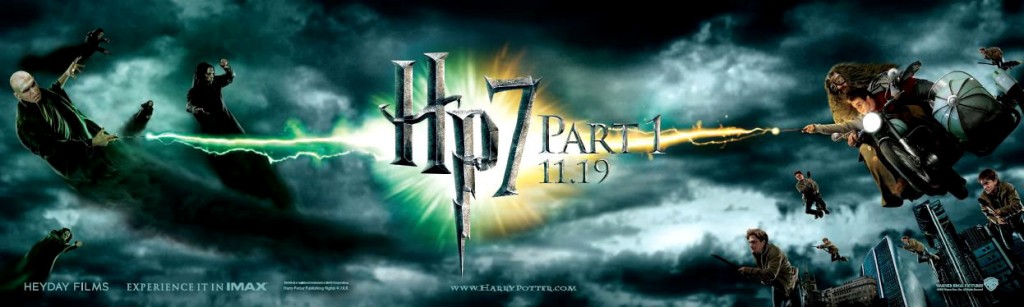 A double-dose of geekdom here–went to see the latest Harry Potter (Deathly Hallows, part 1) on opening day and had my fangirl jones satisfied. Dan, Rupert, & Emma have grown up and learned to act, the special effects were par excellence, and the stellar supporting cast has grown to include the lucky Bill Nighy (who said “For a while, I thought I would be the only English actor of a certain age who wasn’t in a ‘Harry Potter’ film.”)
After wallowing in the 2.5 hour HP movie my consciousness was full of all things Potter. The other movie of note that I’d seen that week was Francis Ng’s new Chinese Western, Wind Blast, so both were vying for space in my backbrain. Then when my buddy and fellow Hong Kong movie otaku Erika, aka Huckle, suggested that Francis would make a great Sirius Black, the game was on. So herewith follows my dream cast for the hypothetical Hong Kong remake of Harry Potter.
NOTE: It was easy to pick the adult actors. The teens were a bit more difficult, since I’m not as tuned into the Hong Kong idol scene as I could be. Any suggestions for the younger cast members, as well as any others, are more than welcome in the comments section.

Anthony Wong Chau-Sang, half-blood extraordinaire
Severus Snape: Anthony Wong. The Half-Blood Prince personified, Anthony has both the swagger and the sneer required to play Severus.
Voldemort: Tony Leung Chiu-Wai. Although Little Tony usually plays the good guy, he proved in Lust, Caution that he can do creepy and evil too.
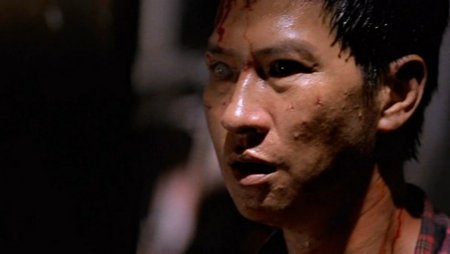
Nick Cheung, half-man, half-beast
Remus Lupin: Nick Cheung. Moody, dark, and a little feral (see Election), Nick is totally believable as a werewolf.
Peter Pettigrew: Louis Koo. Probably a bit too square-jawed to play Wormtail, but he’s got the paranoid nervousness down pat. No one in Hong Kong sweats and twitches as well as Louis Koo.
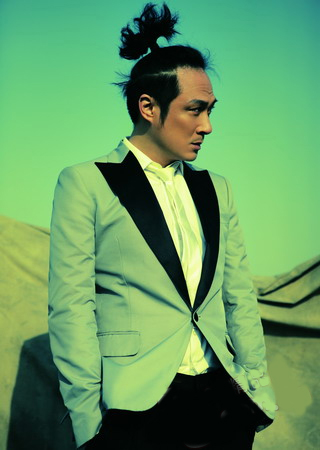
Francis Ng with his hair up
Sirius Black: Francis Ng. Ah, the angst! The fancy frock coats! The insane gleam in his eye! Who else but Francis to play Sirius Black?
Albus Dumbledore: Lau Kar-Leung. The grandmaster of Hong Kong martial arts movies, he can also choreograph his own action scenes.

The glorious Simon Yam
Lucius Malfoy: Simon Yam. A slimy, smirky, ruthless & amoral bad guy? Paging Simon Yam!
Mad-Eye Moody: Lau Ching-Wan: LCW really deserves a bigger role but he’s got the chops to make this part his own. He was also plenty weird in Mad Detective and Himalaya Singh so we know he doesn’t shy away from the offbeat.

Carina Lau, red carpet queen
Narcisa Malfoy: Carina Lau. Because no one does haughty and high-class better than Carina.
Dolores Umbridge: Sandra Ng. The queen of Hong Kong comedy, she’d make a wackier Umbridge. However, she’s got some skilz so I have no doubt that she’d bring the sinister as well.

Eric Tsang & eyebrows
Horace Slughorn: Eric Tsang. He’s got the smarmy gladhanding dialed in.

Andy being Andy
Gilderoy Lockhart: Andy Lau. Handsome, flashy, ultrafamous, and a bit vacuous spells Andy to a T.
Rubeus Hagrid: Ng Man-Tat. Uncle Tat in elevator shoes and in a big furry beard? Hellz yeah!

Helena Law Lan in Troublesome Night 3,245
Minerva McGonagal: Helena Law Lan. The queen ofTroublesome Night, Law Lan has the supernatural down pat.
Vernon Dursley: Lam Suet. Blustery, blubbery, and a little bit malevolent is Lam Suet all over.
Petunia Dursley: Karen Mok. Maybe a bit too glam for Petunia, but she can certainly do the midcentury costumes.

Roy Cheung, wicked
Fenrir Greyback: Roy Cheung. Who’s more qualified than Roy Cheung to tear out people’s throats with his bare hands?
Rita Skeeter: Cecilia Cheung. Glamourous, self-centered & entitled, with a hint of sleaziness–Ceci anyone?

Zhou Xun in red
Nymphadora Tonks: Zhou Xun. The twinkly-eyed Xun is our token mainland star, if only because she’s the best actress of her generation. Plus she’s probably more than willing to do purple hair, as evidenced by her off-kilter turns in All About Women and Ming Ming.
Sybill Trelawny: Sammi Cheng. Especially since Sammi’s been having a bad hair day for about two years now.

Maggie Cheung with blowout
Bellatrix LeStrange: Maggie Cheung. Because Maggie’s been rocking the frizzy hair look lately and because she can do sexy and dangerous in her sleep.
Harry Potter: Lam Yiu-Sing, who played the angsty teen in Heiward Mak’s High Noon. Better him than Jing Boran any day.

Smart girl Evelyn Choi
Hermione Granger: Evelyn Choi Wing Yan. Played Aarif Lee’s geeky girl love interest in Echoes of the Rainbow. Not a lot of competition for this part.
Ron Weasley: If only Chapman To were twenty years younger this would be his role. Still searching for the right teen actor to play Harry’s wingman. NOTE: see update below

Aarif Lee brings it
Cedric Diggory: Aarif Lee. Now in theaters playing a young Bruce Lee, he’s certainly pretty enough to play the part that launched Robert Pattinson’s career.
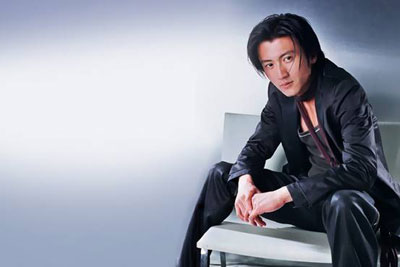
Nic Tse broods
Draco Malfoy: Nicholas Tse (ten years younger). Have to put Nic in a time machine for this one since he’s perfect for the part of the privileged, conflicted scion of a shady family.
UPDATE: angryasianman.com has a link to an Asian Harry Potter lookalike who showed up on the Conan O’Brian show last week. Maybe this is an idea whose time has come–
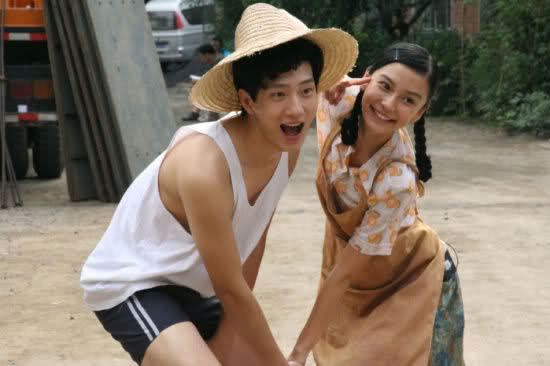
Jing Boran does quirky, with Angelbaby
UPDATE 2: Okay, I take it back what I said about Jing Boran. After seeing Hot Summer Nights and Love In Space I realize that he would be perfect for the part of Ron Weasley. I humbly apologize for slandering the former M-Pop star.
The American In Me: DC APA Film Festival and the Vietnam Veterans’ Memorial
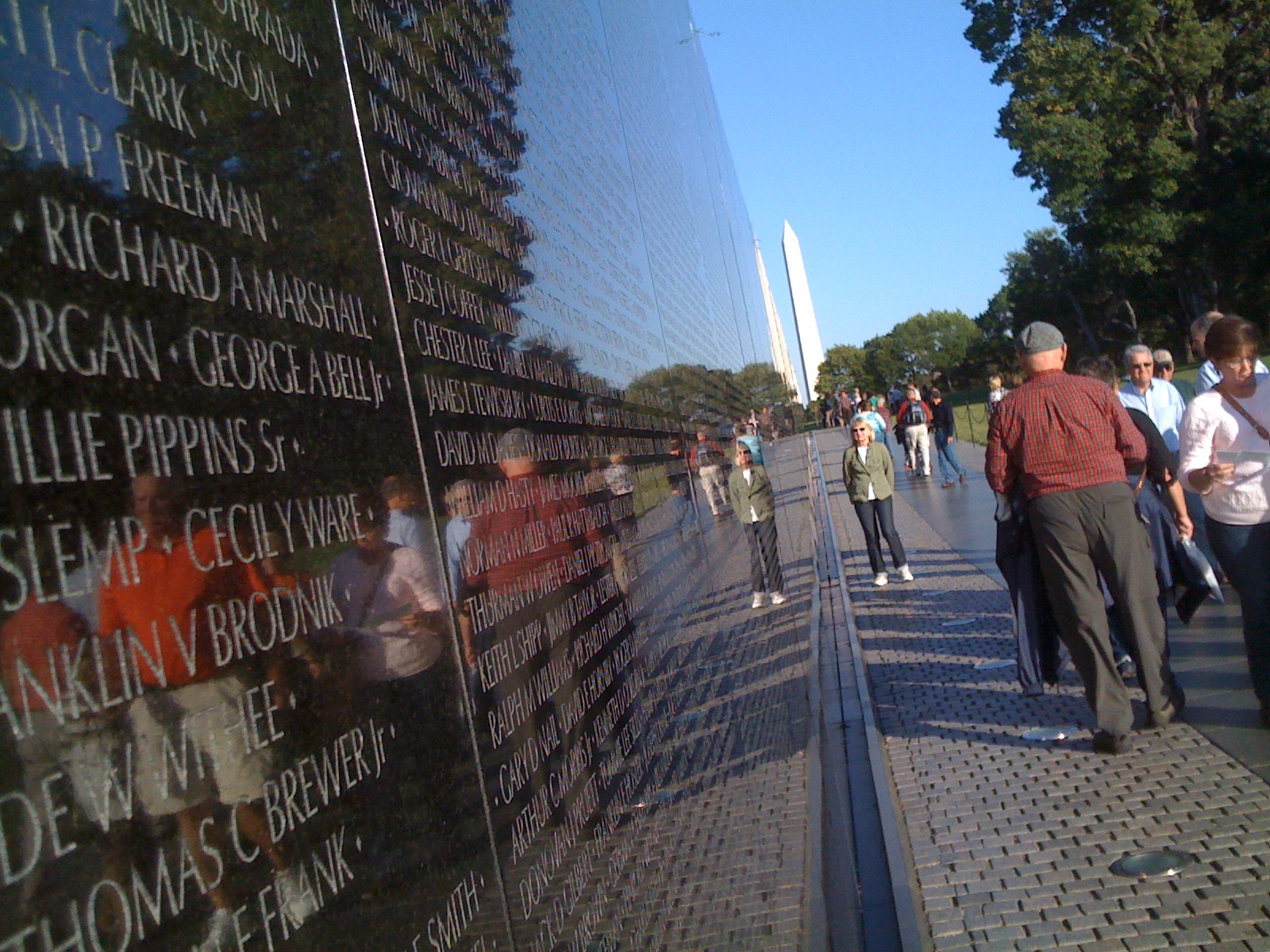
Reflecting, Vietnam Veterans' Memorial, 2010
Just got back from a weekend at the DC Asian Pacific American Film Festival in Washington DC. This is the second time I’ve attended the festival (the first time being in 2007 when the fest screened Snapshot: Six Months of the Korean American Male) and, as with my last visit, it was totally great. Although I had to take the red-eye from SFO and could only attend one day, I saw all three of Saturday’s programs, which pretty much satisfied my Asian American film jones.

Grace & food, DCAPA Film Festival closing night party, 2010
The DCAPA staff are an especially fun and friendly bunch and they always put on a great festival with lots of bang for your buck, with this year being no exception. Staff member Grace even cooked up a bunch of delicious snacks for the closing night reception, including ginger oatmeal cookies, edamame hummous, and K-food mini-tostadas with kimchee salsa.
The closing night film, The Things We Carry, was a gritty and heartfelt little drama about a pair of Korean American sisters coping with their fucked-up crackhead mom. The movie did an especially good job of capturing the rundown, seedy side of LA, with lonely and forlorn drug addicts puking their guts out in mini-mall parking lots. Though the film occassionally flirted with melodrama, the hard-ass lead performance by Alyssa Lobit kept the film from veering into pathos. Lobit also wrote the semi-autobiographical screenplay and the film was produced by her sister Athena and executive-produced by their dad, so it was a family affair all the way.

Tat Marina, before and after, Finding Face, 2009
My short film, The Oak Park Story, screened with Finding Face, an intense agit-prop documentary feature about acid burn attacks on women in Cambodia. Though it wandered a bit in its focus, it still managed to convey a gripping urgency about these crimes, which are growing in number since the high-profile attack on 17-year-old karaoke starlet Tat Marina in 1999. Marina and her family are the focus of the film as both she and her brother, the swoonfully intense Tat Sequndo, attempt to bring the perpetrators (including Cambodia’s Undersecretary of State Svay Sitha) to justice.

Image capturing, Lincoln Memorial, 2010
The day after the festival closed I got to play tourist in DC, visiting the National Gallery to see the amazing Chester Dale collection, which included a huge number of paintings by brand-name Impressionists such as Manet, Degas, Cezanne, Cassat, and Monet. I also hiked over to see the Washington Monument in all of its erect glory, then trekked to the far end of the reflecting pool to cool my heels on the steps of the Lincoln Memorial, where Americans of all shapes and colors snapped photos and posed with Honest Abe.
I ended up at Maya Lin’s Vietnam Veterans’ Memorial, which I’d never seen in person before. The Memorial is arguably the most famous artwork by an Asian American in this country so it’s been on my list of places to visit. Arriving there near the end of a balmy early autumn day, I was impressed by the simple, poignant power and beauty of the piece. Several people there were clearly there to find the names of lost loved ones, somberly pausing in front of the polished black granite. Seeing it in person, I was struck not only by how long and tall the memorial is, but by how small names are rendered and how very many of them there are. It’s amazing exactly how much space more than 58,000 names can take up, even when engraved in pretty small text. It’s a testament to the brilliance of Lin’s design that the piece conveys at once the enormity of the loss of life as well as each individual behind that monstrous sacrifice.
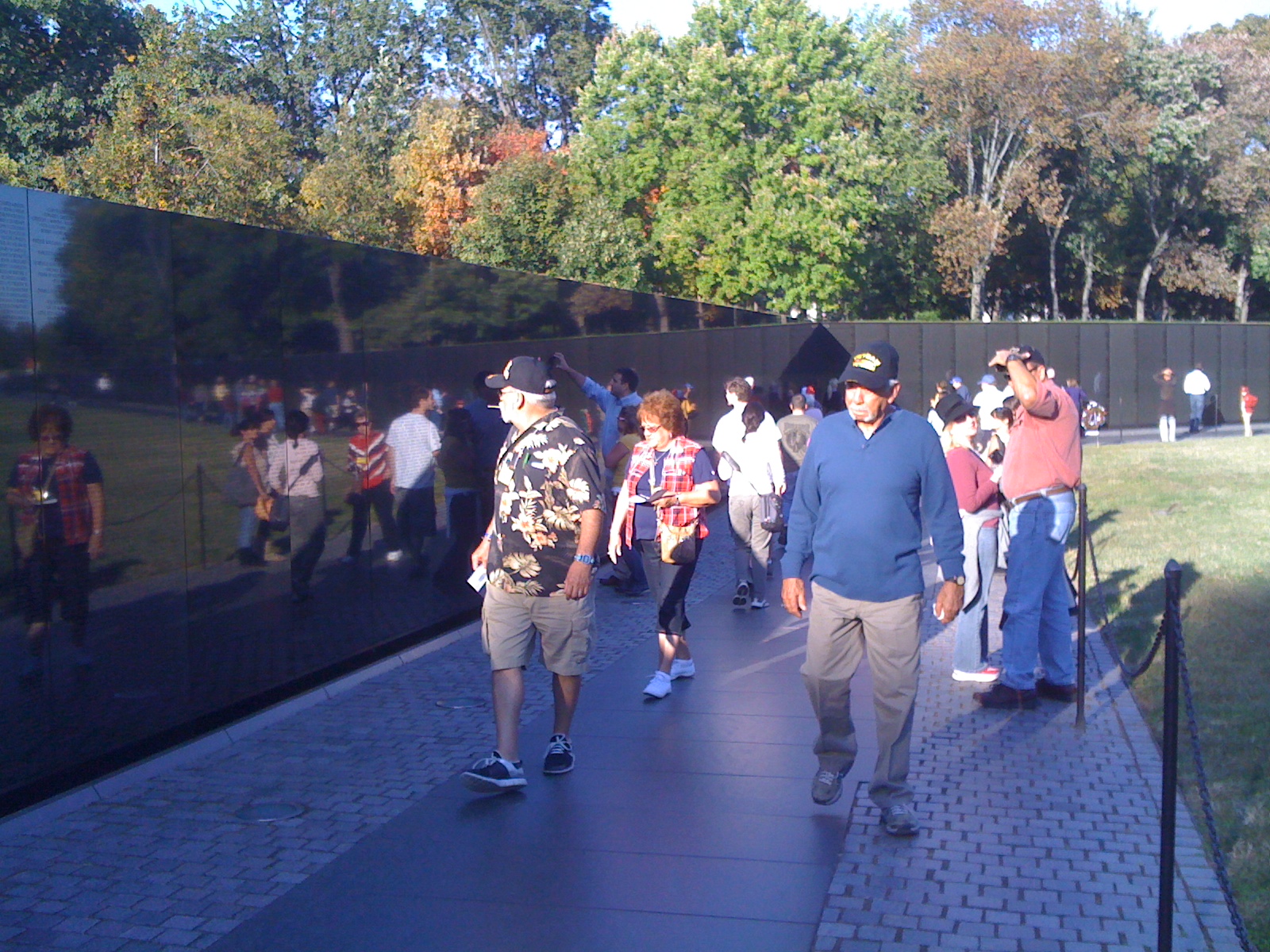
Vets, Vietnam Veterans' Memorial, 2010
It’s significant to remember that back in the early 80s when her design was first selected, Lin was vilified by conservatives as an inappropriate choice for the memorial due to her Chinese background (Ross Perot called her an “egg roll”), since, of course, that was pretty close to being a gook, right? Doubters also wanted to install a more traditionally representative memorial instead of Lin’s minimalist design and because of that sentiment, Frederick Hart’s abysmally banal bronze statue of three noble soldiers mars the entrance to the memorial. But despite the naysayers, Lin put up an epic fight to preserve the integrity of her original design and, nearly 30 years down the line, Lin is a renowned artist, the memorial is a landmark, and the haters have been proven dead wrong. Glad I was able to finally see the results of Lin’s persistant vision, and glad it still resonates today.
Bonus beats: The Avengers, legendary San Francisco punk band, performs “The American In Me,” Winterland, 1978
De Paisano A Paisano: An Interview with 9500 Liberty’s Eric Byler and Annabel Park

Proofed in Prince William County, 9500 Liberty, 2010, Eric Byler & Annabel Park
I had the chance last week to sit down with Eric Byler and Annabel Park, the directors of the new documentary 9500 Liberty that’s now playing across the country. 9500 Liberty outlines the 2007 battle in Prince William County, Virginia, over legislation that legalized racial profiling of “illegal immigrants” and the ways in which that battle polarized the tight-knit community.
I know Eric Byler as the director of Charlotte Sometimes and Tre, two seminal Asian American feature narratives dealing with angsty interpersonal relationships among several Asian Americans, but lately Eric’s been devoting his time and creativity to producing activist shorts. He and Annabel are the instigators of the youtube channel 9500 Liberty, of which the feature doc now in theaters is an offshoot. Both Eric and Annabel are articulate, committed, and smart as a whip, and they’re very passionate about changing the ways that political discourse is conducted in this country. Given the aggravating and idiotic screeds that pass for political expression these days it’s great to talk with thoughtful and creative people who are looking for alternative solutions to some of the tough issues facing the U.S. today.
Here are some excerpts from the almost-hourlong talk I had with them—the full interview can be heard below.
on the dangers of election season
Eric Byler: What we observed in Prince William County is that, in an election season, information is not as important as ammunition, and so people decide what they believe, say and repeat based on whether it helps their side win, not whether it’s true.
I think what certain insurgency tacticians have learned is that, because their positions are so radical and so far outside the mainstream, the only way they can assert their will is to use these tactics that alienate the average American from the political process and shrink participation down to a level that’s easier to manipulate.
So that’s what happened in Prince William County–they organized around deeply negative emotions. By combining racial antagonism with political partisanship they created an environment where only people who really thrive on conflict and who are comfortable with racial tension were going to those board meetings and were daring to speak on these issues.

Messaging, 9500 Liberty, 2010, Eric Byler and Annabel Park
I think that’s why Annabel and I were so concerned when we saw that become a national political strategy and instead of a blog amplifying the most negative emotions you find an entire news network to amplify not only the most negative emotions but those people they had assembled.
on button-pushing
EB: If you can make the election about some sort of social issue that really pushes emotional buttons–there are too many Mexicans in Arizona is basically the underlying theme of this election—that’s a really polarizing issue. Extreme candidates introduce extreme laws that get extreme reactions that create the kind of political landscape that favors the extreme candidate. So it’s not a surprise. And it always happens a certain number of months before the election because you’re lighting a fuse that’s gonna blow up.
on the use of intimidation tactics
EB: The week before the election (in Prince William County) was the scariest time for us. The racial tension in the county was more palpable than I ever expected to see in this century and I hope I never see again. People would drive by Liberty Wall and throw things at us—people would drive by and yell racial slurs. Those kind of climates are deliberately created for election season. Whether you’re a Democrat or a Republican you can respond really negatively to this kind of politics—we all can be intimidated, we all can be afraid.

Annabel Park in situ, 9500 Liberty, 2010, Eric Byler and Annabel Park
on film and the internets as a means of empowerment
EB: Given that there are people who are going to use as a political strategy organizing around the most negative emotions known to humankind then what we have to do is to populate our democracy with people who are willing to be responsible and fact-based and solutions-oriented. That’s what the Coffee Party and 9500 Liberty both seek to do is enlist those people who might otherwise be intimidated into silence because of these kinds of tactics and show them two examples of people who are prepared to engage even in a political process that’s been mightily toxified and frightfully polarized, because we have that much at stake, and to convince them that they have something at stake.
on hearing the news of the anti-immigrant laws in Arizona
Annabel Park: I got really emotional—I started crying! It was almost like a flashback to northern Virginia 2007. It was traumatic!
EB: It’s just such an unnecessary tragedy—the economic hardship that this kind of policy caused, the social toxification, the damage to public safety, was all so unnecessary, and really the only ones who benefit are very extreme politicians who cater to a really tiny fraction of out population.
on creating a more civil political discourse
AP: Politics is about us making collective decisions, and democracy is a method for making collective decisions–it’s not meant to be a fight with two sides. It’s supposed to be a situation where we thrive on differences and diversity but we need to be able to talk to one another. We have to create opportunities for people to talk to one another. That’s the first step in a democracy, that open dialogue—it has to be civil, there has to be real information exchanged. In a way it’s a very simple thing—asking people to protect and practice democracy, and by using social media, to create not only a communication network but by having this idea go viral—let’s go viral with this idea that we have to participate in democracy, and to give them portals for doing it.
on making a difference
AP: The (9500 Liberty) youtube channel did have impact on the community. We just showed (the movie) in Phoenix and in parts of Arizona and I think we made some progress there. I think there are people who are now ready to have dialogue at least. Just saying “Illegal Is Illegal” is just not really a starting point for dialog. It doesn’t help us formulate policy, it’s just grandstanding—it shuts down conversation.
on optimism and inevitability
EB: I feel very optimistic. 9500 Liberty is a microcosm of what’s happening in Arizona and Arizona is a microcosm of what’s happening across the country. The reason why we’re seeing these insurgency tactics, these desperation tactics coming from the right is that they’re afraid of the changes that really are inevitable. They feel that they’re actually delaying those changes by using these extreme tactics but I believe they’re actually accelerating these changes.
Every year another crop of kids turn 18 and registers to vote and during that same time unfortunately we have to say goodbye to our grandparents and aunts and uncles who grew up during the pre-civil rights era and who aren’t really as comfortable with the 21st century as those of us who are younger. So these kinds of cultural issues where a group of very extreme politicians are asking us to hate another group more than they love our country, are gonna cease to be effective, and that’s really when this will stop, when it can be shown, and maybe it will be in November, that this kind of fear politics is not effective.
on the relationship between love stories and political activism
EB: Both Tre and Charlotte Sometimes are essentially love stories where I made the choice to cast both mixed race and full-blooded Asian Americans. And I didn’t realize it but, because it’s an identity issue and identity is very much something that informs my artistic choices, for me it became a political choice. As Annabel likes to say, politics and identity are essentially the same thing.
Eventually I had to become comfortable talking about politics because I was talking about race and identity, and so the transition isn’t as unexpected or as dramatic as you might expect. Identity issues are at the core of American politics right now.
The short answer is I think I decided that in this era of American history, when so many important decisions are being made that are going to affect the rest of this century, that just making love stories, albeit love stories that do have social and political commentary, was not enough of a contribution—I wanted to do more.
(Now) I feel like I could make a movie about Weimar Germany. I could do one of those futuristic movies about a war. I now know what it feels like when you have politicians laying the groundwork for war and you have agitators essentially systematically dehumanizing a population so they can directly take action against them

Looking illegal, 9500 Liberty, 2010, Eric Byler and Annabel Park
on “looking illegal”
EB: I think that in some ways Asian Americans were given a pass on this issue in a weird way, even though many Asian Americans are undocumented—it’s a culture war directed at Latinos, let’s face it. And so I’m the one that actually looks Latino (laughs), being the halfer–
During that time, everything was about looking around and trying to figure out who looks illegal–the police are now being directed to try to tell who looks illegal, the government is basing policy on who looks illegal and who citizens say are illegal, because they went to the emergency room and saw a lot of Latinos—so they must’ve been illegal! So everything’s about who looks illegal– And y’know, some days I wake up I look more “ethnic” and my hair’s messy or curly or something. When you live in a climate like that you wake up in the morning and you see yourself in the mirror and you say, “Oh my god—I look illegal today!”
on the role of film and participation politics
AP: Being filmmakers doesn’t give us a special status not any more than being elected gives us a special status. We all have to be part of this democratic process or it’s just gonna fail. To me that one thing that’s a given—if people don’t participate it’s not a democracy.
There are enough people who have been silent who now have an opportunity to say, “Y’know what, I don’t want to be silent any more, I’m sick of this, enough is enough, let’s come together as a community, let’s stop being Democrats and Republicans and start being Americans and figure out what we have in common and have some of these tough conversations about our future. How much money are we spending on the military? How long can we sustain these two wars? What does it mean to be an American at this point? What unites us as a people in a meaningful way beyond the fact that we live in the same land mass?
on the dire need for civility and the role of the Coffee Party
AP: We’ve got to leave our ideology aside in order to come together. Otherwise you’re submitting to these forces that are in every society that want divide people and separate and secede and balkanize—that’s always there. If we don’t step up and counter that with the force of unity and peace and harmony then we’re headed for a very, very bleak future.
With the rise of the Tea Party there was this narrative that the Tea Party represented America, and there’s a lot of frustration with the government, but their point of view is not representative of America. To me it’s a marginalized view of minorities who know how to engage in political theater.
What happened with the Coffee Party is that I started this fanpage on facebook that just exploded. We want to find another way of engaging. We have these problems but I don’t want to be out there denouncing the government or Obama.
I want to be out there trying to figure out how to improve the government and to feel like we’re on the right path so that ordinary people are being represented and we’re on the path to not destroy one another but to work together.
So people are sort of just self-organizing—we have local chapters across the country. In the Bay Area there’s a cluster of them that are very active—in LA, too. There are local chapters–they function largely autonomously. We have national campaigns—like we’re having one right now where we ask people to discuss campaign finance and corporate personhood.
We’re trying to give people ways of connecting to the political process that isn’t alienating, isn’t negative, it isn’t about fighting people but it’s about dialogue and bringing people together–and really insisting on civility.
I don’t know how true this is but I’ve heard people say that people in the Tea Party, it’s had an impact on them. They’ve been much more conscious of their tactics and whether or not they’re going to be judged as being uncivil or not. I think I just like having civility become a viral idea.
Are we gonna being screaming at our politicians and at each other, or are we gonna say, “Okay, we need reform–how do we get there? Let’s work together.”
9500 Liberty (81 minutes)
Co-Directed by Eric Byler and Annabel Park
UPDATE: 9500 Liberty will have its cable television premiere this month on MTV Networks. It will show on Sunday, September 26th at 8pm (ET/PT) on MTV2, mtvU (MTV’s 24-hour college network), and Tr3s: MTV, Música y Más (formerly MTV Tr3s) as part of Hispanic Heritage Month. You go, Eric & Annabel!
Here’s the extended trailer for the film:
Here’s the full interview (trt: 52 min.)
A Fool Such As I: 36 More Francis Ng movies

Saluting Francis
Since my Francis Ng movie-watching marathon 18 months ago I’ve been scouring the universe trying to see every possible Francis movie I can find. Herein follows another 33 films and 3 dramas that I was able to locate, with bullet reviews of each flick. Although I’m still less than 50% through his 120 movies, my viewing pace has slowed down quite a bit, since the remainder of his films are either out-of-press or only available unsubbed on Chinese-language streaming sites. Luckily our dear Francis is still actively making new movies and he’s got a couple due out this year, Fierce West Wind and The Warring States, which are both big budget Mainland Chinese productions, so I’ve got something to look forward to. Here’s hoping for 120 more Francis movies in the future.
The best
1. Once Upon A Time In Triad Society 1: Francis shows off his acting chops in this clever and original sendup of triad movies, reprising his career-making role of Ugly Kwan from Young & Dangerous. He won the first of three Best Actor awards in a row from the Hong Kong Film Critics Society for this role.
2. Once Upon A Time In Triad Society 2: The story and characters are unrelated to the first film but it’s also an original and energetic take on gangster life. This time Francis plays a cowardly triad more interested in mahjong than brawling. Smokin’ hot Roy Cheung plays a zealous hing dai.
3. Bakery Amour: Offbeat romantic comedy with Francis as a fish-out-of-water country boy navigating Hong Kong. He falls for his gorgeous neighbor Michelle Reis but plot and circumstance endeavor to keep them apart. Will the two mismatched lovers find one another in the end?
4. A Gambler’s Story: A loopy black comedy about a down & out, hapless gambler, played with mournful determination by Francis. In no way resembles God of Gamblers or any other escapist HK poker movie.
5. Banana Spirit: Francis plays a coroner’s assistant whose job is putting makeup on corpses. He falls for a beautiful ghost living in a banana tree and along the way encounters Taoist exorcists, gangsters, and Tommy Wong as a fire demon. Great stuff–
6. A War Named Desire: Francis as a hard-ass but righteous triad in Thailand who gets tangled up in a gang war. Awesome heroic bloodshed movie with an outstanding turn by Gigi Leung as a sharpshooting gun moll.

Stern Francis, Turning Point: Laughing Gor, 2009
7. Turning Point: Laughing Gor: Gritty actioner based on the popular TVB character played by Michael Tse. Francis & Anthony Wong steal the show as dueling triad bosses who battle it out for the most outlandish hair and costumes. Not bad for a low-budget quickie, this film was the second-highest grossing HK movie of 2009.
8. ‘Til Death Do Us Part: Anita Yuen plays a childlike woman destroyed by her husband’s two-timing. Francis is great in a supporting role as a sympathetic divorce lawyer who tries to save her sanity.
9. Big Bullet: Fast-paced and thrilling cop actioner with Francis as a righteous detective whose best friend is fellow police officer Lau Ching-Wan. Anthony Wong as a very bad guy and, in a change of pace, Jordan Chan as an upstanding cop.
The rest—in rough chronological order
10. In The Lap Of God: a very young yet fully formed Francis in a small supporting role as the boyfriend of big-haired 80s dream girl Irene Wan, who throws him over for hotshot cop Roy Cheung (!). Filmed mostly in the jungles of Thailand.
11. Handsome Siblings: Early Francis wuxia, with A-listers Andy Lau & Brigitte Lin battling Francis’ evil transgendered villain. Francis was nominated for Best Supporting Actor for this one, launching his movie career and freeing him from the clutches of TVB.

Co-joined Francis, The Bride With White Hair, 1993
12. The Bride With White Hair: Leslie Cheung & Brigitte Lin as gorgeous star-crossed lovers in this classic wuxia pian. Francis is a lovelorn Siamese twin demon in glittery eye makeup who is surprising sympathetic and fleshed-out.
13. Sexy & Dangerous: Silly knockoff of the Young & Dangerous movies, with four hot babes instead of Ekin & Jordan. Francis plays a dumb, low-level triad with orange hair who courts one of the chickies. Excellent turn by Karen Mok in the Jordan Chan role.
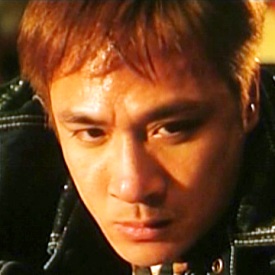
Ginger Francis, Sexy & Dangerous, 1996
14. 24-Hour Ghost Story: Something about a haunted convenience store and the four clueless people who run it. Francis sees ghosts.
15. Wicked Ghost: Don’t remember much about this cheapie horror flick except that Francis wears glasses and plays a professor
16. 9413: Francis directed this quirky tale about an emotionally damaged cop who seeks redemption from his guilt and ennui. Not bad for a freshman directorial attempt, Francis was no doubt much assisted by cinematographer Herman Yau.
17. A Queer Story: Francis turns in a beautiful and subtle supporting role as the younger lover of a man who dies of AIDS. The film fully exploits his astonishing hotness—who wouldn’t fall for him, male or female?

Pretty Francis, A Queer Story, 1997
18. What Makes A Good Teacher? Weird little school drama directed by Francis, who also stars as a former mental patient who ends up teaching a bunch of teenagers in Hong Kong. Amusing cameos by Anthony Wong, Cheung Tat-Ming, Dayo Wong and other friends-of-Francis.
19. The Group: Convoluted action movie about a group of adopted siblings who avenge the death of their priest-father (I think). Francis is the leader of the pack. I think he dances on a table in this one but I can’t remember.
20. Chinese Midnight Express 2: Very cheap prison flick with Francis as a righteous attorney at odds with a corrupt warden. This one has every prison film cliché in the book, done in typical HK low-budget style—not necessarily a bad thing, if you ask me.

Cop Francis, The HK Triad, 1999
21. The HK Triad: Francis & Lau Ching Wan in the 1960s and 70s as lifelong buddies on opposite sides of the law. Tawdry Wong Jing nonsense with senseless torture, gratuitous necking and Athena Chu as a sexy bad girl.
22. 2000 AD: Sleek thriller starring a hapless Aaron Kwok as a computer programmer inadvertently caught up in international espionage. Francis won several Best Actor awards for playing a middle-aged detective who shows Aaron the ropes.
23. Horror Hotline: Big-Headed Baby: Weird Soi Cheang thriller involving an urban legend about a deformed infant. Blair Witchesque ending. Francis smokes a lot in this one.
24. Magnificent Team: Goofy cop adventure comedy that feels like the 80s even though it was made in 1996. Francis leads a bunch of misfit cops through a series of mishandled investigations and gets to court and spark with serious-as-a-heart-attack Amanda Lee from Full Alert.
25. Clean My Name, Mr. Coroner: Francis as a fussy coroner in a bow tie who saves rogue cop Nick Cheung’s bacon. Kinda fun and a good change of pace.
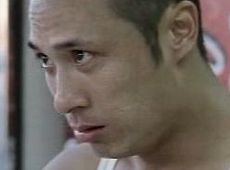
Psycho Francis, Never Compromise, 1999
26. Never Compromise: The ne plus ultra of Evil!Francis, here a heartless mass murderer who casually strangles prostitutes and shoots down entire families. Not really a good movie, but Francis is fascinating as the ultimate sociopathic loser. Great noodle-slurping scene after offing a cop with a hand grenade.
27. Heroic Duo: Francis plays a psychopathic, flashy bad guy and completely overshadows the nominal leads, the bland and boring Ekin Cheng and Leon Lai.
28. Fall For You: Pretty awful rom-com set in Paris, but it’s nice to see Francis as a romantic lead. He charmingly plays a free-spirited artist in the City of Lights who falls for Kristy Yeung, who looks disturbingly like a female Leslie Cheung (although not as charismatic).
29. Women From Mars: did I watch this movie?
30. Hands In The Hair: Francis in a supporting role as the husband of a neurotic and self-centered woman played by Rosamund Kwan. Francis nails it as the mild-mannered cuckolded husband while Rosamund proves again that she really can’t act.
31. McDull, the Alumni: Very cute sequel to My Life As McDull, the surprisingly charming animated kids’ movie. This one mixes live action and animation and has about three dozen cameos by Hong Kong’s biggest stars. Francis very briefly appears as a be-wigged judge in a hot-pot restaurant in a very funny scene with Cheung Tat-Ming and the incomparably entertaining Sandra Ng.

Dissolute Francis, Buttonman, 2009
32. Buttonman: A bloody mess, this extremely violent and nihilistic Taiwanese gangland thriller lacks narrative structure, logical character development, or any kind of directorial guidance. A melancholy Francis sports a James Caan perm and plays a burned-out triad who cleans up after mobster murders.
33. Tracing Shadow: Francis’ latest directorial effort kinda sucks, but some might like it for its excellent swordplay scenes. The dippy comedy falls flat, imho.
34. Triumph In The Skies (drama): Super-popular drama that made Francis a heartthrob in HK, this one focuses on the lives and romances of several airplane pilots. Francis is excellent as the upstanding pilot Sam Tong, whose thwarted love affair with Flora Chan consumes much of the thirty-plus episodes.

Pilot Francis, Triumph In The Skies, 2003
35. The Great Adventurer (drama): Long and languidly paced Mainland Chinese drama about the rise of a business tycoon and his best friend, played by Francis and Dayo Wong. TVB drama queen Flora Chan gets in the way as the scheming woman who comes between them. Surprisingly tepid, although a nattily dressed Francis gets to romance four different women in this one.
36. Healing Souls (drama): Francis as a brain surgeon (!) in a typical hospital soap opera. Much blood, bedside drama, and infectious diseases. Francis unfortunately has orange hair in this one.
Picture This: 2010 San Francisco International Asian American Film Festival

Illuminated curtain, Great Star Theater, A Moment In Time, Ruby Yang, 2010
I’m not sure that the nice Chinese American ladies sitting behind me during the screening of James Hong & Yin-Ju Chen’s Lessons Of The Blood, shown last Tuesday as part of the San Francisco International Asian American Film Festival (SFIAAFF), knew exactly what they had signed up for when the bought their tickets. They had been behind me in line outside of the Sundance Kakuki Cinema, chatting amiably in English and Toi San, and I heard them mention that the film was “about the Nanking massacre” and that it had “won some kind of award in Europe.” As the film progressed and drew the audience deeper into its horrific tale, the ladies began to gasp and groan in dismay since Hong & Jin’s movie is not for the faint of heart and tells its story in chilling detail. Not unlike when I see a particularly brilliant horror flick, I found myself overwhelmed with dread and anxiety by the end of the movie, all the more so since its story is drawn from facts and history.

Germ warfare victim, Lessons Of The Blood, James Hong & Yin-Ju Chen, 2010
The film outlines the infamous series of war crimes commonly known as ‘the rape of Nanking,” but as told by Hong & Chen it’s quite a bit more. Unflinchingly graphic in its description of the various atrocities committed by the Japanese military in Nanjing during World War II, it also included several stomach-turning closeups of festering wounds found on the now-elderly survivors of the germ warfare unleashed by the Japanese Imperial Army in the 1940s. Lessons Of The Blood, however, is more than sensationalized propaganda or simple polemics. It’s also an impressively crafted film, using found footage from propaganda films, newsreels, Hollywood movies, television news, and other filmic detritus, as well as a disturbing and ominous soundtrack, coupled with modern-day interviews with Chinese wartime survivors (who willingly reveal their various scars and disfigurations). The result is a haunting condemnation of both the historical crimes as well as the modern-day complicity that implicates us all. Needless to say, watching this movie was hella intense.
Lessons Of The Blood was one of the strongest films from this year’s action-packed SFIAAFF. Although once again I spent more time at the parties than watching movies (in part because so many shows sold out), I managed to catch A Moment In Time, Ruby Yang & Lambert Yam’s luminous elegy to San Francisco Chinatown movie houses. The film is a comprehensive look at the ways the Great Star, the World, the Bella Union, and the Mandarin theaters were in days of yore the glue that held together the Chinese community, beginning in the 1920s and continuing until their collective demise in the mid-1990s. I myself had the privilege of seeing several classic Hong Kong films with my buddy Patrick at both the World and the Great Star (including a strange and awesome double bill of the violent shoot’em up Big Bullet and the weepy melodrama Comrades: Almost A Love Story) and I can attest to the downscale utilitarianism of both of those movie houses. But there’s nothing like seeing a Chinese-language film with a roomful of Chinese people who are eating cuttlefish, smoking, and chattering incessantly in Cantonese during the show, and Yang and Lam’s movie captures that sensation exactly. One patron interviewed described his entire family including young children attending 9.30p Saturday night shows for 25 cents total, the kids running up and down the aisles and the parents gossiping and eating chicken wings and melon seeds until all hours.

Cell phone a-go-go, Tehran Without Permission, Sepedeh Farsi, 2008
I also caught a screening of Tehran Without Permission, shot surreptitiously on a cell phone in the months running up to the 2009 presidential election in Iran. Although I was dog-tired from attending my own world premiere and reception for The Oak Park Story earlier that day, Sepedeh Farsi’s verite documentary held my attention throughout its 80-minute run time. Through subtle and succinct vignettes the film captures the mood and attitude of citizens of Tehran, with small details and comments presaging the upheavals that would occur in a few months hence.

Deepika Padukone & Saif Ali Khan, just another impossibly gorgeous Bollywood couple, Love Aaj Kal, 2009
I also made time to see the festival’s annual Bollywood at the Castro movie, Love Aaj Kal, although it was the fourth film of a long day of movie-going. I have a soft spot for this program since it was at last year’s festival that I caught my very first Shah Rukh Khan movie, Rab Ne Bana Di Jodi, which spurred my obsessive love for SRK in particular and for Bollywood movies in general. Love Aaj Kal, alas, does not star Shah Rukh Khan but the hot and charming Saif Ali Khan makes an acceptable substitute. Paired with the doe-eyed and astoundingly pretty Deepika Padukone, Saif plays dual roles as a modern-day commitment-phobic NRI in Britain and a noble and lovestruck suitor in the 1960s Punjab. The film deftly shuttles back in forth in time between these two stories, drawing parallels and distinctions between the romances from each period. A well-made and satisfying love story with some excellent dance sequences, the film is a great example of high-quality Hindi-language commercial moviemaking—in other words, a fun and rewarding bit of Bollywood entertainment.
I also passed by a rush line full of excited teens waiting for the special appearance of youtube darlings kevjumba, wong fu, nigahiga and timothy delaghetto. The youth were madly texting and tweeting as they waited to see their favorite internet stars in the flesh, but tickets were, alas, impossible to come by since the show had sold out as soon as it was announced. It was nice to see the next generation of SFIAAFF fans out in force, which hopefully augers well for the continued health and well-being of Asian American filmmaking.

Filmmakers Felicia Lowe & the late, great Loni Ding, 2009. photo: Jay Jao
NOTE: This year’s fest was dedicated to the memory of the force of nature known as Loni Ding, the legendary Asian American filmmaker and educator who a few weeks ago died at age 78 from complications from a serious of strokes. Loni was one of the fiercest and most amazing people on the planet and her energy, dedication, and sheer determination guided her filmmaking, which included seminal documentaries like Ancestors In America and The Color of Honor. She always had a kind word and a smile for younger filmmakers like myself and made us feel like we were doing something significant in our work. She was the moral center of the Asian American film community and she will be sorely missed.
Little Dragon Redux: Mike Lai at Southern Exposure Gallery
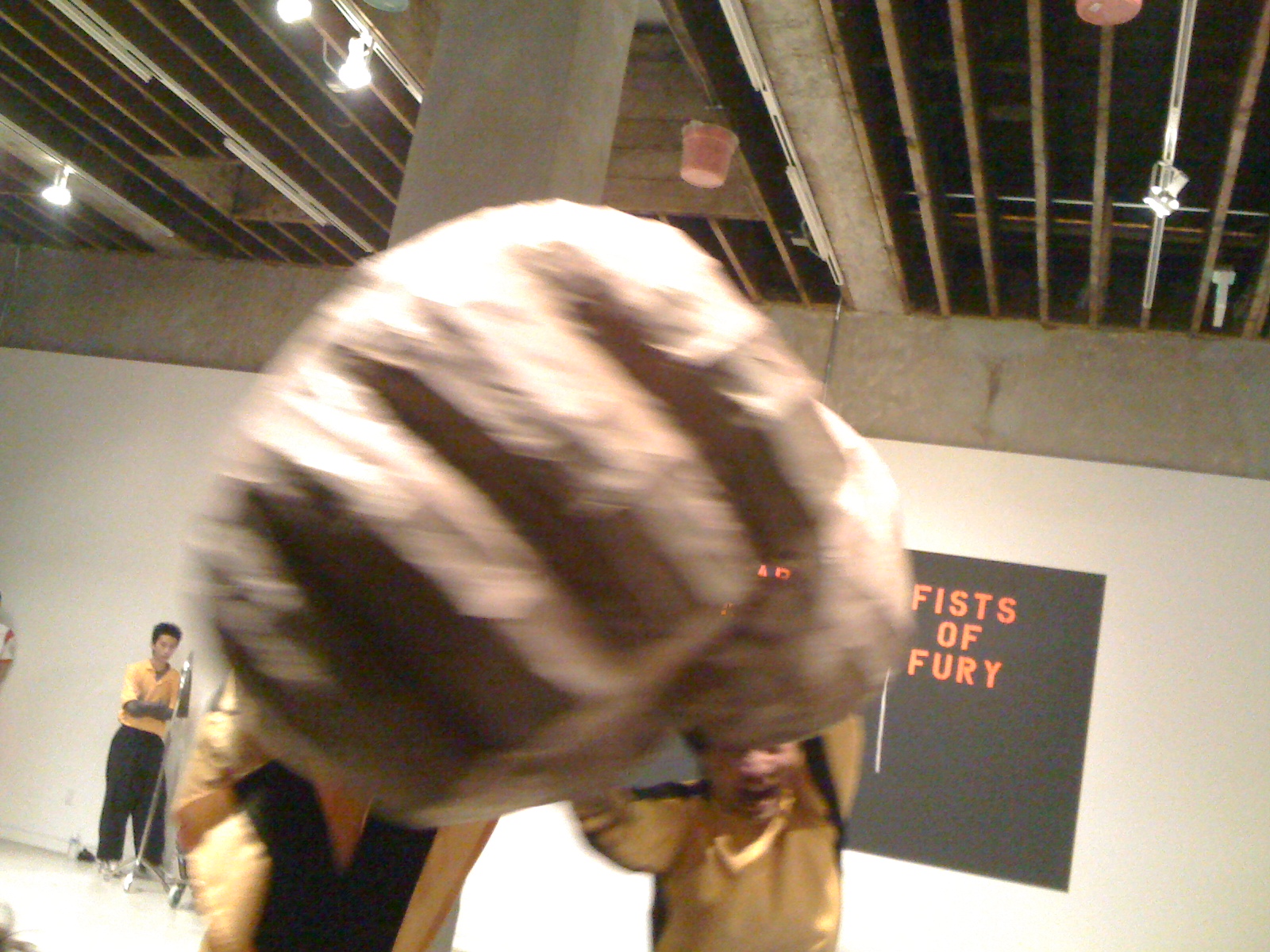
Fist atcha, The Legendary Lions vs. the Fists of Fury, Mike Lai, 2010, Southern Exposure Gallery, San Francisco
Just closed out my Chinese New Year celebration last Friday by attending Mike Lai’s wacky and inspired performance, The Legendary Lions vs. The Fists Of Fury. Staged one night only at Southern Exposure gallery in San Franciso’s Mission District, the performance was a face-off between two traditional Chinese lion dance troupes and the Fists of Fury, Lai’s goofy take on that venerable martial arts/dance/acrobatic form that featured two gigantic paper mache fists trailing yellow-and-black tails.

Nails of fury, Bruce Lee Manicurist/ Golden Dragon Massacre, Mike Lai, Queen’s Nails Annex, 2007
The performance continued Lai’s obsession/fascination with all things Bruce Lee and included yellow-and-black custom-made M & M’s emblazoned with Lai’s face in a Little Dragon bob. Mike Lai is heavy into Bruce and several of his past performances have referenced Siu Lung and his films. He’s especially fond of Bruce’s signature yellow-and-black tracksuit from Game of Death and has used that motif a bunch of times, including at an excellent event at the Queen’s Nails Annex Gallery where he painted tiny yellow-and-black designs on the nails of lucky manicurees.

Leung’s White Crane tears it up, Southern Exposure, 2010
For the first couple rounds last Friday at Southern Exposure the battle was pretty well-balanced between the lion dancers and Lai’s nouveau-dance Fists, but it was all over when the second lion dance troupe took the stage. Leung’s White Crane is one of the top lion dance crews in the world and they’ve performed in oodles of international competitions—the very next night following the SoEx battle they carried the gigantic dragon puppet at San Francisco’s Chinese New Year parade. So though Lai’s Fists put up a valiant fight, they were no match for the mad skillz of Leung’s veteran troupe.

Mike & the Fists, 2010, Southern Exposure Gallery, San Francisco
Although the event was a bit too oppositional for my acculturist tastes (does it really have to be trad vs. modern?) it was a fun and furious, hella loud experience. The night ended with an impromptu confetti fight between myself, my younger daughter (staying up late to watch performance art with her mama), and Chi-Hui Yang, director and curator of the San Francisco International Asian American Film Festival, which is about to start in exactly two weeks. Chi-Hui informed me that Mike and the Fists will reprise their performance at the Film Fest’s big all-day Festival Forum event on Sat. Mar. 13 at 6pm in Japantown’s Peace Plaza. So check it out—it will be brilliant.
Just for kicks, here’s a video of Leung’s White Crane performing atop ten-foot high poles at the 2008 Genting World Lion Dance Championships in Malaysia.
Masculin/Feminin: Shinjuku Incident + Retro Drag Revue at Marlena’s

Jackie Chan & hing dai get their game face on, Shinjuku Incident, 2009
When we arrived at the multiplex, the ticket booth marquee listed Shinjuku Incident merely as “Jackie Chan.” But when is a Jackie Chan movie not a Jackie Chan movie? When it’s directed by Derek Yee, the veteran Hong Kong filmmaker who’s known for both his hard-edged crime thrillers (Protégé; One Nite In Mongkok) as well as his sensitive melodramas (C’est La Vie, Mon Cherie; Lost In Time).
Yee’s one of the best commercial filmmakers currently working in the former Crown Colony and his films are known for an attention to character development, an intensity of emotion, and an affinity for the lives of ordinary, downtrodden people. Shinjuku Incident, which Jackie Chan produced as well as starred in, is no exception, with extreme violence alternating with sympathetic and realistic glimpses into the quotidian existences of its various characters. Although nominally a Jackie Chan vehicle it’s really a Derek Yee movie that happens to star the martial arts superstar, and both Yee and Chan do a good job sublimating Chan’s matinee idol persona in favor of a more serious dramatic characterization.
Jackie Chan plays Steelhead, a Chinese illegal immigrant living in Tokyo’s heavily Chinese Shinjuku district. He’s there to search for an old flame but falls in with other down-on-their luck Chinese, eventually getting involved with petty crimes and tangling with the Tokyo underworld. Shinjuku Incident is definitely not your typical Jackie Chan movie—there are no outrageous stunts or choreographed fight scenes and the film hews pretty closely to a gritty and realistic mis en scene. Steelhead is a real character, not just a variation on the Jackie Chan persona, although occasionally he succumbs to movie star vanity. For instance, although Chan looks every bit his fiftysomething age, both of his love interests (including anime-girl come to life Fan Bing Bing) are women in their late twenties. Probably a perk of executive producing the film, I suppose.

Droogie Daniel, Shinjuku Incident, 2009
But for the most part Chan suppresses his star status and blends seamlessly into the narrative. He’s aided by a strong supporting cast, with veterans such as Chin Kar-Lok (Young and Dangerous; Full Alert), Lam Suet (from the Johnnie To stable), and Jack Gao (Taiwanese heavy extraordinaire) adding gravitas to the proceedings. The East Bay’s own Daniel Wu is also good as Steelhead’s ill-fated buddy Jie, although the poor schmuck gets his third severe beatdown in as many Derek Yee movies. Wu transforms effectively from a timid pretty boy into coke-sniffing clockwork orangey punk who channels Heath Ledger’s Joker, complete with facial scars and smeared lipstick, as well as a crazy silver fright wig.
Unlike most pre-1997 Hong Kong productions, Shinjuku Incident doesn’t focus narrowly on the city of Hong Kong and the provincial interests of its denizens. Instead, like Johnnie To’s Exiled and Fulltime Killer, the film looks beyond Hong Kong’s narrow confines and considers the lives and existence of the Chinese diaspora that Hong Kong residents have only started to realize they belong to.
In a departure from the typical Hong Kong film, the Chinese characters in Shinjaku Incident are not the top dogs but are relegated to second-class status. Although set in Japan and directed and financed by as well as starring mostly Hong Kong natives, the film’s main characters are from the PRC, not Hong Kong, and the dialog is primarily in Mandarin, with smatterings of, Cantonese, Taiwanese and yakuza-style guttural Japanese. Even native HK performers like Jackie Chan and Lam Suet play Mainlanders and speak in putonghua.

Signifier, Shinjuku Incident, 2009
This might be indicative of the general angst that many HK residents have been feeling in the decade or so since 1997’s reunification with China, which is succinctly reflected in not one but two different scenes featuring a severed hand. Talk about castration anxiety—
Postscript: As an interesting contrast to the hypermasculinity on display in Shinjuku Incident, afterwards we stopped by Marlena’s to catch its fabulously retro drag show, The Hayes Valley Follies, hosted by Empress Galilea–the revue included awesome performances by drag queens including Chablis, Chenelle, and Anna Mae Cox. Old-school touches included lip-syncing to disco classics old and new (including Lady Gaga, Whitney Houston and, yes, Gloria Gaynor’s I Will Survive), impossibly arched eyebrows, lots of sequins and fringe, and expert tucking. It was as if the Popstitutes’ smart-ass postmodern punk rock drag never existed and we were time-warped straight back to 1975. Not that I’m complaining, of course—
UPDATE: Shinjuku Incident has just been nominated for Best Picture and Derek Yee for Best Director at this year’s Hong Kong Film Awards, to be announced on April 18.
Bonus beats: Empress Galilea tears it up at Marlena’s
Sweet Dreams Are Made Of This: Top 10 Hong Kong Movies of the Decade
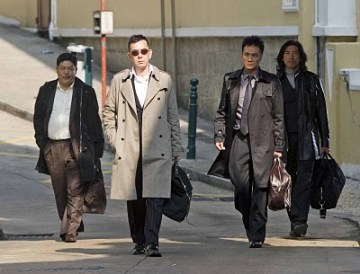
The Hong Kong Spice Boys, Exiled, 2007
This week I’ve been letting my geek flags fly, as I’ve been closely following the countdown of lovehkfilm.com’s Top 50 Hong Kong films of the decade. Webmaster Kozo, Hong Kong film aficionado extraordinaire, has been revealing ten films a day on his blog, Damn You, Kozo, with much commentary from the fanperson peanut gallery. Although Hong Kong films are not the ne plus ultra of film fandom that they were, say, fifteen years ago, more than 150 dedicated otaku responded to lovehkfilm’s poll, which was a completely unscientific open vote of anyone who wanted to send a ranked list of their favorite HK flicks of the past ten years. Being a dutiful HK cinema fangirl I compiled a draft of my top ten and, not surprisingly, the majority of the films on the list starred my personal favorite Francis Ng. Herein follows my list, with reviews of each film. Please note that the list is not a reflection on whether the films are cinematically or historically significant, but based purely on the amount of pleasure that I got while watching them. Which is really how it should be sometimes.
In reverse order:
10. Beauty and the Breast, dir. Raymond Yip, 2003
Wacky comedy starring Francis Ng as an office lothario who bets he can seduce bespectacled smart-girl Michelle Reis. Luckily her dad is an herbalist and kung-fu master who sees through the ruse, setting up Francis and his accomplice, the hapless Daniel Wu, with an appropriate punishment. Unlike most Hollywood actors, Francis Ng sees no need to safeguard his masculine image, which leads to an excellent use of prosthetic mammaries. Favorite scene: A conflicted Francis Ng manifests Good Francis (dressed in white with angel wings) and Bad Francis (in red with a tail and horns), who advise him on his quest to bed Michelle Reis.
9. A Gambler’s Story, dir. Marco Mak, 2000
A weird and loopy, stylized look at a down-on-his-luck gambler, played by Francis Ng, who tries to escape his miserable lot in life. Director Marco Mak mixes slapstick, violence, and pathos as only a Hong Kong director can do in this quirky and bizarre movie. Favorite scene: Francis and Suki Kwan win, then compulsively gamble away a fortune in a Macao casino.

Cecilia Cheung and Lau Ching-Wan show how it's done, Lost In Time, 2003
8. Lost In Time, dir. Derek Yee, 2003
A tearjerker par excellence, by Derek Yee, who also directed the 1993 classic Hong Kong weepy C’est La Vie, Mon Cherie. Lau Ching-Wan and Cecilia Cheung put on an acting clinic as ordinary people coming to grips with personal tragedy. Really one of the best melodramas ever made. Favorite scene: Orphanage scene!
7. PTU: Into The Perilous Night, dir. Johnnie To, 2006
Johnnie To’s dreamlike, surreal travel through nocturnal Hong Kong, with Simon Yam, Lam Suet, and Maggie Siu in search of a lost gun. Possibly the closest To has come to directing an art film, with its poetic use of empty space and expressionistic framing. Favorite scene: Triad musical chairs in a late-night hot pot restaurant.
6. Shaolin Soccer, dir. Stephen Chow, 2001
Though not as brilliant as Stephen Chow’s 1990s mo le tau comedies, Shaolin Soccer still captures Sing Jai’s absurd and wacky persona, with the added bonus of crazy CGI that perfectly meshes with Chow’s insane worldview. Plus it’s a totally fun sports movie. One of the most pleasurable films on the planet, imho. Favorite scene: Stephen Chow demonstrates his kung fu parking skills.

Gigi Leung & Francis Ng a deux, A War Named Desire, 2000
5. A War Named Desire, dir. Alan Mak, 2000
An early film by Alan Mak, one half of the Infernal Affairs team, this intense thriller follows the fate of a pair of estranged brothers who find themselves on the run from triads in Thailand. Francis plays the older brother, a no-nonsense gangster who must choose between duty and honor. Gigi Leung is outstanding as a gun moll whose sharpshooting matches Francis’ shot-for-shot. Favorite scene: Gigi Leung methodically stalks her prey during a chaotic, cacophonous Thai New Year celebration.

Cecilia Cheung and Francis Ng mix it up, The White Dragon, 2003
4. The White Dragon, dir. Wilson Yip, 2003
Fun, frolic, and wuxia, with Francis Ng playing a blind swordsman who falls for bratty and spoiled, vain rich girl Cecilia Cheung. Although the action and comedy scenes are energetic and clever, the best part of the movie lies in the center section of the film, where erstwhile adversaries Francis and Cecilia court and spark. Favorite scene: Cecilia informs the blind, unaware Francis that girls would fall for him since he’s handsome and has straight teeth and a “tall” nose.

Stare-off of the century, Francis Ng and Anthony Wong, Infernal Affairs 2, 2003
3. Infernal Affairs 2, dir. Andrew Lau & Alan Mak, 2003
The prequel to Infernal Affairs, which Martin Scorsese remade as The Departed, Infernal Affairs 2 is a magnificent gangster opus that operatically follows the fate of its many characters. Anthony Wong, Francis Ng, Carina Lau, and Eric Tsang are among the stellar cast. Francis in particular is outstanding as the soft-spoken yet ruthless Triad boss bent on avenging his father’s murder. Favorite scene: Francis mournfully toasts his late father at an outdoor noodle stand, with a cadre of equally somber triads echoing his gesture.
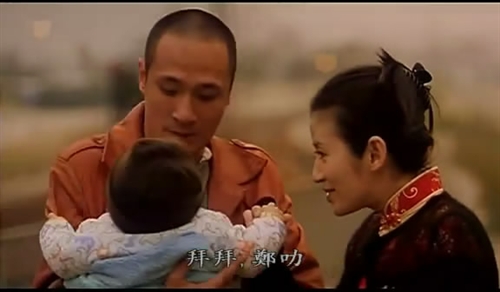
Francis Ng & Sandra Ng try to figure it out, Juliet In Love, 2000
2. Juliet In Love, dir. Wilson Yip, 2000
One of the saddest and most heartfelt genre films ever to reach the screen, with Francis Ng and Sandra Ng as star-crossed lovers who find unexpected solace with each other. Francis plays a low-level triad caught up in a net of fateful events. Sandra is a lonely restaurant hostess who befriends him. Favorite scene: Simon Yam as a mobster boss who indifferently slurps down hot pot while Francis stoically bleeds from a head wound in the corner of the restaurant.

Nick Cheung Ka-Fei shows 'em what for, Exiled, 2007
1. Exiled, dir. Johnnie To, 2007
The ultimate fanperson heroic bloodshed film of the decade, featuring an ensemble cast of hard-guy triad film stars. Anthony Wong, Francis Ng, Lam Suet, Roy Cheung, and Nick Cheung shoot ‘em up on the eve of the 1998 return of Macao to China’s rule. An allegory for the ennui and anomie of Hong Kong and Macao residents during that time, with beautiful cinematography, a haunting soundtrack, and brilliant, tough-as-nails characterizations by the veteran cast, plus five, count ‘em, five amazing shootouts. Favorite scene: the prelude to the awesome opening shootout, in which Anthony Wong and Francis Ng remove ammo from their automatic pistols in order to have the same amount of bullets as Nick Cheung’s six-shooter.
Honorable mentions: Mad Detective; After This Our Exile; Election 1; The Warlords; Sparrow; Turning Point: Laughing Gor; Fantasia; Initial D; Wo Hu; On The Edge



 beyondasiaphilia
Recent Comments