Posts filed under ‘chinese movies’
Addicted To Chaos: Ringo Lam’s Wild City film review

Louis Koo and pistol, Wild City, 2015
Back in 1980s and 90s when Hong Kong cinema ruled the world, the undisputed god of acting was Chow Yun-Fat and his most renowned collaborator was the king of heroic bloodshed, John Woo. But close on Woo’s heels was his grittier, darker compatriot, Ringo Lam, who also made several classic HK crime movies starring Chow. Beginning with City on Fire and continuing through Prison On Fire 1 and 2, Wild Search, and Full Contact, Chow and Lam worked on a string of indispensible action movies that defined the crime film genre in the former Crown Colony.
But after directing eleven films from 1987-1995, many of them excellent and some of them masterpieces, Lam’s output declined—in 1997 he made a crappy Hollywood movie with Jean Claude Van Damme, then returned to Hong Kong to direct the brutal and amazing post-handover cop-and-criminal film Full Alert. But since 1997 Lam has only directed six films. So it was with much rejoicing that Hong Kong movie fanpeople reacted to the news last year that Lam was directing his first film since 2002 and was returning to Hong Kong to make it. That film, Wild City, opens this weekend in the US on a near day-and-date release with China and a month before its debut in Hong Kong.
The story concerns T-Man, a former cop who comes across a forlorn woman drinking in the bar he now owns. As with many dames in crime movies she’s nothing but trouble, and soon T-Man is embroiled in a mess, along with his hotheaded half-brother Chung, running across gangsters, thieves, crooks, and cheaters.
The movie is a throwback to Lam’s glory days and focuses on themes and situations from his classic films with Chow. Not only that but it’s set en la calle in Hong Kong and much of it is in very vernacular Cantonese. If you close your eyes you can almost imagine that it’s 1992 all over again, except that since this is the 21st century the movie stars the ubiquitous Louis Koo and half of the cast are from Taiwan or the PRC, with the dialogue littered with the unmistakable presence of Putonghua.
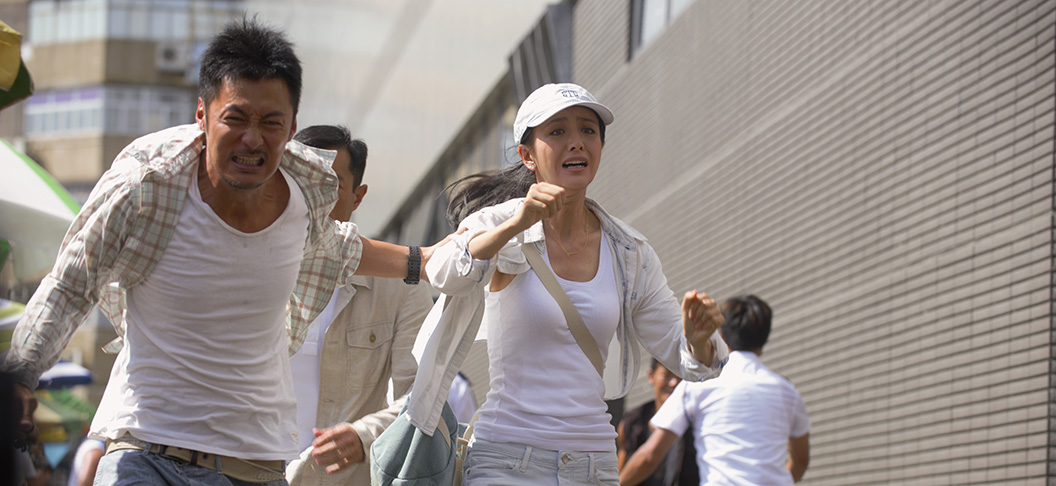
Running, Wild City, 2015
Like a lot of Lam’s ouevre, Wild City draws on several classic film noir tropes. Tong Liya plays the beautiful and mysterious woman with a dark past. Louis Koo is the disgraced former cop with the impulsive, loose cannon half-brother (Shawn Yue) whose nuts he repeatedly has to pull from the fire. The bad guys, led by the moody Joseph Chang (here playing against type as a Taiwanese gangster) are ruthless yet possess a strong sense of loyalty and brotherhood. The nighttime streets of Hong Kong are dark and slicked with rain and Lam’s camera roams restlessly with its characters through the city’s environs.
As with Lam’s past films, the characters are nuanced and shaded, with the good guys displaying flaws and the bad guys showing grief and remorse. Lam also includes his trademark social critique—the very first image of the film is of a Hong Kong 1000 dollar bill that dissolves into a nighttime skyline of the city. The film then cuts to a street-level view of crowds of people in the city at night, lingering on an image of a homeless woman living in a cardboard box, with Louis Koo’s voiceover stating, “We are all driven by one issue: money.” The plot turns on the rampant greed ruining the lives of the characters as well as destroying Hong Kong, and much of the narrative focuses on the looming presence of a shiny suitcase full of gold and currency, with its corrosive influence a metaphor for capitalism’s corrupt effects. The film also reflects Hong Kong’s current state of anxiety, with several characters expressing the difficulty in finding a place to call home.

Pile-up, WIld City, 2015
No one directs an action sequence like Ringo Lam and Wild City includes a crackling car chase, violent murders, and hand-to-hand beatdowns in close quarters. There are also swaggering triads, corrupt lawyers and businessmen, and other denizens of Lam’s nocturnal Hong Kong universe that add a general sense of foreboding to the proceedings. Yet at the same time Lam allows for a glimmer of hope in the darkness, and the film’s conclusion is perhaps less dark and cynical than his past work. I wouldn’t go so far as to say that Lam has mellowed but SPOILER not everything completely goes south like it might have in his past films.
If you’ve never experienced a Ringo Lam Hong Kong movie before, now is the time. Wild City won’t stay in theaters long, so this is your chance to witness some of what made Hong Kong the center of the moviemaking universe back in the day. And if the film does well enough, Lam will be able to get financing to direct more movies and we won’t have to wait eight years for his next joint to drop.
directed by Ringo Lam
opens July 31, 2015
Century 20 Daly City
1901 Junipero Serra Blvd
Daly City, CA 94015
Four Star
2200 Clement St
San Francisco, CA 94121
and selected theaters in North America
I Would Die 4 U: Black Coal, Thin Ice at the San Francisco International Film Festival
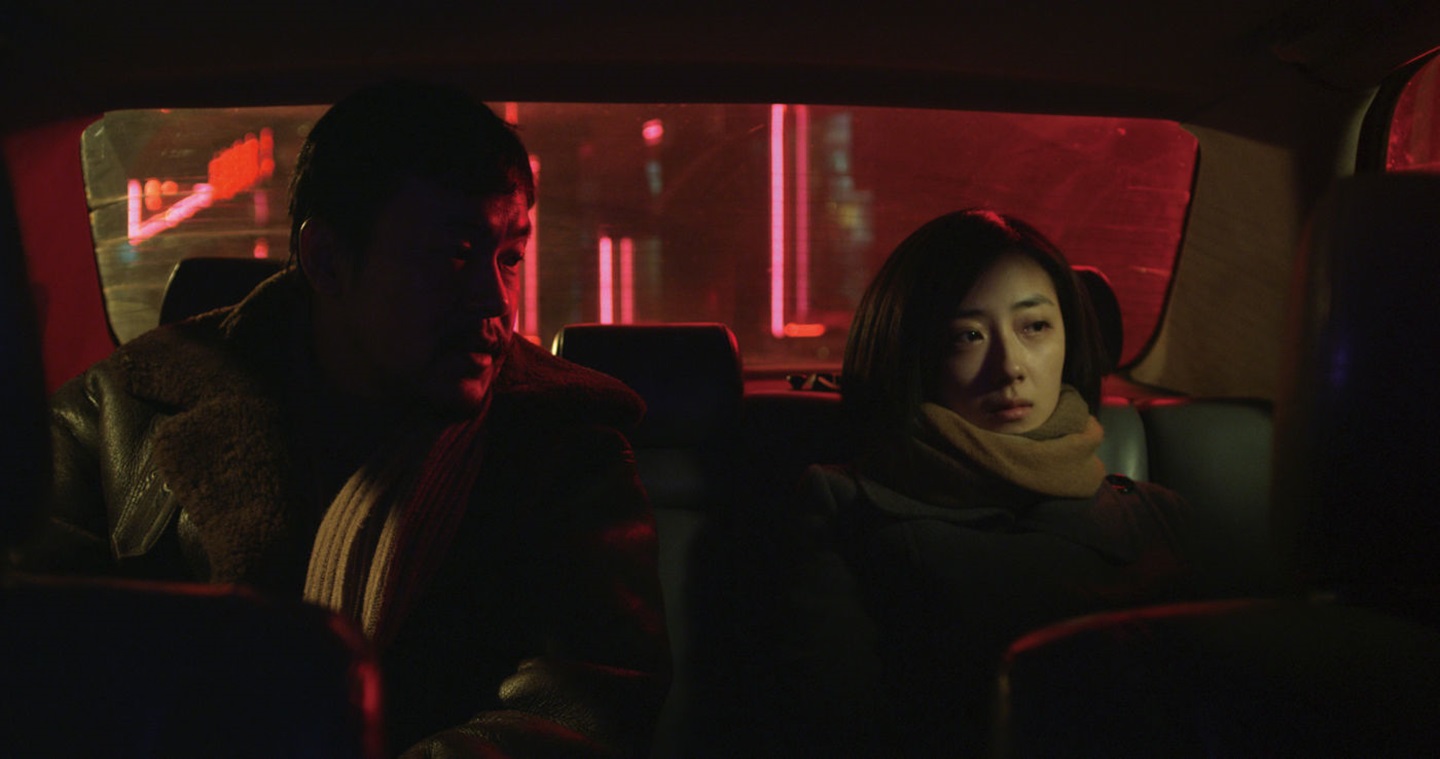
Complicit, Black Coal, Thin Ice, 2014
Just got back into town and am diving into the thick of things at this year’s San Francisco International Film Festival, now running through May 7. I’m leaving town again on Sunday so I’m cramming as many screenings into the next five days as I can manage. Luckily there are plenty of great films to see. I’m hoping to make it to the Viggo Mortenson vehicle Jauja, by Argentine director Lisandro Alonso and featuring Viggo in a role that’s tailor-made for him as a Danish military engineer caught up in unrest in 19th-century Patagonia. Viggo he gets to acts in two of his native tongues, Danish and Spanish, and the film is a magical-realist version of the historical events it depicts.
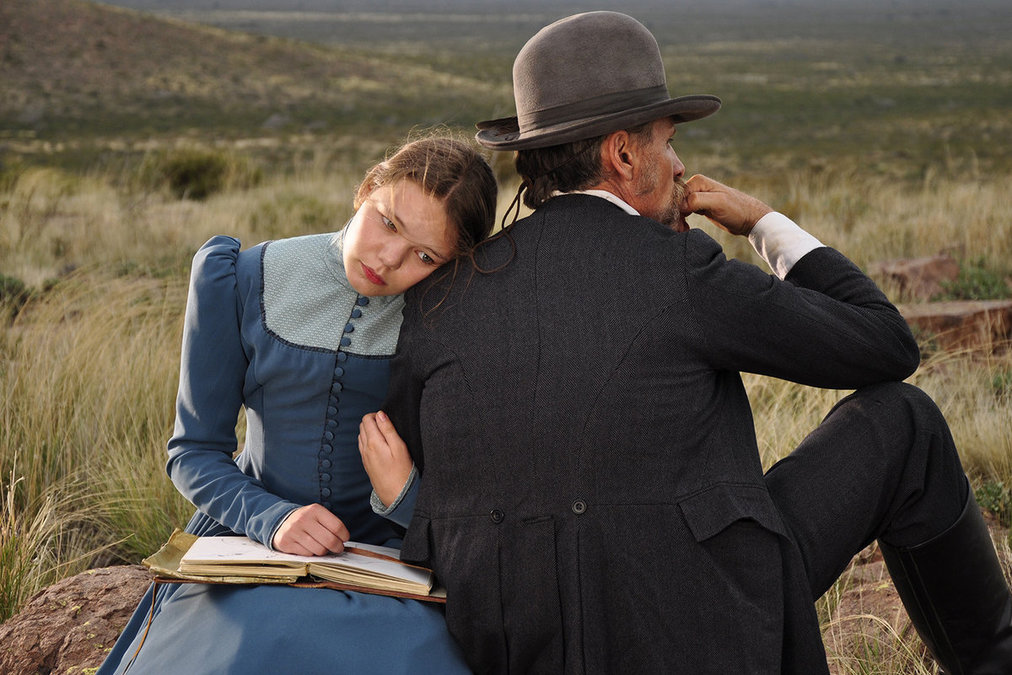
Viggo Mortensen, polyglot, Jauja, 2014
Also on the docket is the 3-D version of Tsui Hark’s The Taking of Tiger Mountain, Hong Kong director Peter Chan’s child-abduction drama Dearest, and City of Gold, the documentary about Pulitzer-prize winning Los Angeles food critic and mensch Jonathan Gold. If I were in town next week I’d surely go see the South Korean thriller A Hard Day but I’m hopeful that it will make it to a theatrical release stateside sometime soon. SFIFF also plays host to Jenni Olsen’s newest feature-length experimental documentary/essay film The Royal Road, which looks at butch longing and unrequited love against the backdrop of El Camino Real, the historic king’s road that stretches nearly the length of California. Indian director Chaitanya Tamhane’s independent feature Court also screens this week, taking a character-based, neo-realist look at the absurdities of the Mumbai judicial system and its surrounding social and cultural milieu, with results that are about as anti-Bollywood as you can get.
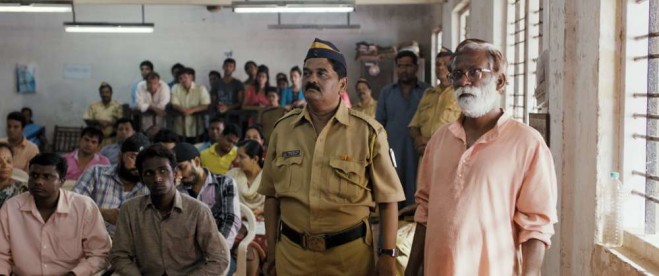
Mumbai legalities, Court, 2015
One of my favorite films from last year, director Diao Yinan’s neo-noir Black Coal, Thin Ice, has one more screening this week at the festival and it’s definitely a don’t-miss movie. From the very start, with shots of random body parts mixed in among train cars of coal shipping throughout the frozen northern regions of China, the film puts a distinctive spin on the classic noir structure. The film follows Zhang (Liao Fan), a less-than-scrupulous cop, as he becomes more and more deeply involved in the mysterious disappearances and murders of various hapless men, all of whom eventually seem to be tied to a classic black-widow character, played by the amazing Taiwanese actress Guey Lun-Mei.

Bleakness, Black Coal, Thin Ice, 2014
Looping back and forth in time and place, with bursts of intense and unexpected violence, the movie effortlessly transfers the noir genre to the China’s bleak and wintry industrial north, making great use of the icy landscape and the characters’ corresponding desperation and hopelessness. Both Liao and Guey won acting awards (at the Berlin Film Festival and the Golden Horse Awards respectively) for their performances in this film and they embody the moral messiness and ambiguity of the best noir characters. As in all great noirs, everyone is complicit and no one is innocent, and the most innocuous situation, whether in a beauty parlor or at an ice skating rink, can suddenly change into a deadly trap.
So although I’m missing the big galas and parties at the beginning and end of the fest I’m still catching the meat of the event this week. As always the festival is a chance to see some of the best recent global cinema on the big screen.
58th San Francisco International Film Festival
through May 7, 2015
Lost In Love: Back In Time movie review

Sentimental, Back In Time, 2014
Classic Chinese pop music, known as Cantopop or Mandopop depending on the dialect, is a bit of an acquired taste. It’s all smooth edges and soft sounds, designed to soothe and comfort, as opposed to, say, the techno-hip hop flavors of Kpop. It’s no surprise that Western imports like Air Supply, kings of the power ballad, are hugely popular in China and Hong Kong. There are of course exceptions to this, including the hard-rocking Cantopop kings Beyond, but the top of the charts in Hong Kong as well as on the mainland have since the 1980s been dominated by sleek pop balladeers such as Jacky Cheung, Faye Wong, and Andy Lau.
The cinematic equivalent of Canto/Mandopop would be Back In Time, (aka Fleet of Time), which recently played here in the U.S. as a day and date release with China. The film was number one at the box office in China before being bumped off the top spot by Jiang Wen’s Gone With The Bullets. Like a lot of Chinese pop music, Back In Time is competently crafted and pleasant to experience, but soft and cloying, without a lot of rough edges.
A slick weepy with attractive leads in Eddie Peng (most recently seen kicking ass in The Rise of the Legend and Unbeaten, among other manly roles) and Nini (chief flower in Zhang Yimou’s Flowers of War), Back In Time is unabashedly nostalgic as it traces the relationships of a group of friends from their high school days to adulthood. The main narrative follows the reminiscences of businessman Chen Xun (Peng) as he recalls his chaste adolescent romance with the Fang Hui (Nini), a transfer student to his secondary school. Although the two promise everlasting devotion, for the sake of narrative tension their romance hits the skids. Will they kiss and make up or will they forever be lost to one another? The film’s gauzy, soft-focus shots of billowing curtains, rain-slicked streets, snowy landscapes, and characters literally crying in their beer heighten the overall sentimentality of the proceedings.

Gauzy, Back In Time, 2014
The movie is also fairly apolitical, despite spanning a period of great change in Chinese history (roughly 1999 to the present day). Although China went through a lot during that time, almost none of this is present in the film (except a reference to Beijing’s winning bid to be the site of the 2008 Olympics). Instead the film focuses on its youthful love story, which strips the narrative of most of its historical context and content. Compared to Taiwan’s similarly structured Girlfriend/Boyfriend (2012), which actively incorporated student political demonstrations into its story, Back In Time only briefly touches on events that occurred during its timeline. The rest of the film takes place in a historical vacuum, with the passage of time primarily reflected in the changing hairstyles and cell phones of the protagonists (with wigs worn with varying degrees of success, including Eddie Peng’s ill-fitting late-90s mop and Nini’s curiously changing hair lengths).
Lead by the pretty leading pair played by Peng and Nini, the film’s cast is winning and earnest, though in the earlier parts of the movie some of the performers look way too old to be high school students. There are also a few confusing plot developments such as a hissy fit at an outdoor restaurant that escalates without explanation into a knock-down brawl, but none of them as contrived or annoying as those found in the Nicholas Tse/Gao Yuan Yuan romantic drama stinker, But Always. But Back In Time, though by no means racy, also deals fairly frankly with sexuality, a change from many similar melodramas of its ilk that’s worth a few points in my book. At times the overwrought emotionality of the movie just barely avoids self-parody and isn’t helped by the swelling violins and tinkly piano on the soundtrack. But it’s a watchable timepass, especially if you’re in the mood for a deeply emo cinematic experience.
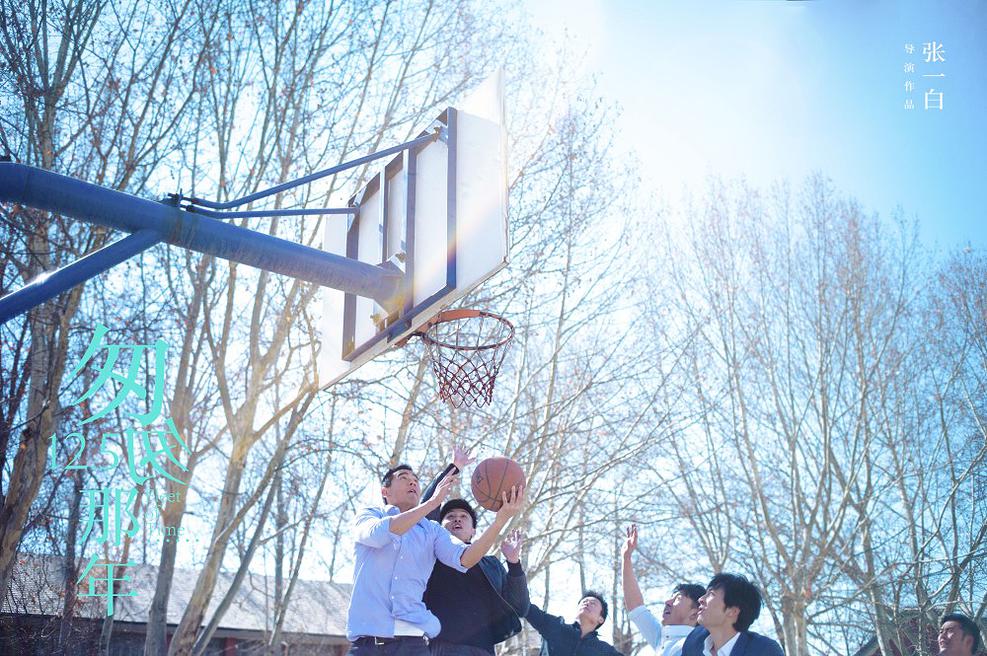
Besties, Back In Time, 2014
With Back In Time, distributor China Lion continues to hit its stride. Unlike the typical Asian genre fare of gangster, martial arts, and wuxia films usually distributed in the U.S. and aimed at Western sensibilities, CL’s most recent releases aim straight for the Chinese expat community. Its last five titles released in 2014—Back In Time, Women Who Flirt, Love On A Cloud, Breakup Buddies, and But Always—are romantic dramas or comedies and feature performers popular in China but mostly unknown in the U.S. even among Asian film aficionados, with the exception of Nicholas Tse and possibly Zhou Xun. These movies also differ from the output of international arthouse favorites like Zhang Yimou or Chen Kaige and are solidly middlebrow and commercial, created to entertain and not to startle, and have found an audience in the U.S. Deadline.com notes, “China Lion has had success with romantic dramas imported from Chinese-speaking regions in the past. They handled Beijing Love Story ($428K cume) in February and other past titles include Love ($309K cume) and Love In The Buff ($256K cume).”
Back In Time (as well as the CL releases that immediately preceded and follow it, Pang Ho-Cheung’s Women Who Flirt and the Angelababy vehicle Love On A Cloud) demonstrates that China Lion has figured out a winning formula that works for its Chinese expat niche audience. Though many of these films may not be appealing to the typical Asian-film fanboy in the U.S., to Chinese audiences away from home they’re just like listening to the latest Jacky Cheung CD—they’re a soothingly familiar entertainment experience.
Love Hangover: Temporary Family and But Always movie reviews

Obligatory condom joke, Temporary Family, 2014
A couple Chinese-language romantico films made their way into the U.S. market this week and one works while the other doesn’t. Hong Kong release Temporary Family uses the backdrop of the superheated HK real estate market to frame its romantic comedy, while PRC rom-dram But Always flails about in China and the U.S. as it attempts to tell its story of lovers pining for each other across years and continents.
Hong Kong renaissance woman Cheuk Wan Chi (aka Goo-Bi GC aka Vincci aka G) directs Temporary Family, an amusing romcom starring A-listers Nick Cheung and Sammi Cheng, along with mainland Chinese starlet Angelababy and rapper/singer Oho (who sings the title track). A broad, hyperlocal comedy that sends up the tight housing crunch in the former Crown Colony, the movie also includes cameos by Heavenly King Jacky Cheung, TVB stars Myolie Wu and Dayo Wong, and Chinese film star Jiang Wu (as an ultrarich PRC real estate speculator) and, not surprisingly, the movie has been a huge hit in its home territory. Although the film tilts towards the slapstick at times it still manages to sustain its narrative tension for most of its running time and is an agreeable timepass. Nick Cheung (Lung) started his career back in the day as a Stephen Chow wannabe so it’s not surprising to find him successfully tempering his usual dramatic intensity in a lighter comedic role. Sammi Cheng pulls out her neurotic jilted lover persona most famously seen in Johnnie To’s huge romcom hit Needing You, this time playing Charlotte, a recent divorcee unable to break from the past. Angelababy plays Lung’s adopted daughter, a slouchy millennial who bounces aimlessly from one low-paying job to another. Oho rounds out the main characters as the awesomely named Very Wong, Lung’s intern and the scion of an unnamed rich man in China. The plot contrives to throw together this unlikely crew as temporary roommates in a luxury condo in Hong Kong’s toniest neighborhood as they attempt to cash in on the real estate market’s volatility.

The wacky crew, Temporary Family, 2014
The movie is chock full of local references and in-jokes (why do all the real estate agents have bleached blonde hair?) and follows the time-honored Hong Kong movie tradition of good-natured vulgarity, including a running joke about a stray pubic hair. Structurally the film recalls the slackly constructed, improvisational comedies of Hong Kong Lunar New Year films and, maybe due to director G’s relative inexperience (this is her second feature), at times scenes abruptly and inexplicably fade to black. Though the movie’s energy flags a bit about two-thirds in, the amiable cast powers through the rough patches and manages to pull out a reasonably entertaining conclusion including the sardonic last scene, as Lung and Charlotte finally find their bliss. Nick Cheung as the desperate realtor Lung is as always quite watchable. Sammi Cheng is somewhat less so, as her neuroticness precludes much lovability, which in turn spoils any chemistry she and Nick might have had.
The movie has been a big hit both in Hong Kong and the PRC, and it’s great to be able to see it here in the U.S. on the big screen, if only to ogle the panoramic shots of Hong Kong harbor and its skyline at night. I had no luck tracking down the U.S. distributor so I was a bit surprised when it popped up here at the Metreon, but I’m glad that I ran across its screening schedule in a random facebook post. It looks like some Chinese distributors are following China Lion and Wellgo’s lead in targeting the Chinese-speaking audience here in the States, although their choice of films is somewhat random. But I’ll take what I can get, especially if it means releases of non-action films like Temporary Family and Pang Ho-Cheung’s Aberdeen, which showed up without fanfare down in Santa Clara a month or so ago.
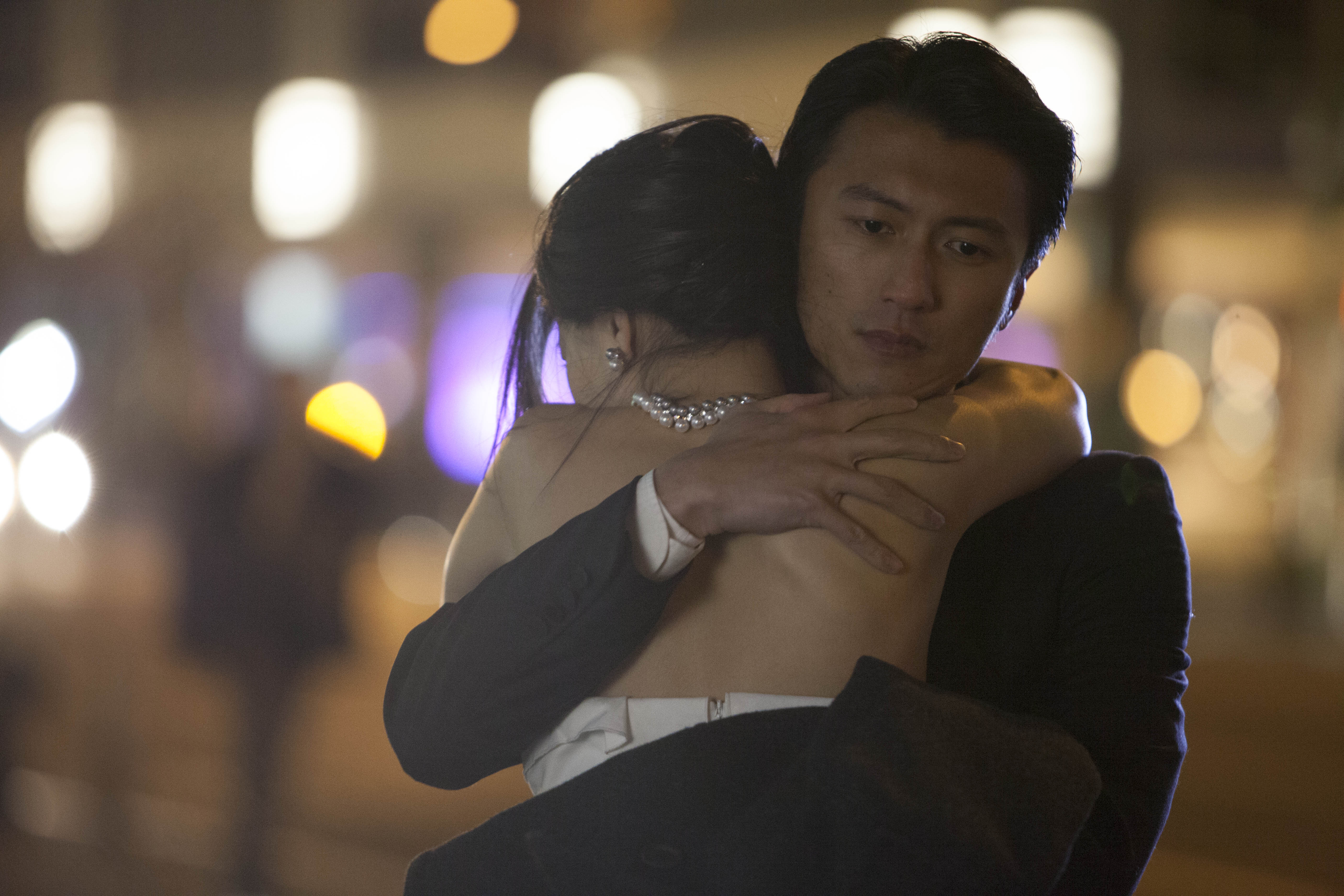
As bad as it looks, But Always, 2014
Like those two films, the Nic Tse/Gao Yuan Yuan romantic vehicle But Always had a day-and-date release here in the Bay, but the movie is no great shakes and is in fact one of the worst, most hackneyed and clichéd films I’ve had the misfortune to witness in a long while. Granted, I don’t go see a lot of romantic films, since my preference is for movies with guns and gangsters, but I know a bad movie when I see one. Not only is the storyline derivative and the narrative conflict forced, but the characters are poorly drawn and the film’s direction is sloppy and amateurish.
The movie starts in 2001 in New York City, then flashes back to 1970s Beijing where Anran (Gao Yuan Yuan) and Yongyuan (Nic Tse), are young kids. This is the best part of the film as the movie renders mid-century China as comfortably shabby and not yet touched by modern global capitalism. The movie then laboriously follows Anran and Yongyuan’s relationship through the years in both China and the U.S. as they hook up, fall apart, and reconcile numerous times for no apparent reason except to generate dramatic angst. The film trowels on the melodrama as suicide attempts, love triangles, jilted lovers, and other tragedies mount. The only things missing from the hit parade of drama trauma are amnesia, long-lost twins, and a car crash, though the ending surely tops these in its maudlin, fatalistic conclusion. Hint: the date and place of the lovers’ last rendezvous gives away the fantastically tragic coincidence at the film’s climax.

Pretty Nic, But Always, 2014
Nic Tse and Gao Yuan Yuan are nicely lit and photographed throughout, though Nic seems a bit embarrassed to be in such a crappy flick. It’s also funny to note that, being a PRC production, we get to see his a lot of his beautiful torso and cut abs but almost none of her naked skin except a decorous peek at her bare shoulder.
There’s nothing wrong with the old-time narrative of star-crossed lovers patiently waiting for each other through endless adversity and I’m all for a well-told version of a classic story, but this movie is not that. Instead it’s a lazy, clumsy rehash of tired tropes without any freshness, originality, wit, or style. Yeah, I didn’t like it much.
Fade Away and Radiate: Tai Chi 0 film review

Angelababy, text, and explosions, Tai Chi 0, 2012
Tai Chi 0, actor-turned-director Stephen Fung’s new-school martial arts movie, opens this weekend in the U.S. after a pretty successful theatrical run in China. The first of a trilogy, Tai Chi 0 is chock full of what we in the nineties used to call self-reflexivity and is loaded with Brechtian bells and whistles, but ultimately the movie doesn’t have a lot of substance below it’s clever exterior. Although it was a lot of fun while I was watching it, the effects of Tai Chi 0 faded pretty quickly after I left the theater.
The movie’s premise is a nice homage to classic kung fu flicks: talented but naïve youngster attempts to hone his martial-arts chops by seeking out an elusive gong fu master, with many obstacles barring his way. Tai Chi 0’s main character, Yang Lu Chan, is born with a small fleshy horn on the side of his forehead that portends his inborn martial arts prowess. Unfortunately, whenever Yang starts an ass-kicking his life essence is dangerously depleted. In an attempt to counter the deleterious effects of using his powers, Yang journeys to Chen village in hopes of training with the master residing there, but tradition forbids any outsiders learning the village’s kung fu secrets. The movie has fun pitting Yang against villagers using mah jong tiles and tofu to defeat his attempts at learning their ways and Tai Chi 0 is best when it riffs on these familiar tropes. Sammo Hung’s classic action choreography carries the movie’s fight scenes, though it’s undercut a bit by Fung’s shaky-cam and too-quick editing.

Jayden Yuan Xiaochao, flexible newbie, Tai Chi 0, 2012
Showing some moxie in her role, Angelababy acquits herself pretty well as the spunky heroine, while Eddie Peng as her conflicted boyfriend torn between tradition and the lure of modernity epitomizes duBois’s double consciousness. Newcomer Jayden Yuan Xiaochao as Yang is good as the archetypal kung fu neophyte, though he doesn’t get to do much but fight sporadically and look innocently confused, and Tony Leung Ka-Fei is excellent as a laborer who secretly aids Yang’s quest to learn Chen village kung fu. Unlike some of his contemporaries, Big Tony’s been transitioning nicely to character roles, both here and in Detective Dee and the Mystery of the Phantom Flame.

Big Tony, Tai Chi 0, 2012
Where Tai Chi 0 departs from its martial arts movie predecessors is through its constant use of quirky onscreen titles, constantly traveling camerawork, and other gaming effects. Recalling an old kung fu movie tradition (more recently adopted by big-budget mainland China agitprop flicks like 1911 and Founding of a Republic), actors are introduced by brief onscreen titles that also declare their resume (ie, “that’s Andrew Lau as Yang’s father: he directed the Infernal Affairs trilogy.”) Other titles both informative and ironic constantly pop up throughout the movie, including those detailing the progress of Yang through his quest, as well as onscreen diagrams tracing the speed and vector of a flying kick and other gameboyesque techniques. The movie also features a steampunky locomotive that resembles a huge cast-iron teapot, with grinding gears and smoking cogs straight out of Modern Times. While this is all very adroit and adds interesting visual texture to the movie, the tricksiness still doesn’t make for a really memorable cinematic experience, unlike, say, Flying Swords of Dragon Gate, Tsui Hark’s recent foray into 3-D IMAX which successfully exploited the latest innovations in movie technology to full and insane effect.
But Tai Chi 0 is certainly as diverting as most Hollywood blockbusters and it’s definitely worth seeing on the big screen, if only to catch all of the rapid-fire DFX. It’s fun to see a lot of expensive postproduction imaginatively utilized in a Chinese-language film and I’m all for expanding the boundaries of cinematic expression, so I’ll go see the next two movies in the trilogy. Especially if they make it to the U.S. in 3-D IMAX.
Tai Chi 0 opens October 19, 2012. Go here for showtimes.
I Want Candy: Hong Kong Cinema & the 3rd I South Asian Film Festival

Lau Ching-Wan, badass, The Longest Nite, 1997
This weekend the Bay’s got another embarrassment of filmi riches from a pair of dueling Asian film festivals. This year’s editions of Hong Kong Cinema, and the 3rd I South Asian Film Festival both offer a ton of tasty movie treats.
The 3rd I festival, which starts Sept. 18, runs six days and features over 20 films from 9 different countries including India, Pakistan, Bangladesh, Sri Lanka, The Maldives, Canada, South Africa, UK and USA. Among the highlights is Jaagte Raho (Stay Awake), from 1956, starring my new favorite actor Raj Kapoor and co-directed by Amit Maitra and famous Bengali theater artist Sombhu Mitra. Jaagte Raho’s story follows Kapoor as a thirsty man from the country that arrives in the city longing for a drink of water. He ends up trapped in an apartment block where he’s mistaken for a thief, spending a long, sleepless night being relentlessly chased by the misguided tenants. As he hides out in various apartments he discovers the corruption and deceit amongst the residents, with adultery, gambling, drunkenness, counterfeiting, greed, and theft among their unsavory traits.

Raj Kapoor, sacrificial lamb, Jaagte Raho, 1956
Although his earlier films featured him as an angsty young romantic lead, in Jaagte Raho Raj Kapoor iterates his naïf-in-the-big-city persona that he repeated many times in his later years. Here he’s all wide eyes and pleading gestures as the country bumpkin, a stark contrast to the duplicitous, licentious lot pursuing him.

Raj and Motilal, tippling, Jaagte Raho, 1956
This is great stuff, sly and satirical, that cleverly exposes the hypocrisy of the corrupt tenants. It’s shot in shimmering black and white with a crack soundtrack with lyrics by Shailendra and music by Salil Choudhary, including the rollicking drunken ramble Zindagi Khwaab Hai. The legendary Motilal is outstanding as an inebriated bourgeois who takes in the destitute Kapoor, in an homage of sorts to City Lights—however, Jaagte Raho’s booze-driven hospitality has a much more twisted outcome than does the Chaplin film. The film concludes with a lovely cameo by Nargis, once again representing the moral center of the movie. This was the final film to star Kapoor and Nargis and coincided with the breakup of their long-time offscreen affair as well, so it’s especially bittersweet to see the famous lovers together for the last time. Jaagte Raho was a box office flop when it was first released, but it’s since been recognized as a classic. Interestingly enough, along with Meer Nam Joker, which also bombed when it first came out, Kapoor cites this as his personal favorite film.
Also of note at the 3rd I festival: Decoding Deepak, a revealing look at the modern-day guru that’s directed by Chopra’s son Gotham; Runaway (Udhao), Amit Ashraf’s slick and stylish indictment of the link between politics and the underworld; Sket, which looks at a vengeful girl gang in an East London slum; the experimental documentaries Okul Nodi (Endless River) and I am Micro; this year’s Bollywood-at-the-Castro rom-com Cocktail; and the short film program Sikh I Am: Voices on Identity.
This year’s edition of Hong Kong Cinema, the San Francisco Film Society’s annual showcase of movies from the former Crown Colony, has a bunch of outstanding product. The program includes a three-film retrospective commemorating the 1997 handover: Peter Chan Ho-sun’s Comrades: Almost A Love Story, which stars Leon Lai and Maggie Cheung as friends almost with benefits from two different sides of the HK/China border; Made In Hong Kong, Fruit Chan’s debut that’s a redux of the venerable Hong Kong gangster movie and which stars the young and skinny Sam Lee in his first role; and The Longest Nite, one of Johnny To’s nastiest crime dramas, with impeccable performances by Lau Ching-Wan and Tony Leung Chiu-Wai as (of course) an immoral cop and a vicious criminal.
These three classics are hard acts to follow but several of the other films on the docket manage to hold their own. Both Pang Ho-Cheung’s Love In The Buff, an excellent romantic dramedy with Miriam Yeung and Shawn Yue as the make-up-to-break-up lovers (full review here) and Ann Hui’s most recent feature, A Simple Life, starring Andy Lau and Deanie Ip as a man and his amah, (full review here) had extended runs in San Francisco earlier this year so this may be the last chance to see then on the big screen in the Bay Area.

Sammi & Louis, bantering, Romancing In This Air, 2012
Also good is Johnny To’s new romantic comedy Romancing In Thin Air, which To co-wrote with longtime creative partner Wai Ka-Fai and the Milkyway Image team. Set mostly at a vacation lodge in an idyllic high-altitude locale in China, the story concerns two romantically wounded individuals grappling with the peculiarities of their damaged relationships. Sammi Cheng is her usual charming self as the female lead, but although he’s likeable enough, Louis Koo as a Hong Kong movie star (!) is a bit lacking in charisma and doesn’t bring a bigger-than-life sensibility or the self-effacing humor that Andy Lau or a more engaging performer might have done.
Although the plot is seems at first to be fairly straightforward, the film gradually reveals Milkyway’s trademark weirdness. The story of Sammi’s missing husband, lost in the dense high-country woods for seven years, is a bit creepy, though I do like that when the husband courts Sammi he turns into a clumsy doofus. The film also includes a very meta movie-within-a-movie conceit and makes several sly jabs at the Hong Kong film business.

Utterly illogical, Nightfall, 2012
Less good are Derek Yee’s The Great Magician, a rambling and messy movie that’s a criminal waste of Lau Ching-Wan, Tony Leung Chiu-Wai, and Zhou Xun (full review here), and Roy Chow’s Nightfall, a turgid and ridiculous film that similarly wastes good performances by Simon Yam and Nick Cheung. I really wanted to like this movie, a wannabee intense and serious thriller, not least for its slick and attractive cinematography. But despite a gripping and violent opening scene the movie has some great gaping holes in logic and alternates between chatty exposition and absurd set pieces. Still, Nick Cheung is very good as a haunted convict with anger management issues, though Simon Yam is somewhat less good as the cop unraveling the mystery. Yam doesn’t have quite the emotional depth of Francis Ng or Lau Ching-Wan and so the payoff at the end of the film is weaker than it might have been. Michael Wong is quite bad as an abusive father, with a shrill, one-note performance and his annoying habit of speaking English at the most illogical moments. I kept imagining what Anthony Wong might have done with this part. The violence is a notch more gruesome than most mainstream Hong Kong films, especially in the opening fight sequence—looks like someone’s been watching Korean movies for tips on emulating their gory tendencies.
All in all, San Francisco Asian film fans are going to have to make some hard choices this weekend—not that that’s a bad thing by any means.
3rd i’s South Asian Film Festival
September 19-23, 2012, Roxie and Castro Theaters, San Francisco
September 30, 2012, Camera12, San Jose
September 21–23, 2012
New People Cinema, San Francisco
Shot By Both Sides: Chen Kaige’s Sacrifice

The baby in question, Sacrifice, Chen Kaige, 2011
Sacrifice, Chen Kaige’s new movie, is now playing in San Francisco and while it’s a quality production, it seems a little dated, as well as being not quite up to the standard of past Chen flicks. But since Chen directed the epic masterpiece Farewell, My Concubine (1993), the bar for his films is pretty high. Sacrifice is certainly at least as worthwhile a watch as, say, Abraham Lincoln: Vampire Hunter, and most likely less insulting to your intelligence.But Sacrifice feels like a relic, caught between the old-timey expectations of international arthouse audiences and the contemporary realities of today’s Chinese film market.
My first encounter with Chen came back in the 80s when I saw Yellow Earth in New York City’s Chinatown. Chen, along with his fellow 5th generationist Zhang Yimou (who was also Yellow Earth’s cinematographer), had just busted out internationally and Yellow Earth was a huge departure from the social-realism of the Mao era. Beautiful and visually lush, with a cogent critique of China’s political and social climate, the movie was a worldwide arthouse hit and set the tone for Chinese films of the time. Chen went on to even more acclaim with Farewell, My Concubine, which famously combined Beijing Opera, 20th century Chinese history, and the divine histrionics of the immortal Leslie Cheung.
Since then Chen has directed a slew of films, though none as popular or critically beloved as FMC. Sacrifice follows in the footsteps of Chen’s most renowned flicks, but perhaps due to this it feels staid and outdated. It’s also to Chen’s disadvantage that his reputation precedes him as the director of the masterly FMC, since his films will be inevitably compared to that classic for the rest of his career.
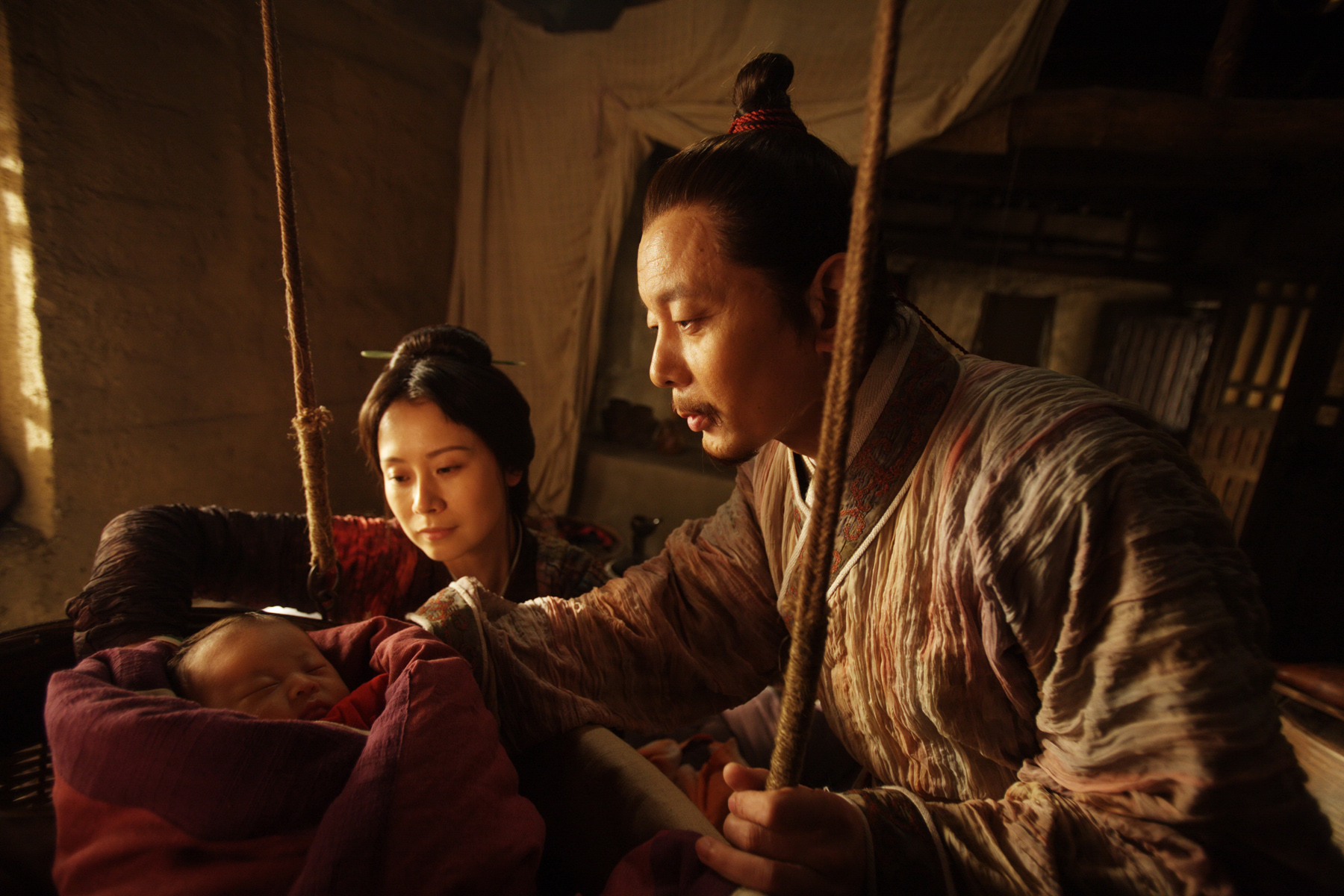
Identity theft, Sacrifice, Chen Kaige, 2011
Sacrifice is based on The Orphan of Zhao, the earliest Chinese play to be staged in Europe, and its storyline is an intricate hash of intrigue and revenge in feudal China. Set during the runup to the Warring States period, the movie follows Cheng Ying, a doctor who is caught up in court machinations. Ruthless warlord General Tu’an mercilessly slaughters his rival, General Zhao, and all 300 of Zhao’s close relatives save one, an infant son born during the chaos of the purge. Due to various byzantine plot twists, identity swaps, and other confusion, Cheng raises the surviving Zhao baby undetected in Tu’an’s court.
The first half of the movie gallops along pretty well, with court intrigue and carnage keeping things running at a brisk pace. But the film’s middle section is awfully slow and the film bogs down considerably at this point. By the end of the movie the pace picks up again, but it’s a long slog through the talky exposition in the middle section. Wang Xuiqi (who starred in Yellow Earth back in 1984) is awesome as the badass Tu’an and Ge You is also outstanding as Cheng, the doctor ground up in the court’s political gears. The secondary characters, however, are less interesting—pretty boy Huang Xiaoming (here with a decorative facial scar) is extraneous and a bit ridiculous and Fan Bing Bing adds another flower vase role to her resume. The final fight scene has some emotional heft since the characters’ relationship is well-established prior. Not so for the significant deaths earlier in the film, since those characters and their relationships are ciphers.

Wang Xiuqi, top dog, Sacrifice, Chen Kaige, 2011
The costumes, art direction, and cinematography are top-notch, but throughout the film Chen makes some janky directing and editing decisions. The identity reveal of a key character is pretty botched, and Chen somewhat clumsily employs flashbacks, dissolves, and intercutting, as well as a repeated fade-to-black motif that’s more distracting than insightful.
Sacrifice is not a bad film per se but it seems a bit old-fashioned given the current state of Chinese cinema. Here in the U.S. audiences seem to think that Chinese movies are all about ponderous costumed historical allegories like Sacrifice, but in China itself the scene is pretty different, with this year’s most popular Chinese-language films to date being Wu Er-Shan’s big-budget fantasy Painted Skin 2, the WWII action comedy Guns N’ Roses, and Mission Incredible: Adventures On The Dragon’s Trail, an animated movie about a goat.
Personally, I’m much more intrigued with Caught In The Web, Chen’s latest film now playing in Asia, that looks at China’s exploding online culture, but it probably won’t see the light of day here in the U.S. for months, if at all. One of Chen’s few modern-day movies, Caught In The Web feels timely and of-the-moment and is probably way too contemporary and edgy for the staid international arthouse demographic that follows Chen. There’s nothing inherently wrong with Sacrifice, and it’s the kind of stately historical Chinese costume drama that U.S. distributors love, but its aesthetic feels as stuffy as a Merchant-Ivory melodrama in the age of Cloverfield.
UPDATE: Looks like Caught In The Web will be playing at this year’s Toronto International Film Festival, which is great news. Here’s hoping it leads to more Stateside screenings—are you listening, SFIFF?

 beyondasiaphilia
Recent Comments