Posts filed under ‘yonghwa’
Where You Are: Searching For CNBLUE

The first time I went to Seoul in Spring 2016 Jung Yonghwa and CNBLUE were comfortably ensconced in the South Korean entertainment scene.

I ran across their images all over the place, and I heard their music everywhere, on sound systems in cafes and in the malls.

I even bought a cute little pair of socks with a cartoon Yonghwa on it.
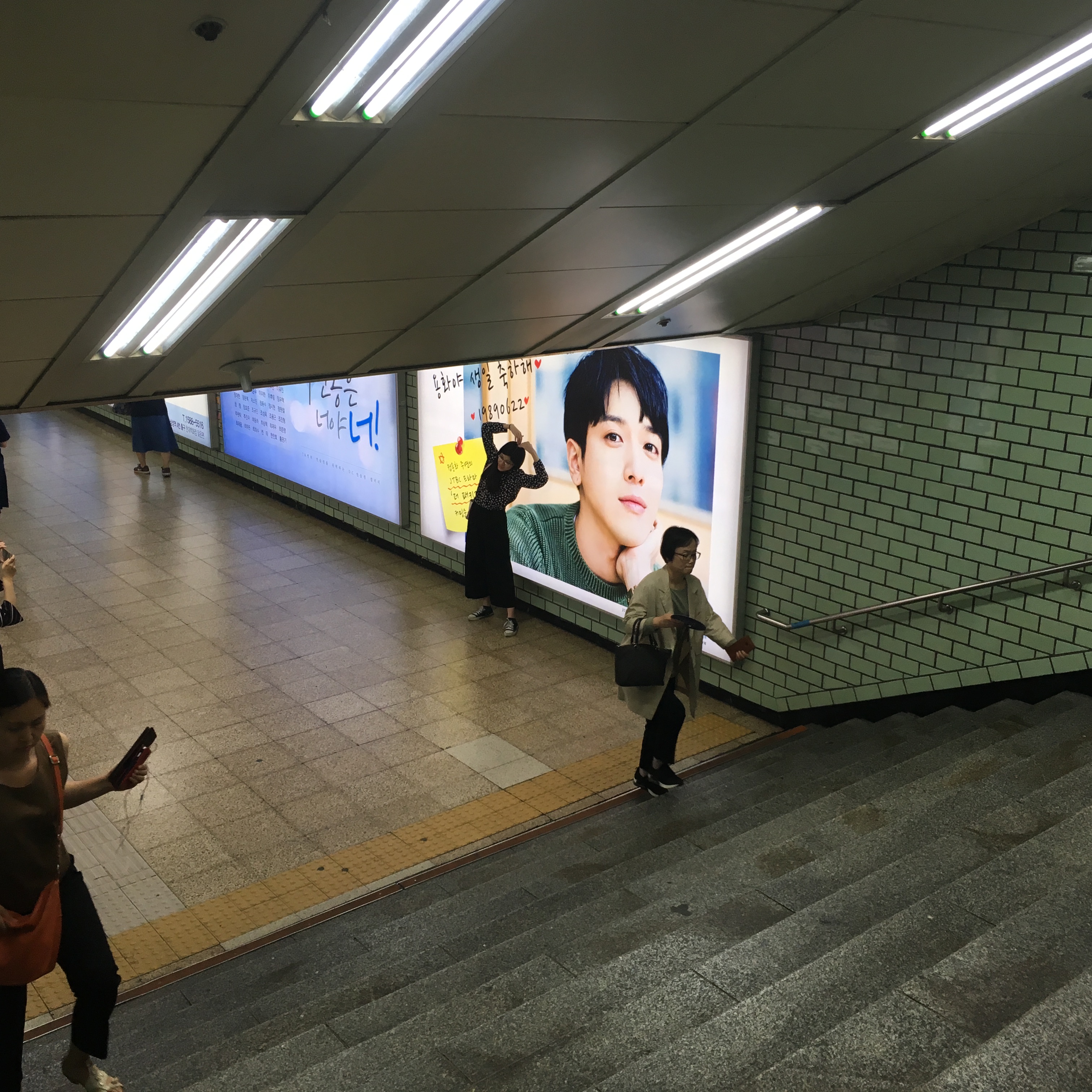
The next time I went to Seoul, in June 2017, CNBLUE was still there, with Yonghwa’s smiling face looking down from a billboard overlooking the freeway from Seoul to Incheon airport, and on both a large video wall as well as a birthday billboard for Yonghwa in the Gangnam subway station that was covered with sticky notes from his adoring fans.


Like any popular South Korean celebrity, Yonghwa’s face adorned skincare ads, calendars, posters and other random merch all over the city.
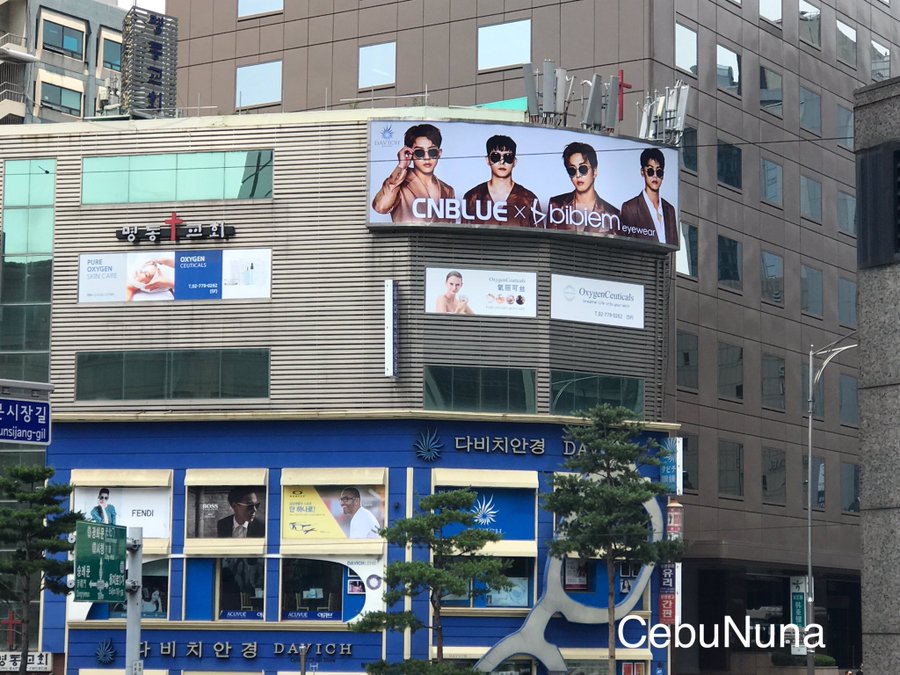
CNBLUE were also models for the South Korean eyeglass manufacturer BIBIEM and their bespectacled faces were on billboards overlooking the Myeongdong area.

In Fall 2019 when I went to Seoul again, CNBLUE had enlisted in the military and their presence was a mere whisper, but I still saw various posters, calendars, and other stray paraphernalia sporting their likenesses at the street markets and Kpop shops.
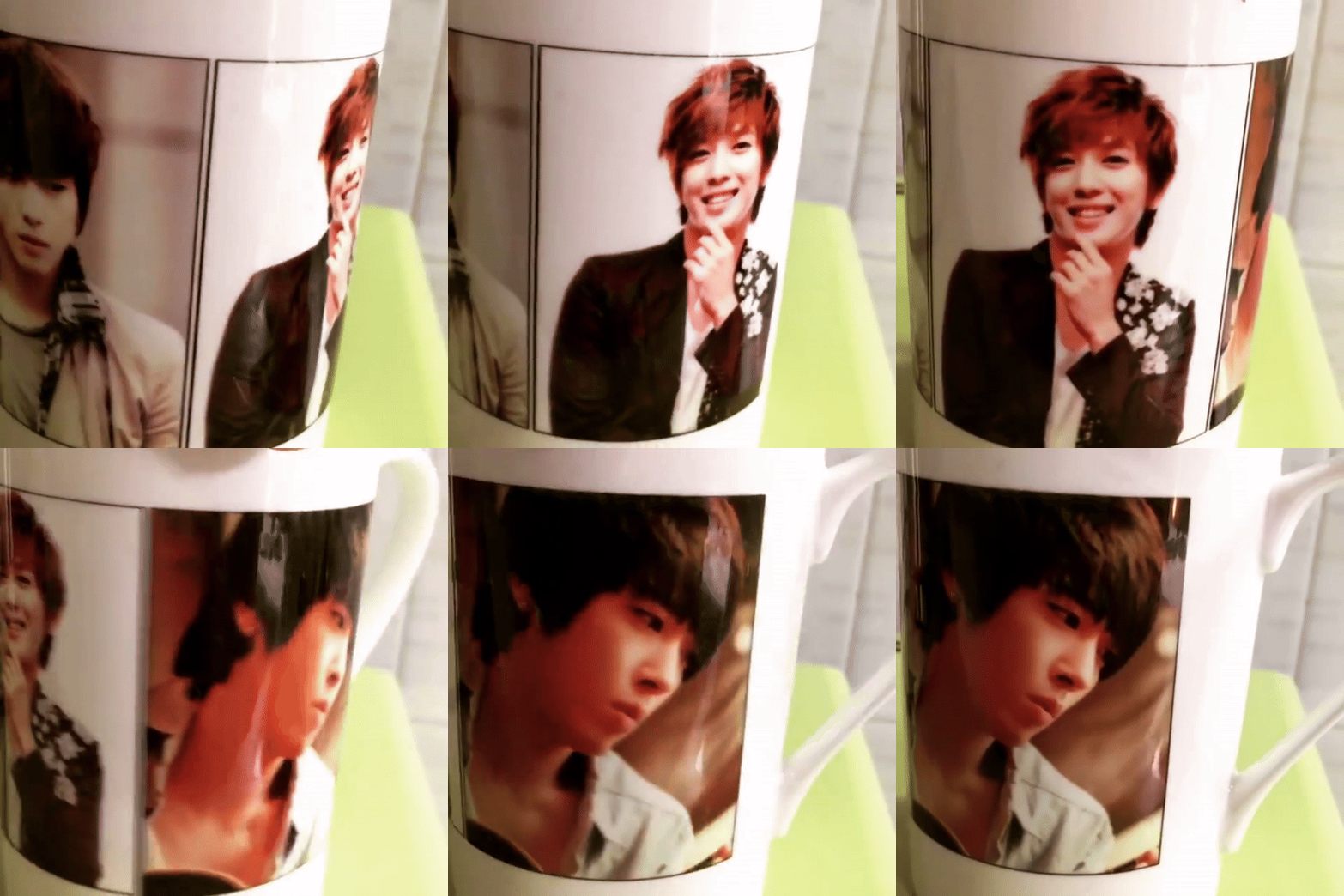
At one store I managed to dig up a coffee mug with Yonghwa’s face on it in a mall somewhere in Dongdaemun.
My most recent trip to Seoul was in Fall 2023. After spending five days all over town I didn’t see any sign of CNBLUE’s presence on the city’s streets. CNBLUE debuted back in 2010 and thirteen years is truly an eternity in Kpop years, so it wasn’t that surprising to find that their images had been supplanted by merch featuring newer, younger groups. But I still felt a bit of melancholy seeing how they’d seemingly vanished from the public consciousness despite consistently releasing brilliant music throughout the years.

But late 2023 also marked a turning point for the band. Yonghwa dropped a new solo mini-album, Your City, in September of that year and instead of promoting on the usual Kpop music shows such as Inkigayo and Music Bank he instead got onto the campus music festival circuit. He played one, then two, then four and eventually six or seven different college festivals that fall, showcasing his superlative live performance chops to audiences outside of the usual Kpop listeners or CNBLUE fans.

Possibly due to the buzz around those shows, CNBLUE was invited to the Someday Christmas festival in December, their first music festival in South Korea after more than a decade of existence, and they also blew the roof off of that venue, playing the only encore out of sets by several different acts.
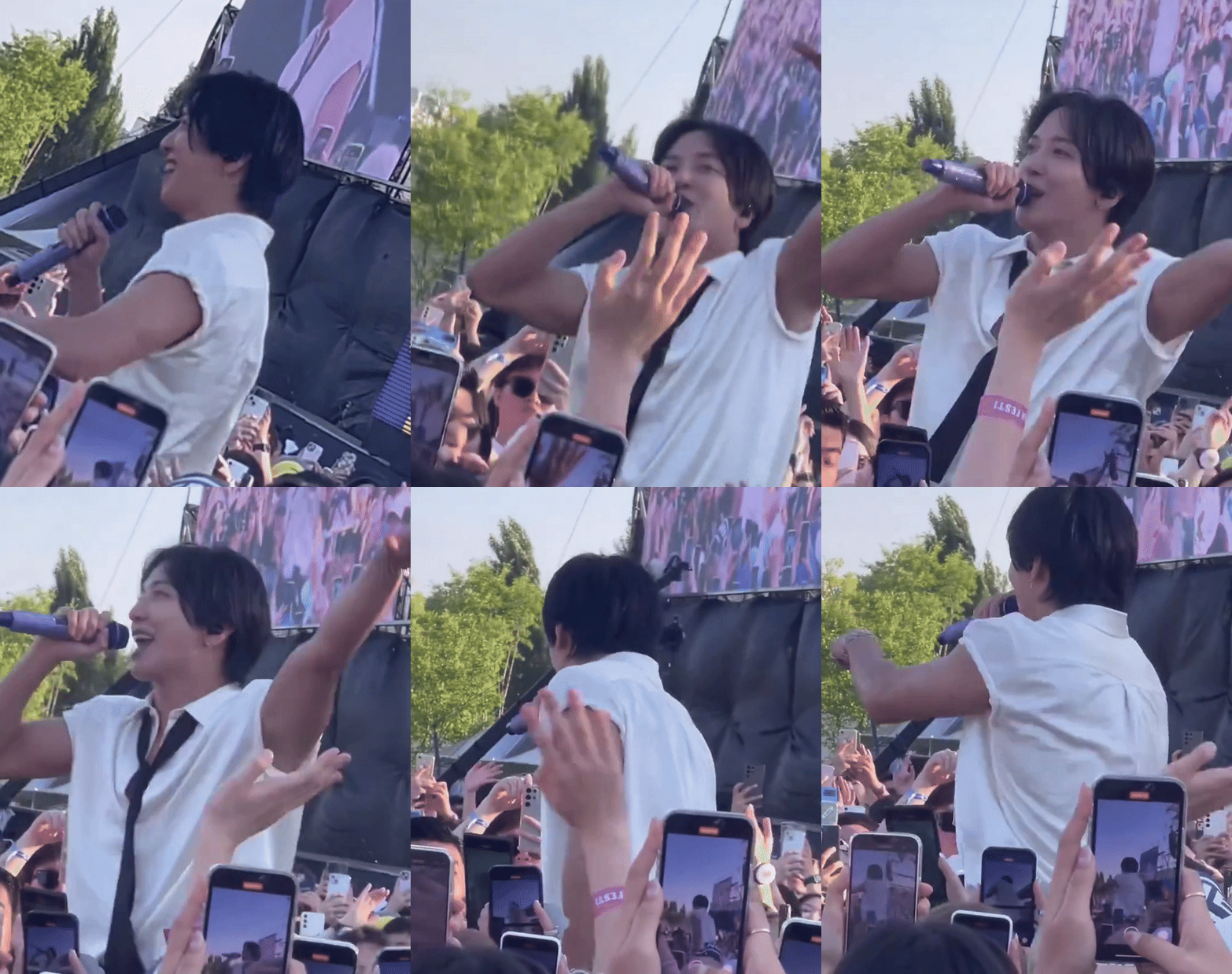
Earlier this summer they tore it up at the Peak Festival in Seoul and they’re scheduled for the Soundberry Festival, also in Seoul, upcoming later in July.
Yonghwa is one of the best and most versatile pop music composers in the world and he and CNBLUE have been popular for years in Japan and across Asia for their blistering live performances, but for some reason in South Korea they haven’t been able to fully shake their image as an idol band. By playing these indie and college music festivals they’re reinventing and reintroducing themselves to a South Korean audience who may have only thought of them as a Kpop group. CNBLUE is finally making the transition from being regarded as just a Kpop idol band to being recognized in South Korea as a legit live band and actual musical artists.
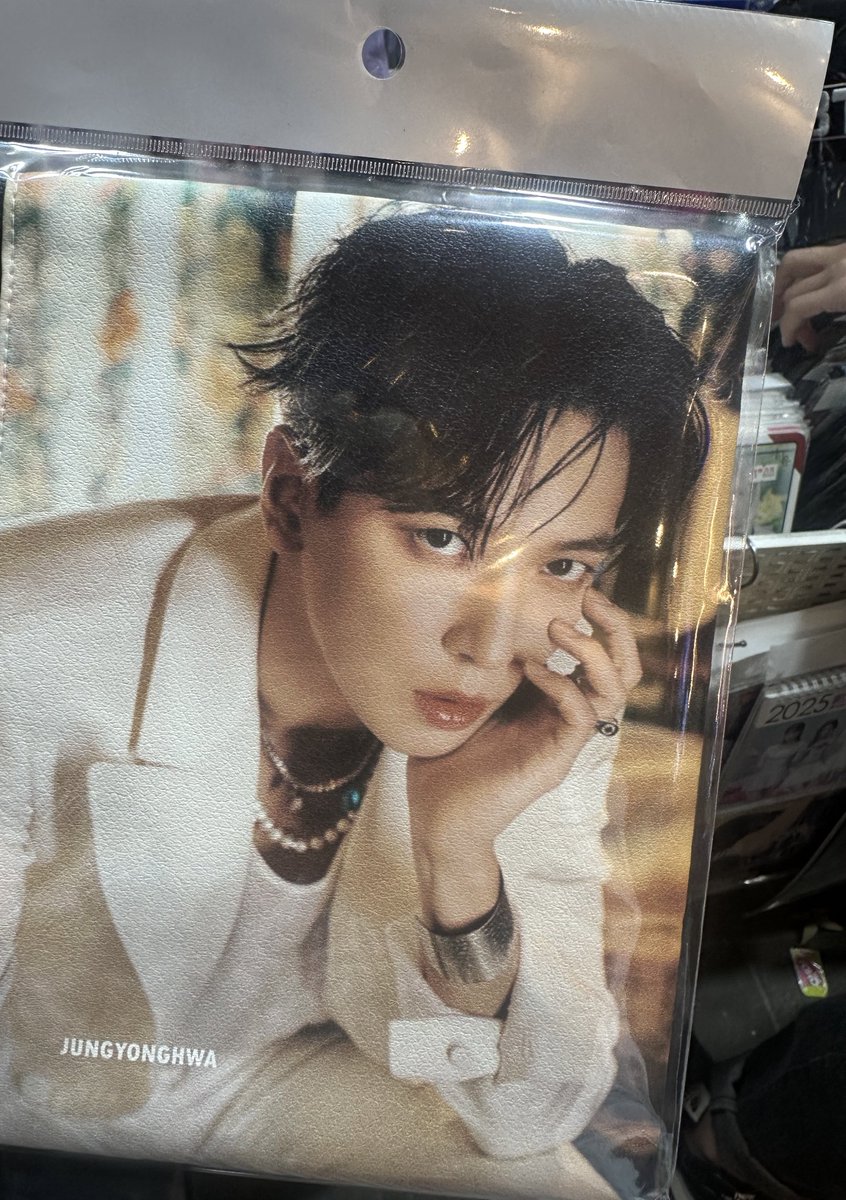

All of these recent shows in South Korea seem to have amped up CNBLUE’s and Yonghwa’s name recognition again in their home country. Recently a fan reported finding socks and other merch for sale once again with Yonghwa’s face on them in street markets in Seoul. Despite being a completely unscientific indicator of popularity or success, this somehow feels like a good omen to me.
You Only Live Twice: CNBLUE in Tokyo and Yonghwa in Hong Kong concert reviews, part 2

The second half of my CNBLUE/Yonghwa doubleheader took place the first week of July in Hong Kong. I hadn’t been to the former crown colony since 2019 so it was nice to visit again and see how things are faring there after the tumultuous pro-democracy protests of that year, followed by the onslaught of the COVID-19 pandemic, and the ongoing brutal human rights violations of the CCP. That’s a whole nother post, but needless to say the people of Hong Kong are very resilient despite all of the upheavals of the past few years.
But as far as the concert went, it exceeded expectations, as Yonghwa was in fine spirits, happy and energetic. After the many angsty performances of the past few years it was great to see him enjoying himself, both solo in Hong Kong and with CNBLUE in Tokyo. He’s most definitely got his swag back after several years of strife and uncertainty.

photo: @colori_KMH
After a few months of touring Yonghwa’s voice at the Hong Kong concert was sure and strong and he was clearly having a blast He wore his peacockiest outfits, including sparkly silver shoes, a striped pink satin shirt, and shimmery white trousers, as well as gorgeous suit jackets festooned with sparkling brooches and a fabulously blingy jeweled vest from the Alexander McQueen menswear collection. He also had a very faint pink wash over his bleached blond hair, which only accentuated his dandy-ness. He clearly came for the fun and wasn’t leaving until he got it.
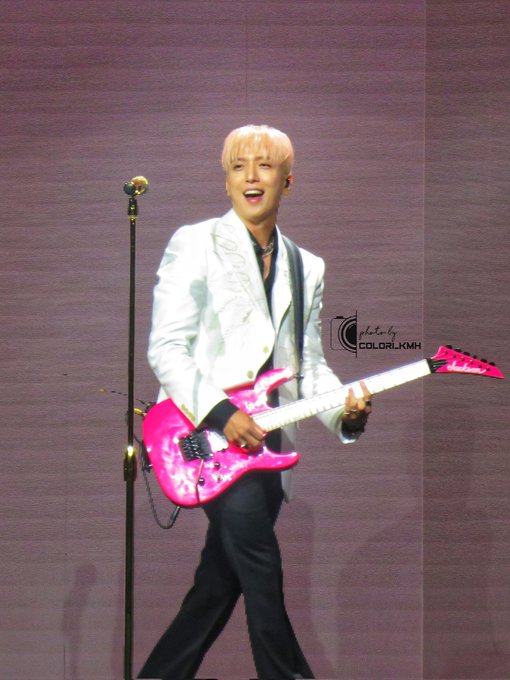
photo: @colori_KMH
This tour’s theme was All-Rounder and Yonghwa was determined to live up to the moniker. He played the guitar and keyboards, rapped, danced, hit some insane high notes, sang in Korean, English, and Mandarin, and showed off his many compositions that were variously deep house, trot, rock, pop, ballads, EDM, city pop, Latin, and jazz. He also made reference to his actor-dol status, performing songs from two of his k-dramas, SELL YOUR HAUNTED HOUSE and HEARTSTRINGS, as well as the marriage reality show WE GOT MARRIED.
Yonghwa’s also gotten much better at dancing since he first tried his hand at it some years ago. His footwork is much lighter, possibly as a result of his new boxing habit, and his time in the ring has loosened up his movements. Unlike he was with his earlier dancing efforts, he’s now loose and limber, with a bigger vocabulary of movement including head twitches, hip rolls, and shoulder dips. He’s feeling the music through his body, not just mechanically doing the moves.
The crowd in Hong Kong skewed much younger than in Tokyo, with many fans in their twenties as opposed to the older ladies that comprised much of the audience in Japan. There was also a whole lotta Mandarin being spoken in the audience even though the show was in Hong Kong, which meant either that a lot of fans from China had made the short trek to the former Crown Colony or that Mandarin is just more common in Hong Kong these days. In a nod to his sinophone fans Yonghwa covered JJ Lin’s sweet pop tune Little Dimples twice, once in the main body of the show and once as part of his marathon encore session. But this meant that the set was missing his glorious cover of the iconic trot song Million Roses (백만송의 장미), which he had previously re-arranged during his stint on K-Trot In Town, the popular variety show he was a main cast member for during the pandemic lockdown.
Notably, compared to shows in Japan, security at the Hong Kong concert was pretty laissez faire. There were security people posted at the end of the rows but none of them made much effort to keep fans from opening up the barriers and running closer to the stage. Security also ignored the many fans taking videos and photos during the show, unlike in Japan where recordings of any sort are punishable by expulsion from the venue. So when Yonghwa decided to come off the stage during Fireworks and subsequently got very close to the crowd, the rush of fans to the front of the hall got a bit dicey. Yonghwa quickly retreated back on stage well out of range. I think he was actually practicing crowd control, trying to calm down a potentially dangerous crowd crush situation.
Just like he and CNBLUE did in Tokyo, after twenty or so songs in his regular set Yonghwa sang several songs during a triple encore, and he was clearly having the time of his life interacting with his fans. He was beaming during all of the encore songs, including the usually very somber ballad One Fine Day. Whereas OFD used to be the final song in the setlist, on this tour he performed it about halfway through the show. It used to be all about Yonghwa preparing to leave, mostly for the military, but now that life is happier and less full of dread he seems content to perform it not as the mood-setter but as just another one of his great compositions. It’s not the theme for his life any more, I don’t think.
He used the second go-round of OFD to show off his pipes and it became a crazy singalong with the crowd swapping lines with him throughout the song. It was almost like he was treating the audience to the song’s high notes just because they loved them so much. He’d already sung the song once earlier in the show with the full theatrical angst that it deserved but I think the second version was actually better, in part because he was so relaxed and in part because the song somehow became happy and redemptive. He may also have been belting it out because it was the last song of the show and he didn’t have to save his voice.
It feels like Yonghwa is finally allowing himself to savor his life and appreciate his happy place, which is onstage performing in front of a huge crowd. Yonghwa is also one of the most relentless people I’ve ever come across and every concert is a step toward his life goals, whatever they may be at the moment. But he also seems to genuinely love being on stage and interacting with audiences as well, and he is a very generous performer, as evidenced by his extended encores in Hong Kong as well as with CNBLUE in Tokyo.
So Yonghwa’s main paradox remains: how can someone so good-looking be so multitalented as well? The casual observer might discount his musical aptitude but closer inspection reveals his prodigious abilities. When he was younger his looks may have unlocked the door, but his talent, perseverance, and hard work have kept it wide open.
You Only Live Twice: CNBLUE in Tokyo and Yonghwa in Hong Kong concert reviews, part 1

Part One: CNBLUE in Tokyo
This summer I had the privilege of replicating the CNBLUE/Jung Yonghwa concert double bill I’d experienced in 2017. I’d already planned to be in Taipei in late June, so when CNBLUE announced that the last concert of their Calling Zepp Tour would be in Tokyo right around then I made a quick decision to extend my itinerary. The recent years of military hiatus and COVID-19 CNBLUE concert-deprivation have made me jump at any chance to see them live. And then Yonghwa announced his All-Rounder tour would have a stop in Hong Kong at the beginning of July and I thought, what the heck, I’ll be in Asia anyway, so after calculating costs and counting my pennies I added a stopover in the former Crown Colony. After all the strife of the past four years I wasn’t about to miss a chance to see my favorite performers in concert-–you only live once, after all.
CNBLUE’s latest Japan tour took place on the Zepp circuit, a chain of small concert halls around the country that hold anywhere from 1,000-2,000 people with general seating tickets. As my friend Glenn recounted in his recap of two CNBLUE Zepp concerts from the tour, the smaller halls create a much more intimate environment than the 8,000-17,000 seat arenas that CNBLUE usually plays in Japan. The tour was a novel experience for fans as well as a way continue to rebuild the CNBLUE brand in Japan after their long hiatus during their military enlistments and during the COVID-19 shutdowns of the past few years. The show I attended at Tokyo Garden was in the largest venue of the tour with about 8,000 seats so it wasn’t quite as cozy as many of the previous stops. But as it was the last stop on the tour, by then CNBLUE was all limbered up and ready to rumble.

The band was definitely more confident and comfortable onstage than when I saw them back in November at Budokan, which were their first live shows after the military/COVID hiatus. By the time I saw them at Tokyo Garden they had a good ten shows under their belt and they had completely regained their swag.
The setlist for this tour was designed for maximum impact in the small Zepp venues, so the band came out swinging, opening with IN MY HEAD and then blazing through three more of their rockiest rock songs. The message was clear that they came for the high energy. Leader Jung Yonghwa busted out the hot pink Jackson guitar he’d debuted at Budokan, taking a few guitar solos to show he knows how. He had his game face on at the start as well, scowling and grimacing rock-star style. The sound in the hall quickly reached that satisfyingly massive roar that CNBLUE achieves when they’re playing their loudest, most rock songs.
Flexing their versatility, in the second set the band completely switched it up, playing three pop tunes that let Yonghwa practice his kawaii. On THIS IS Yonghwa demonstrated another aspect of his impeccable vocal skills as he flawlessly spit the song’s staccato lyrics. CNBLUE even showed off some of their dubious dancing skills during SHAKE, with much joking and smiling amongst the band members as well. They effectively worked the crowd, reflecting the years they’ve spent honing their entertainment chops on countless South Korean variety shows.
After another lengthy comment section they followed with yet another mood change, with a set of three more introspective songs including one of my favorites, the gorgeous trip-hop song SUPERNOVA. I’m happy to see this one added back into the setlist–-I’m wondering if it’s been absent due to the song’s tricky high notes, but recently converted second lead vocalist Jungshin was able to pull it off pretty well. The set concluded with ROYAL RUMBLE, one of their best songs and quite possibly their masterpiece. I’ve heard the song performed in Korean at a previous concert in Taipei but ROYAL RUMBLE in Japanese somehow hits different. The two sidemen guitarists played the intricate counterpoint that had been missing in previous live versions and the spare, repeating motif was mesmerizing, creating a hypnotic, somewhat claustrophobic mood that underscored the song’s bleak lyrics. Yonghwa as usual gave 1000% on the singing of the song, effortlessly moving between crooning, whispering, growling and belting. He puts his entire being into projecting the song’s emotion while maintaining absolute control over his vocals.
Bassist Jungshin’s performance contrasted most strongly of the three from the November Budokan shows. Back then it was his first couple live shows singing second lead and he was nervous as a cat, barely moving from his mic the entire concert, and his somewhat tentative vocals reflected his nervousness. At Tokyo Garden he sounded great and was relaxed and happy, roaming the stage freely and clowning with his bandmates. His basslines also were fire as he switched effortlessly between plucking and thumb-popping, demonstrating that his bass work is the spine of CNBLUE’s sound. Kang Minhyuk’s drumming was also on point, strong, precise, and full of imagination.
I had no idea what they were saying during the long comments between sets but the three were loose and funny the whole night. Jungshin in particular made everything hilarious. Though I don’t understand more than a handful of words in Japanese it seemed to me that Yonghwa has upped his nihongo game, speaking rapid-fire Japanese to the appreciative audience.
They were clearly at ease during this show, unlike the intense nervousness of their Budokan concerts back in November. The interplay between the three of them is one of very old friends who have literally gone through a war together and survived to emerge on the other side.
The band wrapped up the main part of the show with six of their most high-energy tunes, starting with a blistering version of their latest Japan single LET IT SHINE. The crackling guitar riff that opens the song gave an immediate jolt of energy, supplemented by a soulful Hammond organ sound by the backing keyboardist. It’s a testament to the continued quality of CNBLUE’s work that their most recent songs, LET IT SHINE, TRIGGER and MOON, are as strong and catchy as their longstanding classics like COFFEE SHOP and BETWEEN US.
The set also included their interactive jam song WAKE UP. At Budokan in November the no-cheering rules were still in effect at concerts in Japan but those have since been lifted, so Yonghwa was able to practice all of his favorite call-and-response games with the audience. The song, which in its original studio incarnation is only about three minutes long, went on for a good twelve minutes or so and included both Jungshin and Minhyuk stepping up to the mic to join Yonghwa on singing out phrases for the audience to mimic.
The staging at Tokyo Garden added a nice laser light element that reached out over the packed audience. However, the videos on the background screens looked a bit underwhelming and cheesy. There were no background videos for the prior ZEPP Tour shows so maybe an intern was tasked at putting these together at the last minute because they were very minimal and fairly bad and generic.
After concluding the last set the band came back onstage and proceeded to perform five songs during two lengthy encore sessions, encouraged by a very loud and raucous audience. The first encore included their traditional winding-down songs TRY AGAIN SMILE AGAIN and GLORY DAYS, but the enthusiastic crowd drew them back on stage for rounds of Happy Birthday in both English and Korean and presentations of cake and flowers to Yonghwa and Minhyuk, the birthday boys.
Yonghwa seemed to be so happy that he didn’t want to leave the stage, insisting on playing two more songs after that. His ear-to-ear smiles during the final encores were infectious and the whole venue was abuzz with good vibes and adoration. He seemed elated to have successfully concluded the tour and to have performed a complicated show to a very full house.

He and his bandmates also seemed happy and relieved to have completed a popular comeback tour in Japan, where their fanbase is the strongest. But even in their stronghold things have been in turmoil in the past few years, since the withdrawal of their former guitarist, Lee Jonghyun, who had been very popular in Japan and with some fans not supporting his departure. By playing in much smaller venues than they’re accustomed to, this tour was a way of regaining some of those fans and giving them the treat of seeing CNBLUE in close quarters. For the most part they were greeted with full houses and satiated audiences, so their strategy worked. In addition, I think I saw more male fans this time around (which is not to say that there were many of them). One sat next to me and seemed to enjoy the show, though he was less interested in the between-set clowning around. But maybe the band is starting to expand beyond its mostly-female fanbase and will be able to further grow its audience beyond its Kpop roots.
Hopefully CNBLUE will have continued success as they rebuild the brand after a few years of setbacks. It was touch and go for a while after Jonghyun departed the band in 2019 so it’s great that they’re still alive and kicking. The average lifespan of a kpop group is seven years or less so after more than thirteen years on the circuit CNBLUE continues to defy the odds.
Although they could probably have individual careers as actors and entertainers, such as Minhyuk most recently creating a buzz as the male lead in the hit Netflix drama CELEBRITY, it’s nice to see them focus on making music together again. While they’re entirely fine and skilled as actors, they are geniuses at music and live shows. And I’m definitely here for the music myself.
Next up: Part 2: Yonghwa in Hong Kong
Don’t Say Goodbye: Favorite CNBLUE live performances

I just published Have A Good Night: CNBLUE, Band Music, and the Uses of Live Performance in K-pop, my first article in the burgeoning field of CNBLUE studies, in the book The Future of Live Music (Bloomsbury, 2020) and to celebrate that achievement as well as to give the article more context I came up with a list of some of my favorite live CNBLUE performances.
Since CNBLUE is in the midst of reconfiguring from a quartet to a trio and since I wrote the article prior to that in 2019, this post is a bit of a time capsule. The band members were in the army from 2018-2020 and haven’t released any new music since 2017, but more significantly, they had a bad breakup with their guitarist Lee Jonghyun in 2019 due to his involvement with various controversies, so the band is definitely in transitional mode. But their live shows are legendary and as I wrote in my Bloomsbury essay, “In some ways CNBLUE’s drive to excel as live musicians stems from these early perceptions as they have striven to prove their musical legitimacy despite their idol roots.” Since then they’ve gone far beyond that early expectation and have become one of the premiere live performing acts in the world.
With the departure of Jonghyun, who wrote and sang many of their classic songs and whose guitar playing was an indispensable element of their singular sound, CNBLUE is a now different band than the one that performed in the clips below. But nonetheless this post is a tribute rather than an elegy to their prodigious output in the past ten years, as the remaining three members have promised to continue on. As I researched this post I realized that the setlist from one of their classic concerts from 2012, 392 Live, is almost completely different than their setlist from their last tour, Starting Over, in 2017, with only four songs overlapping in both shows. This indicates that although it won’t be easy to move on without Jonghyun, they are capable of remaking themselves almost completely and starting fresh with new material. I’m optimistic that once COVID-19 restrictions on live performances begin to ease up, CNBLUE will resume touring and will light up the sky again with their live shows.
It was pretty challenging narrowing down the list to just 15 clips and in truth the best way to experience CNBLUE live (besides going in person to one of their actual performances) is to watch an entire concert from start to finish, since they are masters of creating setlists and the pacing in their shows is designed for maximum effect. But for those who would like more of a guided tour, here in chronological order is a curated selection of some of my favorite live CNBLUE performances.
1. Hey You, Blue Night in Seoul, 2012
A much heavier version of this song than the studio recording, beginning with each member showing off their instrumental chops. This performance demonstrates their ability to turn even a fluffy pop song into what they call DSM, or dark, sexy metal.
2. Tattoo, You and I, 2012
I can imagine the horror of people who randomly tuned in to this performance on South Korean television during the performance of this ode to sexual obsession. Jung Yonghwa pants and moans into the microphone, thrusts his hips into his guitar, and gets on his knees and headbangs at the climax (and I don’t use that word lightly) of this song.
3. I Don’t Know Why, MTV Unplugged, 2012
CNBLUE shows off their acoustic chops and vocal harmonies in this unplugged concert for MTV Japan, and they really jam on the booming dreadnought guitars. The lyrics are also a good example of Yonglish, Yonghwa’s singular approach to the English language.
4. Y Why, Wave in Osaka, 2014
Slowed down slightly from its original studio version, this performance is a stellar example of CNBLUE’s trademark deep, dark, sexy metal, including Yonghwa’s growling and soaring rock vocals, Kang Minhyuk’s heavy, heavy foot on the drums and a wailing guitar solo by Jonghyun.
6. Lady, Summer Sonic, 2014
The ultimate rave up song and one of CNBLUE’s fastest paced, this tune has been staple in their setlists since its release in 2014. It’s a firestarter of a song and includes a supple bassline by Lee Jungshin. You can literally hear the audience going insane at the end of this version.
5. I’m Sorry, Summer Sonic, 2014
Playing at one of Japan’s premiere music festivals in the heat of the Japanese summer, this performance of their iconic rock track I’m Sorry includes a sweaty AF Yonghwa capping the song with his signature octave-jumping wail. Bonus: a jamming version of Lady, plus a rendition of their sweet sweet 2014 hit song Can’t Stop.
7. Loner, Yu Hui Yoo’s Sketchbook, 2015
An EDM version of their famous debut track, updated with synthesizer, this is one of the first live CNBLUE clips that I saw and the one that started me on this long, crazy journey. It’s also interesting to see the band coiffed and made up instead of sweaty and disheveled like they are in most of their live concerts and it’s pretty clear why they were recruited as idols back at the start of their careers. Even in front of a sedate studio audience they exude sheer energy and blinding charisma, which in combination with their good looks is deadly.
8. Catch Me, FNC Kingdom in Japan, 2015
Just rock. Absolutely electrifying.
9. Lie, We’re Like A Puzzle, 2016
One of CNBLUE’s many vocal duets–here they perform this midtempo rock tune in both Korean and Japanese. It’s a great example of their musical virtuosity on all counts, with the spotlight on Yonghwa and Jonghyun’s perfectly balanced, emotional vocals.
10. Radio, Our Glory Days in Nagoya, 2016
Although pretty much every live version of this song is great, Yonghwa is in fine form in this one, bopping on top of the piano, across the stage and into the audience. He ends up lying flat on his back at the end of the song exchanging a cappella vocal riffs with the audience.
11. LOVE, Between Us in Seoul, 2017
This jazzy rendition one of their sprightly earlier hits shines in the band’s locked-in performance, from Minhyuk’s rat-a-tat-tat drum rolls though Jonghyun’s fluid lead guitar lines, overlaid by Yonghwa’s energetic vocal improvisations and capped off by a monster rock break two-thirds of the way through the song.
12. Wake Up, Between Us in Bangkok, 2017
Wake Up is CNBLUE’s version of a jam band song and the live performances of this song features am extended call-and-response between the band and the audience, Yonghwa and Jonghyun swapping improvised guitar riffs, Yonghwa’s screaming high notes, and endless false endings. The longest version recorded, from Between Us in Seoul, lasts more than 16 minutes, which is pretty impressive for a song that was originally less than 3 minutes in its studio version.
This 2017 fancam is a fragment of a much longer version and demonstrates some of the maniacal improvisational hijinks that typically take place during the song. For a full version go here.
13. Eclipse, Starting Over in Yokohama, 2017
This performance builds beautifully, starting with Jonghyun’s sweet, clear vocal and acoustic guitar. The gradual additions of piano, drums, bass, and Yonghwa’s ragged lead guitar perfectly complement the smooth lightness of Jonghyun’s voice, showcasing CNBLUE’s balanced combination of vocals, guitar, harmony, and beats.
14. Between Us, Arirang I’m Live, 2017
This explosive tune usually brings the house down in 15,000 seat arena shows so CNBLUE performing it here live in front of a tiny crowd is absolutely earth-shattering.
15. Young Forever, Between Us in Seoul, 2017
Besides earworm pop tunes and spectacular rock anthems, CNBLUE also specializes in emotional bops including Glory Days and Book, two of their more recent Japanese releases. Young Forever falls into that category as well and this performance shows off the band’s stellar songcrafting and live chops. A gorgeous roundelay of a song, with three main parts that repeat and overlay each other, this live version beautifully showcases the lovely interplay of the various elements of the song, including layered vocal harmonies, changes in dynamics, and a cappella harmonizing, and which features the plaintive lament “Can we go back/but there’s no way back.”
For further exploration, there are many full CNBLUE concerts on youtube. My favorite full concert is Starting Over, from 2017, and my favorite short concert is FNC Kingdom 2017, which is also the last live with all four members and which demonstrates their ability to whip an audience into a frenzy.
The Endless Melody: Jung Yonghwa’s Feel the Y’s City album review
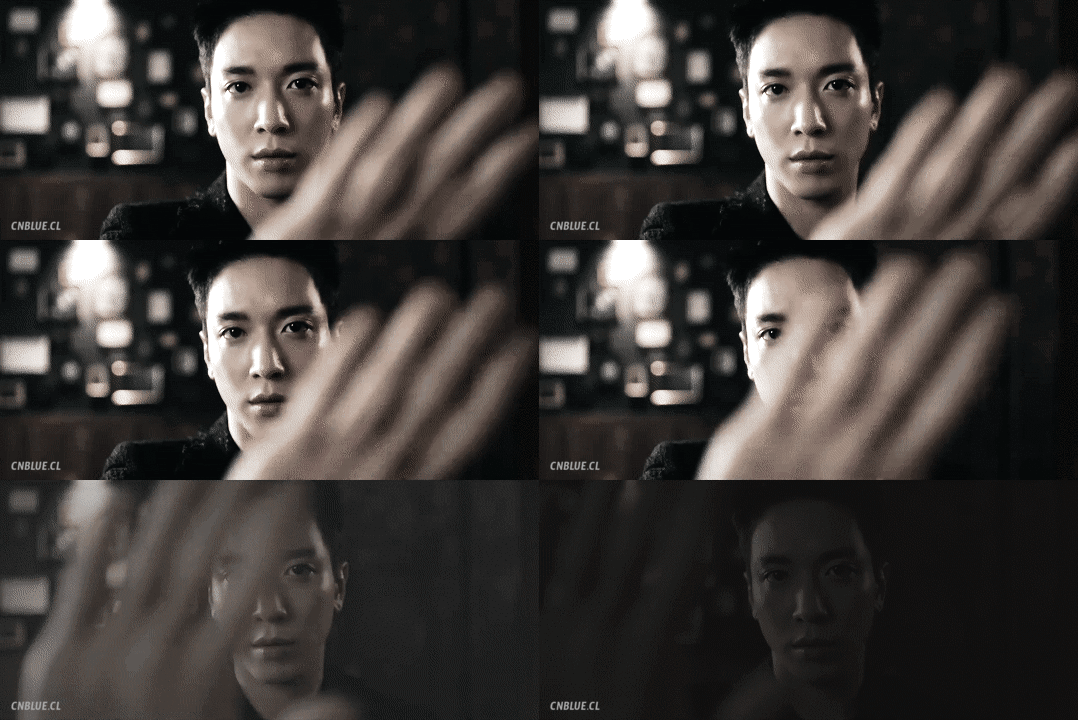
Evolution, Jung Yonghwa
CNBLUE’s leader Jung Yonghwa finished up his mandatory military service in the South Korean army last November and since then he’s been reemerging in Asia’s music and entertainment scene. Feel the Y’s City, his third solo Japanese album, just dropped recently and it shows Yonghwa’s continued evolution as an artist as he moves farther and farther from his Kpop idol roots.
The album’s lead track, The Moment, is an astoundingly joyous song, exploding with optimism and hope. Considering that Yonghwa recorded this just after he’d just gone through one of the darkest periods of his career it’s amazing that he was able to infuse such sheer happiness and hope into this track. This one is pure jazz at its most swinging, and it mixes up some killer changes over a driving piano riff, vibes, and blaring horns. Before he entered the military Yonghwa mentioned his admiration for the soundtrack to the film LaLa Land and The Moment definitely takes its inspiration from that style of midcentury jazz-based pop music. But Yonghwa is a better singer than either Ryan Gosling or Emma Stone and his smooth and swinging, powerful vocals drive the song. He effortlessly travels from his warm lower register up to a sweet falsetto.
The lyrics are mostly in English, with a smattering of phrases in French that seem be taken from a French For Beginners handbook, but he does a great job of rhyming in two languages that are not native to him. Although his French is delivered with a decidedly flat American accent, at one point he cleverly rhymes champagne, display, parlez, and café, which is pretty impressive for someone writing not in his first language. Throughout the song he further randomly throws in other French phrases, including a curious line that reads “Let’s get away and find ourselves la vie en rose, encore,” which sounds a bit like he strung together all of the French words he knew to make a lyric. Later in the song he shouts, “C’est la vie!” again not quite matching the proper use of the term. But it’s not bad for someone writing for the first time in French. I’m a bit surprised he didn’t include “mon petit chou” somewhere but that probably didn’t properly scan.
The next track, Summer Night In Heaven, continues the curious admixture of even more languages. Back in August I wrote a note to myself saying, “I have no doubt that Yonghwa can write a genius city pop song if he wants to,” and sure enough, Summer Night In Heaven is it. The song opens with a throwback guitar riff that emulates the crackly scratches of a vinyl record, followed by an outstanding bit of whistling that leads into Yonghwa’s relaxed, funky vocals. The lyrics are all pretty much about his blissed-out vacations to Hawai’i, and the song’s gently loping beat echoes his Zen experiences there. The track also includes a pleasant bit of Yonghwa scatting over a guitar interlude, a skill he showed off at his last concert tour before enlisting back in 2018.
The chorus demonstrates the polyglot scenario in his busy brain as he mashes up English, Spanish, Hawai’ian, and Japanese.
Summer night in heaven. Don’t you know the reason?
Groovin’ to the soul playground of freedom
Loco Ala Moana Forever I wanna
Uchiyosete kaesu shiosai no kōrasu (The chorus of the tide rushing back)
This somewhat random assemblage of languages, charmingly sung without regard to proper accenting or syntax, still manages to work, conveying the joyful and relaxing, utterly optimistic worldview that Yonghwa seems to be cultivating since his discharge from the army last year.
Continuing in that upbeat vein, the next track, She Knows Everything, is a sweet, simple pop song that’s the definition of a catchy earworm bop. The track is a streamlined throwback to ‘90s new jack swing, anchored by Yonghwa’s gorgeous falsetto. The song’s hooky chorus features Yonghwa’s lovely flutelike upper register as he sings, “I’m in trouble/In Good Trouble,” showing off his effortless, silky vocal range. Here the completely English lyrics sweetly outline a charmed relationship:
When my words get fumbled
Sometimes I’m misunderstood
Before I trip and stumble
She knows how to catch me long before I hit the ground
Once again Yonghwa invokes the Minnesota sound made famous by Prince, with a bright synthesizer jamming over the songs danceable beats.
In Jellyfish Yonghwa uses an upbeat dance track to emulate the backstabbing, duplicitous entertainment world that he inhabits. The song was recorded while he was enduring a particularly vicious witchhunt and Yonghwa shows a remarkable self-awareness for his situation at the time, questioning his own complicity in the trap that he’s in. Although Yonghwa is too polite to say it, the song clearly is about his adopted hometown of Seoul, where he’s spent most of his professional life and where he’s experienced his greatest successes and his greatest betrayals.
The fully electronic instrumentation adds a metallic tang to the song, and the song’s ringing, manufactured beats mesh perfectly with Yonghwa’s raspy purr of a voice. Although beautiful and seductive, the song is completely artificial and false, reinforcing the lyrics which describe being crushed, empty, deluded, and trapped. They also clearly describe the seductiveness and lure of the entertainment world, which Yonghwa envisions as a warm bath of oblivion and deception.
I am bathing in the light of the moon
Always floating
With all the jellyfish in bloom
They are shining in the dark, closing in
Hiding poison
I’m deeper in the city’s womb
The entire song vibrates with mendacity, but Yonghwa doesn’t shy away from his own attraction to the bright lights of fame and fortune, realizing that jellyfish are beautiful but potentially deadly and choosing to tangle with them can be fatal.
There’s a risk I could take when I touch you
Get paralyzed by your sting
Stimulus leads to hallucination
I’d sacrifice for anything
The next track, Fire & Rain, is a dreamy midtempo jam that opens with Yonghwa climbing from midrange to head voice in a beautifully sung acapella phrase. The song then kicks into a powerful dance groove. Yonghwa croons in and around the beat, his understated phrasing and intonation emphasizing the melancholy yet hopeful lyrics (in Japanese and English, with a “fiesta” thrown in for good measure).
We ’re the fire in the rain
hibiku ame no oto daichi ni utai inochi o naraseba fukinukeru kaze seimei no
Breathing moeru yō ni
(Sing on the earth/The Breathing of Life)
Although a very different song, the mood is reminiscent of Yonghwa’s 2014 composition for CNBLUE, Like A Child, as the music and lyrics create a hypnotic ambiance that suggests hope amongst despair.
Melody is a gorgeous slice of orchestral pop, with some lovely half-step progressions that elevate the chorus. Again Yonghwa’s stellar vocals shine, as he runs up and down his range with a fine falsetto at the end of the song, and the song’s arrangement of cascading strings over a lilting piano interweaves beautifully with Yonghwa’s passionate singing. This track was also one of the five recorded before enlistment and released while Yonghwa was in the army and it reflects his desire to continue making music no matter what difficulties or obstacles he faces.
Sekaijuu ni saita Harmony mamoritai yo kienai you ni
Sugite yuku toki no naka de kawaranai you ni
Kiitetai yo towa ni ima doko ni ite mo
Hibikaseyou Baby owarinonai Melody
(I want to protect the harmony that bloomed all over the world, so it doesn’t disappear
So it doesn’t change within this advancing time
I want to listen to it forever, wherever you are now
Let it resound, baby, the endless melody)
At the time he recorded this song there was some doubt as to whether Yonghwa would continue making music so this song holds significant meaning, rededicating his pledge to himself, his bandmates, and his fans to keep going with his career.
The two tracks that immediately follow Melody were also recorded during the controversies prior to Yonghwa’s enlistment and both reflect the state of mind he was in during that crazy time.
Brothers is a straight-up rock song, with power chords and a wailing guitar riff that clearly emulates the style of Yonghwa’s longtime collaborator and bandmate Lee Junghyun (who is currently exiled from CNBLUE following his tangential association with the Burning Sun controversy). In this song Yonghwa also pays tribute to Oasis, one of his favorite bands, as the track has a distinctly Britpop sound to it. The lyrics brilliantly set up the song’s premise, starting with the everyday conflicts that occur between close mates and friends.
Screaming at each other again
We never seem to click,
We’re fighting all of the time
Surrounded by tension and strain
So sick of all your jokes
This stark honesty demonstrates an understanding of the complexities of a longstanding relationship and show Yonghwa’s maturity of thought. As in Letter, despite ups and downs, working through and resolving these struggles ultimately creates an strong and lasting relationship.
The chorus reverses the conflicts introduced in the first verse, revealing the deep bond forged from such conflicts.
When you told me your dreams
And your ambitions
Something crushed inside of me
I see right through you the same
Same way you see right through me
Goin’ back when I found my soul brother
So we’ll never be apart
The song takes on an extra poignancy now that the rest of CNBLUE’s members are returning from their military service. Although Yonghwa has declared that CNBLUE will go on, he’s been mum on whether or not the band’s future includes their erstwhile lead guitarist. Interestingly, while Yonghwa has recently expressed his desire to play rock music again, Brothers is the only track on the album that prominently features guitar, suggesting that he’s waiting for CNBLUE (in whatever formation) to come back in order to get his rock groove on.
Letter, a midtempo love song, also explores an up-and-down relationship that in some ways is a metaphor for Yonghwa’s sometimes problematic relationship with his fans and his career. Yonghwa belts the song effortlessly, infusing the track with a gentle and melancholy longing. He adds a few delicate and powerful trills to the chorus, hitting a sweet crescendo before the song’s soulful denouement. (go here for a more detailed analysis of this track)
The last track on the album, Livin’ It Up, returns to the big-band jazz sound of The Moment. Somewhat more saccharine and less substantial that the other track it nonetheless clearly conveys the mood and meaning Yonghwa intended, which he states is a tribute to the joys of New York City. The song is a throwback to midcentury popular jazz tunes and would be right at home in a Fred Astaire MGM joint, with its lyrics describing “Falling falling snow,” the Brooklyn Bridge, and Rockefeller Center at Christmastime. Somewhere in there there’s a thesis about the pervasiveness of the myth of American exceptionalism in the South Korean imaginary but that’s a discussion for another day.
All in all this is a solid outing and demonstrates Yonghwa’s continued interest in making music that he finds interesting and engaging, rather than what the market dictates. It shows his continued development as an artist rather than an idol or pop star, as he keeps going farther afield from current commercial pop music. Though some of the tracks such as Jellyfish and Fire & Rain are completely on trend, others such as the jazzier cuts are much quirkier and less radio-friendly. As well as his infatuation with big band and jazz, he’s recently stated his fondness for the Indian dream pop duo Parekh & Singh and he’s covered a snippet of a song by the alt-country duo Dan + Shay on his instagram, so his tastes run a wide gamut of pop music.
Not unlike the way he slices and dices several different languages in one song, Yonghwa synthesizes his musical influences in sideways and unexpected ways and it’s very fun following what his fevered mind comes up with. Yonghwa was about to start his latest Japan tour this week but due to the coronavirus crisis those dates have been pushed back until April at the earliest or we’d surely be hearing even more remixes and rearrangements of his music. He’s repeatedly stated that he writes his songs with live performances in mind, so hopefully we’ll soon be able to hear what new directions he’s taking his current batch of tunes. I’m hoping someone plays some Ornette Coleman for him soon as I’d love to hear what happens when he hears some really mindblowing free jazz. A girl can dream—
BONUS: a clip of the new live arrangement of CNBLUE’s Face To Face, originally recorded as a straight-up Motown style jam. Here Yonghwa completely reworks it, and all cutie-pie clowning aside, this is an absolutely killer arrangement of this song, mixing Latin beats, tempo changes, jazz breaks, and some dope strings.
UPDATE: As of March 10, Feel The Y’s City has scored big on the charts throughout much of Asia. In its first day of release on Feb. 26, all five of the new tracks from the album were in the top ten on Japan’s daily Recochoku Kpop/World music chart, with a sixth track, Letter, at number 50.
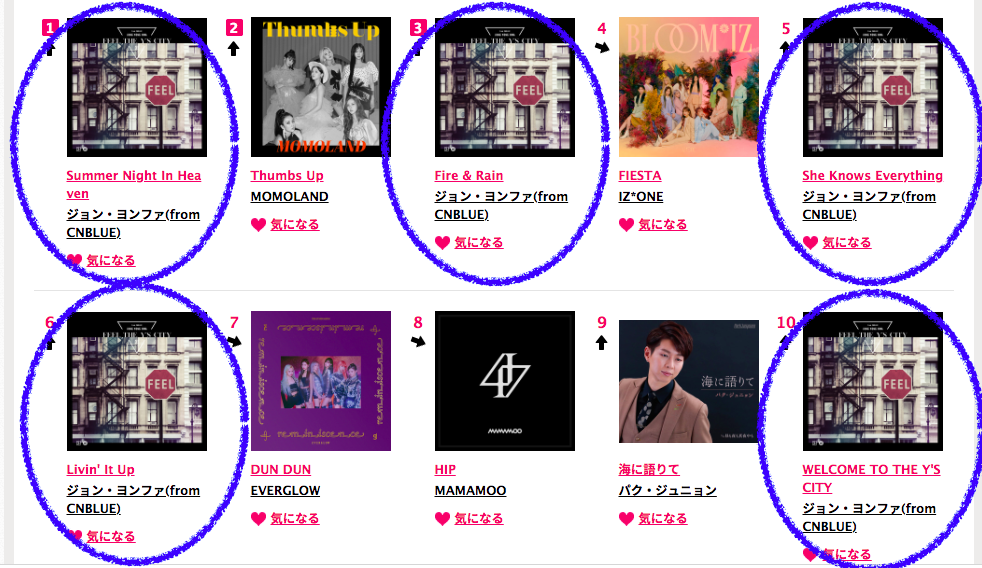
Three tracks, She Knows Everything, Summer Night in Heaven, and Welcome to the Y’s City, swept the top three for two consecutive weeks (Mar. 2 and 9) on China’s weibo New Asia Song Asia-Pacific chart. As noted on weibo, “The whole song has a cool summer feeling from the melody to the voice. There is a sense of playing on the beach.”

The album also charted high on iTunes in several countries, reaching the top 5 in eight countries and topping the charts in Macau and Hong Kong. The album even made it to number 32 on the worldwide iTunes chart, which isn’t bad considering there was absolutely no promotion outside of Asia.

Yonghwa’s new South Korean variety show, K-Trot In Town, also scored very high ratings in its debut episode, reaching 14.9% in the second half of its broadcast. So despite a few bumps including the postponement of his Japan concerts in March, Yonghwa’s re-entry following his discharge from the military for the most part is going well. But in the mercurial world of South Korean entertainment that could change in a flash. Here’s hoping that things continue to go smoothly, especially once the rest of CNBLUE gets out of the army later this month.
Stars Falling From The Sky: Sulli, Hara, and Compressed Modernity

Goo Hara, 2019
NOTE: I started writing this a few weeks ago but didn’t get around to finishing it. Sadly, it’s become relevant again as another Kpop star, Goo Hara, took her life yesterday at the age of 28. I’m now posting this updated version.
On Oct. 14, 2019, Kpop superstar Sulli died by her own hand, bringing into focus the troubles often faced by young performers in a high-pressure industry. She was 25 when she died and had been working in the South Korean entertainment business for more than ten years, debuting in 2008 at age 14 as a teen actor. Soon thereafter she joined the girl group f(x), which was one of the most popular Kpop groups of its era.

Sulli’s funeral, from her brother’s social media post, 2019
Like her fellow Kpop star Kim Jonghyun, who committed suicide in December 2017, Sulli suffered from clinical depression. But perhaps a more pressing factor in her death was the constant cyberbullying she endured for much of her career. She didn’t fit into the mold of the demure, proper South Korean female and she was mercilessly raked over the coals by an unforgiving Korean press and public for her every move. This along with her fragile mental health without a doubt contributed to her decision to end her life.
This highlights the troubling dark side of fandoms in South Korea and around the world. Female celebrities in particular suffer from slut shaming, body shaming, and general hatred and derision in the internet age as anonymous keyboard warriors gang up and exacerbate a mob mentality, playing judge and jury to anyone they deem guilty of transgressing or offending their sensibilities.

No dating clause, Blackpink
Although Western stars such as Taylor Swift, Rihanna, and Miley Cyrus have come under scrutiny for their various romantic misadventures, they haven’t suffered the same accusations of impropriety as have Kpop idols. This is in part because the private lives of South Korean pop stars are much more strictly controlled and regulated. Some idols, including girl group Blackpink, who made a splash at Coachella this year, have no-dating clauses written into their contracts (Blackpink’s ban expired in 2019). Many fans also uphold this standard, often insisting that their favorite idols remain single (although many date in private) so as not to disturb the fantasy of their availability as romantic partners.
But another unpleasant aspect of the idol life is a direct result of the neoliberal competition that is consuming the entertainment world, especially in South Korea. As I’ve noted in the past, idol groups regularly compete for trophies on popular weekly music programs for their newest single releases. These shows pit each group against each other in what are basically popularity contests, with winners determined by youtube and other online streaming numbers, live voting, and other metrics that have little to do with quality and everything to do with quantity. Groups with the biggest and most active fandoms win and those with smaller followings lose, full stop. This has recently translated over to the US, with the wildly popular group BTS originally gaining traction in the west by winning the Billboard social media award back in 2017, which was based on the number of mentions on twitter and other platforms. From there BTS has built up a vast following that has pushed the group to great popularity around the world. Whether or not their music actually warrants this I won’t say, but their success has led to other South Korean groups attempting similarly splashy debuts in the US.

Bundling, Super M, 2019
On Oct. 13 the Kpop group SuperM’s first album debuted at number one on the Billboard Hot 200. However, detractors have noted that the sales for the album may have been artificially inflated by several tactics by the group’s labels, SM Entertainment and Capital Records. These include bundling the album with concert ticket sales and funneling all sales worldwide through US distributors, defying Billboard’s regulations that state that only US sales count toward its charts. This is borne out by the fact that SuperM’s album did not chart on Spotify or iTunes, suggesting that the Hot 200 number one was unfairly manipulated.
As the New York Times notes,
“The (Super M) CD version came in eight packaging variations, one for each member of the group (plus a “united” version), which included a variety of posters and collectible cards. The group’s fans took to social media to display the many versions they acquired.
“The 1st Mini Album” was also available as part of more than 60 sales bundles for merchandise and concert tickets, which featured items like T-shirts enabled with augmented reality: point a smartphone at the shirt using a special app, and the SuperM member pictured on it becomes animated. Tactics like these have become increasingly common, but also raised concerns in the industry about distorting the weekly charts”
But Super M didn’t invent bundling. As the NY Times further observes. “Taylor Swift offered four deluxe versions of her album “Lover” at Target stores, while the metal band Tool sold 88,000 CDs in its first week as part of a $45 foldout package that included a four-inch HD video screen.”

Zero sum game, Sulli
Whatever the truth may be, the excessive focus on quantity as the determinant of success is a contributing factor to the online bullying and harassment that many fans practice. Kpop fans regularly participate in vicious fanwars, tearing down perceived competitors who they see as threats to their idols’ success. Sulli and others may have been caught in the crossfire of this excessive zero sum game attitude, as fans believe that their favorites can only succeed at the expense of the failure of their rivals. It’s an ugly and unpleasant mentality that is a direct result of neoliberalism and global capitalism, which privileges measurable commercial success rather than more ephemeral and subjective metrics such as artistic achievement and appeal.
It’s also a result of what Chang Kyung-Sup calls compressed modernity, or the rapid-fire pace of modernization that South Korea has experienced in the past 50 years. Chang notes, “Compressed modernity is a civilizational condition in which economic, political, social and/or cultural changes occur in an extremely condensed manner.” These changes often cause great stresses in a society and in individuals that may account for the dysfunctional bullying of Sulli and others who are perceived as operating outside of societal norms. Goo Hara was also the victim of slut-shaming and cyberbullying resulting in part from a vindictive campaign by an ex-boyfriend who threatened to release sex videos of the star that he had recorded without her permission. She had also been targeted earlier by the South Korean media for her dating history, which in Kpop idol world is verboten. Yet these are all results of South Korea’s compressed modernity, a result of the highly stressful effects of the country’s rapid economic rise in the past fifty years.
So although many Western observers like to claim that South Korean culture and society is to blame for the deaths of these young stars, in fact the root causes are globally endemic. It’s easy to point the finger at South Korean society, or at Kpop, or at Korean fans or netizens, but these are only symptoms of a much more widespread malaise, a worldwide neoliberal economic system in which hypercompetitiveness pits us all against each other and in which individual achievement is valued over empathy, compassion, or collective well-being. Sulli, Hara, and many others are simply victims caught up in the vicious and exploitative cogs of this system.

Yonghwa, Sulli, Jo Kwon, Inkigayo, 2011
NOTE: This is the fifth person in three years that Jung Yonghwa has personally known or worked with who has committed suicide. Yonghwa knew Kim Jonghyun as a fellow second-generation Kpop star and in 2015 both Jonghyun and Yonghwa had successful solo debuts. In 2009 Yonghwa co-starred with Hara on the reality show Korea Ecosystem Rescue Centre: Hunters. In 2011 Yonghwa co-hosted the music show Inkigayo with Sulli. In 2014 Yonghwa worked with actor Kim Sung-min on the K-drama The Three Musketeers. Kim later committed suicide in 2016. And in 2016 Chinese actor and singer Qiao Renliang killed himself, in part because of cyberbullying. Qiao had attended a CNBLUE concert in 2013 and was a fan of the band, and after his death Yonghwa posted a shocked notification on his weibo. Being personally touched so many times by suicide can’t be good, and speaks to the ripples of trauma that these tragedies create. Despite their seemingly charmed lives this demonstrates the great stress popular entertainers such as Yonghwa are under.

 beyondasiaphilia
Recent Comments