Posts tagged ‘visual art’
No Blood For Oil: ChevWrong poster bombs

I will not complain about my asthma, downloadable poster, ChevWrong Inhumane Energy series, truecostofchevron.com, 2009
Just a quick shoutout to a couple well-placed guerilla art pieces spied around town here in San Francisco in the past week or so. In anticipation of the May 27 Chevron shareholders meeting in San Francisco last week, some enterprising artist/activists last week bombed the city with printouts of the downloadable subvertisements from truecostofchevron’s ChevWrong Inhumane Energy ads. The poster brigade, which plastered the city with hundreds of the alternate ads, decided to take matters into their own hands after CBS Outdoor refused to sell billboard space to truecostofchevron, claiming that it didn’t accept “negative” advertising. The Inhumane Energy series cleverly skewers Chevron’s current greenwashing ad campaign that speciously utilizes earth-friendly taglines such as “I will leave the car at home more,” “I will finally get a programmable thermostat,” and “I will replace 3 light bulbs with CFLs.” As if.
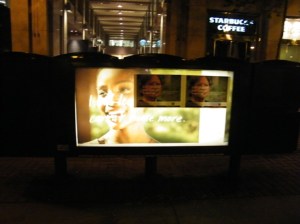
I will ignore the toxic waste pits in my village, downloadable poster over Chevron ad, ChevWrong Inhumane Energy series, truecostofchevron.com, 2009
Truecostofchevron’s slick little numbers nimbly mimic Chevron’s fakey feel-good sentiments with lines including, “I will not breathe when outside,” “I will try not to get cancer,” and “I will not complain about my asthma,” coupled with facts and statistics about Chevron’s environmentally unsound activities in Nigeria, the U.S., Burma, Ecuador, Iraq and other sites worldwide. As with any good detournement, the series simultaneously critiques, neutralizes and repurposes its source material, in this case simulating Chevron’s high-powered happy-smiley corporate propaganda in order to expose and deride the oil giant’s own hypocrisy.

No Blood For Oil, stencil, Bay Bridge lower deck, 2009
I’ve also been appreciating the rawer but no less effective commentary on the link between big oil and the destruction of the planet that’s cropped up on the eastbound approach to the Bay Bridge. Stenciled onto a couple pillars on the Bridge’s lower deck is a simple image of a tank’s silhouette spouting a single a drop of blood. Direct, visual and to the point, the graphic needs no embellishment to gets its message across, even to the distracted driver speeding along the freeway. And though it may be ephemeral, its placement in the line of sight of thousands of drivers a day brings its message to where it’s most needed and where it can’t be ignored. Which is the most that anyone can hope for in combating the baldfaced corporate misinformation that bombards us every day.
Fresh Fruit For Rotting Vegetables: Bill Basquin’s Photographs at the Dump
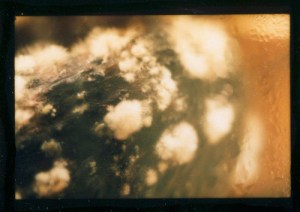
Moldy Avocado, from the series Fruits Uneaten, Bill Basquin, 2009, c-print, 20" x 30"
Surprisingly, the Tunnel Road dump smelled a little ripe when I visited there last week to check out The Way of All Flesh, Bill Basquin’s photo exhibit. My husband is a contractor so I’ve been to a few dumps in my time and in my experience the Norcal Solid Waste Transfer and Recycling Center on Tunnel Road in San Francisco is actually one of the least odiferous ones. Colma’s a bit stinkier and don’t even get me started on the big landfill near Dixon on Highway 113. But Tunnel Road is curiously fragrance-free most of the time, perhaps due to some errant breezes blowing off the ocean a little ways away.

Carrot Triptych: 0 weeks, 6 weeks, 4 weeks, Bill Basquin, 2009, c-prints in frames built from reclaimed wood
Anyways, Bill Basquin’s show was the end product, so to speak, of his four-month residency at the Tunnel Road dump, sponsored by San Francisco’s Recycling & Disposal Artist-In-Residence program. The dump’s AIR program, which has been in operation since 1990, hosts several local artists each year in a nice big studio with a woodshop and all of the trash they can handle. Artists get a monthly stipend and are free to use whatever they can dig out of the adjacent dump site to make art. I’ve seen several shows there, including Donna Keiko Ozawa’s extra-cool crank-handle sculptures (way back in 2001) and Paul Cesewski’s bicycle-powered circus installation (just last year) and each artist transforms the space in his or her own way. By repurposing the waste stream and finding usefulness in discards, the SF Recycling & Disposal AIR program’s undercurrent of anticonsumerism is all too relevant in these days of late capitalism gone awry.
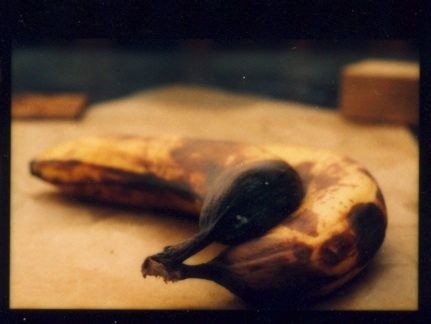
Banana Pair, O weeks, Bill Basquin, 2009, c-print, 8" x 10"
Bill’s exhibit mainly consisted of images of the rotting produce that he composted on-site, then photographed up close and personal. The resulting large-scale color prints, in frames constructed from wood scavenged from the dump, are both fascinating and repellent, with each fruit or vegetable’s decaying carcass so closely rendered you can almost smell them. Some of the photos, like “Banana Pair, O weeks,” keep a wary distance from the subject, while others, such as “Moldy Avocado,” bring the viewer so close that the prosaic subject matter becomes a furry mass of color and texture. But while the fruits and veggies have lost their original shape and form, both through decomposition as well as through Basquin’s intimate portraiture, the photos never sink to simple abstraction. Each desiccated corpus pretty much retains its connection to its origins as a living plant, though some are much farther along than others. Bill Basquin grew up on a farm in the Midwest and his photography reflects an awareness of the planet’s oscillations perhaps less evident to the urban dweller. His loving close-ups of moldy plant matter serve as microcosmic reminders of the cycle of degeneration and rebirth that we city folk too often forget.
The Myth of Chinese Restaurants, Part Three: Indigo Som’s Chinese Restaurant Project

Wonderful House, Rock Springs, Wyoming, 2002, iris print, 34"x34", Indigo Som
Regarding Chinese restaurants of a different sort, Indigo Som has an installation from her Chinese Restaurant Project in Present Tense Bienniel: Chinese Character, at the Chinese Cultural Center in San Francisco. Indigo’s project is manifold and ongoing, but its three main parts basically attempt to document and capture the gestalt of Chinese eateries in the U.S. and look at the ways in which these omnipresent establishments reflect and represent Chinese American culture, both real and imagined.
My brother and his wife once went on a driving trip that took them through a sparsely populated part of Idaho. On the way they stopped at a roadside restaurant and when they walked in, the Chinese proprietor spotted them immediately. As soon as he saw that my brother was Chinese, a huge grin broke out on his face. My brother must’ve been the first Chinese person outside of his own family that the owner had seen in a mighty long time. Indigo’s project reminds me of this incident in that it demonstrates both the pervasiveness and the isolation of these solitary outposts. Living in the Bay Area, which is clogged with Asians of every make and model, it’s pretty easy to forget that Asian Americans still only make up about 4% of the total U.S. population. The Chinese Restaurant Project captures some of the melancholy of life outside of urban centers for many Asians in this country.

Woo's Pagoda, Eau Claire, Wisconsin, 2003, inkjet print, 34x34", Indigo Som
Some of you might be familiar with the large-scale color prints of Chinese restaurant facades that Indigo’s exhibited extensively in the past few years—she’s been selectively documenting Chinese restaurants across the U.S. for a while now, shooting hordes of images of this multifarious architectural phenomenon with a plastic, fixed-focus Holga camera. Many of the pictures were taken in locations far from sizable Chinese American communities and are plaintive reflections on the sometimes funky, in-between state of being Chinese in America.
The other two parts of the Chinese Restaurant Project are Indigo’s blog documentation of her travels across the country in search of Chinese restaurants and her quixotic attempt to collect a menu from every one of the thousands of Chinese restaurants in the U.S.
Indigo’s project captures the absurdity of attempting to define “Chinese American culture” in this modern world. Signage from most of the restaurants uses “ching-chong” script, or what Indigo calls the “Evil Chinky Font,” the one that poorly emulates classical Chinese calligraphy; names for the restaurants usually involve pagodas, jade, bamboo and other tiresome “Chinese” signifiers. Her menu collection also demonstrates the ways in which these restaurants have adapted Chinese cuisine to suit the tastes of the mainstream American palate, such as the weird pervasiveness of Crab Rangoon, those nasty little deep-fried cream cheese and surimi wontons that in all likelihood were invented in the 1950s at Trader Vic’s, that tiki torch lounge heaven in San Francisco.

Chinese Menus, Present Tense Bienniel, 2009, Indigo Som
On display as part of Present Tense Bienniel is a floor-to-ceiling installation of all of Indigo’s current collection of Chinese menus, which number in the hundreds. Covering a pretty big corner of the gallery, it’s still only a tease of what the piece will be when Indigo has, say, a thousand Chinese restaurant menus papering an entire gallery. Knowing her capacity for obsessive activity and her dedication to her goal, I have no doubt that one day we’ll see an entire floor of the deYoung Museum covered over with menus sporting the Evil Chinky Font from all over the country. But until then, this little snippet will more than suffice.
Present Tense Biennial: Chinese Character – an exhibition of
contemporary artwork by 31 artists that reflect and reinterpret China
Curated by Kevin Chen
May 1 – August 23, 2009
Tuesdays-Saturdays, 10am to 4pm; Sundays, 12 to 4pm
Chinese Culture Center, 750 Kearny Street, 3rd Floor (inside the Hilton Hotel), between Clay & Washington Streets in San Francisco CA
Admission is free.
Hawai’ian Eye: Asian American Studies conference

AAAS conference back porch, 2009
Just got back from the Association of Asian American Studies annual conference, which this year was held in Honolulu, HI. Needless to say it was a very well-attended event, taking place a block from the beach in Waikiki. I myself confess that the percentage of time I spent swimming in the ocean vs. attending panels and roundtables was pretty much skewed toward boogie boards and sandcastles, but I’d brought my kids along so I had an excuse.
I did manage to tear myself away from skimming stones and walking in the sea foam to attend a few presentations, however, and participated in a couple as well. UC Berkeley’s Elaine Kim organized a great panel, Bollywood, Believing Women, and the Female Bin-Laden, which included Huma Dar’s pointed critique of Hindi-language films that demonize Muslim men and exoticize Muslim women. Filmmaker and scholar Irum Sheikh displayed several images of “disappeared” individuals who have been detained by the U.S. government, many held for years on flimsy or nonexistent charges in the “war on terror” perpetuated by the Bush regime. Her straightforward and unvarnished presentation made an unimpeachable case against a foreign policy gone horribly awry.

Dawn Mabalon & Allyson Tintiangco-Cubales, fedora'ing
I also ran into several former students, now all grown up, including Sudarat Musikawong, who’s a prof at Willamette University, Mitch Wu, now teaching at SUNY Hunter, Carolyn Tran, about to enter grad school at the New School for Social Research, Margaret Rhee, poet & PhD candidate at UC Berkeley, and Celine Parrenas-Shimizu, who’s a superstar professor at UC Santa Barbara and whose latest tome, The Hypersexuality of Race, won one of conference’s book awards this year. Plus, as at any good Asian American gathering, I spotted several people in felted hats, further supporting my contention that Asian Americans love stylish headwear.
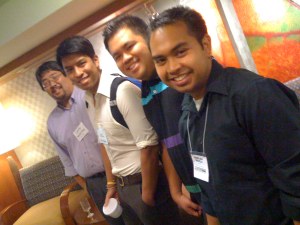
Lawrence Hashima, Pahole Sookkasikon, Kevin Lim & RJ Quiambao rock the house, AAAS 2009
I also took along a couple grad students from SFSU to present their research on a panel called Assimilation, Rice Queens, Porn, and the Mainstream: Constructing Media Images, which, in keeping with scholarly tradition, wordily includes a term from all of the panelists’ papers in its title. Pahole and RJ from SFSU and Kevin from UH Manoa rocked their presentations and made me feel like a proud mother fawning over her young. It ain’t easy covering topics ranging from “The King and I,” Asian & Hawai’ian women in online porn, and a new framework for Asian American cinema, but the guys pulled it off with flair. Larry Hashima provided excellent feedback and tied together the panel in style.
I also organized a panel called Art and the Academy: Working Artists In Asian American Studies wherein I talked about the legacy of creative work in SFSU’s Asian American Studies Department and outlined the production of POP! Producing Our Power: Presenting Asian American Culture, a student-run show at SFSU that asks the age-old question, “What is Asian American culture and how can we express it on stage?” Also presenting their awesome social practice projects were brilliant artist-scholars Ming-Yuen S. Ma, who talked about his amazing video art bus tours through Los Angeles, and Gaye Chan, chair of the Art Dept. at UH Manoa, who described her guerilla gardening project, Eating In Public. Both projects are unapologetic blows against the empire that conclusively prove that artists are indispensible in the battle against tyranny and injustice.
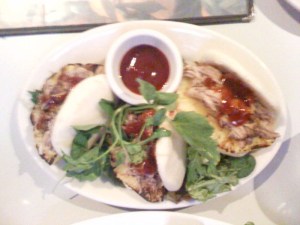
Sliders, Hawai'ian style, Sidestreet Inn, Honolulu
On the recreational tip, I managed to have shave ice nearly every day, though the Waikiki version is pretty tepid. The killer stuff is found on the North Shore in Haleiwa, at Matsumoto’s, where the sour lemon, lilekoi, and coconut combo I tried was stunning. Back in Honolulu, good eats were to be had at Sidestreet Inn, a formica-table sports/karaoke bar that serves up some of the best Hawai’ian food around, including excellent ahi poke, kahlua pig sliders, and fried chicken wings.
So despite my struggle to resist the lure of the beach and do my academic duty, the trip was pretty fun. I’m glad to be back in my cool grey city of love, but I sure do miss swimming in the tropical sea every day.
The Tyranny of Beauty: transPOP! Korea Vietnam remix

Area Park, Three second-frozen defectors from North Korea, 2006, transPOP! Korea Vietnam Remix
Just got back from the symposium attached to the awesome art exhibition, transPOP! Korea Vietnam remix, which is at the Yerba Buena Center for the Arts in San Francisco through March 15. The show looks at the intersections between Korean and Vietnamese pop culture through the eyes of several visual artists from Korea, Vietnam & the U.S. It’s definitely worth a visit for any fans of Korean dramas, Vietnamese movies and Asian pop stars.
Anyways, the symposium today was held at UC Berkeley’s Institute of East Asian Studies and featured heavy hitters like deconstructionist film queen and scholar Trinh T. Minh Ha (who I missed because I had to make pancakes for my kids) and Korean American artist and transPOP co-curator Yong Soon Min. I attended the roundtable discussion about the links between Korean and Vietnamese pop culture, which was pretty great and featured an excellent mashup of Korean and Viet films and dramas that concluded with a music video by The Wonder Girls.
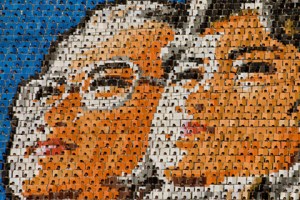
transPOP! Korea Vietnam remix
What I loved most, though, was the same moment occurred that almost always happens when I talk with my fellow academics and scholars about Hong Kong films, or Korean soap operas, or any other form of Asian pop culture. At some point the academic/scholar/intellectual will start to talk about his or her favorite drama/film/idol and will get that same dreamy-eyed look as an adolescent girl when she’s discussing Jay Chou or Takeshi Kaneshiro. It’s usually very brief and it’s followed by a fleeting, giddy smile, then the conversation will quickly return to emotional transnationalism or the crisis of modernity or gender politics. But it always proves to me that we academics are people too, and we’re just as vulnerable to the allure of a beautiful face as anyone else.

 beyondasiaphilia
Recent Comments