Posts tagged ‘film festival’
Picture This: 2010 San Francisco International Asian American Film Festival

Illuminated curtain, Great Star Theater, A Moment In Time, Ruby Yang, 2010
I’m not sure that the nice Chinese American ladies sitting behind me during the screening of James Hong & Yin-Ju Chen’s Lessons Of The Blood, shown last Tuesday as part of the San Francisco International Asian American Film Festival (SFIAAFF), knew exactly what they had signed up for when the bought their tickets. They had been behind me in line outside of the Sundance Kakuki Cinema, chatting amiably in English and Toi San, and I heard them mention that the film was “about the Nanking massacre” and that it had “won some kind of award in Europe.” As the film progressed and drew the audience deeper into its horrific tale, the ladies began to gasp and groan in dismay since Hong & Jin’s movie is not for the faint of heart and tells its story in chilling detail. Not unlike when I see a particularly brilliant horror flick, I found myself overwhelmed with dread and anxiety by the end of the movie, all the more so since its story is drawn from facts and history.

Germ warfare victim, Lessons Of The Blood, James Hong & Yin-Ju Chen, 2010
The film outlines the infamous series of war crimes commonly known as ‘the rape of Nanking,” but as told by Hong & Chen it’s quite a bit more. Unflinchingly graphic in its description of the various atrocities committed by the Japanese military in Nanjing during World War II, it also included several stomach-turning closeups of festering wounds found on the now-elderly survivors of the germ warfare unleashed by the Japanese Imperial Army in the 1940s. Lessons Of The Blood, however, is more than sensationalized propaganda or simple polemics. It’s also an impressively crafted film, using found footage from propaganda films, newsreels, Hollywood movies, television news, and other filmic detritus, as well as a disturbing and ominous soundtrack, coupled with modern-day interviews with Chinese wartime survivors (who willingly reveal their various scars and disfigurations). The result is a haunting condemnation of both the historical crimes as well as the modern-day complicity that implicates us all. Needless to say, watching this movie was hella intense.
Lessons Of The Blood was one of the strongest films from this year’s action-packed SFIAAFF. Although once again I spent more time at the parties than watching movies (in part because so many shows sold out), I managed to catch A Moment In Time, Ruby Yang & Lambert Yam’s luminous elegy to San Francisco Chinatown movie houses. The film is a comprehensive look at the ways the Great Star, the World, the Bella Union, and the Mandarin theaters were in days of yore the glue that held together the Chinese community, beginning in the 1920s and continuing until their collective demise in the mid-1990s. I myself had the privilege of seeing several classic Hong Kong films with my buddy Patrick at both the World and the Great Star (including a strange and awesome double bill of the violent shoot’em up Big Bullet and the weepy melodrama Comrades: Almost A Love Story) and I can attest to the downscale utilitarianism of both of those movie houses. But there’s nothing like seeing a Chinese-language film with a roomful of Chinese people who are eating cuttlefish, smoking, and chattering incessantly in Cantonese during the show, and Yang and Lam’s movie captures that sensation exactly. One patron interviewed described his entire family including young children attending 9.30p Saturday night shows for 25 cents total, the kids running up and down the aisles and the parents gossiping and eating chicken wings and melon seeds until all hours.

Cell phone a-go-go, Tehran Without Permission, Sepedeh Farsi, 2008
I also caught a screening of Tehran Without Permission, shot surreptitiously on a cell phone in the months running up to the 2009 presidential election in Iran. Although I was dog-tired from attending my own world premiere and reception for The Oak Park Story earlier that day, Sepedeh Farsi’s verite documentary held my attention throughout its 80-minute run time. Through subtle and succinct vignettes the film captures the mood and attitude of citizens of Tehran, with small details and comments presaging the upheavals that would occur in a few months hence.

Deepika Padukone & Saif Ali Khan, just another impossibly gorgeous Bollywood couple, Love Aaj Kal, 2009
I also made time to see the festival’s annual Bollywood at the Castro movie, Love Aaj Kal, although it was the fourth film of a long day of movie-going. I have a soft spot for this program since it was at last year’s festival that I caught my very first Shah Rukh Khan movie, Rab Ne Bana Di Jodi, which spurred my obsessive love for SRK in particular and for Bollywood movies in general. Love Aaj Kal, alas, does not star Shah Rukh Khan but the hot and charming Saif Ali Khan makes an acceptable substitute. Paired with the doe-eyed and astoundingly pretty Deepika Padukone, Saif plays dual roles as a modern-day commitment-phobic NRI in Britain and a noble and lovestruck suitor in the 1960s Punjab. The film deftly shuttles back in forth in time between these two stories, drawing parallels and distinctions between the romances from each period. A well-made and satisfying love story with some excellent dance sequences, the film is a great example of high-quality Hindi-language commercial moviemaking—in other words, a fun and rewarding bit of Bollywood entertainment.
I also passed by a rush line full of excited teens waiting for the special appearance of youtube darlings kevjumba, wong fu, nigahiga and timothy delaghetto. The youth were madly texting and tweeting as they waited to see their favorite internet stars in the flesh, but tickets were, alas, impossible to come by since the show had sold out as soon as it was announced. It was nice to see the next generation of SFIAAFF fans out in force, which hopefully augers well for the continued health and well-being of Asian American filmmaking.

Filmmakers Felicia Lowe & the late, great Loni Ding, 2009. photo: Jay Jao
NOTE: This year’s fest was dedicated to the memory of the force of nature known as Loni Ding, the legendary Asian American filmmaker and educator who a few weeks ago died at age 78 from complications from a serious of strokes. Loni was one of the fiercest and most amazing people on the planet and her energy, dedication, and sheer determination guided her filmmaking, which included seminal documentaries like Ancestors In America and The Color of Honor. She always had a kind word and a smile for younger filmmakers like myself and made us feel like we were doing something significant in our work. She was the moral center of the Asian American film community and she will be sorely missed.
Get It While It’s Hot: The 2009 San Francisco International Asian American Film Festival
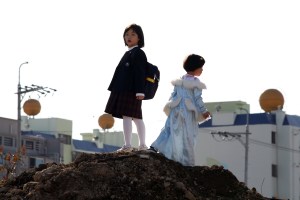
Hee Yeon Kim and Song Hee, Treeless Mountain, 2009
The 2009 version of the San Francisco International Asian American Film Festival starts next week (March 12) and runs until March 22 in San Francisco, Berkeley, and San Jose. Herein follows some of the movies I previewed from the festival, which is in its 27th year and will include 108 films in its ten-day run. The SFIAAFF is the biggest and one of the oldest of its type and kicks off the season for Asian American festivals around the country. Even if you don’t see something you like described below there are plenty of other treats to be had—go to the SFIAAFF website for more details. And buy your tickets early—shows sell out fast and some of these movies will never have another theatrical screening in the Bay Area again.

Ha Jung-Woo and Jeon Do-Yeon duke it out, My Dear Enemy, 200
My Dear Enemy, Lee Yoon-Ki
Powered by a charming, engaging performance by the talented Ha Jung-Woo, who may be becoming one of my favorite actors, this romantic drama follows two former lovers as they travel the streets of Seoul trying to settle a debt. Ha plays a ne’er-do-well ladies man and unemployed gambler whose fed-up ex-girlfriend (Jeon Do-Yeon, recent Best Actress winner at the 2007 Cannes Film Festival) finds him at the racetrack and demands repayment of a loan she’d made him before their breakup. The film skips lightly from one situation to the next, along the way commenting on life, relationships, intimacy, and dreams. One memorable scene features a newlywed couple whose husband is obsessed with his wife’s past lovers; another takes place at a barbeque party with a Korean motorcycle club. Throughout the film Ha and Jeon maintain a wary relationship with each other, trying to resist falling into old patterns while keeping from strangling each other.

Kim Yoon-Suk has a rough night, The Chaser, 2008The Chaser, Na Hong-Jin
A Korean movie of a completely different sort than My Dear Enemy, The Chaser also starts the versatile and charismatic Ha Jung-Woo, this time as a psychotic serial killer on the loose in Seoul. Brutally violent, with a touch of horror film layered on its crime-drama scenario, the film is a cat-and-mouse game between Ha’s nasty murderer and Kim Yoon-Suk’s world-weary pimp. The film features some gorgeous night-photography and good performances from its two lead actors but with a bit too much fetishized violence even for me, as well as too much psychosexual posturing, The Chaser doesn’t manage to transcend its genre into greatness.
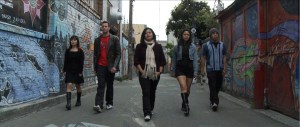
Balmy Alley, Fruit Fly, 2009
Fruit Fly, HP Mendoza
Mendoza’s follow-up to the divine Colma: The Musical, and his directorial debut, Fruit Fly follows the story of Bethesda, a nice Filipina performance artist from Maryland (duh) who’s looking for her biological parents. Set amongst San Francisco’s queer boho crowd, the film lacks Colma’s poignancy and sympathetic characters, as well as Colma director Richard Wong’s cinematic flair. Fruit Fly makes good use of its San Francisco setting, including scenes in Balmy Alley, Dolores Park and various other real-life, non-touristy locations, and it has a great title sequence and nice graphics throughout, but it doesn’t quite have the urgency of Colma’s coming-of-age story, with Bethesda’s search for her birth mother shunted to the side in favor of backstage antics involving a vain magician and a few too many musical numbers with the quirky patrons of a gay bar.
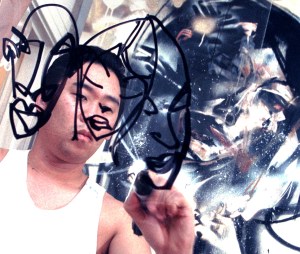
David Choe, insane, Dirty Hands, 2009
Dirty Hands: The Art and Crimes of David Choe, Harry Kim
A lively and comprehensive portrait of batshit-crazy bad-boy Korean American artist David Choe, Dirty Hands follows Choe from his beginnings as a grafitti artist and tagger in Los Angeles to his current status as a blue-chip gallery artist. Choe is an insane mo-fo, but in a productive, creative way, channeling his self-described kleptomaniac, sex-addict, bipolar, OCD personality into a highly successful career as an illustrator and painter. Choe energetically narrates his own story, describing his experiences as an illustrator for porn magazines, his stint in a Japanese jail (for punching a plain-clothes cop), his discovery of and subsequent disillusionment with God, and his various trips to the Congo and other non-industrialized parts of the world. The doc goes easy on its wacky subject, skimming over the misogyny and messed-up violence in Choe’s art in favor of portraying him as a happy lunatic, but it’s a compelling portrait nonetheless. We also meet his long-suffering girlfriend, his family, and his friends, all of whom think Choe is the best thing since sliced bread. The focus is a bit too Giant Robot-hipster-Asiaphile-friendly to be a truly great film but it does a good job of capturing Choe’s insane outlook on life. As he succinctly notes, “If I’m normal in real life it fucks up my art.”

Que paso? Nuevo Dragon City, 2008
The Secret Lives Of Urban Space
This program of short films includes a couple intriguing selections. Sergio de la Torre’s Nuevo Dragon City focuses on a group of Mexican Chinese teens who gradually barricade themselves in an appliance store. Shot without dialog with beautiful cinematography, their mysterious actions lead to serenity. No answers are given for their inexplicable acts but the imagery is lovely and the mood is profound.
Chris Chong’s Block B is a single static long shot of a high-rise housing project in Malaysia, moving from darkness to daylight and back through to night. The film’s bare-bones structure forces the viewer to focus on small mundanities during its twenty-minute running time—a woman drops a piece of laundry from a balcony and it flutters down the side of the building. Children run from one side of the frame to the other. Conversations in Malay emerge and retreat. At some point fireworks go off. Though some might find it incomprehesible, the film is beautiful and intriguing and truly challenges the way that we are accustomed to watching the moving image.

Two good kid actors, Children of Invention, 2008
Children of Invention, Tse Chun; Treeless Mountain, So Yong Kim
One of two “recession dramas” that I previewed, this engaging film looks at the tribulations of a Chinese American family in Boston falling through the cracks of the economic crisis. A single mom with two young kids gets caught up in “multi-level marketing,” a fancy name for a pyramid scheme that preys on immigrants and poor people. After mom gets thrown in jail as a material witness, the two kids are forced to fend for themselves. As the Top Ramen runs out and no adults are in sight, what will happen to our young protagonists? The movie has good, non-cloying performances by its two kid actors, following their fate in a realistic, unsentimental way.
A similar fate faces the two kids in the second recession drama, Treeless Mountain, So Yong Kim’s follow-up to her subtle and intriguing debut film In Between Days. Set in South Korea, the film follows two young sisters whose mother leaves them with an alcoholic auntie when she can no longer support them. Said auntie turns out to be an indifferent caretaker and the girls eventually end up catching, roasting and selling grasshoppers to local schoolkids to assuage their hunger and to make ends meet. Then things really start to go downhill. The movie is grim and beautiful, with an observational style that never veers into melodrama or histrionics, and its conclusion demonstrates the redemption of small kindnesses in the face of hardship.

The late, great Chris Iijima, A Song For Ourselves, 2009
A Song For Ourselves, Tad Nakamura
This short documentary centers on Chris Iijima, the seminal sansei musician who, along with Charlie Chin and Nobu Miyamoto, recorded A Grain of Sand, one of the most significant albums from the 1970s Asian American movement. Layered and emotional, the film looks at Iijima’s community activism, his music, and his later career as a lawyer and professor in Hawaii until his untimely death in 2005. Nakamura follows up on the promise of his earlier docs, Yellow Brotherhood and Pilgrimage, investigating the ties of family, friends, community, and creativity in a moving, resounding portrait of a singular personality.

Lam Yiu-Sing, future idol? High Noon, 2008
High Noon, Heiward Mak
24-year-old Heiward Mak brings it in her debut feature that follows a group of teenage Hong Kong schoolboys as they do drugs, chase girls, fight, eat and get into trouble. Shot on video, with frenetic computer graphics, the movie nicely captures the disposable lifestyle of post-millennial youth. The movie gets bonus points for featuring a sex scandal spread virally via cellphones (the internet is so five years ago). As the characters’ mischief escalates into more serious business, Mak’s strong visual sense and her sure direction of her peers makes the film a quintessential look at teenagers slamming up against their own mortality. Interestingly, Mak almost won the Hong Kong Film Critics Society’s 2008 Best Director award for this flick, nearly upsetting 30-year-veteran Ann Hui for the distinction. Side note: As I watched the movie I couldn’t help wondering which of the cute boys would be picked for this year’s idol status by the relentless Hong Kong media machine. Probably the dreamy one with the orange hair, though lead actor Lam Yiu-Sing has a quiet charm as well.


Recent Comments