Posts tagged ‘asian art museum’
Sound and Vision: Yuan Goang-Ming, Isaac Julian, Ruth Asawa exhibit reviews
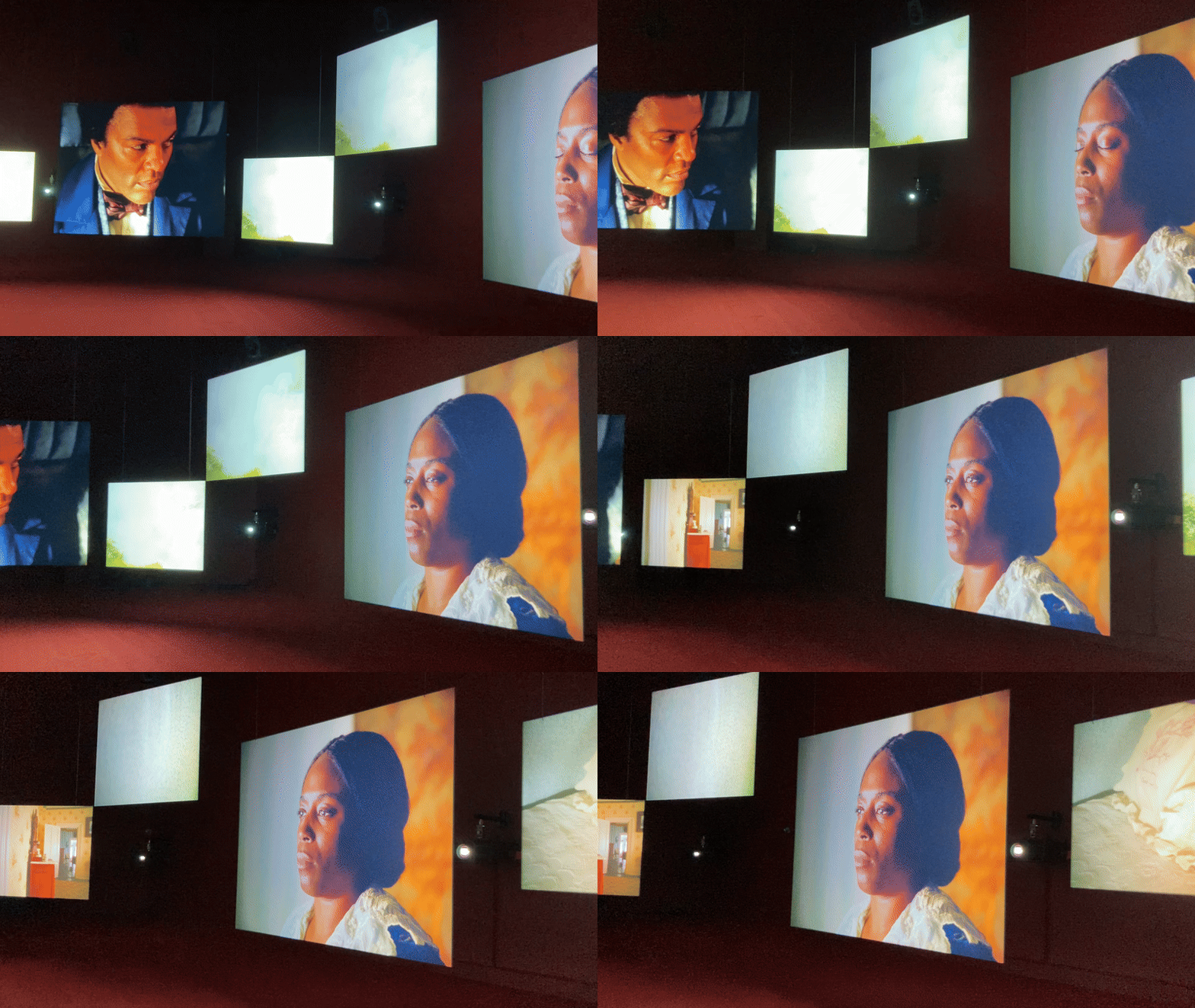
This year three of the major art museums in San Francisco had toplining shows of contemporary artists of color. While this might seem unremarkable in the 21st century it has in fact been a long time coming, especially here in the Bay. Despite the diverse demographics of the city, SF museums have a bit of a history of not exhibiting contemporary BIPOC artists.
It was so egregious that way back in 2004 and 2009 my pal Scott Tsuchitani staged two interventions at San Francisco’s Asian Art Museum pointing out the museum’s lack of support for living contemporary Asian American artists. Both Memoirs of a Sansei Geisha: Snapshots of Cultural Resistance (2004) and Lord, It’s The Samurai (2009) satirically critiqued the AAM’s orientalist tendencies. Since then the AAM has tried to clean up its act, engaging Abby Chen in 2018 as the museum’s head of the department for contemporary art, where she’s booked shows on iconic Asian American artists including Carlos Villa and Bernice Bing. Most recently Chen has curated the first international show of Taiwanese video artist Yuan Goang-Ming, Everyday War.
Yuan’s show includes several single-channel pieces that feature everyday tableaux suddenly exploding or bursting into flames, but the piece that riveted my attention was “The 561st Hour of Occupation” (2014). The piece includes a long drone shot of an empty Taipei cityscape, shot during the country’s annual Wan’an air raid drill (萬安演習) where all residents are required to remain indoors for thirty minutes in preparation for any potential attack from China, Taiwan’s bellicose neighbor to the west. Combined with footage from the 2014 Sunflower Movement, where students peacefully occupied Taiwan’s legislative yuan for twenty-four days to protest a controversial Taiwan-China trade agreement. Yuan’s video piece is a reminder of the constant underlying threat of invasion in Taiwan, whether military or economic, from China.
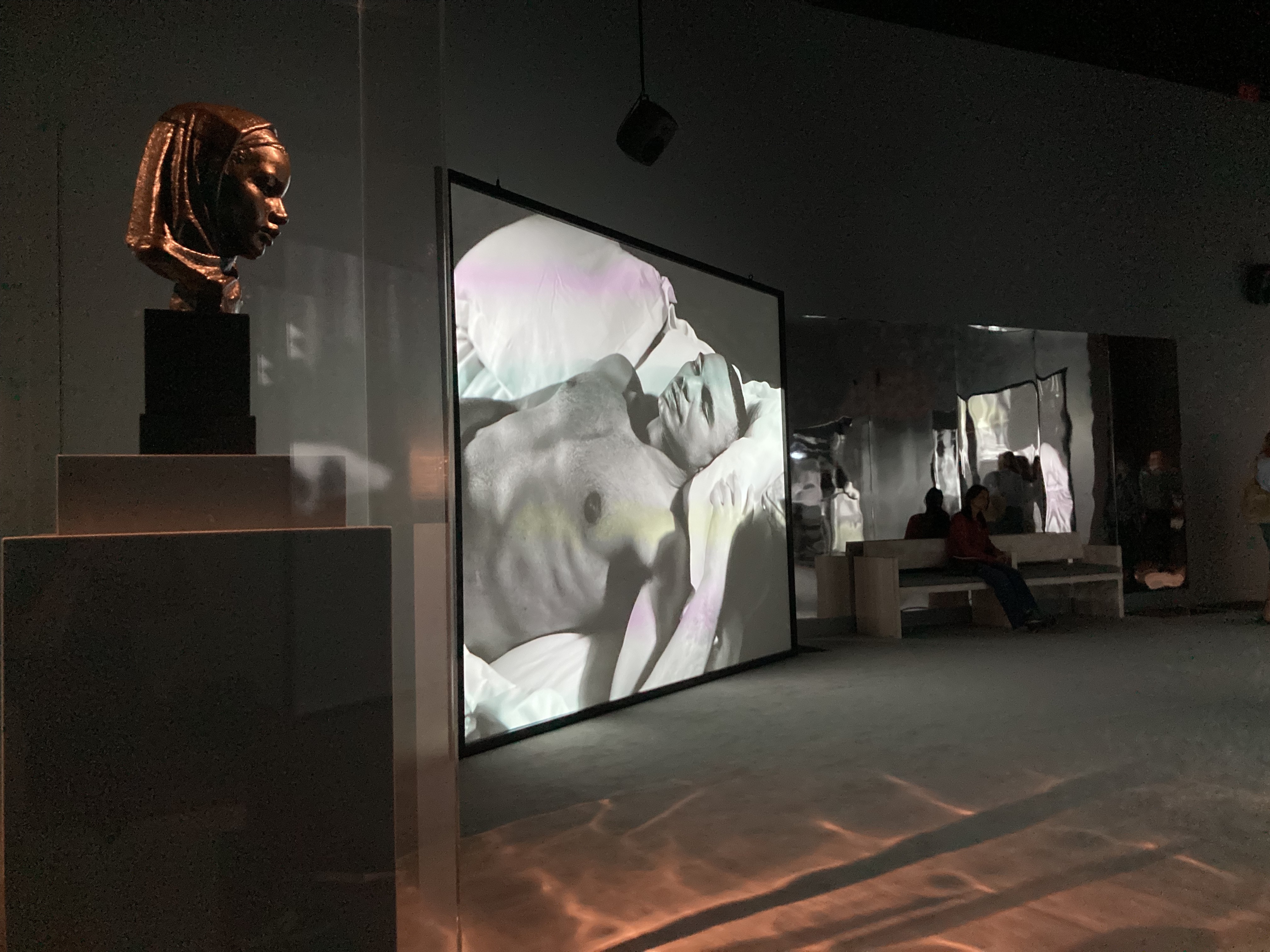
The de Young Museum in Golden Gate Park also recently featured the work of filmmaker and artist Isaac Julian, including several installations of his single and multichannel work. I enjoyed the lush, beautifully lit and photographed images from his more recent works that include fictional re-imaginings of historical events. Once Again . . . (Statues Never Die) (2022) (31 min) mixes in a bit of Africaphilia, gorgeous black and white cinematography, and a healthy dose of queer looks to critique the complicity of the museum system in colonization and exploitation.

Lessons of the Hour (2019) (28 min), a ten-channel installation starring Frederick Douglass (or rather, a reasonable facsimile), combines Douglass’s oratory, including his famous 4th of July speech, lovely landscapes, and images of ships, sailing and coastlines. As a self-identified sewist I also appreciated the images of Douglass’s wife Anna on her hand-cranked sewing machine industriously stitching away.
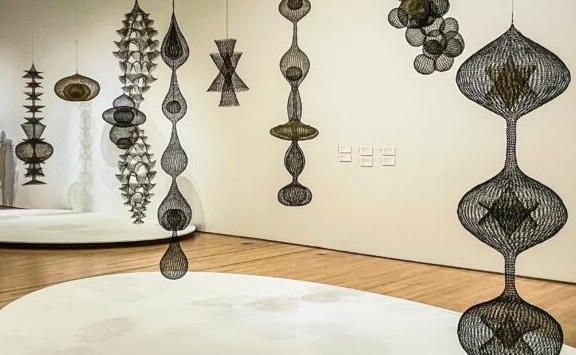
SFMOMA was the third of the major-museum triumvirate to topline BIPOC artists this year, with its blockbuster show Ruth Asawa: Retrospective, the first major exhibition of the influential Japanese American sculptor and arts educator. The show features a huge selection of Asawa’s iconic large-scale hanging woven wire sculptures, with the lighting design emphasizing the cast shadows of the pieces. I also appreciated the asymmetrical lozenge shapes of the platforms below the sculptures, underscoring Asawa’s midcentury aesthetic.
I had the privilege of collaborating with Ruth in 2002 on Each One Teach One: The Alvarado School Arts Program, a documentary about her arts education programs in the San Francisco public schools and seeing her show was very pleasurable for me. In addition to her famous wire sculptures the exhibit also includes several of her paintings and drawings as well as information about her many public art pieces throughout San Francisco and the Bay Area. I grew up seeing these public art pieces, including the nursing mermaid at Ghiradhelli Square, the origami fountains in Japantown, the bread-dough cast bronze round fountain at Union Square, and the woven wire medallion at the entrance to the Oakland Museum of California, so it was great to see documentation of those all collected together in one show.
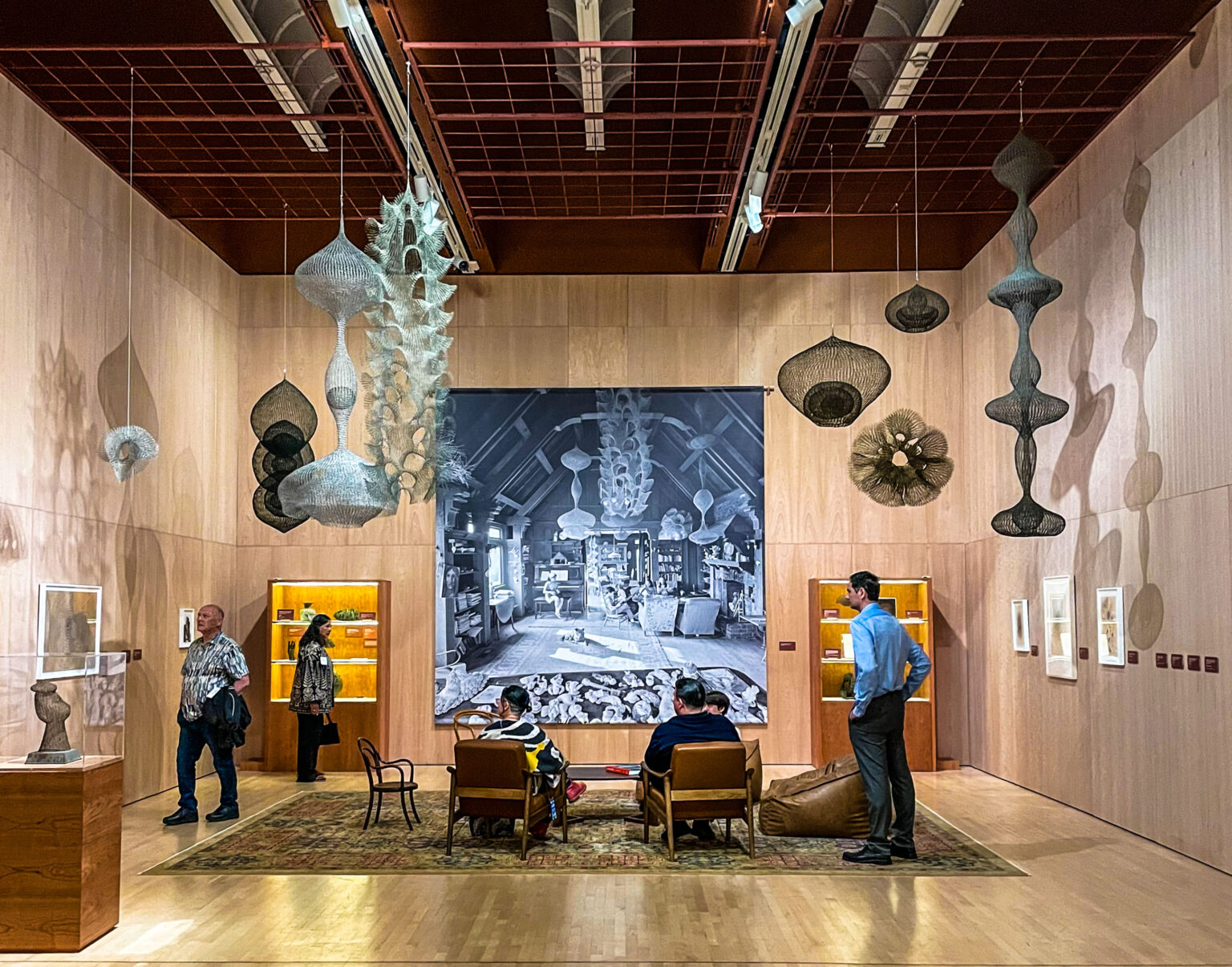
I had visited Ruth’s house a lot when we worked on the movie together and remember many of her sculptures hanging from the high wooden beams of her living room. The SFMOMA includes a reconstruction of her living room, including the carpet and a facsimile of the chairs, which was a fun thing to see in a museum setting and which underscored the primacy of her family and community in her work. Several of Ruth’s children and grandchildren are working artists and uncounted numbers of children who worked with her and her fellow Alvarado School parents have felt the positive effects of her arts education programs. Along with her iconic woven sire sculptures and her ubiquitous and legendary public arts projects Asawa is truly one of San Francisco’s most important artists and culture workers and it’s great to see her legacy honored with a full-scale retrospective.
Along with the 2020 Dawoud Bey show, last year’s Amy Sherald show, the 2023-24 Pacita Abad retrospective and the current Kara Walker installation at SFMOMA, as well as the 2022 Faith Ringgold show at the de Young, it seems like major institutions in the Bay are finally catching up to the important and groundbreaking work that BIPOC artists have been creating for decades. It’s been a long time coming but hopefully it means that more people of color are entering the art world canon, or perhaps more cynically, that more of their work is becoming commodified. Whatever the reason, it’s good to see San Francisco museums showcasing work from artists that reflect the of city’s population.
That’s Not My Name: Lord, It’s The Samurai! intervention
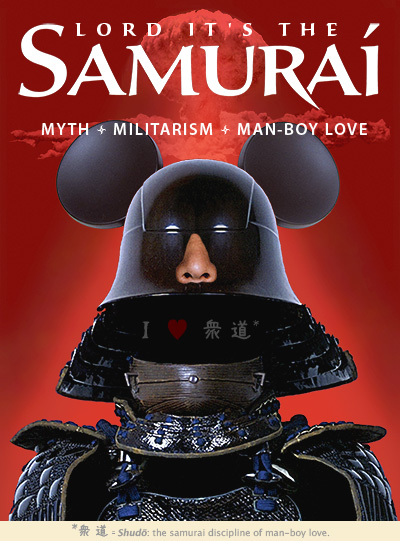
Altered poster, Lord, It's the Samurai!, 2009
Just got tipped to an excellent new intervention critiquing the San Francisco Asian Art Museum’s latest orientalist extravaganza, Lords of the Samurai. My anonymous source sent me the link to Lord, it’s the Samurai!, a brilliant goof on this year’s summer blockbuster which replicates the show’s official website with a twist—it offers a detailed, pointed, and well-researched deconstruction of the problematic exhibition. The faux-site points out the less-than-savory aspects of samurai culture that the AAM conveniently glosses over, including the militarism, slavery, pederasty and misogyny inherent in the “code of the warrior.”
The ersatz site also recognizes the dangers of the exhibit’s glamorization of violence, noting,
No myth here, and it hasn’t changed since the times of the samurai: it’s universal and real, how war dehumanizes everyone.
Aestheticizing violence, normalizing war.
The museum may not want you to see it, but there is blood on those swords.
The faux-site also calls out the AAM’s ongoing Asian fetish with its hilarious tagline (Where Asian Still Means Oriental) and a fun little word-scramble that mixes up past titles from AAM exhibits to form an amalgamation of exotic Asiaphilic fantasies.
The imitation site also makes a cogent connection between the Museum’s soft-peddling of Japanese nationalism and the U.S. government’s interest in remilitarizing Japan, which would aid the U.S. in maintaining the upper hand in Asia. The faux-site also notes that it’s not the first time the AAM has backed up a superpower’s questionable point of view, as seen in Tibet: Treasures from the Roof of the World, the 2005 show that gave credence to the PRC’s claim that Tibet is really just the back door of China.
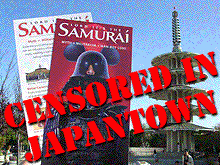
Hard-copy flyers, Lord, It's the Samurai!, 2009
All told, this little fakey website is a fine, funny, and extremely effective critique that packs in a copious number of links and information. It’s a companion piece to hard-copy flyers that have been distributed in public brochure racks in San Francisco’s Japantown. Someone upstairs at the AAM must have twigged to the switch since, as noted in the site, the counterfeit flyers have been systematically removed and replaced with the AAM’s own brochures almost as soon as they’ve been distributed. The fake site’s gmail address was also disabled shortly after sending out its first email blast. If the museum’s functionaries are so freaked out that they’re furiously trying to eradicate it, then I’d have to say that the intervention is working.
UPDATE: After just a couple days it appears that Lord, It’s The Samurai! has gone viral. This very blog entry has outstripped the site’s previous champion Shah Rukh Khan (and his six-pack) as the top post of the week and news of the faux-site has travelled far and wide around the blogosphere. Here are a few links:
mrpoopypants’ post (scroll down to the comments where an AAM employee defends the museum)
8asians post (wherein the bloggers confess to being pwned by the faux-site)
Interview with the anonymous creators of the site here.
UPDATE 2: The Asian Art Museum itself has posted an entry on its blog about the intervention. I’m de-linking it, though, since they’ve selectively refused trackbacks (including mine) from sites critical of their position. Another example of systematic exclusion on their part.
And Japanese history scholars weigh in with their approval of the site, calling it “an instant classic.” There are also some great observations on the significance of museum shows as well as a shout-out to the scholarly rigor of Lord, It’s The Samurai!
UPDATE 3: Found this nice manifesto about social art intervention on John Jota Leanos’ site and thought I’d toss it out there, since it’s relevant to the conversation at hand. You can check out his art and other relevant information there, too. Plus his significant other was my kid’s kindergarten teacher.
UPDATE 3: Myself and a representative from asiansart.org, the folks who put together the parody website, were on Hard Knock Radio on KPFA-FM this week talking about the intervention. Go here for the stream, or download the interview here.
UPDATE 4: Ken Baker, art critic for the San Francisco Chronicle, weighs in here. Mostly positive, with some great dialogue in the user comments (aside from some obvious cluelessness). Viraling!
UPDATE 5: Continued fallout some nine months later as Asian Art Museum director Jay Xu talks in the LA Times about how “painful” it was to be pwned by asiansart.org’s intervention. Maybe getting a clue would ease some of the pain, Jay. asianarts.org talks back here.

 beyondasiaphilia
Recent Comments